Very cool info!
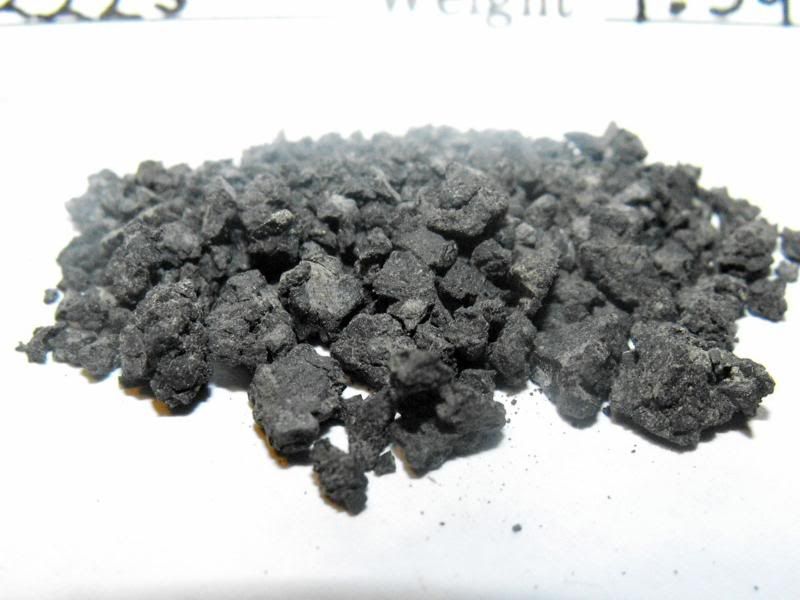
Here is a pic of my Orgueil
http://i27.photobucket.com/albums/c165/jedisdiamond/DSCF5360.jpg
Greg Catterton
www.wanderingstarmeteorites.com
IMCA member 4682
On Ebay: http://stores.shop.ebay.com/wanderingstarmeteorites
On Facebook: http://www.facebook.com/WanderingStarMeteorites


--- On Thu, 9/16/10, MEM <[email protected]> wrote:

> From: MEM <[email protected]>
> Subject: [meteorite-list] Supernova Shrapnel Found in Meteorite
> To: "metlist" <[email protected]>
> Date: Thursday, September 16, 2010, 4:01 AM
> Yet another meteorite related news
> item.  Check your specimens for chromium 54
> grains and see if you've hit the lottery for pre-pre-solar
> grains!  They will be
> magnetic but at 100 nm not somehting you'll see with the
> eye alone.
> Elton
>
> Supernova Shrapnel Found in Meteorite
> ScienceDaily (Sep. 14, 2010) — Scientists have identified
> the microscopic
> shrapnel of a nearby star  that exploded just before
> or during the birth of the
> solar system 4.5  billion years ago.
>
> Faint traces of the supernova,  found in a meteorite,
> account for the mysterious
>
> variations in the  chemical fingerprint of chromium
> found from one planet and
> meteorite to  another. University of Chicago
> cosmochemist Nicolas Dauphas and
> eight co-authors report their finding in the late Sept. 10,
> 2010 issue of the
> Astrophysical Journal.
> Scientists formerly believed that chromium 54 and other
> elements and  their
> isotopic variations became evenly spread throughout the
> cloud of  gas and dust
> that collapsed to form the solar system. "It was a
> very  well-mixed soup," said
> Bradley Meyer, a professor of astronomy and astrophysics at
> Clemson University
> who was not a co-author of the study. "But it looks like
> some of the
> ingredients got in there and didn't get completely
> homogenized, and  that's a
> pretty interesting result."
> Scientists have known for four decades that a supernova
> probably  occurred
> approximately 4.5 billion years ago, possibly triggering
> the  birth of the sun.
> Their evidence: traces of aluminum 26 and iron 60,
> two  short-lived isotopes
> found in meteorites but not on Earth.
> These isotopes could have come from a type II supernova,
> caused by  the
> core-collapse of a massive star. "It seems likely that at
> least one  massive
> star contributed material to the solar system or what was
> going  to become the
> solar system shortly before its birth," Meyer said.
> Researchers have already extracted many type II supernova
> grains from
> meteorites, but never from a type IA supernova.  The
> latter type involves the
> explosion of a small but extremely dense  white-dwarf
> star in a binary system,
> one in which two stars orbit each  other. It should
> now be possible to determine
>
> which type of supernova contributed the chromium 54 to the
> Orgueil meteorite.
> "The test will be to measure calcium 48," Dauphas said.
> "You can make  it in
> very large quantities in type Ia, but it's very difficult
> to  produce in type
> II." So if the grains are highly enriched in calcium
> 48,  they no doubt came
> from a type Ia supernova.
> Cosmochemists have sought the carrier of chromium 54 for
> the last 20  years but
> only recently have instrumentation advances made it
> possible  to find it.
> Dauphas's own quest began in 2002, when he began the
> painstaking meteorite
> sample-preparation process for the analysis he was
> finally able to complete
> only last year.
> Dauphas and his associates spent three weeks searching for
> chromium 54-enriched
> nanoparticles with an ion probe at the California Institute
> of Technology. "Time
>
> is very precious on those instruments and getting three
> weeks of instrument time
>
> is not that easy," he said.
> The researchers found a hint of an excess of the
> chromium-54 isotope  in their
> first session, but as luck would have it, they had to
> search  1,500 microscopic
> grains of the Orgueil and Murchison meteorites before
> finding just one with
> definitely high levels.
> The grain measured less than 100 nanometers in diameter --
> 1,000  times smaller
> than the diameter of a human hair. "This is smaller
> than  all the other kinds of
>
> presolar grains that have been documented before, except
> for nanodiamonds that
> have been found here at the University of Chicago," Dauphas
> said.
> The findings suggest that a supernova sprayed a mass of
> finely  grained
> particles into the cloud of gas and dust that gave birth to
> the  solar system
> 4.5 billion years ago. Dynamical processes in the
> early  solar system then
> sorted these grains by size. These size-sorting
> processes led the grains to
> become disproportionally incorporated into  the
> meteorites and planets newly
> forming around the sun.
> "It's remarkable that you can look at an isotope like
> chromium 54 and
> potentially find out a whole lot about what happened in the
> very first  period
> of the solar system's formation," Meyer said.
> ______________________________________________
> Visit the Archives at
> http://www.meteoritecentral.com/mailing-list-archives.html
> Meteorite-list mailing list
> [email protected]
> http://six.pairlist.net/mailman/listinfo/meteorite-list
>


______________________________________________
Visit the Archives at http://www.meteoritecentral.com/mailing-list-archives.html
Meteorite-list mailing list
[email protected]
http://six.pairlist.net/mailman/listinfo/meteorite-list