Vaughn,
Many thanks for your excellent and comprehensive analysis. I'll also add
my appreciation for Michael's earlier analysis, which pointed out to me
that there is value attached to SpaceX apart from Mars exploits. The
question is what drives that value and what sustains it.
All,
I mention this because, in my humble view, the SpaceX Mars fantasy is a
dead end. There is no possibility of developing any reasonable and
sustainable commercial Mars enterprise in the realistic future.
This is a fantasy because most of those who proffer it conveniently
overlook (or misstate) the technological and logistical obstacles.
Space is incredibly vast. Even destinations we think of as nearby are
not. A round-trip expedition to Mars is, best case, likely to take about
three years. This is inescapable.
Such a trip imposes extreme physical and psychological burdens on the
crew. One such is isolation for such a long period in a tiny space with
other people. Another is the isolation imposed by distance.
There can be no instant communication with Mars. The delay can vary
widely, but a realistic estimate is replies to messages taking 20-30
minutes. Hence, a Mars expedition is on its own in an emergency. This
ought not to be underrated.
As for technological challenges, the most serious is space radiation.
While solar radiation might be effectively dealt with, there is no
known, practical way to overcome high energy galactic radiation. There
are those who suggest surrounding a space vehicle with water. The part
they forget to mention is that around 10 feet of water would be
required—the alternative being several feet of lead. Such might provide
some protection.
Absent adequate protection, a brief Mars visit would expose participants
to 3-4 times what NASA regards as a maximum lifetime radiation exposure.
I've read suggestions that explorers will just live with the risks
imposed by that exposure. They may not be given that choice.
One effect, suggested by NASA, of such exposure is diminished mental
capabilities. That would be an odd risk to expect a mission that had to
be entirely on its own to assume.
There are other implications that folk forget to mention: galactic
radiation is so energetic that, even when it is shielded, it's particles
break off other particles from the shielding, causing the release of
what is called secondary radiation, which can be as and perhaps more
dangerous than the initial radiation.
Moving beyond radiation, we encounter the effects of long-term effects
of low gravity. Strength training, as is used aboard the ISS, mitigates
some problems, but once again, there us no known way to avoid the effect
on various organs and systems of the body. NASA suggests that many of
these would be irreversible.
No one has yet described how to handle the logistic challenges of anu
Mars mission, including consumables for a umber of people over several
years and fuel to land on Mars and return.
Again, there are speculations about processing fuel ftom sources on
Mars, but no one knows whether this might be successful or even
practical. This is something not to be assumed in advance.
If an expedition survived to reach the surface of Mars, it would
encounter a deadly environment. Surface temperatures average -75°. The
atmosphere is unbreathable and radiation is constant, as the planet
lacks magnetic protection. The soil has no biomass, hence any
cultivation is impossible absent extensive and difficult transformation.
The soil is also toxic to humans and the particles so small that they
are not filtered by the lungs and are absorbed into the bloodstream. It
may be possible to prevent human contact with toxic soil, but experience
from the moon teaches that this is difficult.
There are other significant challenges, but the foregoing should suffice
to demonstrate that commercial trips to Mars aren't likely within any
current investment timetable.
Old Man Wardell


------ Original Message ------
From "Vaughn Cordle, CFA via Mifnet" <[email protected]>
To [email protected]
Cc "Vaughn Cordle, CFA" <[email protected]>
Date 6/10/2026 1:57:45 PM
Subject [Mifnet 🛰 76379] Re: Heard in the Hangar #342 Why SpaceX is our
favorite Space Race 3.0 idea and why we would add to or initiate
positions in Planet Labs on its 37% sell-off from recent highs
SpaceX and the IPO MachineThe Most Dangerous IPO in the Pipeline
<https://substack.com/@vaughncordle>
Vaughn Cordle, CFA <https://substack.com/@vaughncordle>
Jun 10, 2026
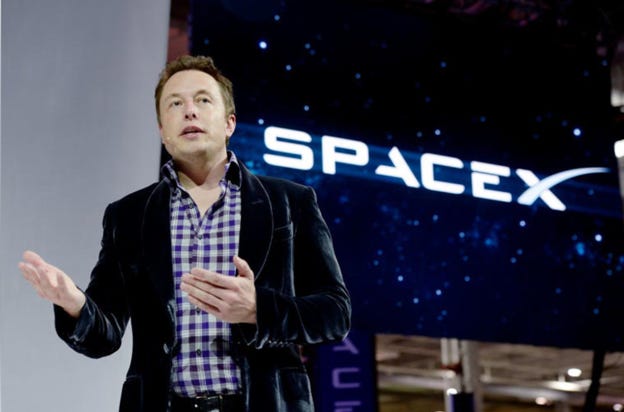
<https://substackcdn.com/image/fetch/$s_!qq29!,f_auto,q_auto:good,fl_progressive:steep/https%3A%2F%2Fsubstack-post-media.s3.amazonaws.com%2Fpublic%2Fimages%2F1ffb2fcd-b819-4a4e-8e98-7bd203052adb_624x412.png>SpaceX
CEO Elon Musk
Part Two of The Valuation Trap Series
Part One <https://vaughncordle.substack.com/p/the-ai-valuation-trap>
documented the AI valuation trap — token bloat, circular revenue,
infrastructure constraints, depreciation stretch, and retail
concentration risk. This report applies that framework to the most
dangerous IPO in the pipeline.
SpaceX is not an AI company. It is being valued like one.

The Most Dangerous IPO in the Pipeline
At $1.75 trillion, SpaceX carries a valuation that exceeds the combined
market capitalization of Boeing, Lockheed Martin, Northrop Grumman, and
Raytheon. Bloomberg reported SpaceX has sought a valuation above $2
trillion. Morningstar values it at $780 billion — roughly 55% below the
$1.75 trillion target.
That gap is not noise. That is an entire mega-cap company made of
expectation.
The justification is Starlink — a satellite broadband business with
genuine revenue — and an AI and data infrastructure buildout that is
burning capital at an accelerating rate.
Starlink is real. Morningstar estimated Starlink generated
approximately $10.6 billion of revenue and $5.8 billion of EBITDA in
2025. At 14x EBITDA, Starlink is worth roughly $81 billion. At 20x
EBITDA, roughly $116 billion. At 25x EBITDA, roughly $145 billion. That
is a powerful business. It does not explain a $1.75 trillion valuation.
The gap between Starlink’s defensible valuation and SpaceX’s total
valuation is filled with three things: the launch business, the Mars
narrative, and the AI infrastructure ambition. The launch business is
profitable but capacity-constrained and faces intensifying competition
from ULA, Rocket Lab, and emerging Chinese launch providers. The Mars
narrative is not a business. The AI infrastructure buildout is
early-stage, capital-intensive, and competing directly against
Microsoft, Google, and Amazon on their home terrain.
Elon Musk retains more than 82% of the voting power through the
dual-class structure. Public shareholders cannot influence capital
allocation in a business that requires tens of billions in ongoing
investment. That governance concentration limits external discipline on
a company burning capital across four speculative frontiers
simultaneously.
SpaceX’s pre-IPO equity is already being accepted as currency. San
Francisco real estate listings are seeking SpaceX equity as payment.
Pre-IPO equity treated as liquid currency — before public markets have
tested the valuation underneath it — is a late-cycle signal. It
happened with WeWork in 2018. It happened with Uber in 2019. It is
happening with SpaceX now.
If Morningstar’s $780 billion fair value is right, the IPO target is
about 124% above fair value. If the IPO prices at $1.75 trillion and
the stock later trades to $780 billion, public buyers face a roughly
55% drawdown. If a more generous sum-of-the-parts model marks fair
value at $1.25 trillion, the IPO still carries roughly 40% downside to
that level.
The retail investor buying SpaceX at IPO is not buying Starlink. They
are buying the Musk premium, the AI infrastructure narrative, and the
Mars option — none of which are auditable, none of which have
precedent, and all of which are priced at multiples that assume
simultaneous success.
The Valuation Life Cycle
Valuations peak before business economics mature.
Railroads, autos, commercial aviation, the internet, and shale all
followed the pattern: real technology, real capital formation, real
overvaluation. The technology mattered. The long-term impact was
enormous. The first wave of valuations still overshot the economics.
AI now shows the same late-growth behavior: exploding revenue, record
capex, extreme valuations, immature margins, political bottlenecks,
accounting stretch, and retail distribution before durable economics
are visible.
The market is not asking whether AI matters. AI matters. The question
is whether today’s valuations already discount more value than the
companies can produce.
The IPO Risk
The current IPO wave asks public investors to capitalize stories that
private investors already marked up.
SpaceX, OpenAI, Anthropic, and related AI names are not coming public
as undiscovered assets. They are coming public after massive
private-market revaluations. The offering price already includes years
of expected growth, margin expansion, capital access, political
execution, power availability, and strategic dominance.
The sell-side will emphasize scale, optionality, market leadership, and
addressable market size. It will bury token bloat, circular funding,
permitting risk, infrastructure bottlenecks, depreciation mismatch,
customer churn, pricing pressure, and the difference between gross
usage and economic value.
The banks that profit from the IPOs distribute the hype. The insiders
cash out at peak valuations. Retail investors inherit the risk.
What Must Be True for Today’s Valuations to Work
The bull case requires everything to go right at once.
Token prices must fall far enough to sustain enterprise adoption
without collapsing revenue. Usage must rise faster than prices fall.
Agentic systems must produce measurable labor savings that justify the
5-30x token multiplier. Enterprises must tolerate the higher AI budgets
those systems demand rather than throttling spend the way Microsoft and
Uber already have.
The infrastructure must keep pace. Data-center projects must survive
local opposition that has already blocked $64 billion in planned
capacity. Power and grid capacity must arrive on an 18-36 month
timeline when permitting runs 5-10 years. GPU useful lives must support
the 4-6 year depreciation schedules that currently inflate reported
margins. If any of those assumptions break, the capex story breaks with
them.
The financial architecture must hold. Pure-play labs must convert
subsidized usage into durable cash demand. Hyperscaler partnerships
must prove real customer revenue, not circular capital flows. Gross
margins must look like software, not compute resale. Retail ETF flows
must keep absorbing concentration risk without triggering correlated
selling.
For SpaceX specifically: Starlink must reach 200 million subscribers.
AI infrastructure must generate $50 billion in annual revenue by 2030.
Launch must maintain monopoly-like pricing power. The Mars program must
generate commercial returns within a decade. Every condition is
speculative. The valuation prices them as certain.
Public investors must believe all of it before the economics are fully
visible.
What Breaks the Story
The story breaks when one of the load-bearing assumptions fails. It
does not need to be a catastrophe. A single miss is enough.
Enterprise renewals weaken as token shock spreads beyond Microsoft and
Uber. Token prices fall faster than paid usage grows — and the Goldman
table in Part One shows how narrow that margin is. Customers cap
agentic workflows after discovering that 52% failure rates at full
token price are not a productivity gain. Local and open-weight models
take share from frontier providers by delivering 80% of the capability
at 10% of the cost.
The physical constraints compound the financial ones. Data-center
projects stall under permitting, power, water, or ratepayer opposition.
Depreciation schedules collide with GPU obsolescence, and the
write-downs arrive before the revenue justifies the investment. S-1
filings reveal related-party revenue, customer concentration, or weak
cash conversion that the private-market narrative buried.
For SpaceX: the AI infrastructure buildout produces utility margins
rather than software margins. The broader AI repricing reduces the hype
premium embedded in $1.75 trillion. Competition from ULA, Rocket Lab,
and Chinese providers erodes launch pricing power. Starlink subscriber
growth slows or ARPU compresses. The downside scenario is not a 20
percent correction. It is a return to Starlink’s defensible standalone
valuation — $80 to $145 billion depending on the multiple — with
everything else written down to zero.
The break does not require AI to fail. It only requires the economics
to miss the multiple.
The Bottom Line
At $1.75 trillion, the valuation prices Starlink dominance, AI
infrastructure success, launch monopoly, Mars commercialization, and
governance concentration as simultaneous certainties. Morningstar
values the entire company at $780 billion. The gap is $970 billion of
pure expectation.
The same forces documented in Part One — token bloat, circular revenue,
infrastructure constraints, depreciation stretch, ETF concentration,
and the sell-side psyop — apply directly to this IPO. SpaceX is not
immune to the AI valuation trap. It is embedded in it. The Starlink
cash flows subsidize the AI bet. The AI bet inflates the multiple. The
multiple justifies the IPO price. The IPO distributes the risk to
retail.
Do not buy this IPO at the offering price. Better risk-adjusted entry
points will come after the initial distribution clears and price
adjusts to reflect economic reality rather than pre-IPO narrative
momentum.
That is not a crash. That is a repricing to reality.
The same forces apply to the upcoming IPOs of Anthropic and OpenAI. The
current valuations capitalize temporary inefficiency as if it were
permanent demand. When the bloat is cut and real prices take hold, the
growth assumptions collapse.
If prices fall, revenue compresses. If prices stay high, adoption
stalls. Both paths lead to multiple compression.
Token bloat is the root. Circular hyperscaler revenue is the amplifier.
Agentic failure is the adoption brake. Price deflation is the trigger.
Multiple compression is the outcome.
Customers will stop paying for noise. The valuation multiples follow.
On Sun, Jun 7, 2026 at 7:18 PM Mifnet Admin via Mifnet
<[email protected]> wrote:
Following its IPO, we are adding SpaceX( SPCX $135) to our favorite
Space Race 3.0 ideas in first place with a long-term price target of
$260 that we consider very conservative.
Our current favorite Space Race 3.0 ideas in order are:


SpaceX
Rocket Lab Corporation
Planet Labs PBC
Intuitive Machines
L3Harris Technologies
Northrop Grumman Corporation
SpaceX’s estimated valuation of $1.77 trillion is justified by 1)
management’s proven ability to execute led by Elon Musk who is one the
best entrepreneurs of our time ; 2) the total addressable market (TAM)
of $28.5 trillion; 3) current revenue base of $19 billion; 4) the TAM
does not include potential lunar economy.
We are at a watershed moment in history. Over the coming years,
artificial intelligence is likely to surpass the intellectual
capabilities of human beings, and because of reusable rockets become
interplanetary creatures harnessing the vast resources of space.
Not unlike transformative industries before it – such as railroads,
automobiles, aviation, and the internet – space will create
extraordinary winners, spectacular failures, and enormous wealth for
those who identify how to tell the difference.
The same characteristics that defined the winners in early aviation
and these other transformative industries – scale, capital access,
first-mover advantages, and government alignment – are emerging is
space, with our six favorite Space Race 3.0 ideas clear winners.
Today, SpaceX is the cornerstone for both defense & intelligence and
commercial activities rooted in competition with China and Russia but
increasingly tied to advancing technology and expanding what’s
possible for humanity.
We are grateful we had our seat belt fastened or our head would have
hit the ceiling last Friday after Planet Labs PBC’s stock cratered (
pun intended) 26% last Friday from $43.53 to $32.22. The sell-off,
which we consider well overblown, was driven by Planet’s announcement
of a new $1.5 billion at-the-market equity program amid a broader
market sell-off that weighed on many growth-oriented and technology
stocks.
With $731 million of cash and a fortress balance sheet, investors were
clearly surprised by the timing and magnitude of equity program which
did not come up in the first quarter earnings call. With $2.2 billion
in cash the company now has a range of opportunities, including
continued organic expansion, strategic acquisitions, and other
initiatives to accelerate long-term growth.
Trading at $32.22, and one of the strongest financial positions in the
space industry, we would add to our positions with a target price of
$66.
Meanwhile, back on Earth… Let’s go Knicks!
The New York Knicks’ return to the NBA Finals for the first time in 27
years has shined a spotlight on a figure who has largely avoided it:
team president Leon Rose. A former player agent with no prior
front-office experience, Rose was hired by Knicks owner James Dolan in
2020 to lead a franchise that had spent decades searching for
stability. Since then, Rose has methodically rebuilt the organization,
assembling a roster that blends star power, depth, and chemistry. The
Knicks resurgence has been driven by the players on the court, but
the foundation was built in the front office. As New York competes for
its first championship since 1973, much of the credit belongs to the
executive who quietly transformed one of the NBA’s most storied
franchises.
Our favorite global airline  ideas in order are:


Delta Air Lines
United Airlines Holdings
Southwest Airlines
Alaska Air Group
JetBlue Airways
Copa Holdings S.A.
Ryanair Holdings plc.
Volaris
American Airlines Group
Allegiant Travel Company


FTAI Aviation is our favorite idea is Aviation Services.


Joby Aviation and Archer Aviation are our favorite ideas in eVTOL.
Also, in this issue of Heard in the Hangar are our takeaways on
basketball, Blue Origin, SpaceX, Planet on pages 3 to 12, RKLB, LUNR,
NOC, easyJet takeover interest, UAL, LUV, ALK, JBLU, RYAAY, VLRS,
FTAI, JOBY, and ACHR.
--------------------------------------------------------------------------
Revised: 20250507

You are receiving The Mifnet because you requested to join this list.
The Mifnet is largely a labor of love, however the infrastructure
isn't exactly cost-free. If you'd care to make a small contribution to
the effort, please know that it would be greatly appreciated:
https://wardell.us/url/mifbit

All posts sent to the list should abide by these policies:
1) List members acknowledge that participation in Mifnet is a
privilege--not a right.
2) Posts are always off the record, absent specific permission from
the author.
3) The tone of discussions is collegial.
4) Posts are expected to be in reasonably good taste.
5) We discuss ideas and not personalities, and we don't speak ill of
other Mifnet members.
* The Mifnet WEB SITE is:
  https://www.mifnet.com/

* To UNSUBSCRIBE from this list at any time please visit:
  https://lists.mifnet.com/
OR: SEND THIS MESSAGE via email:
[email protected]?subject=leave
* Send Mifnet mailing list POSTS/SUBMISSIONS to:
  [email protected]

* You may reach the person managing The Mifnet at:
  [email protected]
* Please consider the DIGEST version of The Mifnet, which consolidates
all list traffic into 1-3
  messages daily. See instructions at:
  https://lists.mifnet.com/

* Manage your personal Mifnet SUBSCRIPTION at:
  https://lists.mifnet.com/
* For a list of all available Mifnet commands, SEND THIS MESSAGE via
email:
  [email protected]?subject=help

* View The Mifnet LIST POLICIES and PRIVACY POLICY at:
  https://mifnet.com/index.php/policies

* View instructions for Mifnet DELIVERY PROBLEMS at:
  https://mifnet.com/index.php/delivery-problems

* View The Mifnet LIST ARCHIVE at:
  https://lists.mifnet.com/hyperkitty/list/[email protected]/
--
Vaughn Cordle, CFA
IONOSPHERE Capital LLC
Washington, DC
703 830-1701 (office)
703 946-5474 (mobile)
[email protected]

'Proprietary Information-Draft'
The information contained in this document/email is privileged and
confidential and is intended only for the use of the individual named
or others who have been specifically authorized to receive such from
Ionosphere Capital, LLC. If the recipient is not the intended
recipient, you are hereby notified that any dissemination, distribution
or copy of this communication is strictly prohibited.
--------------------------------------------------------------------------
Revised: 20250507

You are receiving The Mifnet because you requested to join this list.

The Mifnet is largely a labor of love, however the infrastructure isn't exactly
cost-free. If you'd care to make a small contribution to the effort, please
know that it would be greatly appreciated:
https://wardell.us/url/mifbit

All posts sent to the list should abide by these policies:

1) List members acknowledge that participation in Mifnet is a privilege--not a
right.
2) Posts are always off the record, absent specific permission from the author.
3) The tone of discussions is collegial.
4) Posts are expected to be in reasonably good taste.
5) We discuss ideas and not personalities, and we don't speak ill of other
Mifnet members.

* The Mifnet WEB SITE is:
  https://www.mifnet.com/

* To UNSUBSCRIBE from this list at any time please visit:
  https://lists.mifnet.com/
  OR: SEND THIS MESSAGE via email: [email protected]?subject=leave

* Send Mifnet mailing list POSTS/SUBMISSIONS to:
  [email protected]

* You may reach the person managing The Mifnet at:
  [email protected]

* Please consider the DIGEST version of The Mifnet, which consolidates all list
traffic into 1-3
  messages daily. See instructions at:
  https://lists.mifnet.com/

* Manage your personal Mifnet SUBSCRIPTION at:
  https://lists.mifnet.com/

* For a list of all available Mifnet commands, SEND THIS MESSAGE via email:
  [email protected]?subject=help

* View The Mifnet LIST POLICIES and PRIVACY POLICY at:
  https://mifnet.com/index.php/policies

* View instructions for Mifnet DELIVERY PROBLEMS at:
  https://mifnet.com/index.php/delivery-problems

* View The Mifnet LIST ARCHIVE at:
  https://lists.mifnet.com/hyperkitty/list/[email protected]/