I remember when I was in my early twenties thinking the same thing.  I was so
proud when I build my PWM power supply using a bipolar transistor (I would be
surprised if a MOSFET worked any different). It was a big disappointment to
learn by way of a burnt finger that it dissipated as much heat/power  as a
linear regulator. Also, The power dissipation even in a PWM circuit should be
across a big assed resistor not the transistor. It will allow you to use a
smaller transistor which will run cooler and hopefully last longer.
You need to use the wonders of inductors in the form of buck/boost or
transformers to keep from making Just Another Linear Amplifier (JALA if you
like acronyms)

-joe

On Monday 25 July 2011 18:06:10 Frank Bemelman wrote:
> Dissipation is relative small with a pwm driven transistor.
>
> ----- Original Message -----
> From: "Tidak Ada" <[email protected]>
> To: <[email protected]>
> Sent: Monday, July 25, 2011 10:38 PM
> Subject: RE: [neonixie-l] Nixie Tube Power Supply: 0..300V @ 30mA max.
>
> > Hi,
> >
> > Did you realize the power dissipation in the transistor?
> > Better is to use a tranformer with several taps in a circuit like this.
> >
> > eric
> >
> > -----Original Message-----
> > From: [email protected] [mailto:[email protected]] On
> > Behalf Of jb-electronics
> > Sent: maandag 25 juli 2011 19:00
> > To: [email protected]
> > Subject: Re: [neonixie-l] Nixie Tube Power Supply: 0..300V @ 30mA max.
> >
> > Hi,
> >
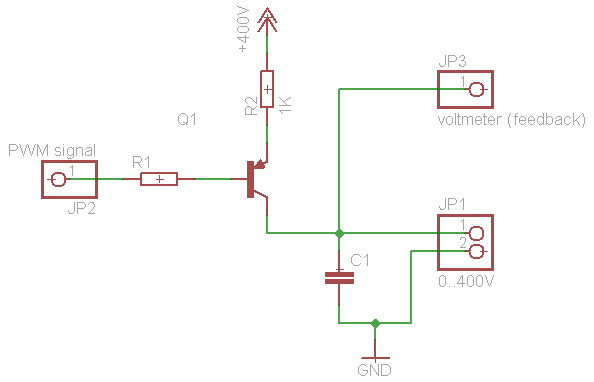
> > thanks for the hint. See the reviewed circuit:
> >
> > http://www.jb-electronics.de/tmp/400v_adjustable.png
> >
> > Yes, the feedback loop will be included, I forgot to mention that my
> > power supply will have both a volt- and amperemeter built in.
> >
> > This way I will be able to check the voltage, as well as to completely
> > shut
> > off the PWM stage when the current is too high. Is this safe?
> >
> > Does anyone know a good PNP transistor for this purpose?
> >
> > Regards,
> > Jens
> >
> > Am 25.07.2011 18:08, schrieb Frank Bemelman:
> >> I would (at least) add some feedback. Voltage divider and opamp to
> >> compare against set value.
> >> Without feedback, the cap would charge to 400V in no time.
> >> Plus a current limiting resistor of 1K in series with the emitter,
> >> which makes a lousy protection but still better than nothing.
> >>
> >> ----- Original Message ----- From: "jb-electronics"
> >> <[email protected]>
> >> To: <[email protected]>
> >> Sent: Monday, July 25, 2011 5:11 PM
> >> Subject: Re: [neonixie-l] Nixie Tube Power Supply: 0..300V @ 30mA max.
> >>
> >>> Hi,
> >>>
> >>> thanks a lot for all these replies. I am not an engineer, so I am not
> >>> familiar with power supply circuitry.
> >>>
> >>> These modules on Ebay are nice, but I would like to build my own
> >>> meters around that supply, that would be a waste of these units I
> >>> think. They are a tad too powerful for me as well ;-)
> >>>
> >>> I like the PWM idea because it is so simple: Why not rectify some AC
> >>> (after two transformers of course) to say 400V. Then use some suited
> >>> PNP transistor (which would that be?) that switches the +400V on and
> >>> off, and then a cap to smoothen the signal. Probably a rather Spartan
> >>> design yet, any improvements? I can tell it is not protected against
> >>> shorts.
> >>>
> >>> http://www.jb-electronics.de/tmp/400v_adjustable.png
> >>>
> >>> The maximum current is then limited by the transformers that are
> >>> used, isn't it?
> >>>
> >>> Thanks again,
> >>> Jens
> >>>
> >>> Am 23.07.2011 02:36, schrieb Charles MacDonald:
> >>>> On 11-07-22 06:51 AM, Tidak Ada wrote:
> >>>>> The background is this: I would like to build a universal power
> >>>>> supply that can be used to drive all kinds of display devices: VFD
> >>>>> tubes with their 50-60V anode voltage, as well as larger Nixie
> >>>>> tubes with 300V anode voltage and 25mA current.
> >>>>>
> >>>>>
> >>>>> Any other ideas are quite welcome, too.
> >>>>
> >>>> Do you really want to BUILD such an item?  They are common on test
> >>>> benches and with fewer test benches using High Voltage devices, they
> >>>> are found in surplus.
> >>>>
> >>>> I recently got a nice looking unit with 1-400 volts at about 100ma
> >>>> as a science lab item. Dial the voltage limit, Dial the current
> >>>> limit.  I have not tried it with an audio amp yet, but it should run
> >>>> fine for Nixie use.
> >>>>
> >>>> For example have a look at Ebay
> >>>> Item number:    230649564649
> >>>> Item number:    150634915051
> >>>>
> >>>>
> >>>>
> >>>> If you want to look at the OLD school way, My old school test bench
> >>>> as a Stark Regulated supply, which is one of the schematics at
> >>>> Pacific TV tubes site.  It uses a 6l6 as a pass regulator.  The C
> >>>> supply would cover your VFD requirements.  This was surplus from an
> >>>> Old High School lab.
> >>>
> >>> --
> >>> You received this message because you are subscribed to the Google
> >>> Groups "neonixie-l" group.
> >>> To post to this group, send an email to [email protected].
> >>> To unsubscribe from this group, send email to
> >>> [email protected].
> >>> For more options, visit this group at
> >>> http://groups.google.com/group/neonixie-l?hl=en-GB.
> >
> > --
> > You received this message because you are subscribed to the Google Groups
> > "neonixie-l" group.
> > To post to this group, send an email to [email protected].
> > To unsubscribe from this group, send email to
> > [email protected].
> > For more options, visit this group at
> > http://groups.google.com/group/neonixie-l?hl=en-GB.

--
You received this message because you are subscribed to the Google Groups
"neonixie-l" group.
To post to this group, send an email to [email protected].
To unsubscribe from this group, send email to
[email protected].
For more options, visit this group at
http://groups.google.com/group/neonixie-l?hl=en-GB.