Thanks for all information!

Do you have any information on cathode resistors or how the circuit
for the reset cathode and auxiliary anode should be connected?
I realise that I might have been a bit unclear in my first message,
English is not my mothers tongue.

So what I am really looking for is information on how they were
connected in real circuits.

/Martin

On 10 Maj, 01:19, threeneurons <[email protected]> wrote:
> On Tuesday, May 8, 2012 5:20:59 AM UTC-7, Dekatron42 wrote:
>
> > I recently aquired a few Western Electric 6167 dekatrons. I have not
> > been able to find a schematic drawing
>
> Here's a video of one working with my
> kit:http://www.dailymotion.com/video/xqpnm0_western-electric-we6167-in-sp...
>
> The few I still have a picky little bastards. They don't want to spin
> unless the anode current is at least 1mA. Also, if they do stall in one
> spot for too long, that spot gets "sticky". To un-stick it, I had to up the
> current over 2mA, and run that way for  a few minutes, then it work again
> at 1mA. My kit makes about 450V. The anode resistor used was 150K. The tube
> connects as follows:
>
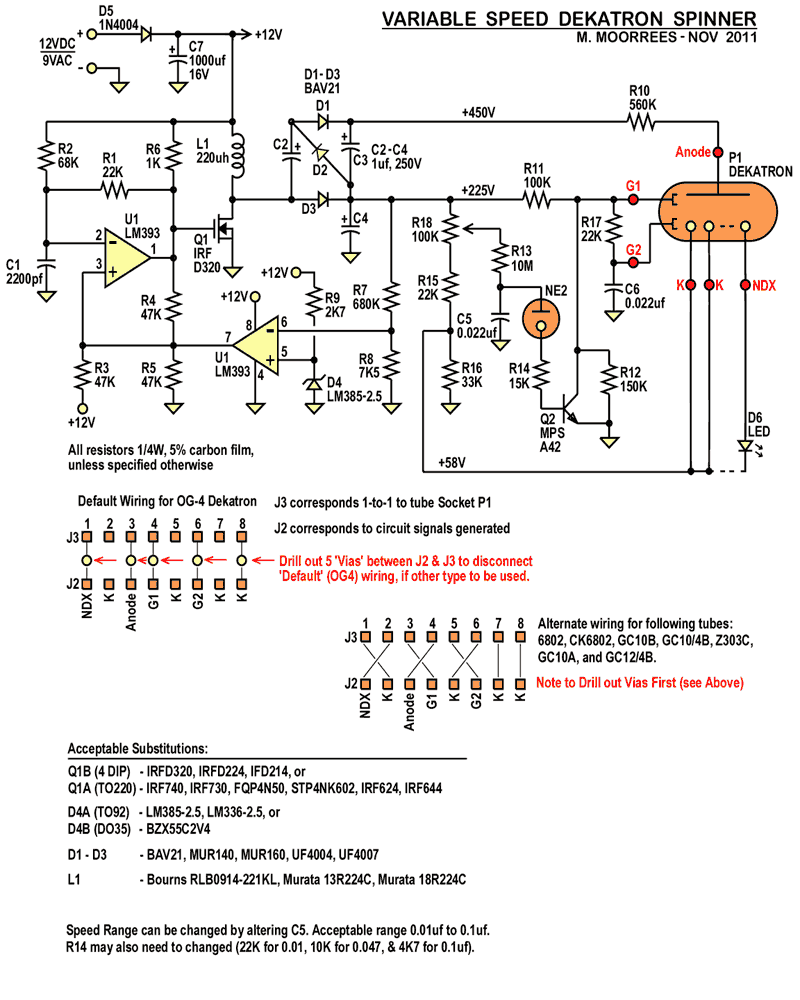
> Pins 1,2,3,7,8,9,10,12, & 13 tie to a 'K' connection, which is +60V on my
> kit. Pin 4 (K10) ties to the NDX, which goes thru an LED, but it can also
> tie to 'K'. Pins 11 (B6-B10) & pin 14 (B1-B5) to to guide G1, The anode is
> pin 19, which gets tied to +450V thru that 150K resistor.
>
> Note, the drop across the tube (anode to cathode) is only 110V. This means
> the anode sits at ~170V, once its on. The voltage drop across the anode
> resistor will be 450V-170V = 280V. Most 1/4W resistors are rated for only
> 250V. For long term assurance, I'd split the anode resistor into two series
> resistors. 150K could be 75K+75K, 68K+82K, or 100K+47K.
>
> Kit schematic:http://threeneurons.files.wordpress.com/2011/12/sp393_sch.gif

--
You received this message because you are subscribed to the Google Groups
"neonixie-l" group.
To post to this group, send an email to [email protected].
To unsubscribe from this group, send email to
[email protected].
For more options, visit this group at
http://groups.google.com/group/neonixie-l?hl=en-GB.