Hello Jens,

pretty sophisticaed way of leak detection ;-)
what do You think by the "insufficient greasing on my needle valve"? The
rubber o-ring used to connect the valve to the system was not greased
properly? Or something else?

"it is not airtight if the scale is adjusted to just zero" - does it really
let the outside air inside the system? I think that the valve stem is not
fully pressed to the valve seat when set to zero, when You screw it further
below zero, it gets full contact with valve seat this making thight seal.
Do You have the needle valve connected in right direction? To the vacuum
system should be connected the line what is on the left on that picture:


By the way, how long did You pump the system before closing and making the
test? I am also strugling with pressure rise, but it is caused by
outgassing of the materials inside the system - it goes from 5x10⁻³ torr to
5x10⁻² in 10 minutes and to 5x10⁻¹ overnight, and all this pressure rise is
caused only by outgassing of rubber rings, air trapped in the metal surface
and so.. Let the pump run for one hour and then close it and do the test.
Or pump the system to 10-2 torr, close it, let it hold the pressure
overnight and then measure it. What pressures are You going to achieve for
pumping the nixies before filling by gas?

What valve do You use for isolating the system from vacuum pump (is it the
ball valve we discussed recently)?

Dalibor


2013/1/26 jb-electronics <[email protected]>

> Hi folks,
>
> I am still working on Nixie tubes, but I have to take it a little slow at
> the moment because I switched my university and I am currently sort of
> living in two cities ;-)
>
> However, today I had some time so I took a look at my vacuum system. My
> problem was that even after I closed the valve to my pump at a pressure of
> 1.5E-2 mbar, the pressure would rise up to 20mbar in 20 minutes. So there
> was a leak.
>
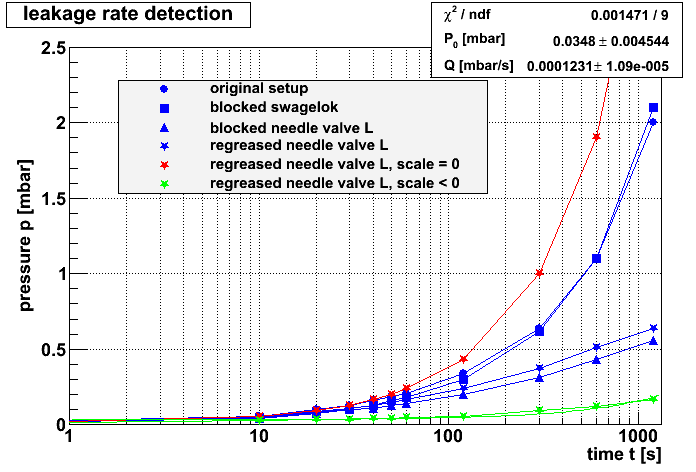
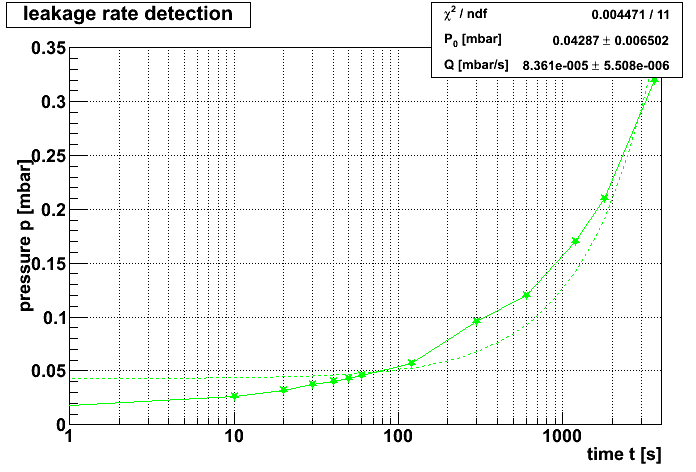
> I then checked every part of my system (swagelok adapter, needle valve) by
> replacing them with a blind flange and recording the pressure after 10s,
> 20s, 30s, 40s, 50s, 60s, 120s, 300s, 600s, 1200s and plotted them. I
> realised that there was insufficient greasing on my needle valve, and the
> most interesting thing is that it is not airtight if the scale is adjusted
> to just zero. You have to (gently) adjust it below the scale zero point.
> Then I get a leakage rate of just 1.2 µbar/s which is very low.
>
> My system has a volume of at most (!) 65ml, so the leakage rate now is Q =
> 5.4E-6 mbar l/s which is pretty good I think. See my results here:
>
> http://www.jb-electronics.de/**tmp/leakage.png<http://www.jb-electronics.de/tmp/leakage.png>
> http://www.jb-electronics.de/**tmp/leakage_extensive.png<http://www.jb-electronics.de/tmp/leakage_extensive.png>
>
> Note that the Q value in these diagrams needs to be multiplied with 65ml.
>
> The next step will be to find a good connection to the pressure reducer
> for my gas bottle. Right now I am using a PVC hose (terrible), and I have
> huge leakage rates.
>
> But as always: One thing at a time ;-)
>
> Jens
>
> --
> You received this message because you are subscribed to the Google Groups
> "neonixie-l" group.
> To post to this group, send an email to [email protected].
> To unsubscribe from this group, send email to neonixie-l+unsubscribe@**
> googlegroups.com <neonixie-l%[email protected]>.
> For more options, visit
> https://groups.google.com/**groups/opt_out<https://groups.google.com/groups/opt_out>
> .
>
>
>


--
Dalibor Farny
http://dalibor.farny.cz

--
You received this message because you are subscribed to the Google Groups
"neonixie-l" group.
To unsubscribe from this group and stop receiving emails from it, send an email
to [email protected].
To post to this group, send an email to [email protected].
For more options, visit https://groups.google.com/groups/opt_out.