It was my experience and learning from this list that originally inspired
the research in that IN-9 document. Based on some private correspondence,
Jan asked me to write something for his site, hence the doc.
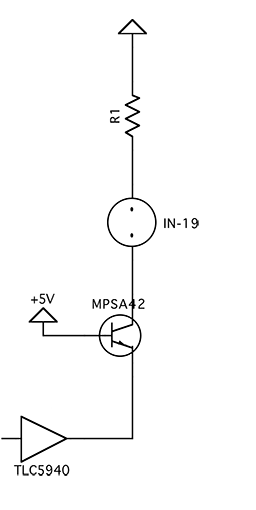
I believe John's suggestion of an MPSA42 configured as common-base
amplifier will work. I've used a similar common-base circuit with 7400 TTL
outputs, which are current-sinking as well.

I would add the following additions to John's recommendation (unverified):

1) Consider placing R1 (in John's schematic) between the MPSA42 emitter and
the TLC5940 output instead of between the IN-9 and B+. This will limit base
current regardless of what the TLC5940 driver tries to do (says person who
has blown more than a few MPSA42s by somehow putting base @ 5V and emitter
@ GND).

2) The TLC5940's PWM feature will probably not work. PWM of LEDs is
"integrated" by the eye to see intensity modulation... while the IN-9 needs
true current modulation. Assuming the driver circuit can switch fast
enough, PWM would likely just intensity modulate an unchanging bar length
on the IN-9. However, it looks like the TLC5940's "dot correction" feature
is exactly current modulation of the individual outputs. The big caveat is
that it is only 6-bit vs. 12-bit for the PWM (64 instead of 4096 steps). If
you can live with only 64-steps in your spectrum analyzer (I probably
could), that may not be a big deal.

3) A proposed design approach:
 - Choose IREF so that the max output current from the TLC5940 is 10mA, the
full scale value for the IN-9. This looks like a reference resistor
(R-IREF) of about ~3.9k, based Figure 3.
 - Choose R1, to be placed between MPSA42 emitter and TLC5940 output so
that the TLC5940 output voltage will be about ~2.5V (arbitrarily chosen to
be the center of the supposed 5V power supply) -> (5V - 0.7V - 2.5V) / 10mA
-> 180ohm. This would basically be Figure C from my IN-9 doc, with R1 =
180ohms, Vin hardwired to 5V, but with the TLC5940 connected in place of a
fixed GND.
- To control, set all TLC5940 channels to 100% PWM, but dynamically set the
dot correction (DCx) on each channel to vary output current from 0 to 10mA
in 64 steps... hopefully allowing 0 to 100% on the IN-9 in 64 steps.

Anyone see any major errors here?

Chase, please let me know if any of this doesn't quite make sense... I was
a total noob too when I first joined this list 12+ years ago (I've been
reading it every day since, but actually post something about once every
World Cup or so).

Jeff


On Tue, Dec 3, 2013 at 6:53 PM, Chill4844 <[email protected]> wrote:

>
>
> On Tuesday, December 3, 2013 12:43:04 AM UTC-5, jrehwin wrote:
>>
>> > I hope someone out there has some thoughts on this and is willing to
>> help out this noob.
>> >
>> > The senerio is this:
>> >
>> > I am attempting to use an Arduino in conjunction with a TLC5940 to
>> drive an array of IN-9's (And not kill myself or blow anything up) the
>> problem being if i understand it right (which I probably don't) is that
>> instead of a positive PWM out the arduino the TLC5940 works by sinking the
>> current on the cathode side. I don't think i can use this with my standard
>> mpsa42 (and I'm not going to attempt anything until i get some advice) I do
>> have some mpsa92's available.
>>
>> That's a somehat peculiar choice for driving an IN-9, but if that's the
>> way you're going, you'll want a common-base setup for your transistor, to
>> provide voltage gain but not current gain (the current through the IN-9
>> will still be controlled by the TLC5940).  You could use your MPSA42 for
>> this (note that I'm just scribbling here, this lashup might not work):
>>
>> http://www.vitriol.com/images/tech/nixies/TLC5940.gif
>>
>> Have you read Jan's writeup on driving IN-9s?
>>
>> http://www.die-wuestens.de/iz/IN9-2.pdf
>>
>> You might also want to look at some other designs used to drive IN-9s,
>> such as Brian Stuckey's Nixietherm:
>>
>> http://www.tubeclockdb.com/forum/Builders-Forum/1280-
>> Nixietherm-IN-9-bargraph-based-thermomer.html
>>
>> - John
>>
>
> Thanks for the quick reply John, the main reason for he 5940 in this case
> is that an arduino does not have enough pwm outs to drive the 14x in-9
> array for my "spectrum analyzer"  probably actually an audio visualizer.
> Yes I have read that write up on driving in-9's and have done a few
> projects with that already.  After much research I found something very
> similar to the lash up you posted. I just have to figure out weather the
> 5940 will sink that much current.  If you have any other ideas for driving
> 14 of them I am all ears I've been thinking on it for months I could use a
> fresh mind. I am sure there is a better way to go about all of this. That's
> what I get for being a noob.
>
> Thanks again John
> Chase
>
> --
> You received this message because you are subscribed to the Google Groups
> "neonixie-l" group.
> To unsubscribe from this group and stop receiving emails from it, send an
> email to [email protected].
> To post to this group, send an email to [email protected].
> To view this discussion on the web, visit
> https://groups.google.com/d/msgid/neonixie-l/d2cb8913-648d-46c7-9878-95050569a952%40googlegroups.com
> .
>
> For more options, visit https://groups.google.com/groups/opt_out.
>

--
You received this message because you are subscribed to the Google Groups
"neonixie-l" group.
To unsubscribe from this group and stop receiving emails from it, send an email
to [email protected].
To post to this group, send an email to [email protected].
To view this discussion on the web, visit
https://groups.google.com/d/msgid/neonixie-l/CAHPDvYnNMEvfk4khgchHwLRSdT4uit3%3D3E5DPonizS49DE-upQ%40mail.gmail.com.
For more options, visit https://groups.google.com/groups/opt_out.