> I picked up a ton of VFD displays from tubes-store.com (good prices and cheap
> shipping btw.) and now I'm trying to figure out how to power them.  It seems
> a fair bit more complicated to power them then the nixies are to power.
Yeah, you need two power supplies, a filament supply and a grid/anode supply.

>  Are there any good/simple power supply circuits anyone can suggest?

Most people run the filament with a DC supply and a dropping resistor.  This
works, but the purists (like me) prefer AC filament drive.

An ordinary transformer works nicely - especially if it has a low voltage
center tapped winding for the filament.

There used to be a chip (LM9022: http://www.ti.com/product/lm9022) that
provided push-pull AC drive for the filament, and with a capacitor/diode
voltage multiplier, also generated the anode/grid supply.  It is worth looking
at its data sheet.  Grahame found a few of the surface mount variety in the UK
a while back.

Konstantin used MAX628/TSC428 FET gate driver chips to implement a similar
filament supply, look at kosbo.com for his designs.

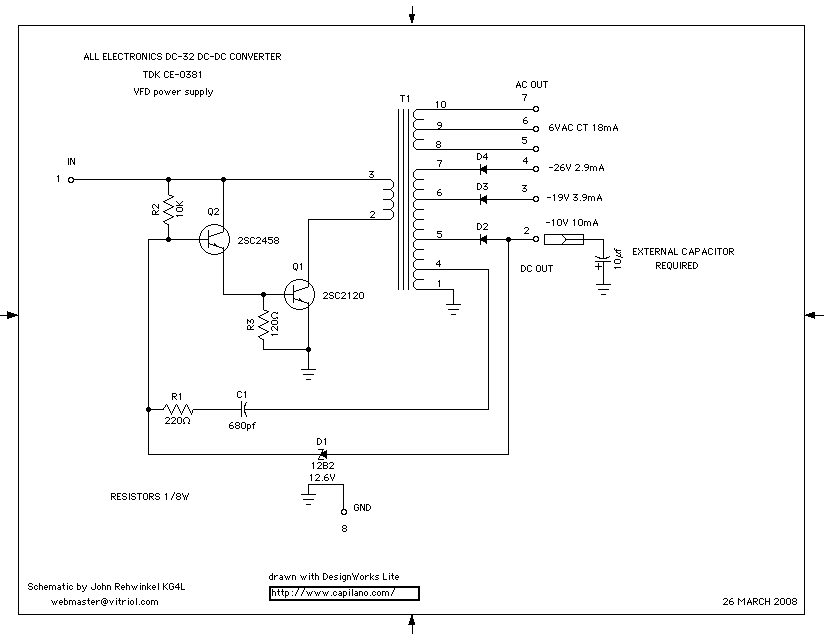
All Electronics used to sell a nice VFD supply on the cheap:

http://www.vitriol.com/images/tech/DC-32.gif

Electronics Goldmine also had a cheap VFD supply:

http://www.vitriol.com/pdf/VFDsupply-G5097.pdf

However, they're both out of stock now.  The DC-32 is smaller, but does not
include the filter capacitors (you have to provide them externally, and if a
particular one is omitted, the regulation loop fails and it self-destructs).
These
supplies produce a center-tapped low AC voltage (to power the filament) and an
assortment of negative voltages.  They're intended to be used by floating the
filament negative and pulling grids/anodes "up" to ground to light them.
By reversing the diodes, you can get positive outputs, which is easier for most
of the circuits and chips we're used
to using.

I bought a raft of the DC-32 supplies, want some?

You can use series resistors to adapt higher VFD filament voltage sources to
the needs of your particular VFDs.

>  Also, any helpful articles/datasheets would be awesome too.

Look at the data sheets for VFD driver chips (STM86312, MM58342, MAX6920, etc.)
for more ideas.

Noritake has some good info:
http://www.noritake-elec.com/vfd_technology_an.php?series=VFD+Technology

Also, read earlier traffic on neonixie-l (search for "Beginner friendly VFD PSU
circuit" for a good thread):

https://groups.google.com/forum/#!topic/neonixie-l/tarPYOcsO60

- John

--
You received this message because you are subscribed to the Google Groups
"neonixie-l" group.
To unsubscribe from this group and stop receiving emails from it, send an email
to [email protected].
To post to this group, send an email to [email protected].
To view this discussion on the web, visit
https://groups.google.com/d/msgid/neonixie-l/85A55AB1-53DA-4870-A7ED-038AC8F9AFB0%40mac.com.
For more options, visit https://groups.google.com/d/optout.