Greg,
The way these 74142 chips work is that each of the ten outputs connects
directly to a nixie tube cathode.
The nixie tube anode is connected in series with a suitable anode
resistance to +170 volts DC.  The 170 volt DC supply and
the 5 volt logic supply share the same ground.    Typically the tubes I am
using (B-5853) and Chinese QS-18-12 use 20k ohm and 15 k ohm
anode resistances respectively.
You are correct about not using a TTL counter output to directly operate
the reset pin.   That causes an extremely short spike and it is therefore
not a reliable method.    This can be solved by inserting a known timed
interval that is initiated by the counter output, but then it provides a
definite, timed
reset to the counter.   74LS221 or 74HC221 works great for this.   Another
quirk of these ancient 74142 chips is that they need to be powered up at a
"cleared" condition.
So a simple housekeeping circuit needs to be employed that holds all 74142
reset pins in "reset" mode during powerup.    This is because if these
chips are randomly
powered up without a mandatory clear condition, they will often wake up
with 2 outputs activated simultaneously.

But in this special case of 74142, one would definitely NOT EVER attempt to
use any output to directly operate the reset pin anyway (even as a crude
experiment)
because of the fact that these outputs are associated with the 170 volt
tube supply!  There in lies the rub.   This is why making a clock using
these chips
requires some unusual techniques.

But as far as the outputs are concerned they work exactly the same as 74141
or the Russian KD155 equivalent.

There is simply nothing fancy about using these outputs.  They connect
directly to the tube cathodes.  Tube anode goes through 15k ohms to +170
volts.
Simple as that.    They were DESIGNED for that.   That is WHY they were
made that way.   They were made for ease of use.

The outputs will handle up to 7 milliamps.   The outputs are protected
internally not to go past what they can handle for the "off" cathodes.

Thank you for your insight.    -Chuck


On Tuesday, January 7, 2025 at 7:58:10 PM UTC-5 Nicholas Stock wrote:

> Greg, using that logic we should just use LCD displays for everything and
> not bother with nixies.... :)
>
> Ha ha.
>
> On Tue, Jan 7, 2025 at 3:25 PM gregebert <[email protected]> wrote:
>
>> Attaching the datasheet I found online.
>>
>> As far as shortening the count, pull the CLR pin low. Since the CLR pin
>> is a TTL-level input, and the outputs are open-collector, you will need to
>> use a diode to protect TTL-level inputs if you drive them from any of the
>> open-collector outputs. The diode is connected such that the cathode is
>> connected to the open-collector output, and the anode goes to the TTL input
>> along with a pullup resistor to +5V. These counters also support cascading,
>> which makes it a ripple-counter. Anyone who has done logic design knows (or
>> *should* know....) decoding ripple-counter outputs will produce
>> glitches, so you cant use those for clocks or resets to other chips.
>>
>> You also have to be careful about the anode supply voltage; if it's too
>> low you wont get reliable nixie-tube ignition. If it's too high, you will
>> cause breakdown at the 74142 outputs, which will cause unwanted cathodes to
>> glow. This is a TTL part, so you wont damage the output from excessive
>> voltage *as long as the current is limited*. The breakdown mechanism in
>> NPN transistors is similar to zener diodes (thru a reverse-biased PN
>> junction), and it's not destructive like CMOS devices where the oxide gets
>> irreparably destroyed by overvoltage. I would set the anode voltage to a
>> point where the voltage across the 74142 measures around 45 volts with a
>> DMM. The anode supply is going to be around 180V depending upon the voltage
>> drop across the nixie tube.
>>
>> I would only build this as a novelty; there are far-better and cheaper
>> ways to do this with modern ICs.
>>
>> On Tuesday, January 7, 2025 at 1:39:12 PM UTC-8 Leroy Jones wrote:
>>
>>> Well I know that  saw a reference to some old RCA data sheet application
>>> note regarding the unobtainium 74142 chip.
>>> It's ok fine with me if that never turns up because I have figured out
>>> how to work with these 74142 chips to effectively shorten their counts
>>> for 10's of seconds,  10's of minutes, 10's of hours counters on a
>>> clock.     However, if such application note does actually exist and can be
>>> found,
>>> it might shed some light on alternate methods used to manage the
>>> count-shortening on these 74142 decade counter/nixie driver ICs.
>>> I am currently scrounging around everywhere for any and all information
>>> I can find about 74142.    Thanks everyone for your help and responses so
>>> far!
>>>
>>>
>>>
>>>
>>> On Tuesday, January 7, 2025 at 3:09:10 PM UTC-5 J Forbes wrote:
>>>
>>>> Reading David's post from 2012, my understanding is that he built a
>>>> CMOS nixie clock in 1976, using 4033 chips, and the schematic in the 1974
>>>> RCA databook. That databook covers CMOS and Linear chips, not TTL.
>>>>
>>>> So, I think you're chasing a ghost, caused by a slight misunderstanding.
>>>>
>>>>
>>>> On Tuesday, January 7, 2025 at 12:14:04 PM UTC-7 Leroy Jones wrote:
>>>>
>>>>> Yes, thank you gentlemen for the responses to my inquiry regarding the
>>>>> rare and esoteric 74142 decade counter/nixie driver IC.
>>>>> I have successfully built a fully operational clock using them.   It
>>>>> was not easy nor practical.  But it works.   This clock uses (17) ICs.
>>>>> I am seeking the supposed ancient RCA application note which
>>>>> reportedly describes a clock design that utilizes these 74142 ICs.
>>>>> The very existence of this app. note is in and of itself somewhat of
>>>>> an urban legend.    Am I chasing a ghost here?
>>>>>
>>>>> But many will ask "why bother doing it?"..............To which I
>>>>> answer:   "because it's cool"
>>>>>
>>>>>
>>>>>
>>>>>
>>>>> On Tuesday, January 7, 2025 at 11:41:04 AM UTC-5 gregebert wrote:
>>>>>
>>>>>> There was a T4142 TTL IC that has a binary counter and nixie driver
>>>>>> in one device; the Texas Instruments datasheet was published in 1972.
>>>>>> Good
>>>>>> luck finding these devices; I've seen a few for sale online and I'm
>>>>>> certain
>>>>>> very few were manufactured because LED displays quickly killed-off
>>>>>> nixies
>>>>>> around that time.
>>>>>>
>>>>>> There is a short thread on neonixie from 2012:
>>>>>> https://groups.google.com/g/neonixie-l/c/R7K9eJcP8h0
>>>>>>
>>>>>>
>>>>>> On Monday, January 6, 2025 at 5:00:49 PM UTC-8 J Forbes wrote:
>>>>>>
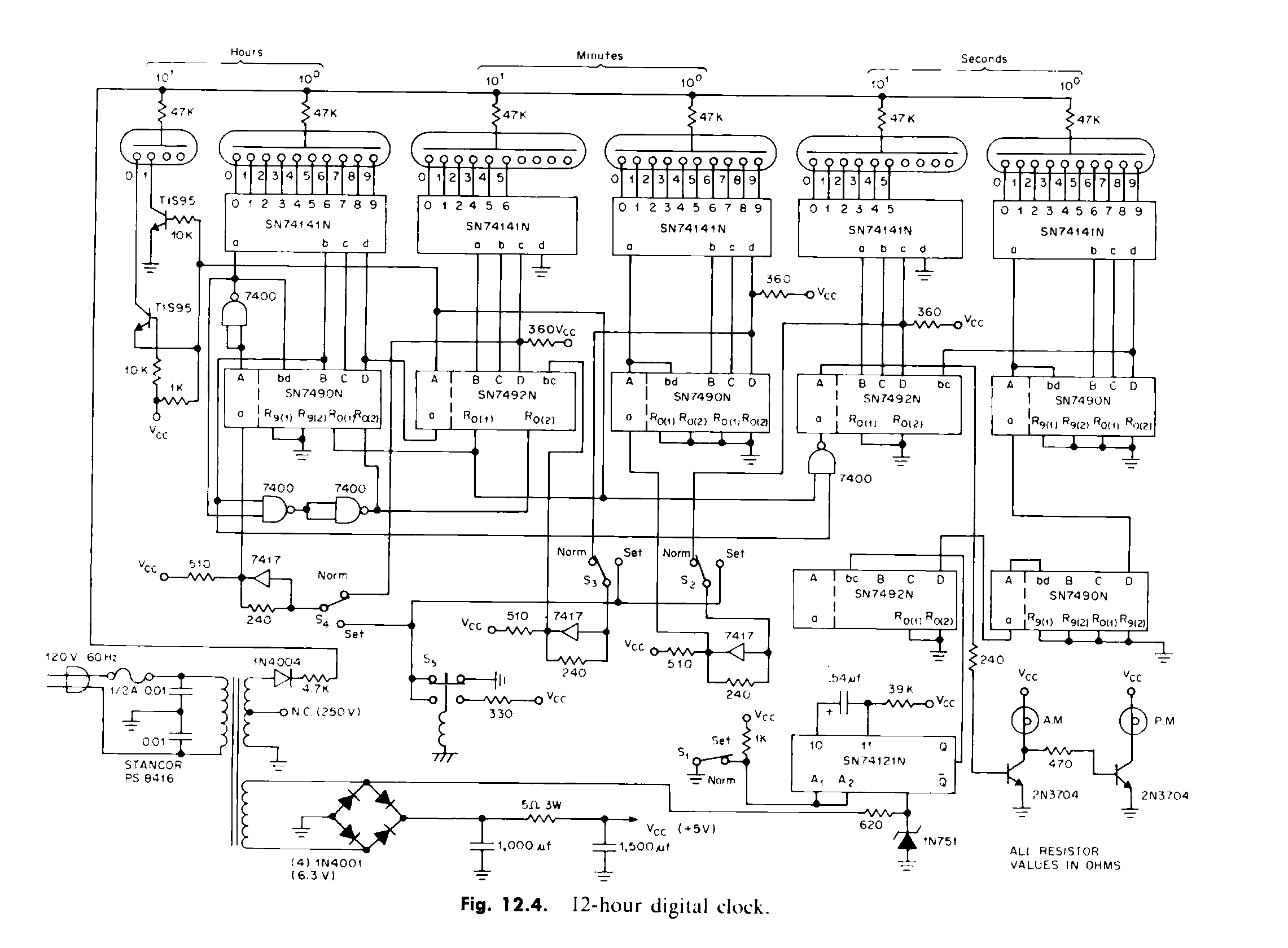
>>>>>>> There's the TI applications for the 74141 driver and 7490/92
>>>>>>> counter, but that's probably not what you want.
>>>>>>>
>>>>>>> http://selectric.org/nixie/ticlock.gif
>>>>>>>
>>>>>>>
>>>>>>>
>>>>>>> On Monday, January 6, 2025 at 4:53:36 PM UTC-7 Leroy Jones wrote:
>>>>>>>
>>>>>>>> Does anyone here remember ever seeing any application notes about
>>>>>>>> making a nixie tube clock based around the 74142 counter/driver IC?
>>>>>>>> I
>>>>>>>> seem to recall a post made many years ago by David Forbes where he
>>>>>>>> referred
>>>>>>>> to an old RCA application note about this.
>>>>>>>>
>>>>>>>> Any info will be greatly appreciated.
>>>>>>>>
>>>>>>>> Chuck
>>>>>>>>
>>>>>>> --
>> You received this message because you are subscribed to the Google Groups
>> "neonixie-l" group.
>> To unsubscribe from this group and stop receiving emails from it, send an
>> email to [email protected].
>> To view this discussion, visit
>> https://groups.google.com/d/msgid/neonixie-l/89a17e21-3184-4653-aa21-92bdef24fadfn%40googlegroups.com
>>
>> <https://groups.google.com/d/msgid/neonixie-l/89a17e21-3184-4653-aa21-92bdef24fadfn%40googlegroups.com?utm_medium=email&utm_source=footer>
>> .
>>
>

--
You received this message because you are subscribed to the Google Groups
"neonixie-l" group.
To unsubscribe from this group and stop receiving emails from it, send an email
to [email protected].
To view this discussion, visit
https://groups.google.com/d/msgid/neonixie-l/03e3db91-acfa-4e4d-a589-381b8e13979an%40googlegroups.com.