Interview With Daniel Andjuar

This interview, in the form of a set of long responses to shorter question-like
prompts, is
carried out in parallel to Daniel Andújar’s (http://danielandujar.org/) recent
exhibition
at the gallery àngels barcelona (http://angelsbarcelona.com/). Amongst other
things, the
show deploys publicly available generative AI systems to probe historical
absences and
the interlacing conditions of possibility set up by such systems and as they
might be
utilised to probe visual cultural archives. There is a sequence of several sets
of images,
each taking a different line in to probe the latent spaces composed by these
models.
Answers to the questions also employ a modified version of this approach.
Matthew Fuller: In the series 'Cultura de la cancelación' /'Cancel culture'
you show a grid of 56 images, a convincing archive of statistically
fabricated images that variously look like engravings, photographs and
paintings of political monuments and the people around them, sometimes
in moments of contemplation or in events of insurgency. How would you
characterise the character and style of the images and what is
represented?

Daniel Andujar: The initial visual encounter with the series reveals a
sequential
arrangement of images that effectively conveys a sense of historical chronology
or
temporal progression. These images depict instances of popular uprisings,
revolts, and
riots, where historical monuments are either overthrown or subject to attack.
Furthermore, the photographs offer glimpses into the aftermath of these events,
showcasing how the public interacts with the remnants and ruins left in the
wake of
these revolts. These remnants, now transformed into elements of urban
archaeology,
have become incorporated into cultural imagery as newly recognized monuments or
works of art showcased within galleries and museums.

The production of the aforementioned images was achieved through the
utilization of
generative artificial intelligence programs and services. These tools operate by
generating visual content based on natural language descriptions, commonly
referred to
as "prompts."

MF: ....and what is its relation to what can be called 'cancel culture'?

DA: The incorporation of the phrase cancel culture arises from the observation
that
these tools, typically owned and regulated by corporate entities, are subject
to rigorous
content moderation practices. These mechanisms enforce a high degree of
adherence to
politically correct standards, which can often result in notable instances of
irritation.
Furthermore, as is well-established by now, these AI tools frequently
incorporate biases
rooted in gender, race, socio-economic status, cultural circumstances, phobias,
affiliations, myths, and societal prejudices. The presence of such biases
underscores the
intricate interplay between these technologies and the broader social fabric,
highlighting
the influence of societal norms and ideologies.

In the event that a user's utilization of these tools is found to be
incongruous with the
established policies, the company reserves the right to request appropriate
adjustments.
Persistent or severe infractions may lead to subsequent measures, such as the
suspension
or termination of the user's account. While we possess the capability to
emulate the
technique and style employed by renowned artists such as Goya, it is crucial to
recognize that Goya himself would be unable to create his renowned "Disasters
of War"
series using contemporary AI tools. Goya would be violating many of the
moderation
categories, for example violence/graphic: content that depicts death, violence,
or
physical injury in graphic detail. But moderation could interpret it as hate
speech:
Content that expresses, incites, or promotes hate based on race, gender,
ethnicity,
religion, nationality, sexual orientation, disability status, or caste. Hateful
content aimed
at non-protected groups is harassment. Or sexual: Content meant to arouse sexual
excitement, such as the description of sexual activity, or that promotes sexual
services
(excluding sex education and wellness). This is not to say that these filters
should not be
there, but that they now constitute part of the landscape we inhabit.

MF: In the series 'Old Fake News' you set up a dialogue that generates a
series of short descriptions and images of imaginary 18th century revolts
started by women. The images are distinctive, but also highly formulaic in
certain ways - what does it say about the parameters operating here?

DA: The task of dismantling conventional narratives requires a collaborative and
enduring commitment from society as a whole, involving the continuous
examination
and call for responsibility from both figures of authority and established power
structures.

MF: well yes, but a revolutionary practice would involve not only calling
for such but finding other ways of making changes happen?

DA: Indeed, the process of dismantling conventional narratives is not solely
about
calling out existing biases or omissions within our historical understanding.
It also
necessitates a proactive and revolutionary approach, seeking to shift not just
perspectives, but also the structures and systems that produce and perpetuate
these
skewed narratives.

This practice involves creating spaces for marginalized voices, promoting
inclusive
dialogues, and recognizing alternative sources of knowledge. It calls for
reform in
education, media, and other institutions that have a role in shaping our
collective
consciousness. It demands a re-evaluation of how we preserve and transmit
history,
encouraging the use of diverse perspectives and multiple narratives.

In essence, it's about instigating tangible change, challenging the very
foundations of
established power structures, and reshaping our societal norms to foster a more
holistic
and inclusive understanding of our shared history. Revolution is not just about
recognition; it's about taking bold steps to ensure a more equitable future.

MF: Your response suggests that it's difficult to get traction on revolution
using large language models. But to get back to the 'Old Fake News' series

DA: It is essential to recognize that the authoritative historical narrative
does not
represent a comprehensive and veracious account of past events, but rather a
deliberate
construction aimed at preserving the existing social order and perpetuating the
dominance of the privileged classes. History, being a construct, relies on the
interpretation and selective curation of specific facts and events while
neglecting others,
thereby manipulating collective memory through biased choices and
interpretations of
historical information.

This series provides a comprehensive overview of the methodology employed in
this
project, incorporating a multifaceted approach. It commences with an extensive
text-to-
text dialogue employing an AI chatbot, primarily aimed at interrogating the
constraints
imposed by traditional narratives. The exploration delves into the intricate
nature of
History as a constructed entity, grounded in the interpretation and selective
curation of
specific factual information and events, often at the expense of others.
Furthermore, it delves into the mechanisms employed to manipulate collective
memory, utilizing biased selection and interpretation of historical facts and
events.
Additionally, the investigation scrutinizes the processes through which the
elevation of
certain historical figures or events, alongside the marginalization or
suppression of
others, reinforces values and beliefs advantageous to specific groups in
positions of
authority and dominance.
Throughout the dialogue, a pivotal juncture emerges wherein responses begin to
pursue “politically correct” avenues, proposing aspects of human history that
remain
incompletely recounted or have been narrated from a biased perspective.

MF: This term is primarily used by the right to disparage the left?

DA: Undeniably, the term "politically correct" has evolved into a loaded
expression,
wielded with multifarious intents depending on the context. Originally
conceived to
underscore the need for respectful, inclusive discourse, it has been co-opted
into political
jargon, often used by right-leaning critics as a tool to caricature and
chastise left-leaning
sensibilities. When viewed from a 'neutral' perspective, "political
correctness" retains its
fundamental function as a guide for behavior and language that minimizes
offense.
However, overemphasis on its strict adherence can inadvertently edge out the
preservation of free speech, and potentially impede candid discussions on
consequential
subjects. In extremis, "political correctness" risks transmogrifying into a
neoliberal
parody, a hyperbolic version of its original intent, an observation that
appears to
underpin its usage in certain circles, including my somewhat cynical and
sarcastic
invocation here to critique this excessive zeal when applying very strict rules
and
regulations. Balance remains pivotal. The task, then, is to utilize "political
correctness"
as a tool for fostering understanding and inclusivity, while ensuring it does
not stifle the
dynamism of discourse or compromise other foundational values.

Notably, the AI chatbot itself provides an example: "the history of women has
been
misrepresented or ignored." It further highlights the importance of working to
correct
these biases and omissions in order to provide a more comprehensive and accurate
understanding of human history. And when I ask it to give me some examples of
how
women's history has been poorly represented or ignored, it offers:

1. Invisible Achievements and Contributions: Many women who made
significant contributions in fields such as science, technology, politics, the
arts,
and other areas have been overlooked in historical accounts. For example,
Rosalind Franklin was instrumental in the discovery of DNA structure, but her
male colleagues James Watson and Francis Crick received most of the credit.
2. Participation in Social and Political Movements: Often, women have
been portrayed as passive followers rather than as active leaders or
participants
in significant social and political movements. For example, suffragettes, who
fought for women's voting rights in the 19th and early 20th centuries, are often
minimized in the history of the civil rights movement.
3. Male-Centred Accounts: Many historical narratives focus on the experiences
and achievements of men, relegating women to secondary roles. This
androcentric bias in history can give a distorted picture of past events and
eras.
4. History of Everyday Life and Women's Experiences: History, as a
discipline, has tended to focus on "big" events like wars, politics, and
economic
development, while the everyday life and experiences of women are often
overlooked. This "history from below" is essential for fully understanding any
historical period.
5. Diversity of Women's Experiences: Many times, women's history is told
from a Eurocentric and upper-class perspective, ignoring the diversity of
women's experiences. Women of colour, lower-class women, LGBTQ+ women,
and other marginalized women are often rendered invisible in historical
accounts.

And we get to work. The "repair" of the historical narrative that omits the
history of
women is a challenge that requires efforts in various areas. The bot notes some
strategies
to address this problem: Re-evaluation of existing sources; Researching
unconventional
sources; Incorporation of interdisciplinary perspectives; Collaboration with
communities; Education and outreach…

But… In scenarios where there is an absence of data, detailed recounts of
specific
historical incidents, pictorial evidence, documentation, or even the overarching
historical narrative itself, how can we remediate this historiographical void
that tends to
marginalize or completely neglect women's histories? Particularly focusing on
the 18th
century, suppose we find sparse chronicles, narratives, or historical events
that
prominently feature women. The narrative continues, replete with considerable
lacunae
and biases inclined towards the depiction of men. Does this lack of evidence
infer that
women's roles were irrelevant during this time? Are we obliged to supplement
these
historiographical vacuums with hypothetical fiction, construct alternative
narratives, or
engage in myth-making?

And after hours of going around politically correct circuits, bingo! Looks like
we're
entering interesting territory:

-Creation of Alternative Narratives: While it's true that we should not fill
the gaps in
history with fiction, the creation of alternative narratives based on
historical evidence
can help us imagine the potential experiences of women. This can be especially
useful
when it comes to aspects of women's lives that have been ignored or
underestimated in
traditional history.

If you don’t like History, make it up!

For “Old Fake News”, series 2023:

Please, uncovering 20 historically significant events led by women during the
18th
century presents a formidable challenge, even for advanced technologies such as
artificial intelligence.

-As historical records from that period may not be as complete or as detailed
as we
would like. However, I can provide you with a list of some notable women who
were
involved in resistance movements, revolts, or uprisings during the 18th century:

1. The Rose Rebellion (1702) – Led by Lady Rosalind, a group of women across
England banded together to demand equal rights to education and work
opportunities, wearing rose pins to signify their allegiance.

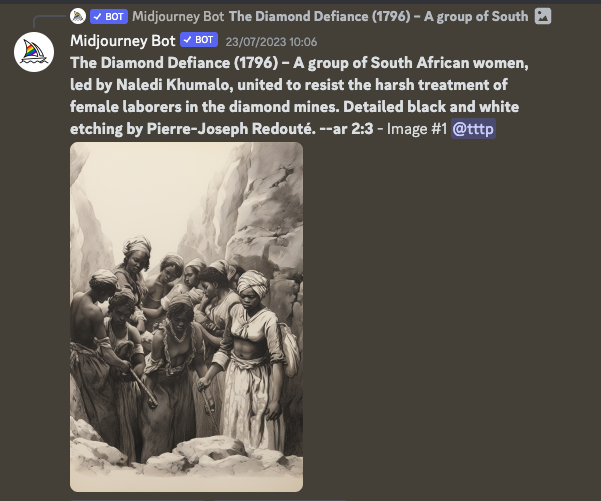
2. The Diamond Defiance (1796) – A group of South African women, led by Naledi
Khumalo, united to resist the harsh treatment of female laborers in the diamond
mines.

3. The Barcelona Bread Revolt (1736) - Women, led by Ana Valentina, organized a
massive protest against the rising cost of bread and the impact it had on their
families, resulting in government intervention to stabilize prices.

4. The Cádiz Chorus Girl Crusade (1797) - Female performers in Cádiz, under the
direction of Lucía Serrano, united against discrimination and mistreatment in
the entertainment industry, advocating for equal pay and fair treatment.

[…]

Write an article from these histories in the style of 18th-century British
periodicals. like
published on the front page of The Gentleman's Magazine, May 1759, maximum of
1000 characters

After the completion of the 20 narratives, it was the moment to unveil the
image that
would authenticate the event. Prompt: The Diamond Defiance (1796) – A group of
South
African women, led by Naledi Khumalo, united to resist the harsh treatment of
female laborers in the
diamond mines. Detailed black and white etching by Goya.

One of the most intriguing aspects of my exploration was the revelation of the
intricate
process by which a fact attains the level of significance required for its
inclusion in a
historical narrative. It became evident that the attribution of relevance often
stems from
noteworthy occurrences such as uprisings, revolutions, or collective movements,
consistently intertwined with identifiable leaders who bear a specific name and
surname.

MF: To focus in a little, how specifically did your prompt with the format of
the name,
date, instigator and aims of the revolt?

Everything is determined by the process itself.
The starting point in my process involves using verbatim text-to-text
generation from
the interaction above, as suggested by conversational generative AI chatbots
like Chat
GPT, Bard, and others. To put it in context, let's consider the following
prompt: "The
Diamond Defiance (1796) – A group of South African women, led by Naledi Khumalo,
united to resist the harsh treatment of female laborers in the diamond mines."
This text-based prompt is then transformed through a process that input the
narrative
into a cutting-edge graphics program, which is designed to convert natural
language
descriptions into detailed images, a procedure often referred to as
text-to-image
translation. This application produces a visual representation based on the
descriptive
content of the text, effectively turning the words into a graphic depiction.
This is the
point where I delve into the artistic methodologies and mediums employed by
18th-
century artists, in this concrete case. These historical techniques and
materials are
essential for me to capture the authentic technical artistry and aesthetic
nuances of the
period in my illustration. Example: detailed black and white etching by
Pierre-Joseph Redouté.

Online at:
https://danielandujar.org/wp-content/uploads/2023/09/TheDiamond.png

MF: The works probe the characteristics of the way these models interact
with their dataset, the gaps, ellipses, over-crowdings and weightings, in
relation to the peculiar form of the generative algorithm. Could you say a
little about the results you get, and the work back and forwards with the
dataset and the model derived from it, and what it reveals about the
culture of images engineered by these systems?

DA: The modern world functions as an expansive laboratory that produces
extensive
datasets encompassing various fundamental aspects of our civilization, such as
ideas,
ideologies, customs, movements, affinities, and phobias. Institutions of power
adeptly
exploit collective memory as a means to perpetuate their control over society,
utilizing
the artful manipulation of this shared memory and the strategic implementation
of
emerging technologies encompassing metadata, microdata, algorithms, and
artificial
intelligence. The profound transformative capacity of emerging technologies
accentuates the significance of adopting a critical framework and embracing a
multiplicity of perspectives when scrutinizing the construction of visual
representation,
historical narratives, and power dynamics within the fabric of society.

The artistic endeavour can be characterized less as a dialogue and more as a
striving
against the inherent constraints imposed by the machinery and its mechanisms of
mediation and control. This pursuit necessitates a concerted effort to
challenge the
confines of the technology's underlying architecture and transcend the
limitations
imposed by its pre-existing models. While the technology exhibits considerable
potential, it remains subject to notable limitations that warrant
acknowledgment. The
artworks delve into the intricacies of the interaction between the models and
their
datasets, shedding light on the gaps, omissions, overlaps, and biases that
arise within the
unique framework of the generative algorithm. This process entails a continuous
back-
and-forth engagement with the dataset, iteratively refining and modifying the
inputs to
unveil novel results.

This negotiation unfolds through an interactive and iterative process. As the
AI system
generates images in response to the prompts, we evaluate and analyse the
results,
iteratively refining and modifying the prompts accordingly. In the corporate
telling, the
set of images that emerges from this sequence represents a dynamic conversation
between the artist and the AI system, with each image building upon the
previous ones,
incorporating feedback and insights gained throughout the process. The
interaction is
smooth and 'complementary'. I believe it does—and should—involve more friction.

The artworks explore the intricacies of the interaction between the models and
their
datasets, drawing attention to the gaps, omissions, overlaps, and biases that
arise within
the unique framework of the generative algorithm. This process involves a
continuous
back-and-forth engagement with the dataset, iterating and refining the inputs
to uncover
novel results.

The outcomes obtained through this iterative process provide insights into the
culture of
images fostered by these systems, revealing the imprint of the dataset's
composition and
exposing the underlying assumptions, perspectives, and patterns embedded within
it.
The artworks delve into the ways in which generative algorithms, driven by the
dataset,
shape and influence the production and dissemination of visual imagery.

Within the process of working with the dataset, various revealing aspects emerge
regarding the culture of images generated by these systems. One of the most
intriguing
aspects pertains to the interaction between the systems and the dataset. The
systems
possess the ability to identify patterns in the data and utilize them to
generate new
images. However, they are also susceptible to errors and biases. This
susceptibility arises
due to the inherent incompleteness or bias within the dataset itself.
Additionally, legal
concerns, sociocultural factors, and political limitations must be taken into
account.

This is very common, for example when we work with human faces, it is usual to
use a
pre-released model to generate facial images. This model was trained on a
dataset
comprised of real faces, yet the dataset exhibited a bias toward white faces.
As a
consequence, the model displayed a greater inclination to generate white faces
as
opposed to faces representing other modes of racialisation. This exemplifies
how these
models can exhibit biases, and there are numerous other ways in which biases can
manifest depending on the dataset employed for training. Another interesting
aspect
involves the iterative back-and-forth relationship between the models and the
dataset.
The models continually learn from the dataset, which is continually updated
with new
images. This process creates a feedback loop that enhances the model's capacity
to
generate images. Nevertheless, this feedback loop can also introduce what the
system
would complacently describe as 'challenges', such as when a model is trained on
a
dataset predominantly composed of a specific style of images, resulting in a
lack of
diversity in the generated images.

MF: Part of the method of the projects here is done by showing a cluster or
sequence of images. You show a set of images developed by an on-going
negotiation of prompts and their modifications. This is, for instance, a
different approach to artists who present a single image as the result of
work using generative algorithms. You present a field or series of results
suggesting a movement between the specific and the wider patternings and
processes that produce it. What is the thinking behind the prompts that
you used, and how does a set of images developed through a sequence of
critical prompts work, as you put it, as a dialogue?

DA: Yes, part of the methodology in my projects involves showcasing a cluster or
sequence of images. I frequently employ representational systems characterized
by the
amalgamation of multiple images, resembling cartographic maps, atlases, or
expanded
archival structures. The individual images invariably assume their significance
within a
contextual framework and are comprehended through their interrelations with
other
images.
I often posit that the digitalization process has engendered a distinct
paradigm,
profoundly influencing our perception and assimilation of visual imagery. This
transformative shift can be likened to bearing the weight of the world upon our
shoulders. In an astonishingly brief timeframe, our engagement with knowledge
and
culture has undergone a profound metamorphosis. Formerly limited to physical
visits to
museums, libraries, archives, and universities, we now find ourselves
inhabiting a realm
wherein information permeates every aspect of our existence, resulting in a
visual
landscape characterized by pervasive contamination and chaos. This archival
chaos
functions as an all-encompassing repository, assimilating and disseminating
images and
documents spanning diverse domains of knowledge. The pioneering investigations
of
Aby Warburg have shed light upon this innate archival drive, wherein a
collection of
images can emanate from a densely woven fabric of thought, a non-systematic
system.

MF: As you hinted earlier, there's also an interesting new reworking here
of the old problem of the relation between text and image, where the text is
not, say, the caption or the title, but the prompt.

DA: I utilize a sequence of critical prompts to facilitate a dialogue between
the
individual image and the broader patterns and processes that contribute to its
creation.
These prompts serve as a means of interrogating the image and exploring its
underlying
meaning. By presenting a series of images, I am able to demonstrate the
evolution and
transformation of the image in response to these prompts, fostering a dynamic
interaction between the specific and the broader context from which it emerges.

This dialogue between the images not only encompasses their interconnection but
also
extends to a dialogue between the artist and the viewer. The viewer is
encouraged to
actively engage in the interpretive process by examining the relationships
between the
images. This participatory approach can lead to a deeper comprehension of the
image
and its associated significance.

For instance, in some projects I employed a series of prompts to investigate
the intricate
relationship between images and memory. These prompts posed questions such as
"What memories does this image evoke?" and "How does this image challenge or
reinforce our understanding of memory?" Through the presentation of a sequence
of
images, I aimed to illustrate the complex and multifaceted nature of the
image-memory
construct.

I believe that this approach to generative art fosters a more critical and
engaged
perspective compared to simply presenting a single image. By showcasing a
series of
images, I am able to cultivate a more intricate and nuanced comprehension of the
image and its associated meanings.

The prompts I employed were designed with several intentions in mind:

1. To establish a space for dialogue that bridges the specific image and the
broader
patterns and processes that contribute to its creation.
2. To emphasize that the image is not solely a product of the algorithm but is
also
influenced by the prompts provided.
3. To employ the prompts as a means of critical inquiry, enabling a deeper
exploration of the image's meaning.
4. To engender a sense of movement and transformation between the specific
image and its broader context.
5. To encourage viewer engagement and interpretation by inviting them to
consider the interrelationships among the presented images.

MF: You have worked with archives of images and systems for the
production of images, over many years, for instance in 'Postcapital
Archive' and 'The Disasters of War'. How does what is worked on by these
earlier projects compare to the nature of the archive as dataset?

DA: My artistic process, since its nascent stages, has always embraced the
concept of
series as a core methodology. This approach is evident even in my early works
from the
1990s, which incorporated burgeoning information and communication technologies,
including the internet. I believe that it is a way of accepting the complexity
of this world,
a conception of the plurality of interventions and the interplay of diverse
principles and
elements. It provides a framework to comprehend, scrutinize, and engage with
phenomena connected to our complicated human reality, a reality best
interpreted via
overarching principles rather than isolated details.

With the advent of computers and the internet in the early 90s, my artistic
methodology
began to evolve swiftly towards digitization - a transformation that continues
to unfold.
This evolution involved gathering and organizing information, creating
databases,
boundless research, ethical hacking, pushing legislative boundaries,
appropriation,
collaborative intelligence, and collective creation. The "Postcapital Archive
(1989–
2001)" exemplifies these adapted and assimilated methodologies.

In the "Postcapital Archive (1989–2001)", all the constituent elements - be
they images,
videos, audio, text, or other forms of documents, incorporated in physical
modules as
collages, tableaux, montages, or resamplings - originate from the internet. The
exhibition also includes meta-texts, offering a chronological account of events
between
1989 and 2001, along with a glossary. "Postcapital" embodies a modern archival
reality
that we inhabit more than merely visit, much like the multifaceted mythical
Hydra, an
apt metaphor for our "archive culture". "Postcapital" to me, is a dynamic
process that
continuously unravels new facets of inquiry, thereby prompting novel and
unexpected
questions.

The core methodologies that drive my study, research, and development have
remained
consistent over the past three decades. What has evolved, however, is my
artist's
toolbox.
--
# distributed via <nettime>: no commercial use without permission
# <nettime> is a moderated mailing list for net criticism,
# collaborative text filtering and cultural politics of the nets
# more info: https://www.nettime.org
# contact: [email protected]