The new Great Communicator ... isn't

Obama is stumbling in the stimulus debate -- and public support is
dropping -- because for 30 years Republicans have lied about the role
of government. Now he's got to tell the truth.

By Joan Walsh

Feb. 04, 2009 |

<http://www.salon.com/opinion/feature/2009/02/04/obama/print.html>http://www.salon.com/opinion/feature/2009/02/04/obama/print.html

Tuesday's Tom Daschle news stepped all over President Obama's
stimulus sales campaign. Likewise, it kept me from writing about
Robert Reich's excellent Salon piece on the larger issues at stake in
the stimulus battle, but I want to take it up today.

Reich said something Democrats almost never say: The so-called
fundamentals of our economy didn't start weakening in 2007 or 2008
with the housing and credit crisis; they haven't been strong for most
American workers since wages began stagnating in the 1970s.

I'm going to quote Reich in a major way in a minute. But I'm writing
because I'm concerned about how Obama is and isn't selling his
crucial stimulus/recovery bill. I'm wondering about what he'd say
about it in an FDR-style "fireside chat." On YouTube, or wherever.
Even though I'm an Obama admirer, and also, I'm paid to know these
things, I'm not sure I do know how he'd make the case for why this
bill will solve our economy's problems, and why it must pass. And
soon, because new poll numbers now show that public support for it is
already dropping fast. A Rasmussen poll says 43 percent oppose it,
and 37 support it,
<http://www.rasmussenreports.com/public_content/business/economic_stimulus_package/support_for_stimulus_package_falls_to_37>an

8-point slide in two weeks. Nate Silver thinks
<http://www.fivethirtyeight.com/2009/02/stimulus-still-popular-after-all-these.html>that

poll overstates the bill's troubles. "There is some evidence -- the
trendline in the Rasmussen poll -- that he stimulus has become less
popular. There is no evidence, on the other hand, that the stimulus
has become unpopular; on the contrary, the preponderance of polling
evidence suggests it remains a course of action that most of the
public likes." Still, the Washington Post reported today that Senate
Democrats don't think they have the votes to pass it right now.

Obama is the Democrats' Great Communicator, our Ronald Reagan. It's
fitting that his highest priority will be reversing the tax and
spending priorities Reagan enshrined as a new American compact almost
30 years ago, and reviving the notion of government as an engine of
capitalist growth -- not merely the safety net provider, but the
catalyst for organizing our public resources around what makes the
economy strong. We've been arguing at the margins during these last
two years of pain: Government should regulate more, or less. Tax
rates should be higher, or lower. But there's a dangerous civic
illiteracy in our country about what the larger role of government in
a modern economy is, or should be, and I don't think Obama will
ultimately prevail if he doesn't start to take it on.

Obama is the most remarkable Democratic communicator of my lifetime,
I think, and even he's not rising to the task, yet. He needs to lay
out his priorities, clearly; he needs to simplify his pitch, yet he
also needs to add some depth to his and our understanding of how we
got here. This economic crisis is not just about bad mortgages and/or
the housing bubble bursting, and it won't be solved by reinflating
that bubble, the Republicans' latest dumb idea. These problems have
been building since at least the 1970s. Here's how Reich laid it out
on Salon:

The bursting of the housing bubble caused the current crisis, but the
underlying problem began much earlier -- in the late 1970s, when
median U.S. incomes began to stall. Because wages got hit then by the
double-whammy of global competition and new technologies, the typical
American family was able to maintain its living standard only if
women went into the workforce in larger numbers, and later, only if
everyone worked longer hours.

When even these coping mechanisms were exhausted, families went into
debt -- a strategy that was viable as long as home values continued
to rise. But when the housing bubble burst, families were no longer
able to easily refinance and take out home-equity loans. The result:
Americans no longer have the money to keep consuming. When you
consider that consumers make up 70 percent of the economy, the
magnitude of the problem becomes apparent.

What happened to the money? According to researchers Thomas Piketty
and Emmanuel Saez, since the late 1970s, a greater and greater share
of national income has gone to people at the top of the earnings
ladder. As late as 1976, the richest 1 percent of the country took
home about 9 percent of the total national income. By 2006, they were
pocketing more than 20 percent. But the rich don't spend as much of
their income as the middle class and the poor do -- after all, being
rich means that you already have most of what you need. That's why
the concentration of income at the top can lead to a big shortfall in
overall demand and send the economy into a tailspin. (It's not
coincidental that 1928 was the last time that the top 1 percent took
home more than 20 percent of the nation's income.)

Now, honestly, I'm not sure how President Obama makes this point,
roughly hourly, for the next four (and I hope eight) years. But this
point has to be made, as often as possible, by anyone with an
audience. We've had a deliberate shift of resources from middle- and
working-class Americans and the poor, to the very rich, supported by
our tax codes, twisted political values and the "winner-take-all"
ethic that's prevailed at the highest levels of business and
government for the last 30 years. Now, unbelievably, Republicans are
saying we need even more tax cuts. (What part of tax-cutter George W.
Bush's economic catastrophe, and his 22 percent approval rating, do
they not understand?) They also back measures to reinflate the
housing bubble that let Americans ignore their stagnating wages, as
long as they worked more hours as a family and could also use their
homes as an ATM. Their plans to reinflate the housing bubble seem as
delusional, frankly, as their backing tax cuts, and even more
irresponsible. Tax cuts won't work, but reinflating the housing
bubble might work -- to encourage more consumption and less savings,
and roll this problem a few more years down the road.

Democrats know the Republicans are wrong. Little children know
they're wrong. Cats and dogs know they're wrong. But somehow this
week, unbelievably, Obama and the Democrats seem to be losing the
spin war. There are the worrying poll numbers. And there is the
Washington Post report that Senate Democrats don't have the votes to
pass a stimulus bill yet, at least not with the 60 votes that would
rule out a filibuster. In this economic crisis, with
<http://money.cnn.com/2009/01/09/news/economy/jobs_december/>2.6
million jobs lost last year and thousands more lost in every news
cycle, what does it take to create the urgency and responsibility to
get this done?

I'd like everyone in charge of selling the stimulus to take a deep
breath, and then, in an extended sound bite, articulate the long view
(I know, I ask a lot). Along with Reich, Jeff Madrick goes into all
the larger issues in greater detail in his excellent book "The Case
for Big Government," and winds up in the same place (even though,
remarkably, the book was written before the current economic collapse
and attendant debate over what the stimulus should do). I hope Obama
and his team are reading Madrick and Reich. Because they're really
just talking common sense: Public spending priorities need to catch
up to 21st-century economic life. The long and lamentable Republican
revolution of 1980 through 2008 aimed, and partly succeeded, in
sending us back to the 19th century -- and we are all suffering for
it. We will continue to suffer unless Democrats grab the political
momentum voters gave them in November.

Of course, the 19th century wasn't all bad, but in our current
political environment, we've forgotten what was good: Eventually
government (thanks to political, religious and labor agitation) came
to see its role as providing K-12 education, building roads, canals,
bridges and railroads (after private sector efforts faltered), and
the slow budding of certain health and safety regulations. In the
20th century, that public mandate expanded into Social Security,
Medicaid, unemployment insurance and other safety net programs,
thanks to the New Deal and the Great Society. Today, profound
economic change likewise requires new government initiatives, but
they are many years overdue, for a lot of depressing political and
economic reasons. The years since the early 1970s have been hard for
middle- and low-income workers. Real wages became stagnant -- the
average weekly earnings of non-supervisory workers actually fell
between 1973 and 2005. The late '60s and early '70s also marked the
exodus of manufacturing jobs in the central cities, which William
Julius Wilson and others persuasively argue played a huge role in
creating the so-called underclass in many once-vital African-American
neighborhoods.

Madrick lays out a few new-economy political priorities; you may have
more, add them in comments:

Why, when post-secondary education is essential in this economy, are
most families on their own when it comes to paying for college?
Secondary education is awesome, isn't it? Can you imagine this
country without it? But isn't it time to think beyond that? Why isn't
K-16 or so an American entitlement?

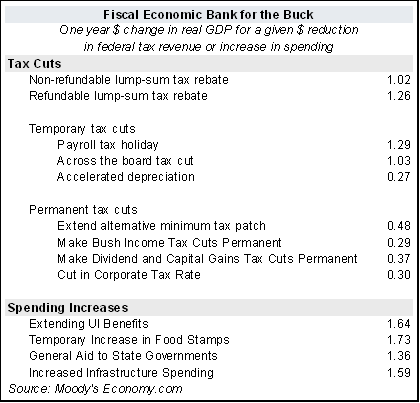
<http://www.economy.com/dismal/graphs/blog/mz_012208_1t.GIF>A chart
published a year ago by Moody's
<http://www.economy.com/dismal/article_free.asp?cid=102598>Economy.com
shows that the types of measures in the Democrats' stimulus plan
actually put money into the economy, fast. For example, according to
Economy.com's model, every dollar lost to the Treasury from increased
infrastructure spending would add $1.59 to the gross domestic product
in a year. Every dollar lost to a cut in the corporate tax rate would
add 30 cents to the GDP in a year.

And why, when most women work, is there so little support for
childcare, family leave and other family friendly social policies?

Also: Why, when the cost of health insurance is tacking thousands of
dollars onto the cost of every American-made car, and threatening to
capsize many small businesses, is there so little serious progress on
healthcare and insurance reform in our public realm? Where are the
capitalist visionaries of yesteryear, trying to shape public spending
by driving it toward what businesses need to thrive?

Oh, and climate change: If that continues, we're all screwed, college
grads and high school dropouts, moms, dads, auto execs,
small-business owners, capitalist pigs and visionaries alike. But
we've gotten no real movement on climate change these last eight
years (though I'm grateful to Obama for deferring to my GOP Gov.
Arnold Schwarzenegger at least a little bit on this one). Again: why?

The Democrats' stimulus plan has funding to deal with all of those
enormous unmet needs (although probably not enough). The bigger
question is, why isn't the country clamoring for support for such
capitalism-bolstering programs, especially at this time of economic
crisis and political optimism ushered in by the election of Obama,
which was, paradoxically, motivated by enormous voter pessimism about
that same crisis?

The answer is not merely that American workers and voters and unions
and Democrats mysteriously stopped agitating for progressive change
in the 1960s (although many did, and the weakness of unions is part
of the story, but it's as much an effect as a cause of these
political and economic sea-changes). The fact is, there was a massive
organized political campaign against the egalitarian and
economy-growing reforms of the 1930s and the 1960s, one that ran from
Barry Goldwater to Ronald Reagan to John McCain, a very well-run and
well-funded and sadly effective backlash. And it's one that nobody
wants to talk about, in our convivial, bipartisan,
cable-news-dominated, partisan-blog-loving, newspaper-shrinking,
amnesia-promoting political and media-freakshow entertainment economy.

But we have to.

It's clear from the stimulus debate that some conservatives never
stopped fighting the New Deal, as empty as their arguments were then
and now. Andrew Leonard is brilliant, in my opinion, but he's only
one guy, and he alone takes down multiple well-funded think tanks
dedicated to anti-New Deal idiocy. The stupid, it burns, but the
stupid is relentless.

Then there's the whole legacy of the Great Society. A lot of the
opposition to government spending suddenly, opportunistically became
(overtly or covertly) racial in the 1960s and '70s, as the social and
political and economic change inspired by the civil rights movement
intersected with new social programs, some of them awesome, a few of
them wasteful, all of them only partly effective. The bottom line for
Republicans became: The government is helping those other people with
your tax dollars, they're not helping you. And some Democrats agreed.

Now, many if not most of us need help from our own tax dollars, and
the Democrats seem ill-equipped to make the arguments to make that
happen, despite Obama's overwhelming win in November. This really
makes no political sense to me.

Here's how I think Obama should sell the stimulus. Long version here,
short version below.

First, he should make it unapologetically clear that we are putting
money in the hands of people who will spend it, fast, when no one
else is spending: Working-class and low-income people, the employed
and the recently unemployed. Food stamps, extended unemployment
insurance, help with health insurance, the earned income tax credit,
payroll tax relief. (Stunningly, Ronald Reagan lowered taxes on the
rich but raised payroll taxes, an unforgivably regressive wealth
transfer.) All those measures get money in the hands of people who
can't afford to hoard it, and it goes back into the economy
immediately. Democrats think such spending is justified by the
principles of fairness and equity, but whatever your political
beliefs, you should know that these priorities mean that money will
be spent in the real world quickly, and that's what the economy needs.

Almost as quickly, we are funding so-called shovel-ready
infrastructure programs, which will get money into the economy ASAP,
funding jobs while also doing the things American business and
government needs to catch up with the rest of the world. We can't
afford more levies breaking in New Orleans or bridges collapsing in
Minneapolis -- or anywhere else.

We're also putting money into not-quite shovel-ready but crucial
programs, especially mass transit that links our suburbs and exurbs
with our central cities, and creates opportunity for everyone, and
programs that reduce climate change and move us to a future driven by
green jobs and industry.

Finally, we are belatedly making down payments on our 21st-century
economy that, sadly, nobody was wise enough to make in the last
century. Head Start and education funding, college programs,
healthcare reform, green job creation, energy efficiency and climate
change spending: We can't catch up with the rest of the world if we
don't spend on those things, belatedly, right now. It's not a matter
of if, it's when, and I believe the time is now. That's what you
elected me to do. These programs will stimulate the kind of recovery
that will make sure our children don't face the same kind of crisis
in another generation.

Obama can no doubt improve on my language. He can probably improve
the taxonomy of spending. He may even have different priorities. The
point is, he has to lay them out.

He made a start today. Here's what he said when introducing limits on
executive compensation for firms getting TARP money:

That's why I feel such a sense of urgency about the Economic Recovery
and Reinvestment Plan that is before Congress today. With it, we can
save or create more than three million jobs, doing things that will
strengthen our country for generations to come. It is not merely a
prescription for short-term spending - it's a strategy for long-term
economic growth in areas like renewable energy, health care, and
education.

Now, in the past few days I've heard criticisms of this plan that
echo the very same failed theories that helped lead us into this
crisis -- the notion that tax cuts alone will solve all our problems;
that we can ignore fundamental challenges like energy independence
and the high cost of health care and still expect our economy and our
country to thrive.

I reject that theory, and so did the American people when they went
to the polls in November and voted resoundingly for change. So I urge
members of Congress to act without delay. No plan is perfect, and we
should work to make it stronger. But let's not make the perfect the
enemy of the essential. Let's show people all over our country who
are looking for leadership in this difficult time that we are equal
to the task.

It's better, but it's not enough. He needs bigger and simpler themes:
Put money in the hands of those who need it most -- and will spend it
fastest. Create jobs and rebuild infrastructure so we see no more
levees fail, bridges collapse and school buildings crumble. Invest in
new, future-facing job-creating projects like new transit and green
industry. Finally, do what our brave ancestors did, and make
government again the engine of economic development, by providing the
support 21st century employers and workers require: from Head Start
and early education programs through college funding; new health
insurance programs; lifetime worker retraining, investments in
broadband infrastructure and green technologies.

It could be inspiring; it's certainly necessary. If Obama fights on
big themes of rights and responsibilities and how we get through this
crisis together, he wins. If he lets the debate remain on the level
of "Why is there contraception funding in the bill? How is furniture
for the Department of Homeland Security stimulative? We've just got
to reinflate the housing bubble!" he loses, and we lose. It shouldn't
be this hard.

Here's how Madrick summed up the Reagan revolution. It's depressing:
"A life of family strain, inequality and insecurity has become
accepted as inevitable. It is even thought to be a strength of
America. This was Ronald Reagan's Trojan horse, disguised as
optimism." But now it's Morning in America, for the rest of us. Obama
needs to take his sales pitch to a new level. People want to believe
he can make a difference, but time's a wasting.


-- By Joan Walsh


Peace,
Liz

Liz Rich
[email protected]


Stay up to date on the latest news -
<http://aol.com?ncid=emlcntaolcom00000022>from sports scores to
stocks and so much more.
--~--~---------~--~----~------------~-------~--~----~
You received this message because you are subscribed to Mark Crispin Miller's
"News From Underground" newsgroup.

To unsubscribe, send a blank email to
[email protected] OR go to
http://groups.google.com/group/newsfromunderground and click on the
"Unsubscribe or change membership" link in the yellow bar at the top of the
page, then click the "Unsubscribe" button on the next page.

For more News From Underground, visit http://markcrispinmiller.com
-~----------~----~----~----~------~----~------~--~---