>
> https://theintercept.com/2020/10/19/bolivia-returns-evo-morales-party-to-power-one-year-after-a-u-s-applauded-coup/
> Bolivians Return Evo Morales’s Party to Power One Year After a
> U.S.-Applauded Coup
>
> *Right-wing forces cheered by the U.S. tried to destroy one of Latin
> America’s most vibrant democracies. Voters just restored it.*
> *Glenn Greenwald <https://theintercept.com/staff/glenn-greenwald/>*
> October 19 2020, 11:37 a.m.
>
> *In November 2019,* Bolivia’s three-term President Evo Morales was forced
> under threat of police and military violence to flee to Mexico, just weeks
> after he was declared the winner of the October presidential election that
> would have sent him to his fourth term. Installed in his place was an
> unelected right-wing coup regime, led by self-declared “interim President”
> Jeanine Áñez, who promptly presided over a military massacre
> <https://apnews.com/article/530280a8d9674f58ad19af8d3f00edee> that killed
> dozens of Morales’s Indigenous supporters and then granted immunity to all
> the soldiers involved. U.S. Secretary of State Mike Pompeo at the time cheered
> the coup <https://twitter.com/SecPompeo/status/1193600452849475584> by
> citing subsequently debunked claims
> <https://theintercept.com/2020/06/08/the-nyt-admits-key-falsehoods-that-drove-last-years-coup-in-bolivia-falsehoods-peddled-by-the-u-s-its-media-and-the-nyt/>
>  of
> election fraud by the Organization of American States, or OAS, and urging
> “a truly democratic process representative of the people’s will.”
>
> But after the Áñez regime twice postponed
> <https://www.france24.com/en/20200723-bolivian-elections-postponed-again-due-to-covid-19-this-time-until-october>
> scheduled elections this year, Bolivians went to the polls on Sunday. They
> delivered a resounding victory to presidential candidate Luis Arce,
> Morales’s former finance minister and the candidate from his Movement
> Toward Socialism, or MAS, Party. Although official results are still being
> counted, exit polls from reputable firms show Arce with a blowout victory —
> over 50 percent against a centrist former president and a far-right coup
> leader — and Áñez herself conceded that MAS has won
> <https://twitter.com/JeanineAnez/status/1318048552191483904>: “We do not
> yet have an official count, but from the data we have, Mr. Arce and [MAS
> Vice Presidential candidate] Mr. Choquehuanca have won the election. I
> congratulate the winners and ask them to govern with Bolivia and democracy
> in mind.”
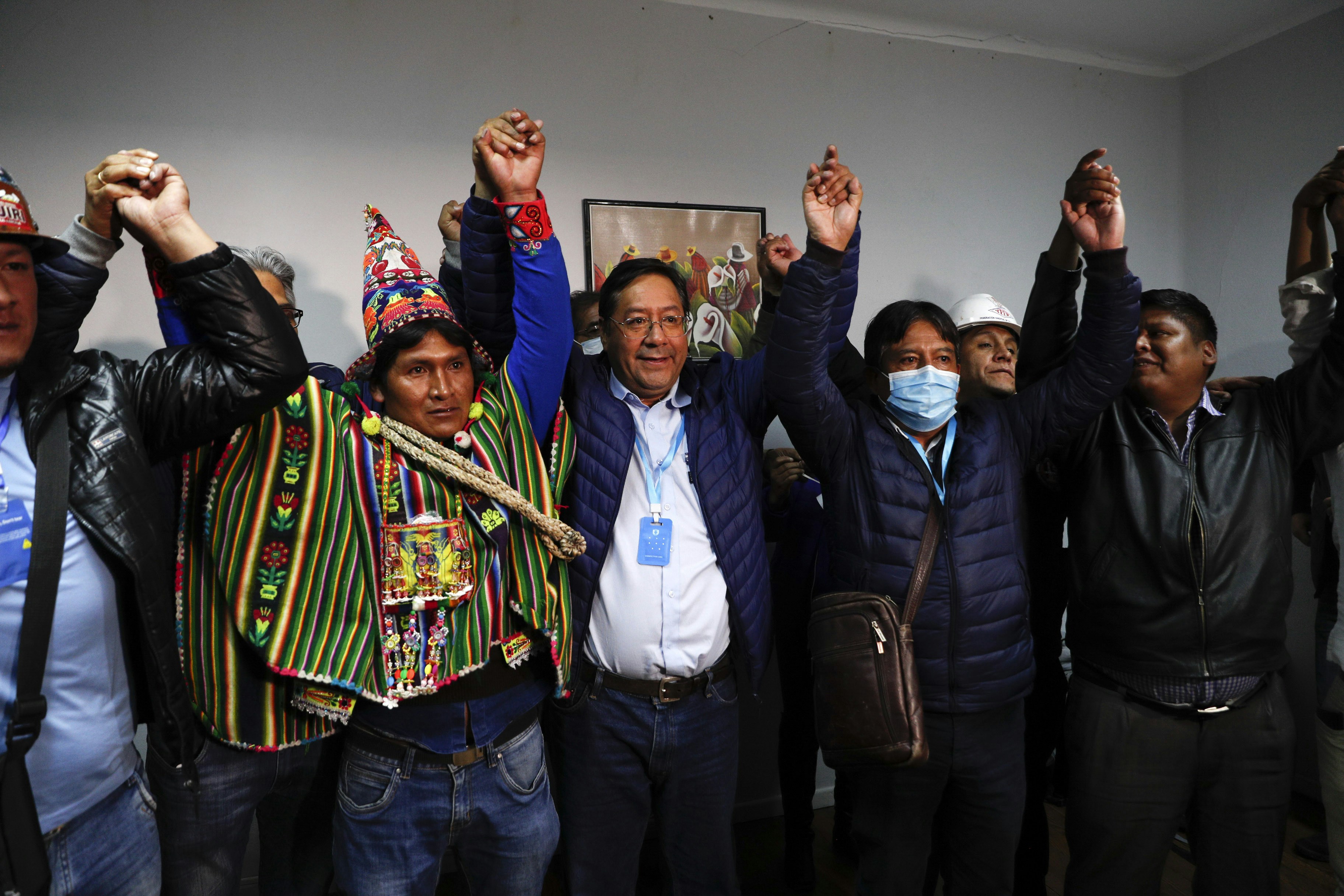
> [image: Luis Arce, center, Bolivian presidential candidate for the
> Movement Towards Socialism Party, MAS, and running mate David Choquehuanca,
> second right, celebrate during a press conference where they claim victory
> after general elections in La Paz, Bolivia, Monday, Oct. 19, 2020. (AP
> Photo/Juan Karita)]
> <https://theintercept.imgix.net/wp-uploads/sites/1/2020/10/AP_20293168297613.jpg?auto=compress%2Cformat&q=90>
>
> Luis Arce, center, Bolivian presidential candidate for the Movement Toward
> Socialism Party, or MAS, and running mate David Choquehuanca, second right,
> celebrate during a press conference where they claim victory after general
> elections in La Paz, Bolivia, on Oct. 19, 2020. (AP Photo/Juan Karita)
>
> AP
>
> It is difficult to remember the last time a U.S.-approved military coup in
> Latin America failed so spectacularly. Even with the U.S.-dominated
> OAS’s instantly dubious claims of electoral fraud, nobody disputed that
> Morales received more votes in last October’s election than all other
> candidates (the only question raised by the OAS was whether his margin of
> victory was sufficient to win on the first round and avoid a run-off).
>
> Despite Morales’s election win, the Bolivian police and then military made
> clear to Morales that neither he, his family, nor his closest allies would
> be safe unless he immediately left the country, as Morales detailed in an
> interview <https://www.youtube.com/watch?v=-hEwE64-kUQ&;> I conducted with
> him just weeks after he was driven into exile in Mexico City. In that
> interview, Morales blamed
> <https://theintercept.com/2019/12/16/evo-morales-interview-glenn-greenwald/>
> not only the U.S. for giving the green light to right-wing coup leaders but
> also attributed the coup to Western anger over his decision to sell some of
> the country’s valuable lithium supply to China rather than to the West.
> Related Watch: Glenn Greenwald’s Exclusive Interview With Bolivia’s Evo
> Morales, Who Was Deposed in a Coup
>
> <https://theintercept.com/2019/12/16/evo-morales-interview-glenn-greenwald/>
>
> After 12 years in office, Morales was not free of controversy or critics.
> As the first elected Indigenous leader of Bolivia, even some of his core
> supporters grew wary of what they regarded as his growing reliance
> on quasi-autocratic tactics in order to govern. Several of his most
> prominent supporters — both in Bolivia and in South America — were critical
> of his decision to secure judicial permission
> <https://www.aljazeera.com/news/2018/12/5/bolivia-court-allows-president-morales-to-run-for-fourth-term>
> to seek a fourth term despite a constitutional term-limits provision of two
> terms. Even Morales’s long-time close Brazilian ally, former President Lula
> da Silva — who correctly predicted in a 2019 interview
> <https://theintercept.com/2019/05/22/lula-brazil-ex-president-prison-interview/>
> with me that “you can be certain that if Evo Morales runs for president,
> he’ll win in Bolivia” — nonetheless called
> <https://www.theguardian.com/world/2019/nov/22/exclusive-bolsonaro-is-turning-back-the-clock-on-brazil-says-lula-da-silva>
> Morales’s pursuit of a fourth term a “mistake.”
>
> But none of those criticisms changed a central, unavoidable fact: More
> Bolivians voted for Morales to be their president in 2019 than any other
> candidate. And in a democracy, that is supposed to be decisive; for those
> purporting to believe in democracy, that should be the end of the matter.
> That is why Lula, in his Guardian interview shortly after the coup where
> he criticized Morales’s bid for a fourth term, nonetheless emphasized the
> far more important point: “what they did with him was a crime. It was a
> coup – this is terrible for Latin America.”
>
> And whatever critiques one can legitimately voice about Morales — it is
> hard to imagine any leader ruling for more than a decade without alienating
> some supporters and making mistakes — there is no question that Morales’s
> presidency, by almost every metric, was a success. After decades of
> instability in the country, he ushered in a stable and thriving democracy,
> presided
> over economic growth
> <https://www.nytimes.com/2014/02/17/world/americas/turnabout-in-bolivia-as-economy-rises-from-instability.html>
> that even western financial institutions praised, and worked to ensure a
> far more equitable distribution of those resources than ever before,
> particularly to the country’s long-oppressed Indigenous minority and its
> rural farmers <https://www.youtube.com/watch?v=UgxK9w5DSvQ>. That success
> is what was destroyed, on purpose, when the Bolivian presidency was decided
> in 2019 not democratically but by force.
>
> The West’s reaction to the 2019 Bolivian coup featured all of its classic
> propaganda tropes. Western officials, media outlets, and think tank writers
> invoked
> the standard Orwellian inversion
> <https://twitter.com/Yascha_Mounk/status/1193152753079668737> of heralding
> a coup
> <https://www.theatlantic.com/ideas/archive/2019/11/evo-morales-finally-went-too-far-bolivia/601741/>
> of any democratically elected leader they do not like as a “victory for
> democracy.” In this warped formula
> <https://twitter.com/ClaraJeffery/status/1193682649535135745>, it is not
> the U.S.-supported coup plotters but the overthrown democratically elected
> leader who is the “threat to democracy.”
>
> Depicting U.S.-supported coups as democratic and democratically elected
> leaders disliked by the U.S. as “dictators” has been a staple of U.S.
> foreign policy propaganda for decades
> <https://theintercept.com/2014/10/17/democracy-really-means-u-s-jargon-subservience-u-s/>.
> That is the rubric under which the Obama administration and its Secretary
> of State John Kerry somehow celebrated
> <https://www.nytimes.com/2013/08/02/world/middleeast/egypt-warns-morsi-supporters-to-end-protests.html>
>  one
> of the world’s worst despots, Egyptian Gen. Abdel-Fattah el-Sissi, as
> “restoring democracy” following the brutal military coup he carried out.
>
> But thanks to Sunday’s stunning rebuke in Bolivia, the standard tactics
> failed. Ever since Morales’s election victory almost exactly one year ago
> today, Bolivians never stopped marching, protesting, risking their liberty
> and their lives — even in the middle of a pandemic — to demand their rights
> of democracy and self-governance. Leading up to the election, the coup
> regime and right-wing factions in the military were menacingly vowing — in
> response to polls universally showing MAS likely to win — that they would
> do anything to prevent the return to power of Morales’s party.
>
> At least as of now, though, it looks as though the margin of victory
> delivered to MAS by the Bolivian people was so stunning, so decisive, that
> there are few options left for the retrograde forces — in Bolivia,
> Washington, and Brussels — which tried to destroy the country’s democracy.
> Anyone who believes in the fundamentals of democracy, regardless of
> ideology, should be cheering the Bolivians who sacrificed so much to
> restore their right of self-rule and hoping that the stability and
> prosperity they enjoyed under Morales expands even further under his first
> democratically elected successor.
>
---
Support News from Underground: http://bit.ly/NFUSupport

Visit News from Underground: https://markcrispinmiller.com

You received this email because you are subscribed to News from Underground. To
unsubscribe from this email list, please go to:
http://www.simplelists.com/confirm.php?u=pIdjNUgiG2h8yxbhC54SSy4SEskAoEMs

For archives, please go to: http://archives.simplelists.com/nfu