This is an automated email from the ASF dual-hosted git repository.

bzp2010 pushed a commit to branch master
in repository https://gitbox.apache.org/repos/asf/apisix-website.git
The following commit(s) were added to refs/heads/master by this push:
new d031802bd6e docs: add goole cloud T2A blog (#1230)
d031802bd6e is described below
commit d031802bd6e9760a77e0b6b85de3bb283f40d0ec
Author: Fei Han <[email protected]>
AuthorDate: Fri Jul 22 16:30:43 2022 +0800
docs: add goole cloud T2A blog (#1230)
Co-authored-by: hf400159 <[email protected]>
---
.../22/how-is-google-cloud-tau-t2a-performing.md | 205 ++++++++++++++++++++
.../22/how-is-google-cloud-tau-t2a-performing.md | 207 +++++++++++++++++++++
2 files changed, 412 insertions(+)
diff --git a/blog/en/blog/2022/07/22/how-is-google-cloud-tau-t2a-performing.md
b/blog/en/blog/2022/07/22/how-is-google-cloud-tau-t2a-performing.md
new file mode 100644
index 00000000000..68d301a524c
--- /dev/null
+++ b/blog/en/blog/2022/07/22/how-is-google-cloud-tau-t2a-performing.md
@@ -0,0 +1,205 @@
+---
+title: "How is Google Cloud Tau T2A performing? "
+authors:
+ - name: "Shirui Zhao"
+ title: "Author"
+ url: "https://github.com/soulbird";
+ image_url: "https://github.com/soulbird.png";
+keywords:
+ - APISIX
+ - API Gateway
+ - Google Cloud
+ - Google Cloud T2A
+ - ARM64
+description:This article mainly uses the cloud native API gateway Apache
APISIX to compare the performance of Google Cloud T2A and Google Cloud T2D.
+tags: [Technology]
+---
+
+> This article mainly uses Apache APISIX to compare the performance of Google
Cloud T2A and Google Cloud T2D.
+
+<!--truncate-->
+
+## Background
+
+On July 13, Google Cloud released a preview of the first series of Arm-based
Tau T2A VMs. The T2A VM is powered by an Ampere® Altra® Arm-based processor
that Google claims has an attractive price and excellent single-threaded
performance.
+
+It is worth noting that Ampere® Altra® Arm is a cloud-native processor, and
the Tau T2A virtual machine based on the Ampere® Altra® Arm processor can run
scale-out cloud-native applications efficiently.
+
+So how about the actual experience and performance? Let's take a cloud-native
API Gateway as an example to show you the performance of the Google Cloud Tau
T2A virtual machine. We chose Apache APISIX for testing on the Google Cloud T2A
server environment.
+
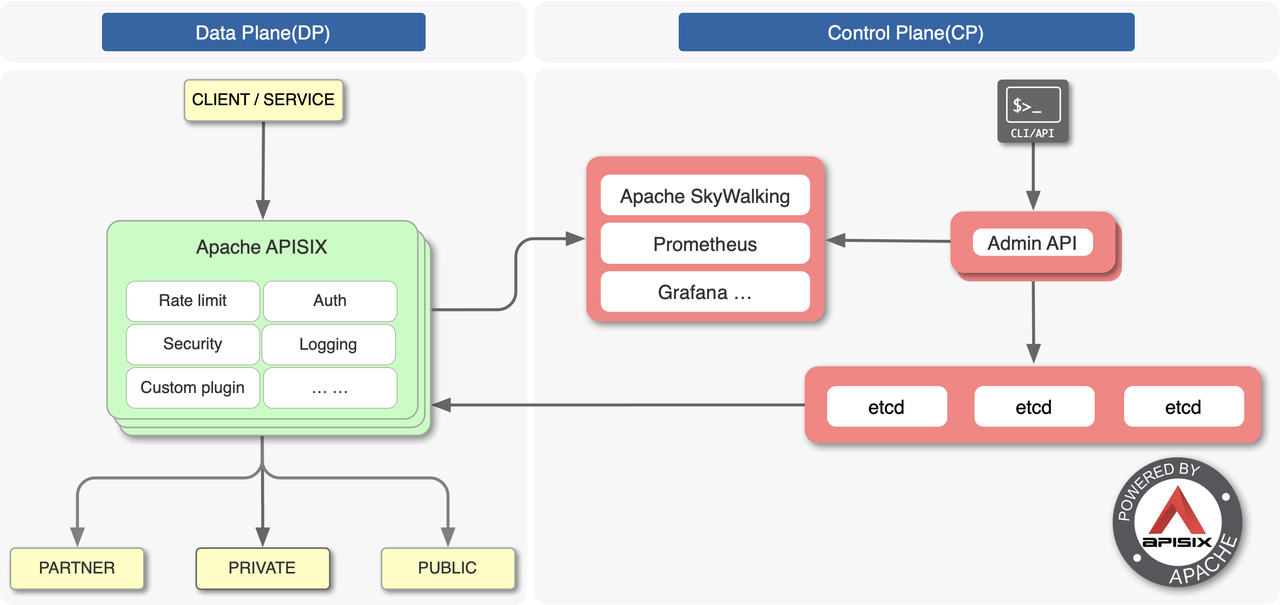
+Apache APISIX is a cloud-native, high-performance, scalable API gateway. Built
on NGNIX+LuaJIT and etcd, APISIX has the characteristics of dynamic routing and
plugin hot-reloading compared with traditional API gateways, which are
especially suitable for API management in the cloud-native architecture.
+
+
+
+## Preliminary Preparation
+
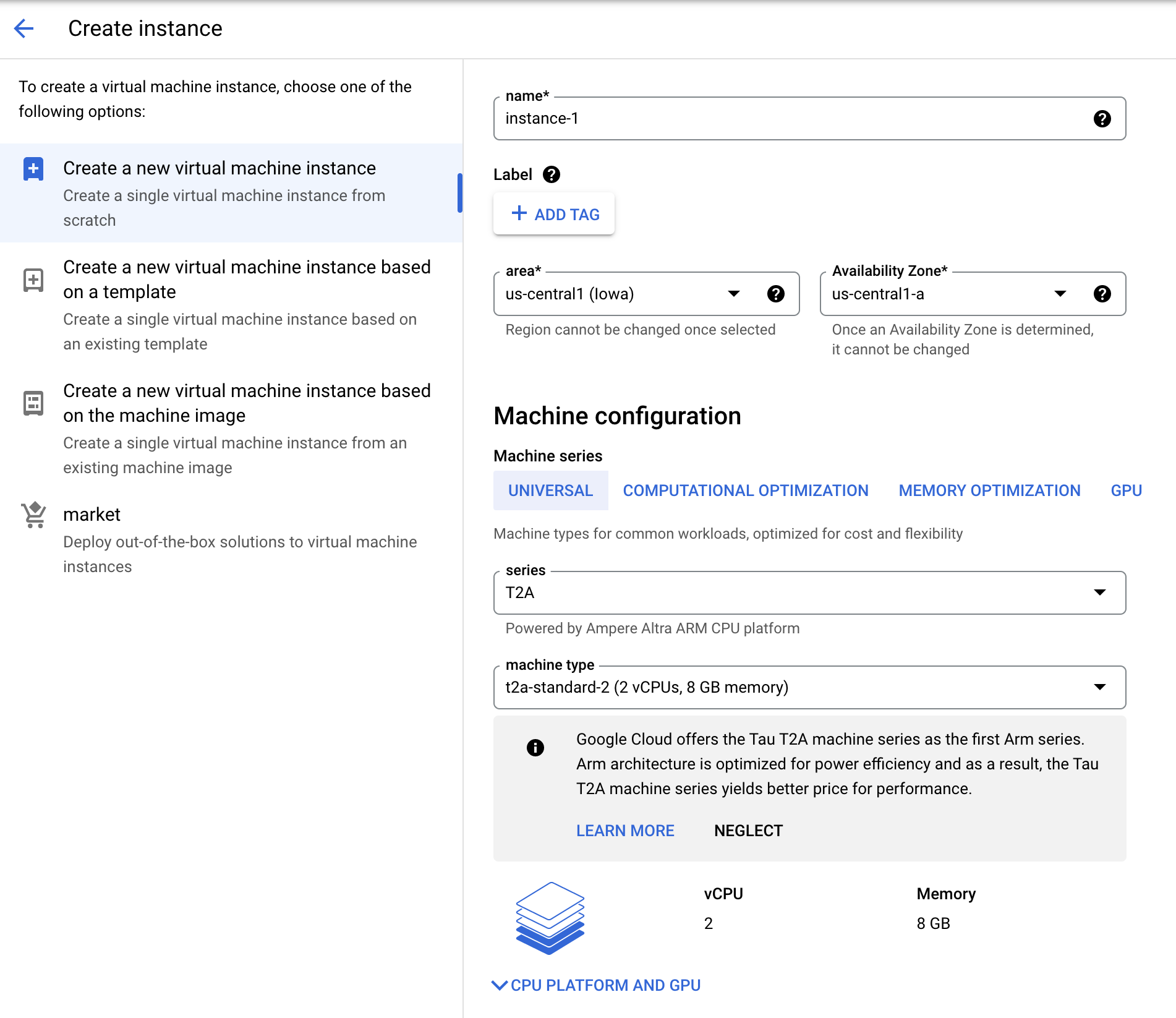
+First, we need to start a T2A instance on Google Cloud, and choose Ubuntu
20.04 as the operating system.
+
+
+
+Install Docker, so that we can install and deploy Apache APISIX in a
containerized way.
+
+```shell
+sudo apt-get update && sudo apt-get install docker.io
+```
+
+## Install Apache APISIX
+
+Apache APISIX uses etcd as the configuration center, so we need to start an
etcd instance first.
+
+```shell
+sudo docker run -d --name etcd \
+ -p 2379:2379 \
+ -e ETCD_UNSUPPORTED_ARCH=arm64 \
+ -e ETCD_LISTEN_CLIENT_URLS=http://0.0.0.0:2379 \
+ -e ETCD_ADVERTISE_CLIENT_URLS=http://0.0.0.0:2379 \
+ rancher/coreos-etcd:v3.4.16-arm64
+```
+
+Start an instance of Apache APISIX.
+
+```shell
+sudo docker run --net=host -d apache/apisix:2.14.1-alpine
+```
+
+Create route:
+
+```shell
+curl "http://127.0.0.1:9080/apisix/admin/routes/1"; \
+-H "X-API-KEY: edd1c9f034335f136f87ad84b625c8f1" -X PUT -d '
+{
+ "uri": "/anything/*",
+ "upstream": {
+ "type": "roundrobin",
+ "nodes": {
+ "httpbin.org:80": 1
+ }
+ }
+}'
+```
+
+Do the following test.
+
+```
+curl -i http://127.0.0.1:9080/anything/das
+```
+
+```shell
+HTTP/1.1 200 OK
+.....
+```
+
+## Google Cloud T2D vs Google Cloud T2A
+
+From the previous steps, the installation and compatibility testing of Apache
APISIX on Google Cloud Tau T2A can be successfully completed. So what is the
actual performance of Google Cloud T2A? Next, we will use Apache APISIX to do a
performance test on Google Cloud T2A and Google Cloud T2D to see their actual
performance.
+
+Google Cloud T2D is another model of Google Cloud Tau series, which is based
on Intel® x86 architecture, so the etcd installation steps are slightly
different from above:
+
+```shell
+sudo docker run -d --name etcd \
+ -p 2379:2379 \
+ -e ETCD_LISTEN_CLIENT_URLS=http://0.0.0.0:2379 \
+ -e ALLOW_NONE_AUTHENTICATION=yes \
+ -e ETCD_ADVERTISE_CLIENT_URLS=http://0.0.0.0:2379 \
+ bitnami/etcd:3.4.16
+```
+
+For simplicity, only one worker is enabled in this test with Apache APISIX,
and the following performance test data are all run on a single-core CPU.
+
+### Scenario 1: Single upstream
+
+Using a single upstream without any plugins: it mainly tests the performance
of APISIX in pure proxy back-to-origin mode.
+
+```shell
+# apisix: 1 worker + 1 upstream + no plugin
+
+# create route
+curl http://127.0.0.1:9080/apisix/admin/routes/1 \
+-H 'X-API-KEY: edd1c9f034335f136f87ad84b625c8f1' -X PUT -d '
+{
+ "uri": "/hello",
+ "plugins": {
+ },
+ "upstream": {
+ "type": "roundrobin",
+ "nodes": {
+ "127.0.0.1:1980":1
+ }
+ }
+}'
+```
+
+### Scenario 2: Single upstream + two plugins
+
+Using a single upstream with two plugins: it mainly tests the performance of
APISIX when the two core performance-consuming plugins, `limit-count` and
`prometheus` are enabled.
+
+```shell
+# apisix: 1 worker + 1 upstream + 2 plugins (limit-count + prometheus)
+
+# create route
+curl http://127.0.0.1:9080/apisix/admin/routes/1 \
+-H 'X-API-KEY: edd1c9f034335f136f87ad84b625c8f1' -X PUT -d '
+{
+ "uri": "/hello",
+ "plugins": {
+ "limit-count": {
+ "count": 2000000000000,
+ "time_window": 60,
+ "rejected_code": 503,
+ "key": "remote_addr"
+ },
+ "prometheus": {}
+ },
+ "upstream": {
+ "type": "roundrobin",
+ "nodes": {
+ "127.0.0.1:1980":1
+ }
+ }
+}'
+```
+
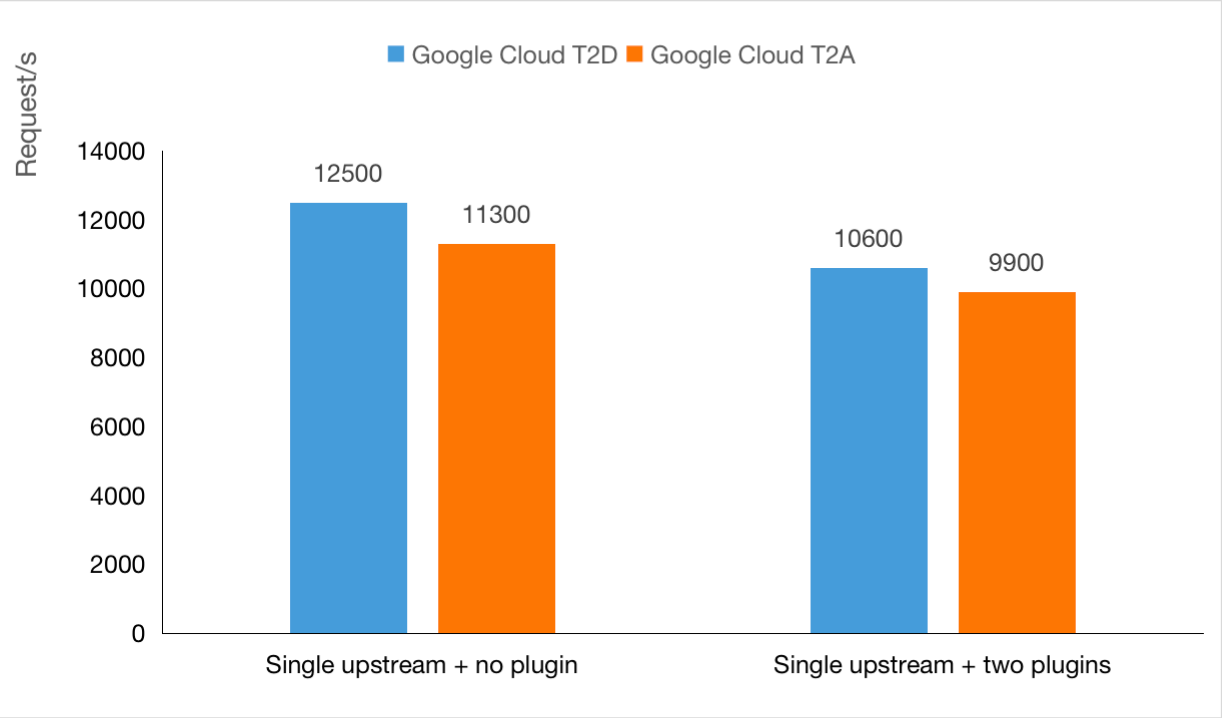
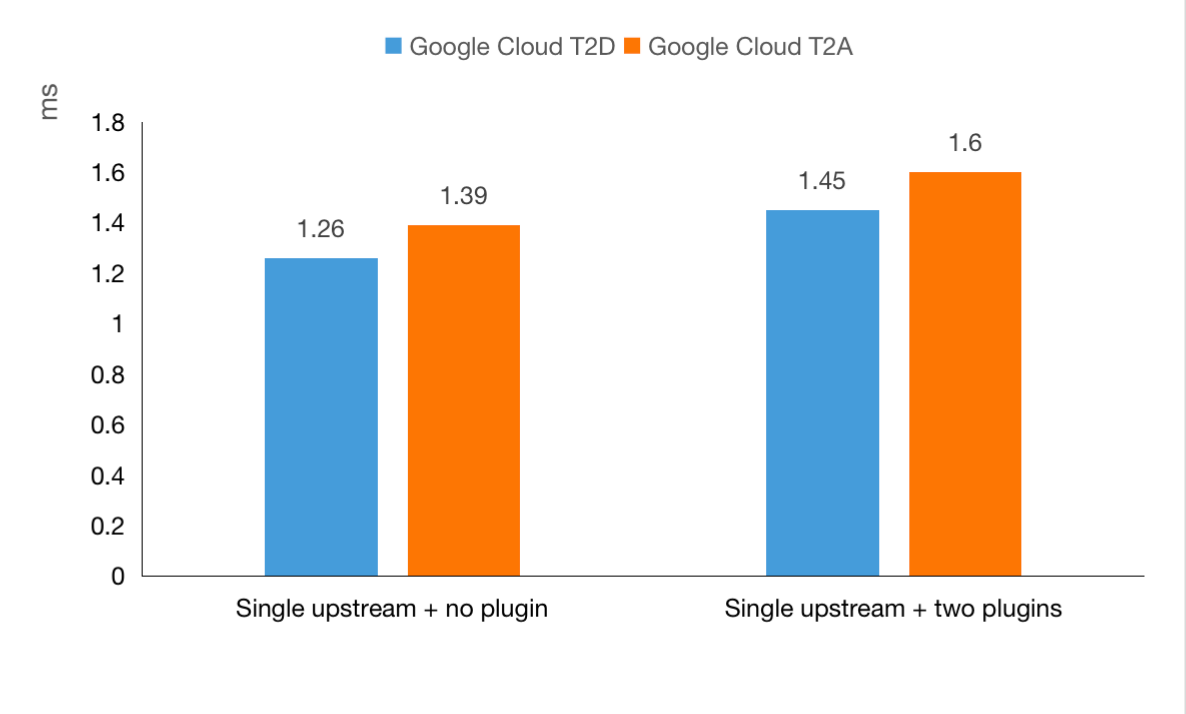
+In the above two scenarios, relevant tests and comparisons were carried out
regarding the request QPS(Queries Per Second) and delay time. The result is as
follows:
+
+- QPS comparison:
+
+
+
+- Latency comparison:
+
+
+
+<table>
+ <tr>
+ <td><b> </b></td>
+ <td colspan="2">Single Upstream</td>
+ <td colspan="2">Single Upstream+Two Plugins</td>
+ </tr>
+ <tr>
+ <td><b> </b></td>
+ <td><b>Google Cloud T2D</b></td>
+ <td><b>Google Cloud T2A</b></td>
+ <td><b>Google Cloud T2D</b></td>
+ <td><b>Google Cloud T2A</b></td>
+ </tr>
+ <tr>
+ <td><b>QPS(request/s)</b></td>
+ <td><b>12500</b></td>
+ <td><b>11300</b></td>
+ <td><b>10600</b></td>
+ <td><b>9900</b></td>
+ </tr>
+ <tr>
+ <td><b>Latency(ms)</b></td>
+ <td><b>1.26</b></td>
+ <td><b>1.39</b></td>
+ <td><b>1.45</b></td>
+ <td><b>1.60</b></td>
+ </tr>
+ </table>
+
+It can also be seen from the above data that in network IO-intensive computing
scenarios such as API Gateway, T2A still has a performance gap compared with
T2D virtual machines of the same series. However, another good news is that the
price of T2A is only 10% cheaper than that of T2D under the same configuration.
When selecting the actual machine, users can make flexible decisions according
to their business volume.
+
+## Summarize
+
+This article mainly uses Apache APISIX to compare the performance of Google
Cloud T2A and Google Cloud T2D. It can be seen that in network IO-intensive
computing scenarios such as API gateways, Google Cloud T2A is not so brilliant
compared to T2D, but as the first attempt of Google Cloud VMs on the ARM
architecture, I believe it will continue to evolve better.
diff --git a/blog/zh/blog/2022/07/22/how-is-google-cloud-tau-t2a-performing.md
b/blog/zh/blog/2022/07/22/how-is-google-cloud-tau-t2a-performing.md
new file mode 100644
index 00000000000..23e28e19250
--- /dev/null
+++ b/blog/zh/blog/2022/07/22/how-is-google-cloud-tau-t2a-performing.md
@@ -0,0 +1,207 @@
+---
+title: "API 网关 APISIX 在谷歌云 T2A 和 T2D 的性能测试"
+authors:
+ - name: "赵士瑞"
+ title: "Author"
+ url: "https://github.com/soulbird";
+ image_url: "https://github.com/soulbird.png";
+keywords:
+ - APISIX
+ - API 网关
+ - Google Cloud
+ - Google Cloud T2A
+ - ARM64
+description: 本文主要使用云原生 API 网关 Apache APISIX 分别在 Google Cloud T2A 和 Google
Cloud T2D 进行性能测试,并且进行对比两者的性能。
+tags: [Technology]
+---
+
+> 本文主要使用 Apache APISIX 来对比 Google Cloud T2A 和 Google Cloud T2D 的性能。
+
+<!--truncate-->
+
+## 背景
+
+2022 年 7 月 13 日 Google Cloud 发布了第一个基于 Arm® 架构的 Tau T2A 的 VM 系列预览版。T2A VM 由基于
Ampere® Altra® Arm 的处理器提供支持,谷歌宣称其拥有极具吸引力的价格和卓越的单线程性能。
+
+值得注意的是,Ampere® Altra® Arm 是一款云原生处理器,基于 Ampere® Altra® Arm 处理器的 Tau T2A
虚拟机也因此能以高效的方式运行横向扩展的云原生应用程序。
+
+那么具体实际体验和性能如何呢?我们以一个云原生的 API 网关为例,带大家一起看看一起 Google Cloud Tau T2A
虚拟机的表现。这里,我们选择了 Apache APISIX 在 Google Cloud Tau T2A 服务器环境上进行安装测试。
+
+Apache APISIX 是一个云原生、高性能、可扩展的 API 网关。基于 NGNIX + LuaJIT 和 etcd,APISIX 与传统 API
网关相比,具有动态路由和插件热加载特性,特别适合云原生架构下的 API 管理。
+
+
+
+## 前期准备
+
+首先需要在 Google Cloud 上启动一个 T2A 实例,操作系统选择 Ubuntu 20.04。
+
+
+
+然后安装 Docker,方便后续使用容器化的方式来安装部署 Apache APISIX。
+
+```shell
+sudo apt-get update && sudo apt-get install docker.io
+```
+
+## 部署 Apache APISIX
+
+Apache APISIX 使用 etcd 作为配置中心,所以这里需要先启动一个 etcd 实例。
+
+```shell
+sudo docker run -d --name etcd \
+ -p 2379:2379 \
+ -e ETCD_UNSUPPORTED_ARCH=arm64 \
+ -e ETCD_LISTEN_CLIENT_URLS=http://0.0.0.0:2379 \
+ -e ETCD_ADVERTISE_CLIENT_URLS=http://0.0.0.0:2379 \
+ rancher/coreos-etcd:v3.4.16-arm64
+```
+
+启动 Apache APISIX 实例:
+
+```shell
+sudo docker run --net=host -d apache/apisix:2.14.1-alpine
+```
+
+注册路由。
+
+```shell
+curl "http://127.0.0.1:9080/apisix/admin/routes/1"; \
+-H "X-API-KEY: edd1c9f034335f136f87ad84b625c8f1" -X PUT -d '
+{
+ "uri": "/anything/*",
+ "upstream": {
+ "type": "roundrobin",
+ "nodes": {
+ "httpbin.org:80": 1
+ }
+ }
+}'
+```
+
+访问测试。
+
+```shell
+curl -i http://127.0.0.1:9080/anything/das
+```
+
+```shell
+HTTP/1.1 200 OK
+.....
+```
+
+## Google Cloud T2D vs Google Cloud T2A
+
+从上述操作来看,Apache APISIX 在 Google Cloud Tau T2A 上的安装和兼容性测试都能顺利完成。那么 Google Cloud
T2A 的实际性能到底如何呢?接下来我们将使用 Apache APISIX 分别在 Google Cloud T2A 和 Google Cloud T2D
上做性能测试对比,来看看其实际表现。
+
+Google Cloud T2D 是 Google Cloud Tau 系列的另一款机型,是基于 Intel® x86 架构的,所以上述 etcd
安装步骤略有不同:
+
+````shell
+sudo docker run -d --name etcd \
+ -p 2379:2379 \
+ -e ETCD_LISTEN_CLIENT_URLS=http://0.0.0.0:2379 \
+ -e ALLOW_NONE_AUTHENTICATION=yes \
+ -e ETCD_ADVERTISE_CLIENT_URLS=http://0.0.0.0:2379 \
+ bitnami/etcd:3.4.16
+````
+
+为简单起见,本次测试 APISIX 中只启用了一个 Worker,以下性能测试数据均在单核 CPU 上运行。
+
+### 场景一:单上游
+
+该场景下将使用单个上游(不包含任何插件),主要测试 APISIX 在纯代理回源模式下的性能表现。在本地环境中进行测试:
+
+```shell
+# apisix: 1 worker + 1 upstream + no plugin
+
+# 注册路由
+curl http://127.0.0.1:9080/apisix/admin/routes/1 \
+-H 'X-API-KEY: edd1c9f034335f136f87ad84b625c8f1' -X PUT -d '
+{
+ "uri": "/hello",
+ "plugins": {
+ },
+ "upstream": {
+ "type": "roundrobin",
+ "nodes": {
+ "127.0.0.1:1980":1
+ }
+ }
+}'
+```
+
+### 场景 2:单个上游 + 两个插件
+
+该场景下将使用单个上游与两个插件进行,主要测试 APISIX 在开启 `limit-count` 和 `prometheus` 两个核心性能消耗插件时的表现。
+
+```shell
+# apisix: 1 worker + 1 upstream + 2 plugins (limit-count + prometheus)
+
+# 注册路由
+curl http://127.0.0.1:9080/apisix/admin/routes/1 \
+-H 'X-API-KEY: edd1c9f034335f136f87ad84b625c8f1' -X PUT -d '
+{
+ "uri": "/hello",
+ "plugins": {
+ "limit-count": {
+ "count": 2000000000000,
+ "time_window": 60,
+ "rejected_code": 503,
+ "key": "remote_addr"
+ },
+ "prometheus": {}
+ },
+ "upstream": {
+ "type": "roundrobin",
+ "nodes": {
+ "127.0.0.1:1980":1
+ }
+ }
+}'
+```
+
+### 数据比较
+
+上述两个场景中,分别从请求 QPS(每秒查询数) 和延迟时间两个层面进行了相关的测试对比。结果如下:
+
+- QPS 比较
+
+
+
+- 请求延迟比较
+
+
+
+<table>
+ <tr>
+ <td><b> </b></td>
+ <td colspan="2">单个上游</td>
+ <td colspan="2">单个上游 + 两个插件</td>
+ </tr>
+ <tr>
+ <td><b> </b></td>
+ <td><b>Google Cloud T2D</b></td>
+ <td><b>Google Cloud T2A</b></td>
+ <td><b>Google Cloud T2D</b></td>
+ <td><b>Google Cloud T2A</b></td>
+ </tr>
+ <tr>
+ <td><b>QPS(request/s)</b></td>
+ <td><b>12500</b></td>
+ <td><b>11300</b></td>
+ <td><b>10600</b></td>
+ <td><b>9900</b></td>
+ </tr>
+ <tr>
+ <td><b>Latency(ms)</b></td>
+ <td><b>1.26</b></td>
+ <td><b>1.39</b></td>
+ <td><b>1.45</b></td>
+ <td><b>1.60</b></td>
+ </tr>
+ </table>
+
+从以上数据也可以看出,在 API Gateway 等网络 IO 密集计算场景下,T2A 相比同系列的 T2D
虚拟机,在性能上仍然有差距。不过另一个好消息是,在同等配置情况下,T2A 的价格要比 T2D 便宜 10%
左右。在实际机器选型时,用户可以根据自己的业务体量来灵活决策。
+
+## 总结
+
+本文主要使用 Apache APISIX 对比 Google Cloud T2A 和 Google Cloud T2D 的性能。可以看出,在 API
网关等网络 IO 密集计算场景中,Google Cloud T2A 相比 T2D,表现虽然不是那么亮眼,但是作为 Google Cloud 在 ARM
架构下的第一次尝试,相信其会在 ARM 架构的虚拟机上持续发力,也期待它的后续迭代表现。





