juzhiyuan commented on code in PR #1304:
URL: https://github.com/apache/apisix-website/pull/1304#discussion_r957396159
########## blog/en/blog/2022/08/28/fault-injection-testing-with-api-gateway.md: ########## @@ -0,0 +1,202 @@ +--- +title: "Fault Injection Testing with API Gateway" +authors: + - name: Bobur Umurzokov + title: Author + url: https://github.com/Boburmirzo + image_url: https://avatars.githubusercontent.com/u/14247607 +keywords: +- API gateway +- Apache APISIX +- Testing +- Fault Injection +- Microservices +description: +The blog post describes how an **API Gateway** like [Apache APISIX](https://apisix.apache.org/) is useful for testing the robustness and resilience of microservices APIs. Throughout the post, we also get to know the types of possible failure injections with the **[Fault Injection Plugin](https://apisix.apache.org/docs/apisix/plugins/fault-injection/)** 🔌 and simulate failures on our existing [Product backend service](https://github.com/Boburmirzo/apisix-dotnet-docker/tree/main/ProductApi) (developed by using [ASP.NET Core WEB API](https://docs.microsoft.com/en-us/aspnet/core/?view=aspnetcore-6.0)). +tags: [Case Studies] +--- + +> 💁 This blog post describes how an **API Gateway** like [Apache APISIX](https://apisix.apache.org/) is useful for testing the robustness and resilience of microservices APIs. + +<!--truncate--> + +## Explore distributed system stability💪 + +[Distributed systems](https://azure.microsoft.com/en-us/resources/designing-distributed-systems/) such as [microservices](https://docs.microsoft.com/en-us/azure/architecture/guide/architecture-styles/microservices) have led to an increase in the complexity of the systems we work with. It is difficult to have full confidence in this architecture when there are many components and “a lot of moving parts” that could potentially fail. It is critical to handle failures in service-to-service calls gracefully. Also, we want to be sure that any resilience mechanisms we have in place such as error handling code, [circuit breaker](https://dev.to/apisix/implementing-resilient-applications-with-api-gateway-circuit-breaker-ggk), [health checks](https://dev.to/apisix/implementing-resilient-applications-with-api-gateway-health-check-338c), [retry](https://docs.microsoft.com/en-us/azure/architecture/patterns/retry), fallback, redundant instances, and so on. We can verify this with the help of t he testing method **[Fault Injection](https://en.wikipedia.org/wiki/Fault_injection)** 💉. + + + +### Here is a quick overview of what we cover👇 + +- ✅ [Software Fault Injection](https://www.intechopen.com/chapters/56668). +- ✅ Fault injection testing (FIT) with API Gateway. +- ✅ Apache APISIX [Fault Injection Plugin](https://apisix.apache.org/docs/apisix/plugins/ltfa -injection/). +- ✅ Fault injection different types of failures. +- ✅ Experiment with Fault Injection Plugin. + +> Application is **correct** if it acts as specified. It is **robust** if it can take a high load until it goes down. Application is **resilient** if it can go back to normal after a disruption. + +## Software Fault Injection 💻💉 + +Among the many methods to perform Fault Injection, the technique of **Software Fault Injection** is especially getting more popular among companies managing large, complex, and distributed systems. In this sort of software testing technique, a special piece of code, associated with the system under test, tries to simulate faults. It is normally completed before deployment to identify any potential flaws that might happen in the running software😱. Fault injection can better identify the nature and cause of production failures. Review Comment: ```suggestion Among the many methods to perform Fault Injection, the technique of **Software Fault Injection** is especially getting more popular among companies managing large, complex, and distributed systems. In this software testing technique, a special piece of code associated with the system under test tries to simulate faults. It is usually completed before deployment to identify potential flaws in the running software 😱. Fault injection can better identify the nature and cause of production failures. ``` ########## blog/en/blog/2022/08/28/fault-injection-testing-with-api-gateway.md: ########## @@ -0,0 +1,202 @@ +--- +title: "Fault Injection Testing with API Gateway" +authors: + - name: Bobur Umurzokov + title: Author + url: https://github.com/Boburmirzo + image_url: https://avatars.githubusercontent.com/u/14247607 +keywords: +- API gateway +- Apache APISIX +- Testing +- Fault Injection +- Microservices +description: +The blog post describes how an **API Gateway** like [Apache APISIX](https://apisix.apache.org/) is useful for testing the robustness and resilience of microservices APIs. Throughout the post, we also get to know the types of possible failure injections with the **[Fault Injection Plugin](https://apisix.apache.org/docs/apisix/plugins/fault-injection/)** 🔌 and simulate failures on our existing [Product backend service](https://github.com/Boburmirzo/apisix-dotnet-docker/tree/main/ProductApi) (developed by using [ASP.NET Core WEB API](https://docs.microsoft.com/en-us/aspnet/core/?view=aspnetcore-6.0)). +tags: [Case Studies] +--- + +> 💁 This blog post describes how an **API Gateway** like [Apache APISIX](https://apisix.apache.org/) is useful for testing the robustness and resilience of microservices APIs. + +<!--truncate--> + +## Explore distributed system stability💪 + +[Distributed systems](https://azure.microsoft.com/en-us/resources/designing-distributed-systems/) such as [microservices](https://docs.microsoft.com/en-us/azure/architecture/guide/architecture-styles/microservices) have led to an increase in the complexity of the systems we work with. It is difficult to have full confidence in this architecture when there are many components and “a lot of moving parts” that could potentially fail. It is critical to handle failures in service-to-service calls gracefully. Also, we want to be sure that any resilience mechanisms we have in place such as error handling code, [circuit breaker](https://dev.to/apisix/implementing-resilient-applications-with-api-gateway-circuit-breaker-ggk), [health checks](https://dev.to/apisix/implementing-resilient-applications-with-api-gateway-health-check-338c), [retry](https://docs.microsoft.com/en-us/azure/architecture/patterns/retry), fallback, redundant instances, and so on. We can verify this with the help of t he testing method **[Fault Injection](https://en.wikipedia.org/wiki/Fault_injection)** 💉. + + + +### Here is a quick overview of what we cover👇 + +- ✅ [Software Fault Injection](https://www.intechopen.com/chapters/56668). +- ✅ Fault injection testing (FIT) with API Gateway. +- ✅ Apache APISIX [Fault Injection Plugin](https://apisix.apache.org/docs/apisix/plugins/ltfa -injection/). +- ✅ Fault injection different types of failures. +- ✅ Experiment with Fault Injection Plugin. + +> Application is **correct** if it acts as specified. It is **robust** if it can take a high load until it goes down. Application is **resilient** if it can go back to normal after a disruption. + +## Software Fault Injection 💻💉 + +Among the many methods to perform Fault Injection, the technique of **Software Fault Injection** is especially getting more popular among companies managing large, complex, and distributed systems. In this sort of software testing technique, a special piece of code, associated with the system under test, tries to simulate faults. It is normally completed before deployment to identify any potential flaws that might happen in the running software😱. Fault injection can better identify the nature and cause of production failures. + +## Fault Injection Testing with API Gateway + +The **fault injection** approach at the [API Gateway](https://apisix.apache.org/docs/apisix/terminology/api-gateway/) level can be used to test the resiliency of application or microservices APIs against various forms of failures to build confidence in the production environment. The technique can be used to inject delays and abort requests with user-specified error codes, thereby providing the ability to stage different failure scenarios such as service failures, service overloads, high network latency, network partitions, etc. Fault injection can be limited to a specific set of requests based on the (destination) upstream cluster of a request and/or a set of pre-defined request headers. + +For a streaming giant like [Netflix](https://www.netflix.com/), the migration to a complex cloud-based microservices architecture would not have been possible without a revolutionary testing method known as fault injection👊. There is a very well-known strategy like [Chaos engineering](https://en.wikipedia.org/wiki/Chaos_engineering) which uses fault injection to accomplish the goal of more reliable systems. And Netflix teams built their own _Chaos engineering tool_ called [Chaos Monkey](https://netflix.github.io/chaosmonkey/). + +## Apache APISIX Fault Injection Plugin🔌 + +[Apache APISIX Fault Injection Plugin](https://apisix.apache.org/docs/apisix/plugins/fault-injection/) also offers a _mechanism_ to inject some errors into our APIs and ensures that our resilience measures are effective. + +Apache APISIX works in **two different modes**, both configured using the `fault-injection` plugin attributes⤵️: + +1. **Delays:** Delays are timing failures. They simulate increased network latency or an overloaded upstream service. + +2. **Aborts:** Aborts are crash failures. They mimic failures in upstream services. Aborts usually manifest in the form of HTTP error codes or TCP connection failures. + +For detailed instructions on how to configure delays and aborts, see [Fault Injection](https://apisix.apache.org/docs/apisix/plugins/fault-injection/). You can also try out a centralized platform [API7 Cloud](https://www.api7.cloud/) ☁️ to use more advanced API Gateway [features](https://www.api7.cloud/docs/overview/api7-cloud). API7 Cloud provides a fully managed chaos engineering service with the dashboard to configure the [Fault Injection policy](https://www.api7.cloud/docs/references/policies/traffic-management/fault-injection) easily👍🏻. + +## Experiment with the Fault Injection Plugin🔬 + +This part shows you how to inject faults to test the resiliency of your application. + +### Before you begin🙅 + +☝️ Familiarize yourself with the [fault injection concept](https://microsoft.github.io/code-with-engineering-playbook/automated-testing/fault-injection-testing/). +☝️ If you followed the previous blog post about [Manage .NET Microservices APIs with Apache APISIX API Gateway](https://dev.to/apisix/manage-net-microservices-apis-with-apache-apisix-api-gateway-2cbk), make sure you have read it and completed the steps to set up `APISIX, etcd and ASP.NET WEB API` before continuing with a demo session. Or you can see the complete source code on [Github](https://github.com/Boburmirzo/apisix-dotnet-docker) and the instruction on how to build a multi-container APISIX via Docker CLI. + +### Understand the demo scenario + + I assume that you have the demo project [apisix-dotnet-docker](https://github.com/Boburmirzo/apisix-dotnet-docker) up and running. In the ASP.NET Core project, there is a simple API to get all products list from the service layer in [ProductsController.cs](https://github.com/Boburmirzo/apisix-dotnet-docker/blob/main/ProductApi/Controllers/ProductsController.cs) file. + +Let’s suppose that we have an _online shopping sample application_ that consists of many microservices such as `Catalog, Product, Order and etc`. When we are retrieving data about products belonging to a specific catalog, there will be service-to-service interaction between Catalog and Product services. In this case, something might go wrong due to any number of reasons. + +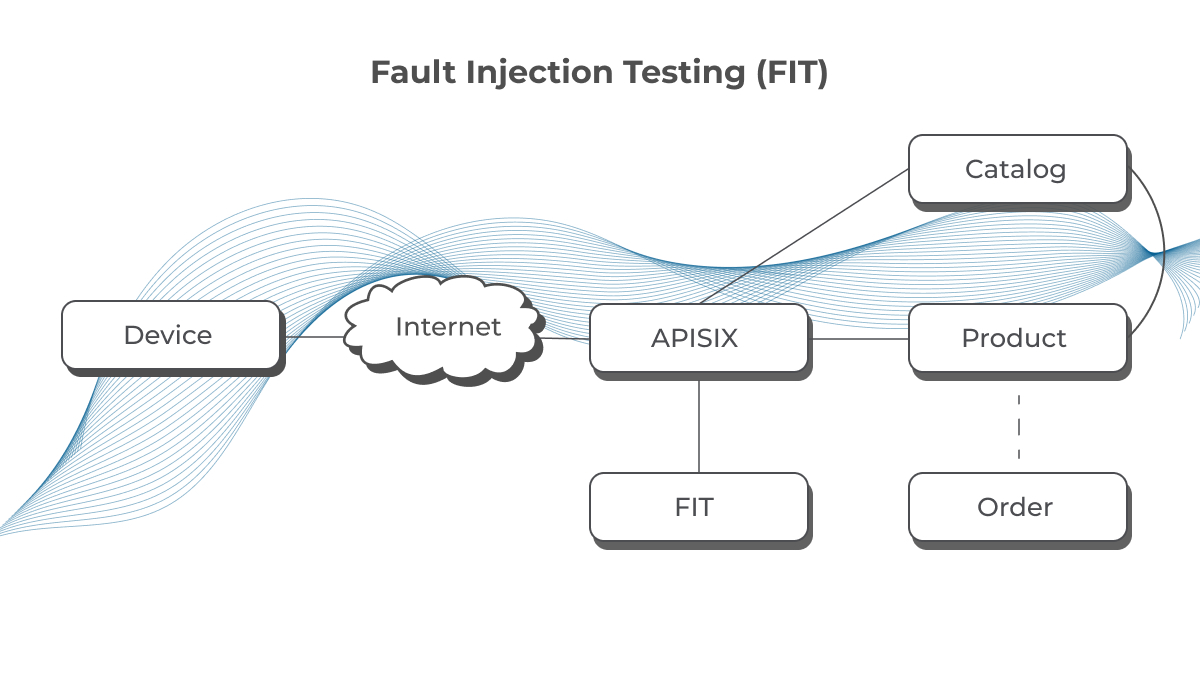 + +To test the shopping application’s microservices for resiliency, we are going to simulate the product service misbehaving as a faulty service: + +- By adding a **delay** to the HTTP request. +- By **aborting** the HTTP requests and returning a custom status code. + +### Injecting an HTTP delay fault + +In the first example, we introduce a 5-second delay for every request to the product service to test if we correctly set a connection timeout for calls to the product service from the Catalog service. + +> Note that you can also specify the percentage of requests to be delayed in numbers. Like 10 means: _10% of overall requests will be delayed_. In our demo case, we made it 100% to easily test the delay in time. + +The following route configuration example creates a new upstream for our backend service (productapi) that runs on port `80`, and registers a route with the `fault-injection` plugin enabled. You can notice that we set the delay injection in the plugin settings: + +``` bash +curl http://127.0.0.1:9080/apisix/admin/routes/1 -H 'X-API-KEY: edd1c9f034335f136f87ad84b625c8f1' -X PUT -d ' +{ + "name": "Route for Fault Injection with the delay", + "methods": ["GET"], + "uri": "/api/products", + "plugins": { + "fault-injection": { + "delay": { + "duration": 5, + "percentage": 10 + } + } + }, + "upstream": { + "type": "roundrobin", + "nodes": { + "productapi:80": 1 + } + } +}' +``` + +Below we confirm the rule was created by running another `curl` command with the time measurement: + +``` bash +time curl http://127.0.0.1:9080/api/products -i +``` + +After you run the cmd, you will see there is some delay was introduced: + +``` text +HTTP/1.1 200 OK +Content-Type: application/json; charset=utf-8 +Transfer-Encoding: chunked +Connection: keep-alive + +[{"name":"Macbook Pro","price":1500.9},{"name":"SurfaceBook 3","price":1599.9}] +real 0m5.004s +user 0m0.004s +sys 0m0.000s +``` + +The result of fault injection is as we expected.👏 + +### Injecting an HTTP abort fault + +In the following example, we will introduce an HTTP abort to the product microservice to check how our imaginary Catalog service responds immediately to the failures introduced by the dependent service. Let’s say when the Product service fails, we should expect an HTTP error with the `Product service currently unavailable` error message. + +We can test it in action. Now we can enable abort injection with the following route settings. + +``` bash +curl http://127.0.0.1:9080/apisix/admin/routes/1 -H 'X-API-KEY: edd1c9f034335f136f87ad84b625c8f1' -X PUT -d ' +{ + "name": "Route for Fault Injection with the abort", + "methods": ["GET"], + "uri": "/api/products", + "plugins": { + "fault-injection": { + "abort": { + "http_status": 503, + "body": "The product service is currently unavailable.", + "percentage": 100 + } + } + }, + "upstream": { + "type": "roundrobin", Review Comment: Hi Bobur, could you please format the json? ########## blog/en/blog/2022/08/28/fault-injection-testing-with-api-gateway.md: ########## @@ -0,0 +1,202 @@ +--- +title: "Fault Injection Testing with API Gateway" +authors: + - name: Bobur Umurzokov + title: Author + url: https://github.com/Boburmirzo + image_url: https://avatars.githubusercontent.com/u/14247607 +keywords: +- API gateway +- Apache APISIX +- Testing +- Fault Injection +- Microservices +description: +The blog post describes how an **API Gateway** like [Apache APISIX](https://apisix.apache.org/) is useful for testing the robustness and resilience of microservices APIs. Throughout the post, we also get to know the types of possible failure injections with the **[Fault Injection Plugin](https://apisix.apache.org/docs/apisix/plugins/fault-injection/)** 🔌 and simulate failures on our existing [Product backend service](https://github.com/Boburmirzo/apisix-dotnet-docker/tree/main/ProductApi) (developed by using [ASP.NET Core WEB API](https://docs.microsoft.com/en-us/aspnet/core/?view=aspnetcore-6.0)). +tags: [Case Studies] +--- + +> 💁 This blog post describes how an **API Gateway** like [Apache APISIX](https://apisix.apache.org/) is useful for testing the robustness and resilience of microservices APIs. + +<!--truncate--> + +## Explore distributed system stability💪 + +[Distributed systems](https://azure.microsoft.com/en-us/resources/designing-distributed-systems/) such as [microservices](https://docs.microsoft.com/en-us/azure/architecture/guide/architecture-styles/microservices) have led to an increase in the complexity of the systems we work with. It is difficult to have full confidence in this architecture when there are many components and “a lot of moving parts” that could potentially fail. It is critical to handle failures in service-to-service calls gracefully. Also, we want to be sure that any resilience mechanisms we have in place such as error handling code, [circuit breaker](https://dev.to/apisix/implementing-resilient-applications-with-api-gateway-circuit-breaker-ggk), [health checks](https://dev.to/apisix/implementing-resilient-applications-with-api-gateway-health-check-338c), [retry](https://docs.microsoft.com/en-us/azure/architecture/patterns/retry), fallback, redundant instances, and so on. We can verify this with the help of t he testing method **[Fault Injection](https://en.wikipedia.org/wiki/Fault_injection)** 💉. + + Review Comment: Will this link get expired? ########## blog/en/blog/2022/08/28/fault-injection-testing-with-api-gateway.md: ########## @@ -0,0 +1,202 @@ +--- +title: "Fault Injection Testing with API Gateway" +authors: + - name: Bobur Umurzokov + title: Author + url: https://github.com/Boburmirzo + image_url: https://avatars.githubusercontent.com/u/14247607 +keywords: +- API gateway +- Apache APISIX +- Testing +- Fault Injection +- Microservices +description: +The blog post describes how an **API Gateway** like [Apache APISIX](https://apisix.apache.org/) is useful for testing the robustness and resilience of microservices APIs. Throughout the post, we also get to know the types of possible failure injections with the **[Fault Injection Plugin](https://apisix.apache.org/docs/apisix/plugins/fault-injection/)** 🔌 and simulate failures on our existing [Product backend service](https://github.com/Boburmirzo/apisix-dotnet-docker/tree/main/ProductApi) (developed by using [ASP.NET Core WEB API](https://docs.microsoft.com/en-us/aspnet/core/?view=aspnetcore-6.0)). Review Comment: Also, make sure the description is less than 150 words for better SEO. ########## blog/en/blog/2022/08/28/fault-injection-testing-with-api-gateway.md: ########## @@ -0,0 +1,202 @@ +--- +title: "Fault Injection Testing with API Gateway" +authors: + - name: Bobur Umurzokov + title: Author + url: https://github.com/Boburmirzo + image_url: https://avatars.githubusercontent.com/u/14247607 +keywords: +- API gateway +- Apache APISIX +- Testing +- Fault Injection +- Microservices +description: +The blog post describes how an **API Gateway** like [Apache APISIX](https://apisix.apache.org/) is useful for testing the robustness and resilience of microservices APIs. Throughout the post, we also get to know the types of possible failure injections with the **[Fault Injection Plugin](https://apisix.apache.org/docs/apisix/plugins/fault-injection/)** 🔌 and simulate failures on our existing [Product backend service](https://github.com/Boburmirzo/apisix-dotnet-docker/tree/main/ProductApi) (developed by using [ASP.NET Core WEB API](https://docs.microsoft.com/en-us/aspnet/core/?view=aspnetcore-6.0)). +tags: [Case Studies] +--- + +> 💁 This blog post describes how an **API Gateway** like [Apache APISIX](https://apisix.apache.org/) is useful for testing the robustness and resilience of microservices APIs. + +<!--truncate--> + +## Explore distributed system stability💪 + +[Distributed systems](https://azure.microsoft.com/en-us/resources/designing-distributed-systems/) such as [microservices](https://docs.microsoft.com/en-us/azure/architecture/guide/architecture-styles/microservices) have led to an increase in the complexity of the systems we work with. It is difficult to have full confidence in this architecture when there are many components and “a lot of moving parts” that could potentially fail. It is critical to handle failures in service-to-service calls gracefully. Also, we want to be sure that any resilience mechanisms we have in place such as error handling code, [circuit breaker](https://dev.to/apisix/implementing-resilient-applications-with-api-gateway-circuit-breaker-ggk), [health checks](https://dev.to/apisix/implementing-resilient-applications-with-api-gateway-health-check-338c), [retry](https://docs.microsoft.com/en-us/azure/architecture/patterns/retry), fallback, redundant instances, and so on. We can verify this with the help of t he testing method **[Fault Injection](https://en.wikipedia.org/wiki/Fault_injection)** 💉. + + + +### Here is a quick overview of what we cover👇 + +- ✅ [Software Fault Injection](https://www.intechopen.com/chapters/56668). +- ✅ Fault injection testing (FIT) with API Gateway. +- ✅ Apache APISIX [Fault Injection Plugin](https://apisix.apache.org/docs/apisix/plugins/ltfa -injection/). +- ✅ Fault injection different types of failures. +- ✅ Experiment with Fault Injection Plugin. + +> Application is **correct** if it acts as specified. It is **robust** if it can take a high load until it goes down. Application is **resilient** if it can go back to normal after a disruption. + +## Software Fault Injection 💻💉 + +Among the many methods to perform Fault Injection, the technique of **Software Fault Injection** is especially getting more popular among companies managing large, complex, and distributed systems. In this sort of software testing technique, a special piece of code, associated with the system under test, tries to simulate faults. It is normally completed before deployment to identify any potential flaws that might happen in the running software😱. Fault injection can better identify the nature and cause of production failures. + +## Fault Injection Testing with API Gateway + +The **fault injection** approach at the [API Gateway](https://apisix.apache.org/docs/apisix/terminology/api-gateway/) level can be used to test the resiliency of application or microservices APIs against various forms of failures to build confidence in the production environment. The technique can be used to inject delays and abort requests with user-specified error codes, thereby providing the ability to stage different failure scenarios such as service failures, service overloads, high network latency, network partitions, etc. Fault injection can be limited to a specific set of requests based on the (destination) upstream cluster of a request and/or a set of pre-defined request headers. + +For a streaming giant like [Netflix](https://www.netflix.com/), the migration to a complex cloud-based microservices architecture would not have been possible without a revolutionary testing method known as fault injection👊. There is a very well-known strategy like [Chaos engineering](https://en.wikipedia.org/wiki/Chaos_engineering) which uses fault injection to accomplish the goal of more reliable systems. And Netflix teams built their own _Chaos engineering tool_ called [Chaos Monkey](https://netflix.github.io/chaosmonkey/). Review Comment: Do we need a space between word and icon? ########## blog/en/blog/2022/08/28/fault-injection-testing-with-api-gateway.md: ########## @@ -0,0 +1,202 @@ +--- +title: "Fault Injection Testing with API Gateway" +authors: + - name: Bobur Umurzokov + title: Author + url: https://github.com/Boburmirzo + image_url: https://avatars.githubusercontent.com/u/14247607 +keywords: +- API gateway +- Apache APISIX +- Testing +- Fault Injection +- Microservices +description: +The blog post describes how an **API Gateway** like [Apache APISIX](https://apisix.apache.org/) is useful for testing the robustness and resilience of microservices APIs. Throughout the post, we also get to know the types of possible failure injections with the **[Fault Injection Plugin](https://apisix.apache.org/docs/apisix/plugins/fault-injection/)** 🔌 and simulate failures on our existing [Product backend service](https://github.com/Boburmirzo/apisix-dotnet-docker/tree/main/ProductApi) (developed by using [ASP.NET Core WEB API](https://docs.microsoft.com/en-us/aspnet/core/?view=aspnetcore-6.0)). Review Comment: Hi @Boburmirzo, the description field will be injected to the HTML's description tag, please remove `**` or `[]()` 😊 Or it will be injected as plain text. ########## blog/en/blog/2022/08/28/fault-injection-testing-with-api-gateway.md: ########## @@ -0,0 +1,202 @@ +--- +title: "Fault Injection Testing with API Gateway" +authors: + - name: Bobur Umurzokov + title: Author + url: https://github.com/Boburmirzo + image_url: https://avatars.githubusercontent.com/u/14247607 +keywords: +- API gateway +- Apache APISIX +- Testing +- Fault Injection +- Microservices +description: +The blog post describes how an **API Gateway** like [Apache APISIX](https://apisix.apache.org/) is useful for testing the robustness and resilience of microservices APIs. Throughout the post, we also get to know the types of possible failure injections with the **[Fault Injection Plugin](https://apisix.apache.org/docs/apisix/plugins/fault-injection/)** 🔌 and simulate failures on our existing [Product backend service](https://github.com/Boburmirzo/apisix-dotnet-docker/tree/main/ProductApi) (developed by using [ASP.NET Core WEB API](https://docs.microsoft.com/en-us/aspnet/core/?view=aspnetcore-6.0)). +tags: [Case Studies] +--- + +> 💁 This blog post describes how an **API Gateway** like [Apache APISIX](https://apisix.apache.org/) is useful for testing the robustness and resilience of microservices APIs. + +<!--truncate--> + +## Explore distributed system stability💪 + +[Distributed systems](https://azure.microsoft.com/en-us/resources/designing-distributed-systems/) such as [microservices](https://docs.microsoft.com/en-us/azure/architecture/guide/architecture-styles/microservices) have led to an increase in the complexity of the systems we work with. It is difficult to have full confidence in this architecture when there are many components and “a lot of moving parts” that could potentially fail. It is critical to handle failures in service-to-service calls gracefully. Also, we want to be sure that any resilience mechanisms we have in place such as error handling code, [circuit breaker](https://dev.to/apisix/implementing-resilient-applications-with-api-gateway-circuit-breaker-ggk), [health checks](https://dev.to/apisix/implementing-resilient-applications-with-api-gateway-health-check-338c), [retry](https://docs.microsoft.com/en-us/azure/architecture/patterns/retry), fallback, redundant instances, and so on. We can verify this with the help of t he testing method **[Fault Injection](https://en.wikipedia.org/wiki/Fault_injection)** 💉. + + + +### Here is a quick overview of what we cover👇 + +- ✅ [Software Fault Injection](https://www.intechopen.com/chapters/56668). +- ✅ Fault injection testing (FIT) with API Gateway. +- ✅ Apache APISIX [Fault Injection Plugin](https://apisix.apache.org/docs/apisix/plugins/ltfa -injection/). Review Comment: Can you please check this link? ########## blog/en/blog/2022/08/28/fault-injection-testing-with-api-gateway.md: ########## @@ -0,0 +1,202 @@ +--- +title: "Fault Injection Testing with API Gateway" +authors: + - name: Bobur Umurzokov + title: Author + url: https://github.com/Boburmirzo + image_url: https://avatars.githubusercontent.com/u/14247607 +keywords: +- API gateway +- Apache APISIX +- Testing +- Fault Injection +- Microservices +description: +The blog post describes how an **API Gateway** like [Apache APISIX](https://apisix.apache.org/) is useful for testing the robustness and resilience of microservices APIs. Throughout the post, we also get to know the types of possible failure injections with the **[Fault Injection Plugin](https://apisix.apache.org/docs/apisix/plugins/fault-injection/)** 🔌 and simulate failures on our existing [Product backend service](https://github.com/Boburmirzo/apisix-dotnet-docker/tree/main/ProductApi) (developed by using [ASP.NET Core WEB API](https://docs.microsoft.com/en-us/aspnet/core/?view=aspnetcore-6.0)). +tags: [Case Studies] +--- + +> 💁 This blog post describes how an **API Gateway** like [Apache APISIX](https://apisix.apache.org/) is useful for testing the robustness and resilience of microservices APIs. + +<!--truncate--> + +## Explore distributed system stability💪 + +[Distributed systems](https://azure.microsoft.com/en-us/resources/designing-distributed-systems/) such as [microservices](https://docs.microsoft.com/en-us/azure/architecture/guide/architecture-styles/microservices) have led to an increase in the complexity of the systems we work with. It is difficult to have full confidence in this architecture when there are many components and “a lot of moving parts” that could potentially fail. It is critical to handle failures in service-to-service calls gracefully. Also, we want to be sure that any resilience mechanisms we have in place such as error handling code, [circuit breaker](https://dev.to/apisix/implementing-resilient-applications-with-api-gateway-circuit-breaker-ggk), [health checks](https://dev.to/apisix/implementing-resilient-applications-with-api-gateway-health-check-338c), [retry](https://docs.microsoft.com/en-us/azure/architecture/patterns/retry), fallback, redundant instances, and so on. We can verify this with the help of t he testing method **[Fault Injection](https://en.wikipedia.org/wiki/Fault_injection)** 💉. + + + +### Here is a quick overview of what we cover👇 + +- ✅ [Software Fault Injection](https://www.intechopen.com/chapters/56668). +- ✅ Fault injection testing (FIT) with API Gateway. +- ✅ Apache APISIX [Fault Injection Plugin](https://apisix.apache.org/docs/apisix/plugins/ltfa -injection/). +- ✅ Fault injection different types of failures. +- ✅ Experiment with Fault Injection Plugin. + +> Application is **correct** if it acts as specified. It is **robust** if it can take a high load until it goes down. Application is **resilient** if it can go back to normal after a disruption. + +## Software Fault Injection 💻💉 + +Among the many methods to perform Fault Injection, the technique of **Software Fault Injection** is especially getting more popular among companies managing large, complex, and distributed systems. In this sort of software testing technique, a special piece of code, associated with the system under test, tries to simulate faults. It is normally completed before deployment to identify any potential flaws that might happen in the running software😱. Fault injection can better identify the nature and cause of production failures. + +## Fault Injection Testing with API Gateway + +The **fault injection** approach at the [API Gateway](https://apisix.apache.org/docs/apisix/terminology/api-gateway/) level can be used to test the resiliency of application or microservices APIs against various forms of failures to build confidence in the production environment. The technique can be used to inject delays and abort requests with user-specified error codes, thereby providing the ability to stage different failure scenarios such as service failures, service overloads, high network latency, network partitions, etc. Fault injection can be limited to a specific set of requests based on the (destination) upstream cluster of a request and/or a set of pre-defined request headers. + +For a streaming giant like [Netflix](https://www.netflix.com/), the migration to a complex cloud-based microservices architecture would not have been possible without a revolutionary testing method known as fault injection👊. There is a very well-known strategy like [Chaos engineering](https://en.wikipedia.org/wiki/Chaos_engineering) which uses fault injection to accomplish the goal of more reliable systems. And Netflix teams built their own _Chaos engineering tool_ called [Chaos Monkey](https://netflix.github.io/chaosmonkey/). + +## Apache APISIX Fault Injection Plugin🔌 + +[Apache APISIX Fault Injection Plugin](https://apisix.apache.org/docs/apisix/plugins/fault-injection/) also offers a _mechanism_ to inject some errors into our APIs and ensures that our resilience measures are effective. + +Apache APISIX works in **two different modes**, both configured using the `fault-injection` plugin attributes⤵️: + +1. **Delays:** Delays are timing failures. They simulate increased network latency or an overloaded upstream service. + +2. **Aborts:** Aborts are crash failures. They mimic failures in upstream services. Aborts usually manifest in the form of HTTP error codes or TCP connection failures. + +For detailed instructions on how to configure delays and aborts, see [Fault Injection](https://apisix.apache.org/docs/apisix/plugins/fault-injection/). You can also try out a centralized platform [API7 Cloud](https://www.api7.cloud/) ☁️ to use more advanced API Gateway [features](https://www.api7.cloud/docs/overview/api7-cloud). API7 Cloud provides a fully managed chaos engineering service with the dashboard to configure the [Fault Injection policy](https://www.api7.cloud/docs/references/policies/traffic-management/fault-injection) easily👍🏻. Review Comment: What's this icon? 😂  -- This is an automated message from the Apache Git Service. To respond to the message, please log on to GitHub and use the URL above to go to the specific comment. To unsubscribe, e-mail: [email protected] For queries about this service, please contact Infrastructure at: [email protected]



