This is an automated email from the ASF dual-hosted git repository.

juzhiyuan pushed a commit to branch master
in repository https://gitbox.apache.org/repos/asf/apisix-website.git
The following commit(s) were added to refs/heads/master by this push:
new ee707422788 docs: Why Is Apache APISIX the Best API Gateway? (#1320)
ee707422788 is described below
commit ee707422788fe9fc3869e21b1c5515c7edb64241
Author: 琚致远 <[email protected]>
AuthorDate: Fri Sep 16 10:13:27 2022 +0800
docs: Why Is Apache APISIX the Best API Gateway? (#1320)
Co-authored-by: Young <[email protected]>
---
.../why-is-apache-apisix-the-best-api-gateway.md | 198 +++++++++++++++++++++
blog/en/config/picked-posts.json | 1 +
2 files changed, 199 insertions(+)
diff --git
a/blog/en/blog/2022/09/13/why-is-apache-apisix-the-best-api-gateway.md
b/blog/en/blog/2022/09/13/why-is-apache-apisix-the-best-api-gateway.md
new file mode 100644
index 00000000000..3b15327b8d5
--- /dev/null
+++ b/blog/en/blog/2022/09/13/why-is-apache-apisix-the-best-api-gateway.md
@@ -0,0 +1,198 @@
+---
+title: "Why Is Apache APISIX the Best API Gateway?"
+authors:
+ - name: Ming Wen
+ title: Author
+ url: https://github.com/moonming
+ image_url: https://avatars.githubusercontent.com/u/26448043
+keywords:
+ - Ingress controller
+ - Open Source API Gateway
+ - API Management Platform
+ - The Best API Gateway
+ - Apache APISIX
+description: Why is Apache APISIX the best API Gateway? We will compare
multiple API gateways (Kong, Tyk, Gloo) in terms of the popularity among
developers, open source licenses, performances, and the ecosystem as a whole.
+tags: [Technology, Products]
+image: https://static-site.apiseven.com/wp-content/uploads/2022/09/APISIX.webp
+---
+
+> Why is Apache APISIX the best API Gateway? We will compare multiple API
gateways (Kong, Tyk, Gloo) in terms of the popularity among developers, their
open source licenses, their performances, and the ecosystem as a whole.
+
+<!--truncate-->
+
+<head>
+ <link rel="canonical"
href="https://api7.ai/blog/why-is-apache-apisix-the-best-api-gateway"; />
+</head>
+
+> This post was first published at
[API7.ai](https://api7.ai/blog/why-is-apache-apisix-the-best-api-gateway/) by
[Ming Wen](https://github.com/moonming).
+
+Nowadays, mobile phones are used for all sorts of things, and various
applications are available on the AppStore including social media, utility,
games, lifestyle, online shopping, etc. Building these apps is inseparable from
APIs. Therefore, companies that provide services through APIs must choose a
reliable API gateway to ensure their services’ speed, stability, and security.
+
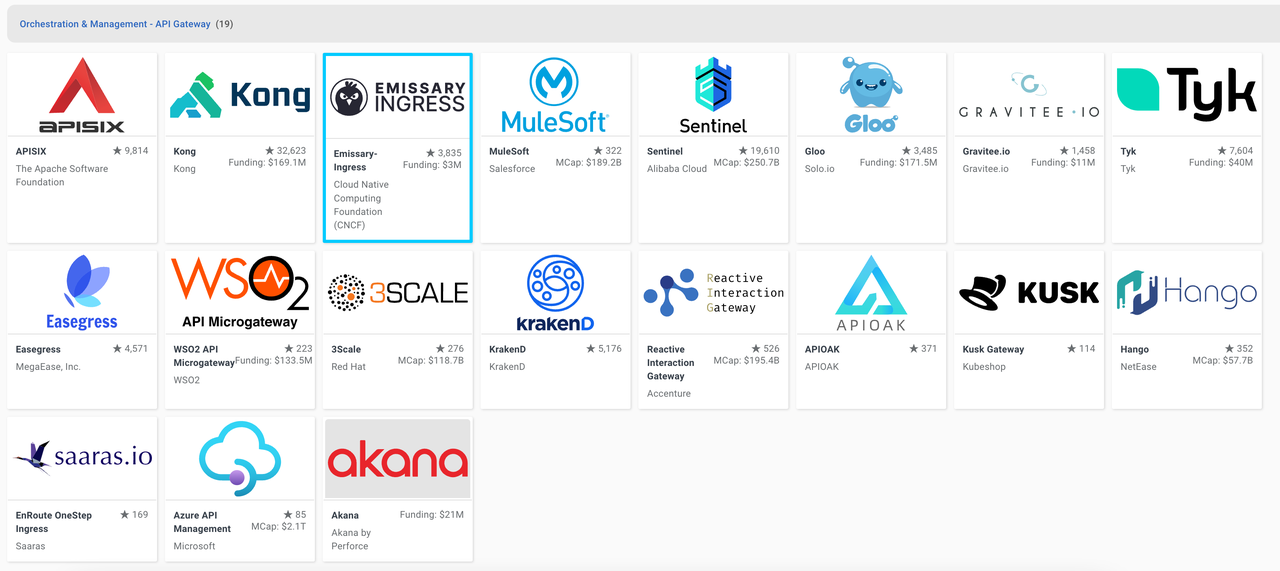
+In [CNCF’s API Gateway
landscape](https://landscape.cncf.io/card-mode?category=api-gateway&grouping=category&sort=contributors),
there are nearly 20 types of API gateway (not including cloud vendor’s
services), including Apache APISIX, Kong, Tyk, etc. Many of them claim
themselves to be the most popular open-source API gateway project, the
next-generation API gateway, but are they?
+
+In this article, we are going to analyze multiple API gateways in the
dimensions of the popularity among developers, their open source licenses,
their performances, and the ecosystem as a whole. In this analysis, we will see
how Apache APISIX is the next-generation API Gateway, performing better than
its peers in many aspects.
+
+
+
+## Software Engineers Know It Well
+
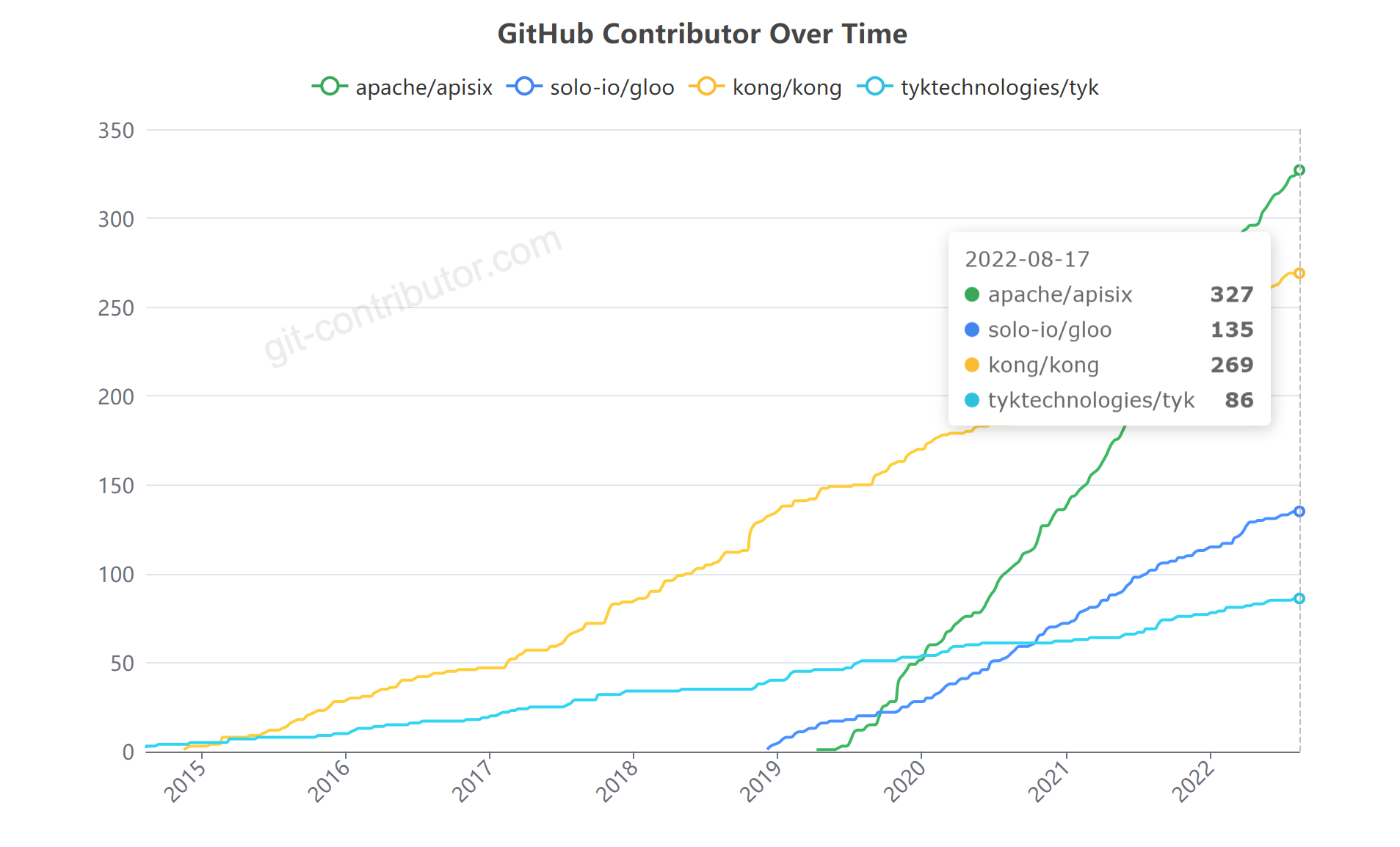
+Software engineers are the users and developers of API and API gateway, so the
popularity among engineers is a direct indicator of the trend. Below is a graph
comparing the total number of GitHub contributors of four API gateways: Apache
APISIX, Kong, Tky, and Gloo.
+
+
+
+We can see from the graph that both Kong and Tyk started around 2015, while
Apache APISIX and Gloo started later in 2019. More significantly, we can also
see that the youngest Apache APISIX has the steepest curve among all of them
and has accumulated more than 320 contributors, surpassing the second-best Kong
by 57 people, becoming the API gateway project that has the most number of
contributors.
+
+
+
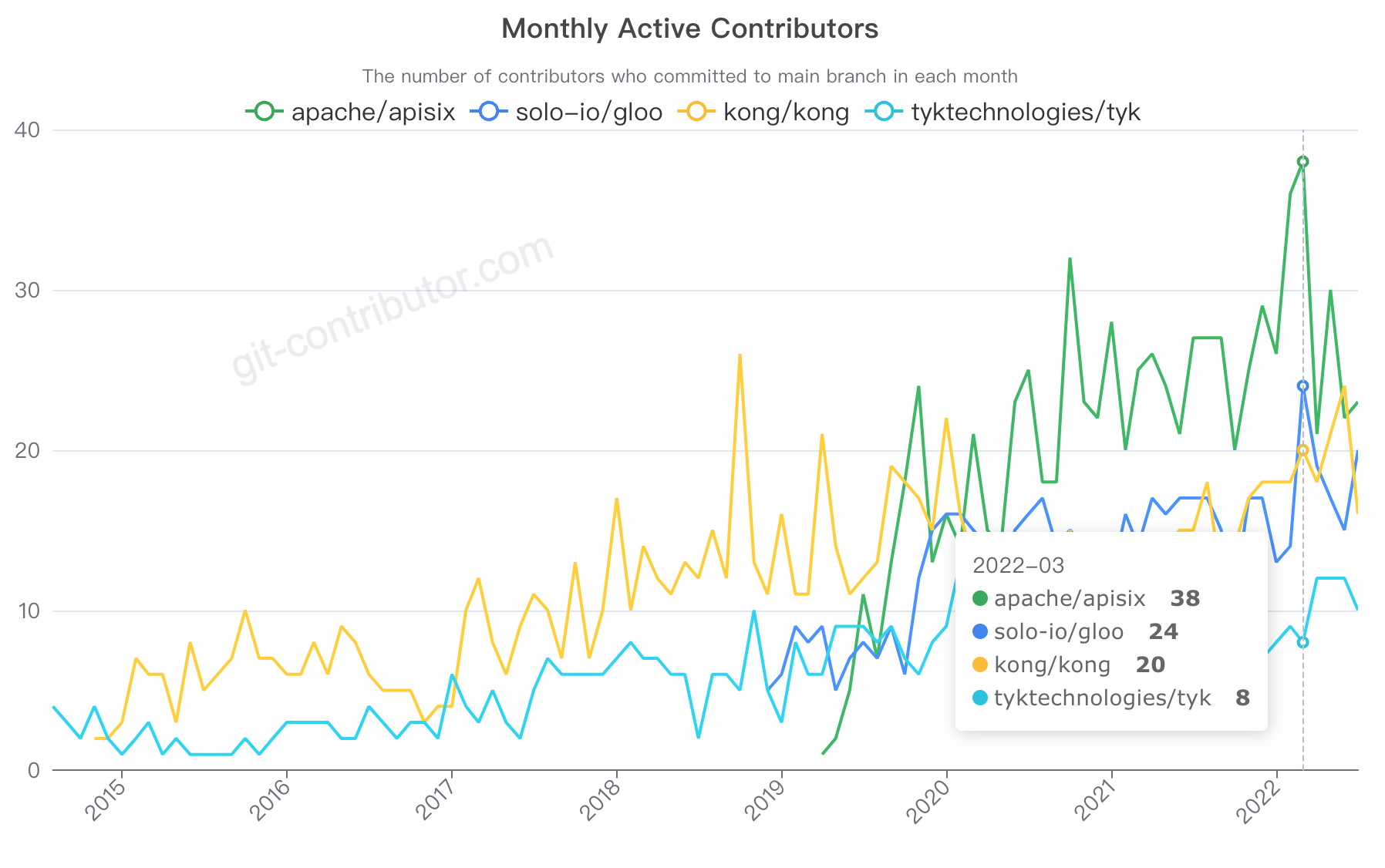
+Aside from the total number of contributors, the number of monthly active
contributors indicates more significance. The monthly active contributors for
Tyk have been only around 5 and rarely go above 10, while Kong and Gloo have
been fluctuating between 10 and 20. In the meantime, Apache APISIX has monthly
active contributors above 20 stably, and nearly 40 at the peak, making it the
most active API gateway project.
+
+Behind the four open-source API gateway projects, there are four corresponding
commercialized companies. So, another indicator that makes APISIX stand out is
the ratio of the number of monthly active contributors versus the number of
employees.
+
+| **API Gateway** | **APISIX** | **Kong** | **Tyk** | **Gloo** |
+| :----------------------: | :--------: | :------: | :-----: | :------: |
+| monthly active | 38 | 20 | 8 | 24 |
+| employees(from Linkedln) | 40+ | 500+ | 200+ | 100+ |
+
+As of 2022, Kong and Tyk have a ratio of 4%, and Gloo has a ratio of 24%. In
contrast, APISIX almost reached 100%. The reason behind it is that since the
very beginning when the company API7.ai started the APISIX project, it has been
putting continuous effort into the open-source community and gained its
reputation among developers.
+
+## Open Source Licence: The Most Important Factor of Choosing an Open Source
API Gateway
+
+Ever since MongoDB changed its open source license to SSPL (Server Side Public
License) in 2018, enterprises now have to open source their own code when
MongoDB is being used as a managed service. As a result, enterprises need to
take into serious consideration of a project’s open source license when
choosing a project.
+
+From the surface, Apache APISIX, Kong, and Gloo all use the
commercial-friendly Apache License Version 2.0, and Tyk uses Mozilla Public
License Version 2.0. Dig deeper though, Kong, Gloo, and Tky are all backed by
commercialized open source vendors. They can change their license any time just
like MongoDB, limiting public cloud or other companies from using it freely,
and forcing you to pay to access the new versions.
+
+Nobody knows the probability of license changes. This risk, though, is just
like the sword of Damocles, hanging above the users.
+
+Under such circumstances, choosing an Apache Software Foundation(ASF)'s open
source project or a CNCF’s open source project is the best choice, because they
cannot modify the license of the project. Apache APISIX is such a project. It
is an ASF top-level project, meaning no commercial company has absolute control
of the Apache APISIX project, all codes belong to ASF and the license will not
be changed. Enterprise users can use it freely without worrying about receiving
inquiry emails fro [...]
+
+## Performance of Apache APISIX, Kong and Gloo
+
+A frequently asked question in the community: which one has the better
performance, Envoy-based Gloo or NGINX-based APISIX? Although performance is
not the most critical metric, it is inarguably the most direct metric. The
table below shows the benchmark scores of Apache APISIX and Gloo. The QPS of
Apache APISIX is 4.6 times that of Gloo, and the latency of Apache APISIX is
merely 7% of Gloo’s.
+
+| **API Gateway** | Apache APISIX
| Gloo Edge
|
+| :-------------: |
:----------------------------------------------------------------------: |
:--------------------------------------------------------------------: |
+| **QPS** | 59122
| 12903
|
+| **Latency** | 50.000% 470.00us<br>75.000% 648.00us<br>90.000%
0.89ms<br>99.000% 1.60ms | 50.000% 6.80ms<br>75.000% 9.25ms<br>90.000%
11.32ms<br>99.000% 17.06ms |
+
+The choice of NGINX or Envoy is not the main factor of the performance
difference, but the underlying optimization APISIX did in its source code. Even
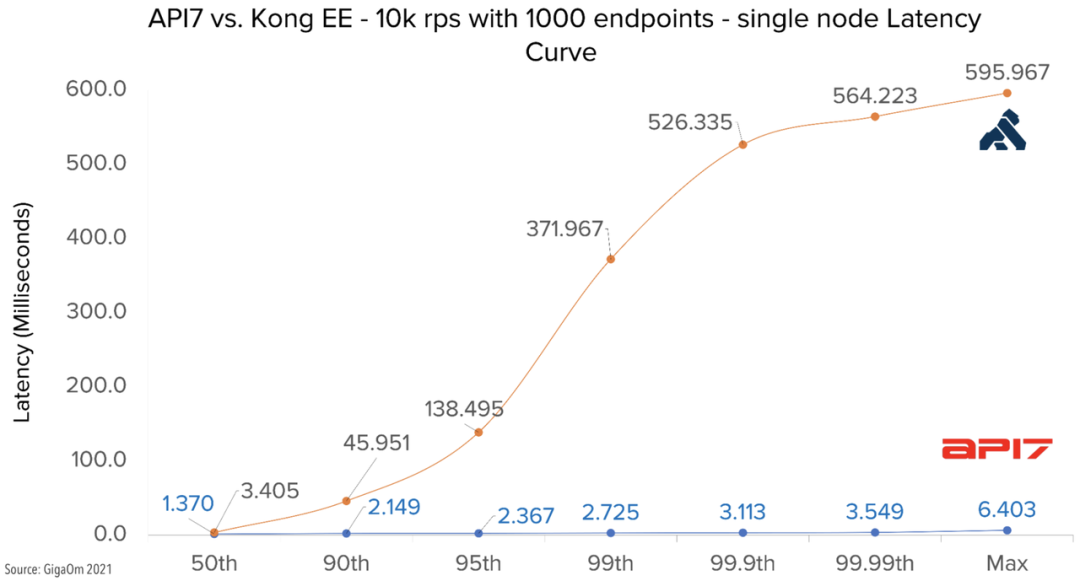
compared to KONG, which is also NGINX-based, APISIX has a huge performance
upper hand. The graph below is extracted from [GigaOm’s](https://gigaom.com/)
report on testing Kong’s Enterprise Edition and AP7 Enterprise Edition ([You
can contact us for the complete data](https://api7.ai/request-demo/)).
+
+
+
+The latency of Kong is tens or even a hundred times of API7(Enterprise Edition
created by authors of Apache APISIX)’s.
+
+Why does APISIX have such a big performance upper hand? There are no secrets
in front of the code.
+
+## Talk Is Cheap, Show Me the Code
+
+Now, let us analyze Apache APISIX, Kong, and Gloo from a technical point of
view. Apache APISIX’s advantage mostly relies on optimization and innovation of
the source code. The advantages of these technologies are not necessarily
reflected in the simple PoC(Proof of Concept), but shown in a more complex
production environment.
+
+Before the emergence of the APISIX project, there were many commercial API
gateways or open source API gateway products. These products stored API data,
routing information, certificates, and configuration data in a relational
database. The advantages of storing these data in relational databases are very
obvious. Users can use SQL statements to perform flexible queries, and it is
also convenient for users to perform backup and subsequent maintenance.
+
+However, the gateway is a middleware that handles all traffic from the client.
The requirement for availability is extremely high. If the API gateway relies
on a relational database, it means that once the relational database fails
(such as downtime or data loss), the API gateway will also be affected, and the
availability of the entire system will also be suffering.
+
+To reduce the damage, APISIX structured its architecture to avoid the
possibility of downtime and data loss. APISIX used etcd to store configuration
data instead of a relational database, the advantages of doing so are as
follows:
+
+1. It is more aligned with the cloud-native architecture
+2. It is a better representation of the data type needed for the API gateway
+3. It will have higher availability
+4. The changes can be notified at a sub-millisecond level
+
+After using etcd to store configuration data, users only need to monitor etcd
updates for data changes. APISIX will be able to obtain the latest
configuration within milliseconds, achieving a real-time effect. If we were
polling from the database, however, it may take 5-10 seconds to obtain the
latest configuration information. Therefore, using etcd as the storage scheme
not only makes APISIX more cloud-native but also higher availability.
+
+### High-Performance Route Matching Algorithm
+
+To process a request, API Gateway needs to match the target expression with
each request's host information, URI, HTTP methods, and other information.
Thus, an efficient matching algorithm is crucial. The hash-based algorithm has
good performance, but cannot achieve fuzzy matching. Regular expressions can
perform fuzzy matching, but the performance is not so good. Apache APISIX’s
solution is to use a tree, an efficient search data structure that supports
fuzzy matching. To be more precis [...]
+
+When matching a request, the algorithm with the radix tree will match it
progressively, with an O(K) complexity (K is the length of the URI in the
route, and it is independent of the number of APIs). This algorithm suits very
well in scenarios when there are a large number of routes, such as on public
clouds or CDN. It also has no problem dealing with a large number of routes
that increases rapidly.
+
+### High-Performance IP Matching Algorithm
+
+An IP address has two notations: standard IP notation and CIDR notation,
taking 32-bit IPv4 as an example:
+
+- Standard IP notation: 192.168.1.1
+- CIDR notation: 192.168.1.1/8
+
+Apache APISIX's IP matching and route matching use different algorithms. Take
the IP of 192.168.1.1 as an example, since the range of each IP segment is 0 to
255, we can think that the IP address is composed of four 16-bit integer
numbers, and the length of the IP is fixed. Thus, we can use a more efficient
algorithm to complete the matching.
+
+Assume that there is an IP library containing 500 IPv4 records, APISIX will
cache the 500 IPv4 records in the hash table, and use the hash table for IP
matching. The time complexity is O(1). Other API gateways complete IP matching
through list iteration and each request sent to the gateway may be iterated up
to 500 times. Therefore, APISIX's high-precision IP matching algorithm greatly
improves the efficiency of scenarios that require massive IP allowlist and
denylist matching (such as WAF).
+
+### Routes Refinement
+
+API Gateways match the pre-defined rules with various information of the
requests, such as the host information, URI, URI query parameters, URI path
parameters, HTTP methods, request headers, etc. These pieces of information are
supported by most of the API gateway. However, Apache APISIX supports more data
in addition to these to solve more complex cases.
+
+First, Apache APISIX supports NGINX built-in variables, which means that we
can use dozens of NGINX built-in variables as matching parameters, including
`uri`, `server_name`, `server_addr`, `request_uri`, `remote_port`,
`remote_addr`, `query_string`, `host`, `hostname`, `arg_name`.
+
+For a list of NGINX built-in variables, [see NGINX
Variables](http://nginx.org/en/docs/varindex.html).
+
+Second, Apache APISIX supports conditional expressions as matching rules, and
its structure is `[var, operator, val], ...]]`, where:
+
+- `var` values can be NGINX built-in variables.
+- `operator` supports equal, greater than, less than, regular expressions,
contains, etc.
+
+Assuming the expression is `["arg_name", "==", "json"]`, it means whether
there is a parameter value of `name` equal to `json` in the URI query
parameters of the current request. Apache APISIX implements this feature
through its library `lua-resty-expr`. For details, please refer to
[lua-resty-expr](https://github.com/api7/lua-resty-expr). This feature gives
the user a lot of flexibility and is highly extensible.
+
+In addition, Apache APISIX allows the users to set up routes’ ttl(time to
live).
+
+```shell
+$ curl http://127.0.0.1:9080/apisix/admin/routes/2?ttl=60 -H 'X-API-KEY:
edd1c9f034335f136f87ad84b625c8f1' -X PUT -i -d '
+{
+ "uri": "/aa/index.html",
+ "upstream": {
+ "type": "roundrobin",
+ "nodes": {
+ "39.97.63.215:80": 1
+ }
+ }
+}'
+```
+
+The above code means that APISIX will automatically delete the routing
configuration after 60sec, which will be required for some temporary
verification scenarios, like canary release. It is also very convenient for
online traffic splitting, a feature that other gateway products do not have.
+
+Lastly, Apache APISIX supports customized filter functions, one can write
custom Lua functions in the `filter_func` parameter, for example:
+
+```shell
+$ curl http://127.0.0.1:9080/apisix/admin/routes/1 -H 'X-API-KEY:
edd1c9f034335f136f87ad84b625c8f1' -X PUT -i -d '
+{
+ "uri": "/index.html",
+ "hosts": ["foo.com", "*.bar.com"],
+ "filter_func": "function(vars)
+ return vars['host'] == 'api7.ai'
+ end",
+ "upstream": {
+ "type": "roundrobin",
+ "nodes": {
+ "127.0.0.1:1980": 1
+ }
+ }
+}'
+```
+
+The input parameter of `filter_func` is `vars`, and NGINX variables can be
obtained from `vars`, and then the filtering logic can be customized.
+
+### Support for Multi-Language Plugins
+
+Users often need to customize some of the development and system integration
of API gateway towards specific scenarios.
+
+APISIX currently supports more than 80 plugins, but it is still difficult to
cover all user scenarios. Thus, most companies will develop customized plugins
for specific businesses, integrate more protocols and systems through the
gateway, and achieve unified management at the gateway layer.
+
+In earlier versions of APISIX, developers could only use Lua to develop
plugins. Although plugins developed in native computing languages have very
high performance, learning Lua, a new development language, requires time and
learning costs.
+
+In response to this situation, APISIX provides two solutions.
+
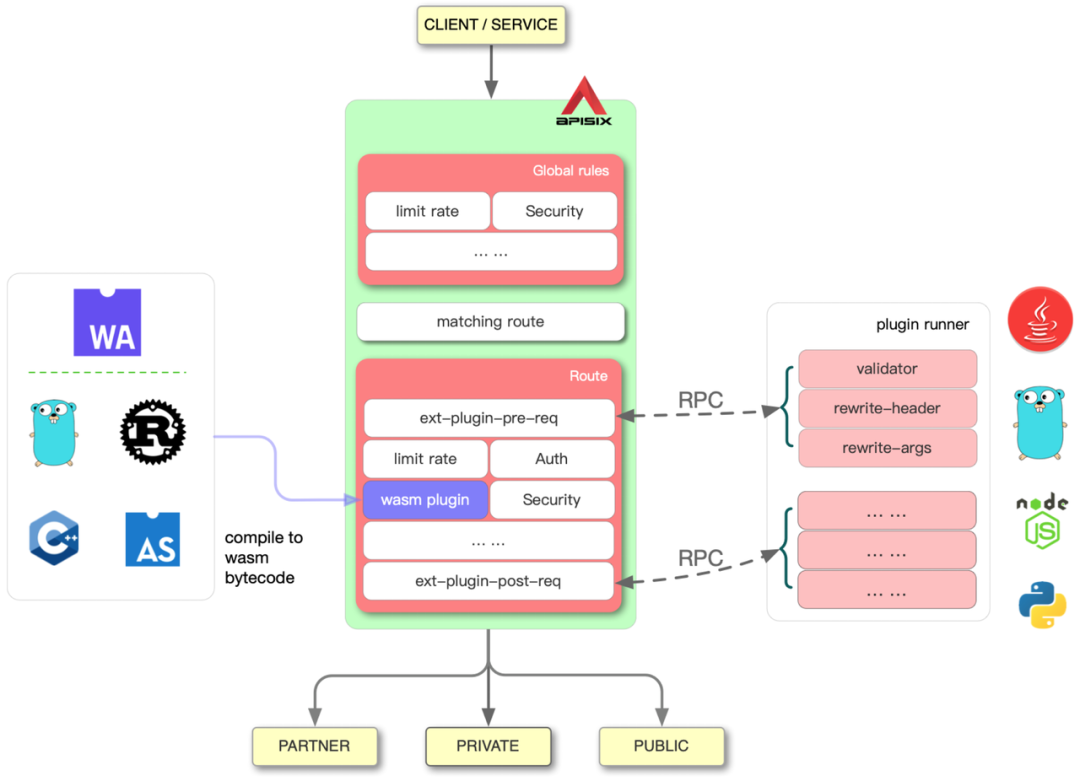
+The first solution is to support more mainstream programming languages (such
as Java, Python, Go, etc.) through Plugin Runner. Using Plugin Runner, back-end
engineers can communicate through local RPC to develop APISIX plugins using the
programming languages they are familiar with. The advantage of this is to
reduce development costs and improve development efficiency. The disadvantage
will be performance losses. So, is there a way to achieve the near-native
performance of Lua using hi [...]
+
+
+
+The second solution is to use Wasm to develop plugins, as shown in the left
part of the above figure. Wasm (WebAssembly) was first used as a new type of
technology that runs in browsers, but now it is also gradually showing its
advantages on the server side. We embedded Wasm into APISIX, and users can use
Wasm to compile Wasm bytecode to run in APISIX. To make use of Wasm we
developed a Wasm plugin where users can develop near-native APISIX plugins
using high-level programming languages.
+
+As a result, users can use Lua, Go, Java, Python, Node.js, and Wasm to write
custom plugins on APISIX. By making development easy, it opens doors for APISIX
plugin development.
+
+## Conclusion
+
+In this article, we analyzed and compared API gateway products from multiple
perspectives such as software engineers, open source protocols, performance
evaluation, technology, and ecosystem. We can see that Apache APISIX is
superior in many aspects, a pioneer in the API network.
+
+Apache APISIX is not only an API gateway that can handle north-south traffic,
but also has open source products such as APISIX Ingress Controller and Service
Mesh.
+
+It also provides APISIX-based enterprise-level products and SaaS products.
+
+[Try Apache APISIX and API7 Enterprise products
today!](https://api7.ai/request-demo/)
diff --git a/blog/en/config/picked-posts.json b/blog/en/config/picked-posts.json
index 20cbf34b76f..5d8ebd07cb7 100644
--- a/blog/en/config/picked-posts.json
+++ b/blog/en/config/picked-posts.json
@@ -1,4 +1,5 @@
[
+ "blog/en/blog/2022/09/13/why-is-apache-apisix-the-best-api-gateway.md",
"blog/en/blog/2021/12/30/apisix-proxy-grpc-service.md",
"blog/en/blog/2022/02/16/file-logger-api-gateway.md",
"blog/en/blog/2022/03/05/apisix-integration-eureka-service-discovery.md",






