This is an automated email from the ASF dual-hosted git repository.

wenming pushed a commit to branch master
in repository https://gitbox.apache.org/repos/asf/apisix-website.git
The following commit(s) were added to refs/heads/master by this push:
new ed6aa368692 blog: a tiny APISIX plugin (#1627)
ed6aa368692 is described below
commit ed6aa368692c86a3d2094115ce196f64d589c5c2
Author: Navendu Pottekkat <[email protected]>
AuthorDate: Tue Nov 14 19:51:10 2023 +0530
blog: a tiny APISIX plugin (#1627)
---
blog/en/blog/2023/07/07/tiny-apisix-plugin.md | 213 ++++++++++++++++++++++++++
1 file changed, 213 insertions(+)
diff --git a/blog/en/blog/2023/07/07/tiny-apisix-plugin.md
b/blog/en/blog/2023/07/07/tiny-apisix-plugin.md
new file mode 100644
index 00000000000..924bddd28c5
--- /dev/null
+++ b/blog/en/blog/2023/07/07/tiny-apisix-plugin.md
@@ -0,0 +1,213 @@
+---
+title: "A \"Tiny\" APISIX Plugin"
+authors:
+ - name: Navendu Pottekkat
+ title: Author
+ url: https://github.com/navendu-pottekkat
+ image_url: https://avatars.githubusercontent.com/u/49474499
+keywords:
+ - Wasm
+ - Go
+ - Plugin
+description: "A \"tiny\" example to demonstrate how Apache APISIX supports
Wasm plugins."
+tags: [Plugins]
+image: https://static.apiseven.com/uploads/2023/06/27/Z8CkI8kj_wasm-cover.png
+---
+
+> In this article, we will write a "tiny" Go plugin for APISIX, compile it to
a Wasm binary, run it in APISIX, and learn how it all works. We will also
compare the benefits and costs of using Wasm plugins, external plugins (plugin
runners), and native Lua plugins.
+
+<!--truncate-->
+
+<head>
+ <link rel="canonical" href="https://navendu.me/posts/tiny-apisix-plugin/";
/>
+</head>
+
+A key feature of Apache APISIX is its pluggable architecture. In addition to
providing [80+ Lua plugins](https://apisix.apache.org/plugins/) out of the box,
APISIX also supports external plugins written in other languages through
[plugin
runners](https://apisix.apache.org/docs/go-plugin-runner/getting-started/) and
[WebAssembly (Wasm)](https://apisix.apache.org/docs/apisix/wasm/).
+
+In this article, we will write a "tiny" Go plugin for APISIX, compile it to a
Wasm binary, run it in APISIX, and learn how it all works. We will also compare
the benefits and costs of using Wasm plugins, external plugins (plugin
runners), and native Lua plugins.
+
+## APISIX and Wasm
+
+APISIX supports Wasm through the [WebAssembly for Proxies (proxy-wasm)
specification](https://github.com/proxy-wasm/spec). APISIX is a host
environment that implements the specification, and developers can use the
[SDKs](https://github.com/proxy-wasm/spec#sdks) available in multiple languages
to create plugins.
+
+Using Wasm plugins in APISIX has multiple advantages:
+
+* Many programming languages compile to Wasm. This allows you to leverage the
capabilities of your tech stack in APISIX plugins.
+* The plugins run inside APISIX and not on external plugin runners. This means
you compromise less on performance while writing external plugins.
+* Wasm plugins run inside APISIX but in a separate VM. So even if the plugin
crashes, APISIX can continue to run.
+* _APISIX can only maintain its Wasm support without having to maintain plugin
runners for multiple languages\*._
+
+_\* These advantages come with a set of caveats which we will look at later._
+
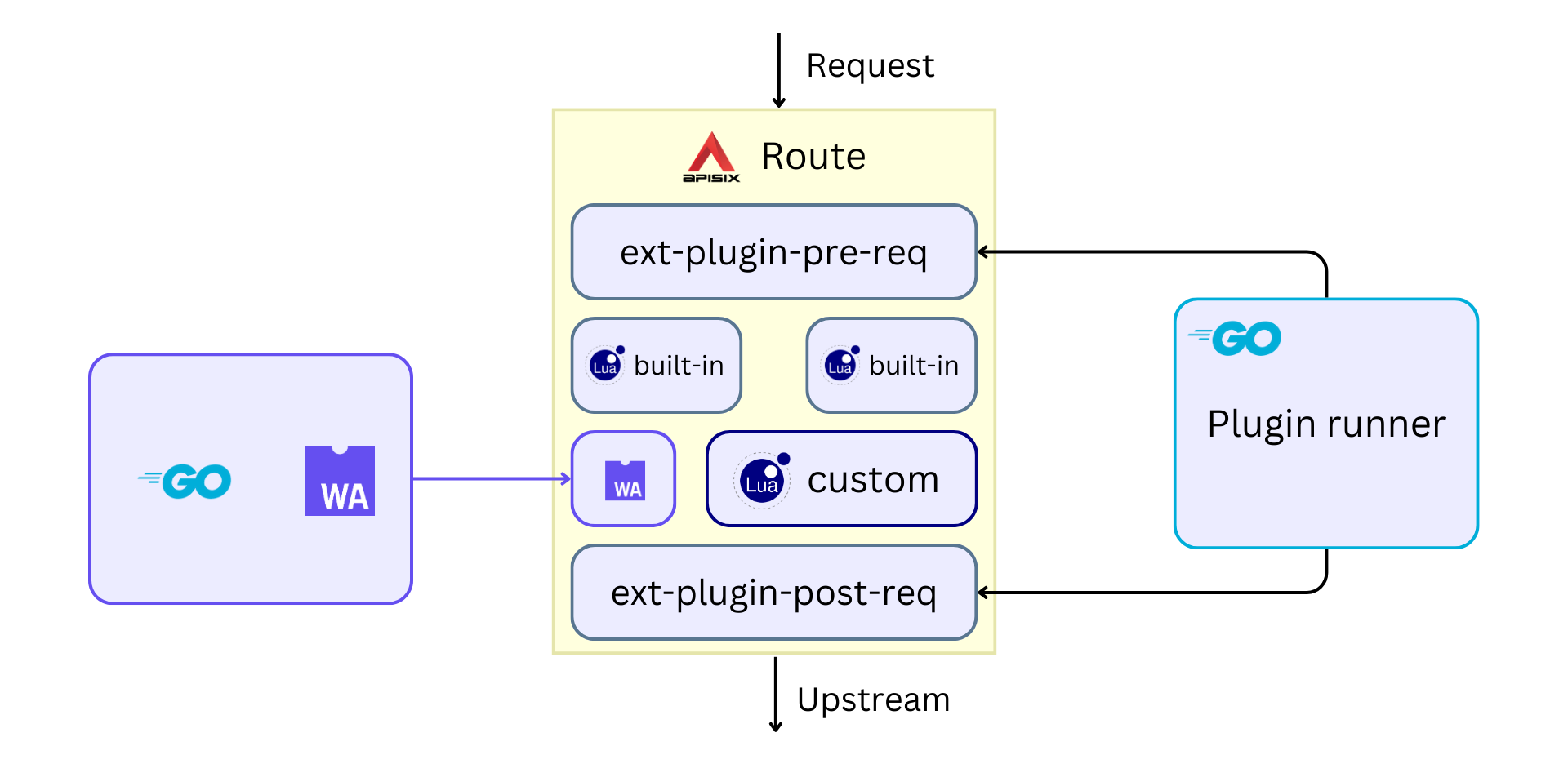
+APISIX's plugin architecture below shows native Lua plugins, external plugins
through plugin runners, and Wasm plugins:
+
+
+
+## A "Tiny" Go Plugin
+
+Let's get coding! To write a Go plugin, we will use the
[proxy-wasm-go-sdk](https://github.com/tetratelabs/proxy-wasm-go-sdk).
+
+Reading through the documentation, you will understand why this plugin is
called "tiny," i.e., the SDK uses the [TinyGo](https://tinygo.org/) compiler
instead of the official Go compiler. You can read more about why this is the
case on the [SDK\'s overview
page](https://github.com/tetratelabs/proxy-wasm-go-sdk/blob/main/doc/OVERVIEW.md),
but the TLDR version is that the Go compiler can only produce Wasm binaries
that run in the browser.
+
+For our example, we will create a plugin that adds a response header. The code
below is pretty self-explanatory, and you can refer to [other
plugins](https://github.com/apache/apisix/blob/master/t/wasm/) for more
implementation details:
+
+```go title="main.go"
+// references:
+// https://github.com/tetratelabs/proxy-wasm-go-sdk/tree/main/examples
+// https://github.com/apache/apisix/blob/master/t/wasm/
+package main
+
+import (
+ "github.com/tetratelabs/proxy-wasm-go-sdk/proxywasm"
+ "github.com/tetratelabs/proxy-wasm-go-sdk/proxywasm/types"
+
+ "github.com/valyala/fastjson"
+)
+
+func main() {
+ proxywasm.SetVMContext(&vmContext{})
+}
+
+// each plugin has its own VMContext.
+// it is responsible for creating multiple PluginContexts for each route.
+type vmContext struct {
+ types.DefaultVMContext
+}
+
+// each route has its own PluginContext.
+// it corresponds to one instance of the plugin.
+func (*vmContext) NewPluginContext(contextID uint32) types.PluginContext {
+ return &pluginContext{}
+}
+
+type header struct {
+ Name string
+ Value string
+}
+
+type pluginContext struct {
+ types.DefaultPluginContext
+ Headers []header
+}
+
+func (ctx *pluginContext) OnPluginStart(pluginConfigurationSize int)
types.OnPluginStartStatus {
+ data, err := proxywasm.GetPluginConfiguration()
+ if err != nil {
+ proxywasm.LogErrorf("error reading plugin configuration: %v", err)
+ return types.OnPluginStartStatusFailed
+ }
+
+ var p fastjson.Parser
+ v, err := p.ParseBytes(data)
+ if err != nil {
+ proxywasm.LogErrorf("error decoding plugin configuration: %v", err)
+ return types.OnPluginStartStatusFailed
+ }
+ headers := v.GetArray("headers")
+ ctx.Headers = make([]header, len(headers))
+ for i, hdr := range headers {
+ ctx.Headers[i] = header{
+ Name: string(hdr.GetStringBytes("name")),
+ Value: string(hdr.GetStringBytes("value")),
+ }
+ }
+ return types.OnPluginStartStatusOK
+}
+
+// each HTTP request to a route has its own HTTPContext
+func (ctx *pluginContext) NewHttpContext(contextID uint32) types.HttpContext {
+ return &httpContext{parent: ctx}
+}
+
+type httpContext struct {
+ types.DefaultHttpContext
+ parent *pluginContext
+}
+
+func (ctx *httpContext) OnHttpResponseHeaders(numHeaders int, endOfStream
bool) types.Action {
+ plugin := ctx.parent
+ for _, hdr := range plugin.Headers {
+ proxywasm.ReplaceHttpResponseHeader(hdr.Name, hdr.Value)
+ }
+
+ return types.ActionContinue
+}
+```
+
+To compile our plugin to a Wasm binary, we can run:
+
+```shell
+tinygo build -o custom_response_header.go.wasm -scheduler=none -target=wasi
./main.go
+```
+
+## Configuring APISIX to Run the Plugin
+
+To use the Wasm plugin, we first have to update our APISIX configuration file
to add this:
+
+```yaml title="config.yaml"
+wasm:
+ plugins:
+ - name: custom-response-header
+ priority: 7000
+ file: /opt/apisix/wasm/custom_response_header.go.wasm
+```
+
+Now we can create a route and enable this plugin:
+
+```yaml title="apisix.yaml"
+routes:
+ - uri: /*
+ upstream:
+ type: roundrobin
+ nodes:
+ "127.0.0.1:80": 1
+ plugins:
+ custom-response-header:
+ conf: |
+ {
+ "headers": [{
+ "name": "X-Go-Wasm", "value": "APISIX"
+ }]
+ }
+#END
+```
+
+:::note
+
+The above configuration assumes that APISIX is deployed in [standalone
mode](https://apisix.apache.org/docs/apisix/deployment-modes/#standalone).
+
+:::
+
+## Testing the Plugin
+
+We can send a request to the created route to test the plugin:
+
+```shell
+curl http://127.0.0.1:9080 -s --head
+```
+
+The response header would be as shown below:
+
+```text
+...
+X-Go-Wasm: APISIX
+```
+
+## Wasm for the Win?
+
+From this article, it seems like using Wasm plugins benefits both users and
APISIX maintainers.
+
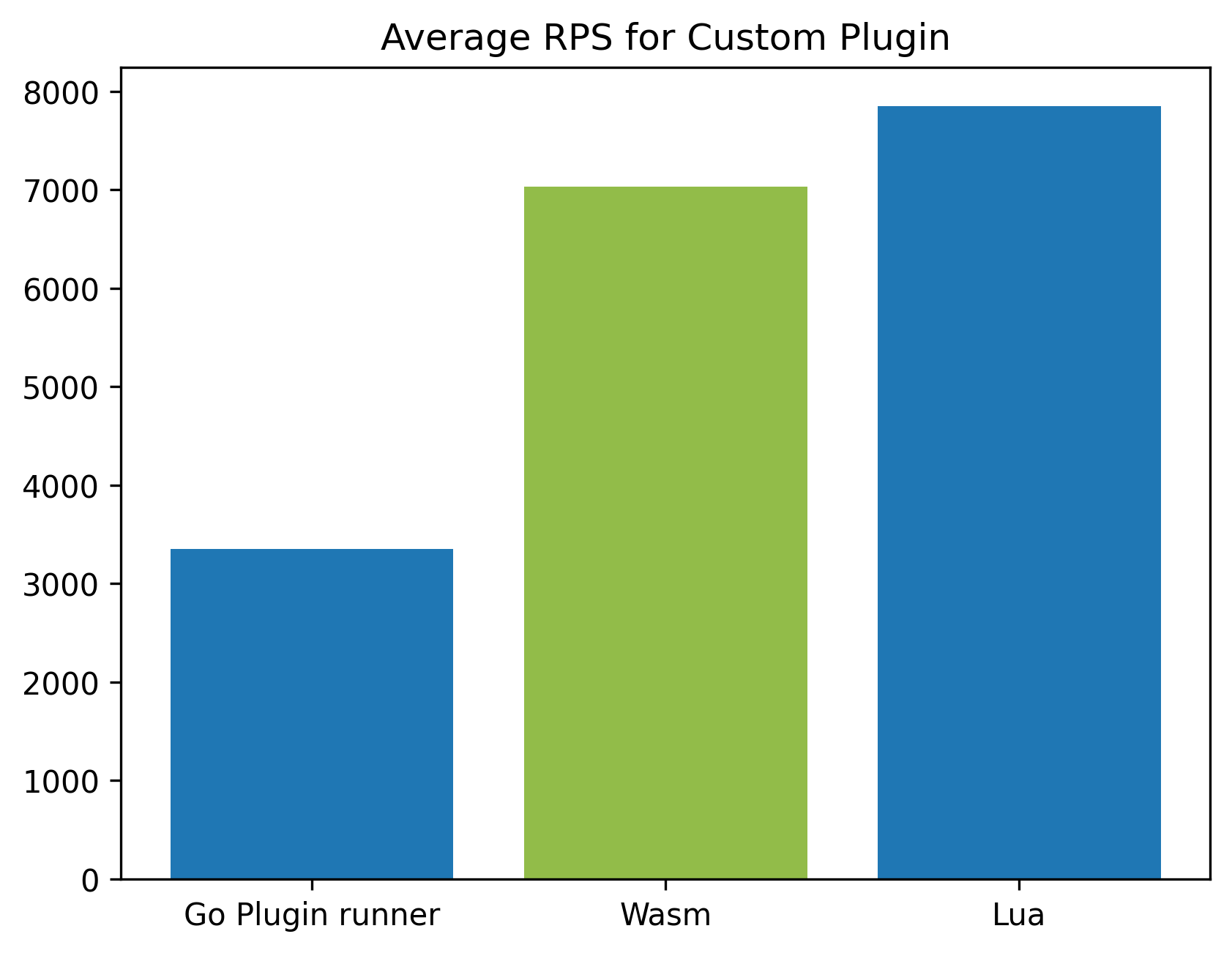
+A test using our example `custom-response-header` function implemented through
a Lua plugin, an external Go plugin runner, and a Wasm plugin show how the
performance varies:
+
+
+
+_Running 30s tests with 5 threads and 50 connections using
[wrk](https://github.com/wg/wrk)._
+
+Looking solely at this example, it might be tempting to ask why anyone would
want to use plugin runners or write Lua plugins. Well, all the advantages of
using Wasm comes with the following caveats:
+
+* **Limited plugins**: The Wasm implementation of programming languages often
lacks complete support. For Go, we were limited to using the TinyGo compiler,
similar to other languages.
+* **Immature stack**: Wasm and its usage outside the browser is still a
relatively new concept. The proxy-wasm spec also has its limitations due to its
relative novelty.
+* **Lack of concurrency**: Wasm does not have built-in concurrency support.
This could be a deal breaker for typical APISIX uses cases where high
performance is critical.
+* **Better alternatives**: Since APISIX can be extended using Lua plugins or
plugin runners, there are always alternatives to using Wasm.
+
+Despite these caveats, the future of Wasm in APISIX and other proxies seems
promising. You can choose to hop on the Wasm bandwagon if its benefits tip the
scale against these costs. But currently, APISIX plans to continue supporting
all three ways of creating custom plugins for the foreseeable future.