EmilyKeer commented on code in PR #1749:
URL: https://github.com/apache/apisix-website/pull/1749#discussion_r1437334223
########## blog/en/blog/2023/12/26/zhengcaiyun-uses-apisix.md: ########## @@ -0,0 +1,253 @@ +--- +title: "Building a Robust 'Highway' with APISIX: Gateway and Protocol Performance Optimization" +authors: + - name: Xiaobin Wang + title: Author + url: https://github.com/wxbty + image_url: https://github.com/wxbty.png + - name: Jing Yan + title: Technical Writer + url: https://github.com/JYan00 + image_url: https://github.com/JYan00.png +keywords: + - Open Source Community + - API Gateway + - Apache APISIX + - Zhengcaiyun +description: 'Author: Xiaobin Wang, Apache Dubbo Committer, Senior Development Engineer at Zhengcaiyun. This article is based on a presentation given by Xiaobin Wang at the APISIX Shanghai Meetup in November 2023.' +tags: [Case Studies] +image: https://static.apiseven.com/uploads/2023/12/08/XDJDiILW_Zheng.jpeg +--- + +> Author: Xiaobin Wang, Apache Dubbo Committer, Senior Development Engineer at Zhengcaiyun. This article is based on a presentation given by Xiaobin Wang at the APISIX Shanghai Meetup in November 2023. +<!--truncate--> + +In tackling cross-network data challenges, Zhengcaiyun has constructed a "highway" based on Dubbo, with APISIX serving as the central gateway for network routing and supporting common features. This article delves into the optimization of gateway and protocol performance, addressing the specific challenges encountered during the construction of the "highway" project. + +## Background + +The Zhengcaiyun platform serves as an exclusive hub for government procurement, catering to various government departments and state-owned enterprises. From a network architecture perspective, this platform forms a hybrid cloud network by integrating elements of public cloud, private cloud, and government cloud. + +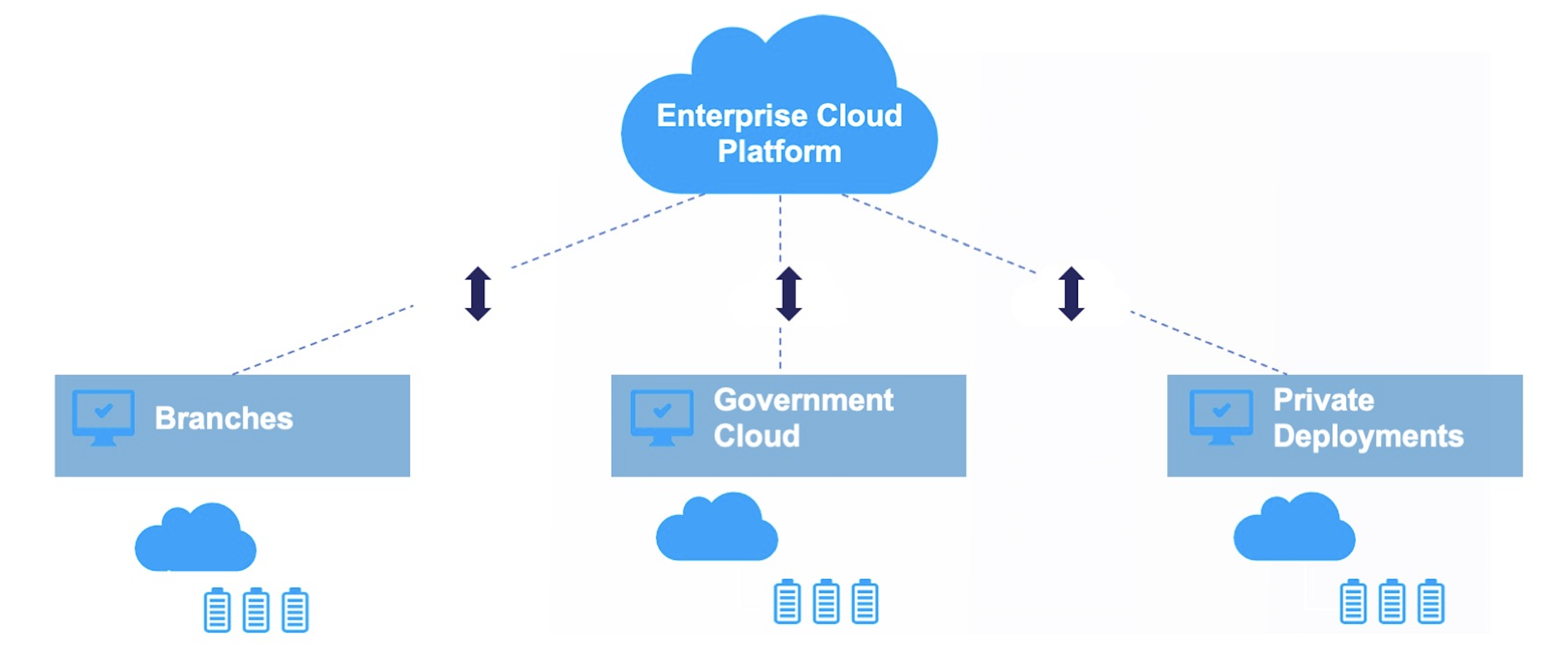 + +When Zhejiang governmental departments engage in procurement activities on the Zhengcaiyun platform, they are essentially utilizing the cloud-based operational framework. This cloud platform, situated in Zhejiang, forms a microservices network system. It serves as a platform that the company independently deploys and manages. Beyond Zhejiang, several other provinces also leverage the cloud platform for their procurement needs. + +Moreover, the platform extends its services to branch offices established in different provinces, each having distinct requirements. These branch offices deploy the same microservices framework, adapting to the administrative divisions of their respective provinces but operating within the local environment. Additionally, non-administrative entities, like banks, may opt for private deployment. + +All these microservices collectively form a segment of the hybrid cloud network. Consequently, cross-network data transmission becomes a common scenario for the business. + +In response to this demand, Zhengcaiyun initiated the "highway" project in late 2022. The project aimed to consolidate existing network transmission solutions, providing a unified, user-friendly, and high-speed cross-network business experience. As the integration of cross-network solutions progresses, an increasing portion of the company's cross-network traffic is directed toward this novel infrastructure. + +## "Highway" Project + +The "highway" project unfolds in three distinctive phases. The initial phase sees the deployment of the "highway" project based on Dubbo. Subsequently, the second phase consolidates prior solutions into the new framework. The third and final phase aims to address challenges emerging from the initial phases and undertake further refinements. + +In the initial phase, a pioneering architecture was designed using Dubbo, with APISIX playing a central role. Each node represents an island, signifying different provinces or other administrative divisions. Interestingly, the cloud platform itself serves as a unique island, and our platform encompassed multiple such islands, collectively forming a hybrid cloud network. + +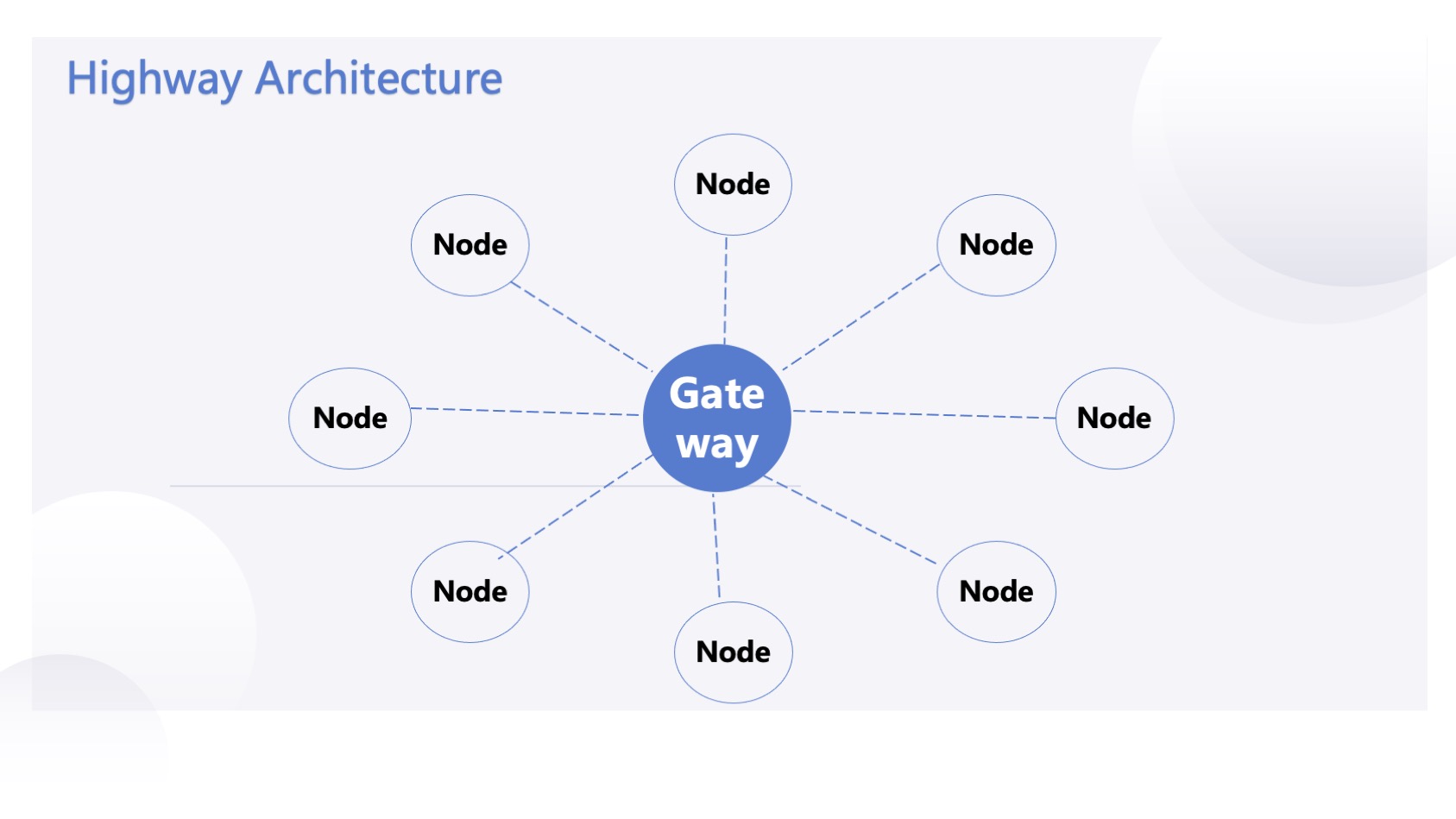 + +Why did we choose the star-shaped network architecture for this project? The need for cross-network communication existed right from the inception of Zhengcaiyun. In the early days, business operations involved point-to-point data transfers across networks, eventually leading to the formation of a mesh architecture. Previously, we had various projects and solutions related to cross-network operations—some provided by the foundational platform and others developed independently by businesses. The primary goal of the current "Highway" project is to integrate these solutions, establish a unified technical foundation, reduce individual operational costs, and streamline processes. This allows businesses to concentrate on their core activities while incorporating more common features. + +Developing individual solutions for each business could lead to functional limitations as they would only focus on their specific areas. On the other hand, opening up business operations for others might introduce challenges, such as the need to support custom features that the business itself does not prioritize. + +The star-shaped architecture of the "Highway" is the outcome of this integration. In the previous mesh structure, interconnecting each island required a series of intricate processes. For instance, coordinating with the operations and maintenance teams in provinces like Shanxi and Shanghai, having them open specific ports, deploying services based on those ports, and establishing network interactions. This resulted in numerous complex lines within the mesh structure. With n islands, there could be approximately n squared lines. The star-shaped architecture simplifies this, avoiding the intricacies of pairwise connections found in the earlier mesh structure. + +## Challenges + +After the successful trial of new business in the first half of 2023 under the "Highway" project, we initiated the gradual migration of historical cross-network solutions in the latter half of the year. Monitoring revealed increased pressure from the growing traffic, evidenced by: + +* **Frequent alerts from the heartbeat application:** To ensure the stability of the highway, we deployed a universal heartbeat application on each segment, responsible for network interconnectivity. This application triggers alerts if any issues arise. For instance, if requests slow down within a specific timeframe, exceeding 1 second per request, we promptly receive alerts. Monitoring indicated a frequent occurrence of alerts from the heartbeat application. +* **Declines in monitoring metrics such as response time (RT) and throughput:** We also employed the Prometheus-formatted BRAF interface for monitoring. On this interface, certain response volume and throughput curves exhibited a noticeable downward trend. + +The pressure in these two aspects gradually manifested as we transitioned historical solutions into the "Highway" project, coupled with the increasing traffic volume. + +In order to ensure the stability of our business operations and enhance the overall user experience, we have implemented a range of optimization strategies. Broadly speaking, our efforts have centered around three key approaches: + + Review Comment: "barrel model" in the chart seems to be an incorrect phase; please fix it -- This is an automated message from the Apache Git Service. To respond to the message, please log on to GitHub and use the URL above to go to the specific comment. To unsubscribe, e-mail: [email protected] For queries about this service, please contact Infrastructure at: [email protected]