This is an automated email from the ASF dual-hosted git repository.

nfrankel pushed a commit to branch master
in repository https://gitbox.apache.org/repos/asf/apisix-website.git
The following commit(s) were added to refs/heads/master by this push:
new 379f8bca471 blog: Add Fixing duplicate API requests post (#1782)
379f8bca471 is described below
commit 379f8bca4715c72c1dbfc6ce197823144836ebb2
Author: Nicolas Fränkel <[email protected]>
AuthorDate: Mon Apr 1 09:21:36 2024 +0200
blog: Add Fixing duplicate API requests post (#1782)
---
.../blog/2024/04/04/fix-duplicate-api-requests.md | 112 +++++++++++++++++++++
1 file changed, 112 insertions(+)
diff --git a/blog/en/blog/2024/04/04/fix-duplicate-api-requests.md
b/blog/en/blog/2024/04/04/fix-duplicate-api-requests.md
new file mode 100644
index 00000000000..586160d39b1
--- /dev/null
+++ b/blog/en/blog/2024/04/04/fix-duplicate-api-requests.md
@@ -0,0 +1,112 @@
+---
+title: Fixing duplicate API requests
+authors:
+ - name: Nicolas Fränkel
+ title: Author
+ url: https://github.com/nfrankel
+ image_url: https://avatars.githubusercontent.com/u/752258
+keywords:
+ - APISIX
+ - Idempotency
+ - IETF
+ - specification
+description: >
+ The first rule of distributed systems is "Don’t distribute your system".
Designing distributed systems right is infamously hard for multiple reasons.
+tags: [Community]
+image:
https://static.apiseven.com/uploads/2024/03/28/XObjRS46_stormtrooper-2899993.jpg
+---
+
+<head>
+ <link rel="canonical"
href="https://blog.frankel.ch/fix-duplicate-api-requests/"; />
+</head>
+
+>The first rule of distributed systems is "Don’t distribute your system".
Designing distributed systems right is infamously hard for multiple reasons.
+
+<!--truncate-->
+
+## The idempotency concept
+
+For example, a call to a function can succeed or fail in non-distributed
systems. Once you move the called function to a remote component, a third
option appears: you call the remote function but get no response from the
component. At this point, it’s impossible to know whether the call reached the
component or not, *i.e.*, whether the problem occurred on the way to or the way
back.
+
+The only choice is to resend the request again. It’s a non-issue for reads;
for calls that update the remote state, it’s "complicated." We need to describe
the concept of *idempotence*:
+>Idempotence is the property of certain operations in mathematics and computer
science whereby they can be applied multiple times without changing the result
beyond the initial application.
+>
+>—- [Idempotence on Wikipedia](https://en.wikipedia.org/wiki/Idempotence)
+
+In the realm of HTTP APIs:
+
+* `GET`, `PUT`, `DELETE`, `HEAD`, `OPTIONS`, and `TRACE` are idempotent. For
example, if you repeatedly delete an entity from the system, whether the said
entity exists or not, the end state will be the same: there will be no entity.
+* **`POST` and `PATCH` are not idempotent**. For example, posting multiple
times a new entity will create that many new entities.
+
+## A possible solution
+
+Imagine that the client sending a request sends a unique key along. The server
keeps track of key-request pairs. Overall, two things can happen:
+
+* The server already has a record of such a pair and discards the request
+* The server has no such previous record and stores the pair
+
+It’s precisely the idea behind the IETF specification [The Idempotency-Key
HTTP Header
Field](https://datatracker.ietf.org/doc/html/draft-ietf-httpapi-idempotency-key-header-04).
The `Idempotency-Key` HTTP header’s value is a string; the specification uses
a UUID as an example. It’s the client’s responsibility to generate such a
value, which must be unique.
+
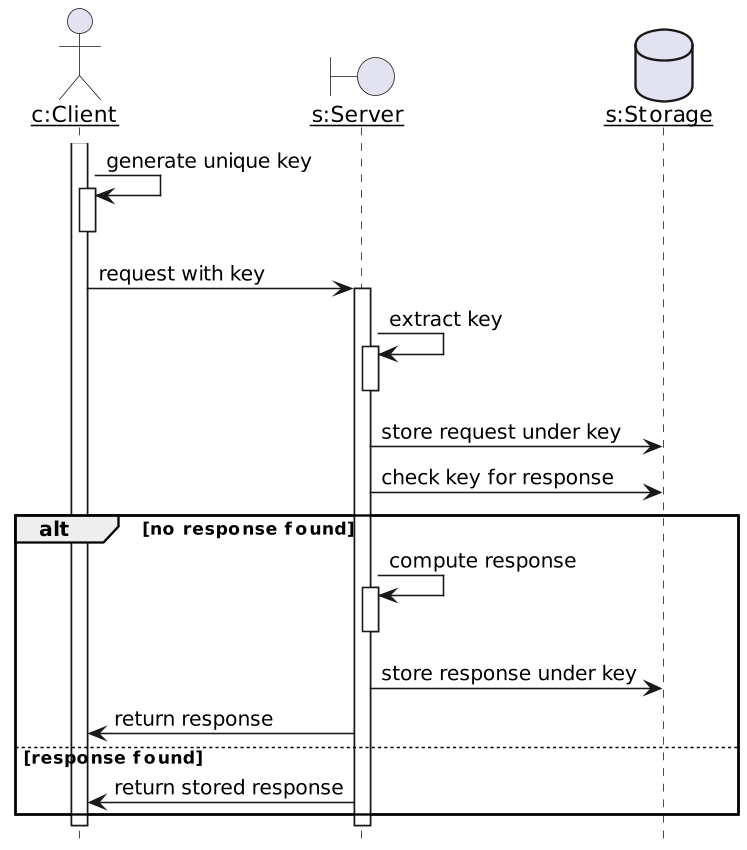
+The spec describes the following flow:
+
+
+
+The specification mentions the server can optionally fingerprint the request,
*i.e.*, hash it, and store the hash instead.
+
+## Error scenarios
+
+The nominal path is pretty straightforward, but the specification also defines
three possible error scenarios that can happen.
+
+Here they are:
+
+* The request doesn't provide the idempotency key for a documented idempotent
operation requiring this header/400:
+
+ ```
+ HTTP/1.1 400 Bad Request
+ Content-Type: application/problem+json
+ Content-Language: en
+ {
+ "type": "https://developer.example.com/idempotency";,
+ "title": "Idempotency-Key is missing",
+ "detail": "This operation is idempotent and it requires correct usage of
Idempotency Key.",
+ }
+ ```
+
+* Attempt to reuse an idempotency key with a different request payload/422:
+
+ ```
+ HTTP/1.1 422 Unprocessable Content
+ Content-Type: application/problem+json
+ Content-Language: en
+ {
+ "type": "https://developer.example.com/idempotency";,
+ "title": "Idempotency-Key is already used",
+ "detail": "This operation is idempotent and it requires
+ correct usage of Idempotency Key. Idempotency Key MUST not be
+ reused across different payloads of this operation.",
+ }
+ ```
+
+* Request is retried while the original request is still being processed/409:
+
+ ```
+ HTTP/1.1 409 Conflict
+ Content-Type: application/problem+json
+ Content-Language: en
+ {
+ "type": "https://developer.example.com/idempotency";,
+ "title": "A request is outstanding for this Idempotency-Key",
+ "detail": "A request with the same Idempotency-Key for the
+ same operation is being processed or is outstanding."
+ }
+ ```
+
+## Conclusion
+
+Distributed systems are complex in part because if a call to a remote
component times out, it’s impossible to know whether it reached the said
component. The only option is to repeat the call, but we risk executing a
non-idempotent operation twice. In the realm of APIs, we can rely on the
`Idempotency-Key` HTTP Header, an IETF specification currently in draft.
+
+From an architect’s point of view, it makes sense to factor the behavior
described in the above sequence diagram into a component, *i.e.*, an API
Gateway. In a future post, I’ll try implementing the behavior in Apache APISIX.
+
+**To go further:**
+
+* [Idempotency-Key HTTP Header
Field](https://datatracker.ietf.org/doc/html/draft-ietf-httpapi-idempotency-key-header-04)