This is an automated email from the ASF dual-hosted git repository.

guoqi pushed a commit to branch master
in repository https://gitbox.apache.org/repos/asf/apisix-website.git
The following commit(s) were added to refs/heads/master by this push:
new 3076dff43a4 blog: 360-built-unified-l7-load-balancer-with-apisix
(#1951)
3076dff43a4 is described below
commit 3076dff43a4c837fc5acb8fde85964c7618be772
Author: Yilia Lin <[email protected]>
AuthorDate: Mon Sep 8 18:28:42 2025 +0800
blog: 360-built-unified-l7-load-balancer-with-apisix (#1951)
---
...0-built-unified-l7-load-balancer-with-apisix.md | 100 ++++++++++++++++++++
...0-built-unified-l7-load-balancer-with-apisix.md | 103 +++++++++++++++++++++
2 files changed, 203 insertions(+)
diff --git
a/blog/en/blog/2025/09/03/360-built-unified-l7-load-balancer-with-apisix.md
b/blog/en/blog/2025/09/03/360-built-unified-l7-load-balancer-with-apisix.md
new file mode 100644
index 00000000000..2aceb11537f
--- /dev/null
+++ b/blog/en/blog/2025/09/03/360-built-unified-l7-load-balancer-with-apisix.md
@@ -0,0 +1,100 @@
+---
+title: "360 Built Unified L7 Load Balancer Using Apache APISIX"
+authors:
+ - name: 360 ZYUN Cloud
+ title: Author
+ - name: Yilia Lin
+ title: Technical Writer
+ url: https://github.com/Yilialinn
+ image_url: https://github.com/Yilialinn.png
+keywords:
+ - open source
+ - API gateway
+ - Apache APISIX
+ - 360
+ - L7 load balancing
+ - API gateway use case
+description: 360 unifies Layer 7 load balancing using APISIX, gaining VPC,
cloud-native, and fine-grained routing in one seamless upgrade.
+tags: [Case Studies]
+image:
https://static.api7.ai/uploads/2025/09/05/SWaSLAns_360-zyun-cloud-use-case.webp
+---
+
+> 360 unifies Layer 7 load balancing using APISIX, gaining VPC, cloud-native,
and fine-grained routing in one seamless upgrade.
+>
+<!--truncate-->
+
+## About 360 and 360 ZYUN Cloud
+
+360 Security Technology Inc., also branded as [Qihoo
360](https://www.linkedin.com/company/qihoo-360/), is a leading Internet and
security technology enterprise and the first advocate of free Internet security
in China. In the wave of AI, it is committed to helping industries and
organizations achieve intelligent digital transformation.
+
+360 ZYUN Cloud is the intelligent data cloud foundation of 360, offering a
wide range of products and services, including databases, middleware, storage,
big data, artificial intelligence, computing, networking, video, and IoT
integration, and communications, as well as one-stop solutions.
+
+Positioned as an open enterprise application service platform with the mission
of "aggregating the value of data and enabling an intelligent future," 360 ZYUN
Cloud provides robust products and technical services for businesses and
applications across industries, helping enterprises and organizations unlock
greater commercial value.
+
+## Project Background
+
+Layer 7 (L7) load balancing, which operates at the application layer of the
OSI model, provides deep inspection of protocols like HTTP/HTTPS and supports a
rich set of advanced routing rules. Unlike Layer 4 (L4) load balancing, which
only considers IP addresses and ports, L7 load balancing understands
application-layer content, enabling far more granular traffic control.
+
+Our existing internal L7 load-balancing system at 360 faced two critical
limitations:
+
+1. It was built for traditional data center infrastructure and did not support
Virtual Private Clouds (VPCs), making it unable to meet the needs of our
cloud-based tenants.
+2. While it supported bare-metal and virtual machine backends, it was not
designed for modern, cloud-native workloads such as containers.
+
+To overcome these challenges, we initiated the Unified L7 Load Balancing
project. The goal was to build a single, comprehensive load balancing service
that supports a hybrid network architecture and can route traffic to diverse
backend instance types.
+
+The core features required for this new service were:
+
+* **Intelligent Routing:** Fine-grained traffic routing by parsing HTTP
headers (`User-Agent`, `Cookie`), URL paths, and other parameters.
+* **Session Persistence:** Ensuring user requests are consistently directed to
the same backend server by injecting cookies or generating session IDs.
+* **Active Health Checks:** Proactively monitoring the health of backend
upstreams to prevent requests from being sent to unhealthy instances.
+* **Dynamic Configuration (Hot Reloading):** Allowing configuration changes to
take effect in real-time without service interruptions, simplifying maintenance.
+* **High Availability (HA):** Ensuring instance reliability through
cluster-based failover, session persistence, and multi-AZ deployments.
+
+## Service Architecture Design
+
+### 1. Overall Architecture
+
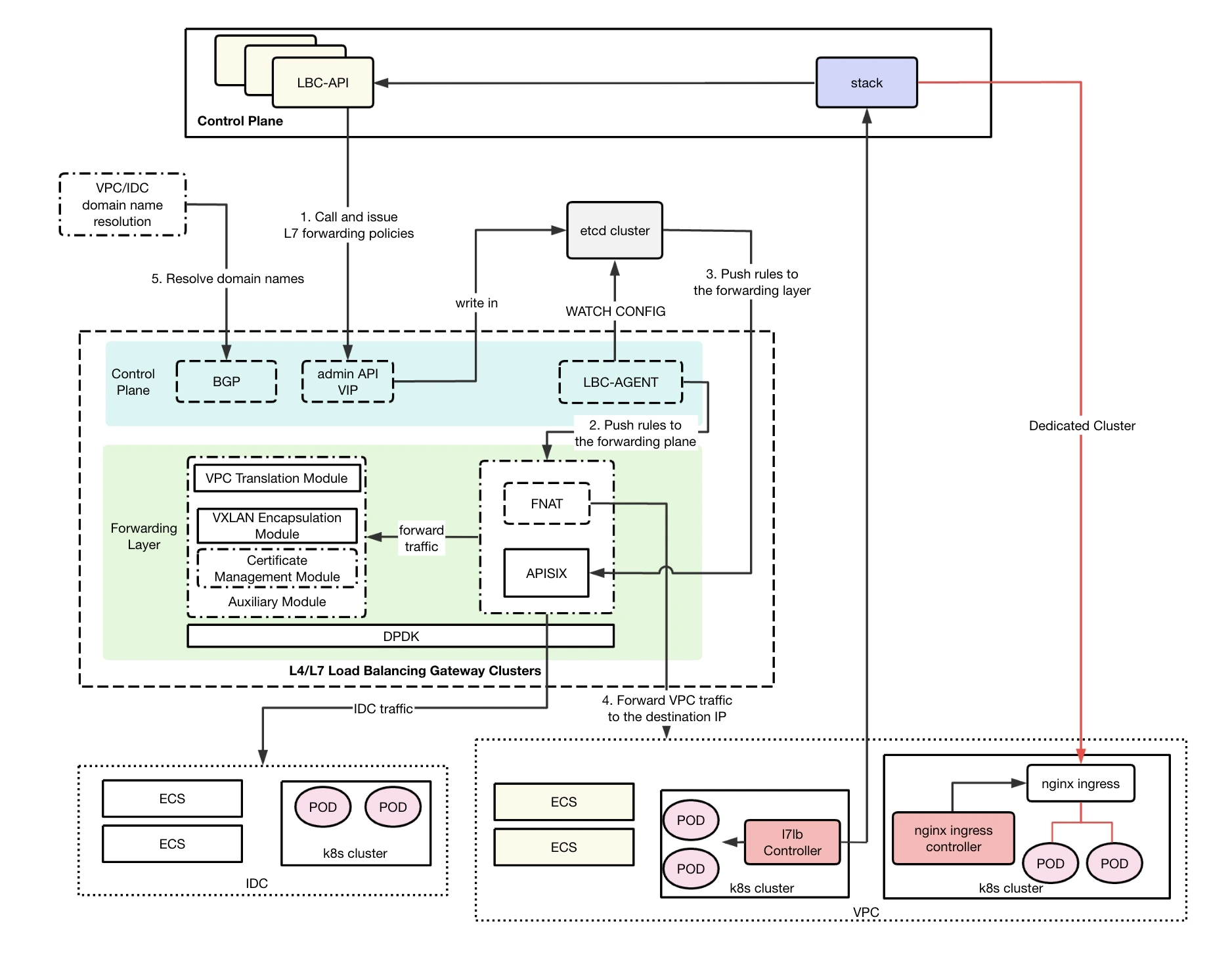
+The unified L7 load balancing architecture is composed of two main components:
a **control plane** and a **data plane**.
+
+The **control plane** is responsible for configuration management. In addition
to our existing `LBC-API` (shared by L4 and L7), we integrated the `apisix
admin API` for managing L7 rules. We use an `etcd` cluster as the configuration
store; its millisecond-level notification mechanism enables real-time
configuration updates, which is ideal for scalable, containerized environments.
In VPC scenarios, the control plane assigns a unique internal IP to each
upstream to mask its real VPC IP address.
+
+The **data plane** is the component that processes client requests and
forwards user traffic. It is stateless but supports a wide range of functions,
including authentication, SSL/TLS offloading, logging, and observability. For
VPC traffic, the data plane integrates with our FNAT gateway's forwarding
logic. Using the mapping between the unique internal IP and the real VPC IP, it
encapsulates traffic in **VXLAN** packets before sending them to the host
machine where the upstream instance [...]
+
+
+
+L7 resources (e.g., `service`, `route`, `upstream`) are managed via calls to
the internal `LBC-API`. The workflow is as follows:
+
+1. The API then calls the `apisix admin API` to persist the configuration into
the `etcd` cluster.
+2. The `LBC-AGENT` process listens for changes in `etcd` and applies VPC IP
mapping configurations to the FNAT data plane.
+3. The APISIX data plane nodes also listen for changes in `etcd`, allowing new
L7 routing rules to take effect dynamically.
+4. Traffic from our on-prem data center (IDC) is forwarded directly to its
destination IP, while traffic destined for VPCs is encapsulated and forwarded
to its host.
+5. To use the service, teams simply point their application's DNS to the
corresponding Virtual IP (EIP for public services or a VPC-internal VIP).
+
+### 2. Service Deployment Architecture
+
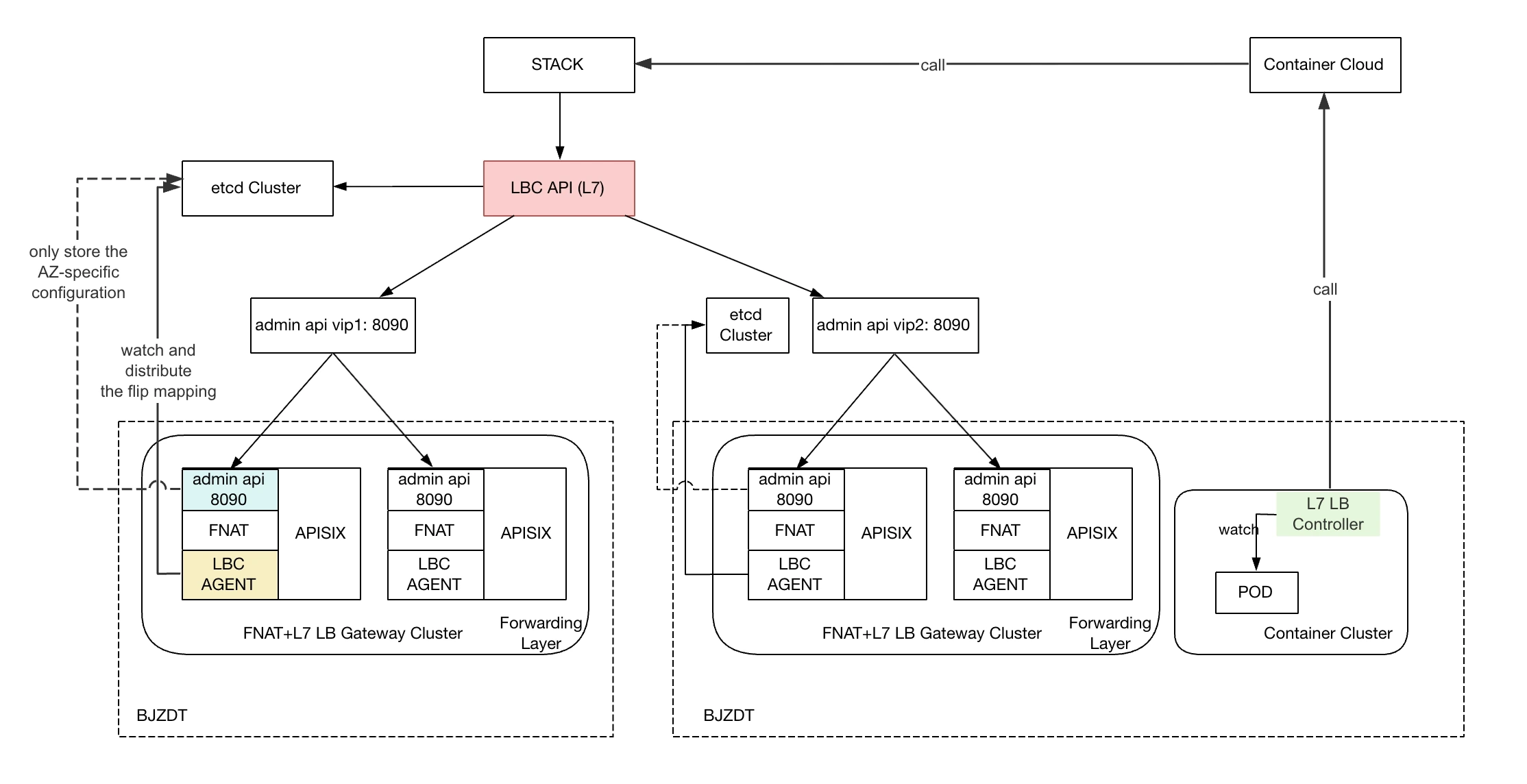
+Our deployment architecture is shown in the diagram below. It has several
features:
+
+* **Unified Interface:** Our internal "Stack" platform provides a single
OpenAPI for all teams, including our container cloud platform, to manage their
L7 load balancing resources.
+* **High Availability:** The control plane and storage are deployed at a
regional level. The data plane is deployed in a clustered mode within each
Availability Zone (AZ), ensuring that if one server fails, requests are
automatically redirected to other nodes in the cluster.
+* **Hybrid L4/L7 Deployment:** We reuse existing L4 capabilities, which
reduces development overhead and creates a seamless hybrid infrastructure.
+
+
+
+### Traffic Path
+
+Traffic flows through one of two primary paths depending on the environment:
+
+* **Classic Network (On-Prem) L7 Traffic:**
+ Public EIP -> L4 Load Balancer (idc vip) -> **L7 LB Gateway** ->
IDC-routable IP (VM, pod, etc.)
+* **VPC Cloud L7 Traffic:**
+ Public EIP -> L4 Load Balancer (vpc vip) -> **L7 LB Gateway with VXLAN
encapsulation** -> VPC-internal IP (VM, pod, etc.)
+
+<div align="center">
+<img alt="Traffic Path Diagram" style="width: 65%"
src="https://static.api7.ai/uploads/2025/09/04/zO2tt4qq_3.1-en.webp";></img>
+</div>
+
+### Conclusion & Future Outlook
+
+The unified Layer-7 load balancing service has now been fully launched across
all three regions within 360, and container services have also been adapted.
+
+At present, the unified Layer-7 load balancing only supports relatively basic
features, with more functional enhancements planned, such as SSL offloading
optimization, supporting forwarding rules with redirect, traffic mirroring, and
support for additional protocol types. It is gradually evolving toward
intelligence, transforming from a simple traffic distribution tool into an
intelligent scheduling hub.
diff --git
a/blog/zh/blog/2025/09/03/360-built-unified-l7-load-balancer-with-apisix.md
b/blog/zh/blog/2025/09/03/360-built-unified-l7-load-balancer-with-apisix.md
new file mode 100644
index 00000000000..a4b2a3bd00a
--- /dev/null
+++ b/blog/zh/blog/2025/09/03/360-built-unified-l7-load-balancer-with-apisix.md
@@ -0,0 +1,103 @@
+---
+title: "APISIX 在 360 统一七层负载均衡的落地实践"
+authors:
+ - name: 360 智汇云
+ title: author
+ - name: Yilia Lin
+ title: Technical Writer
+ url: https://github.com/Yilialinn
+ image_url: https://github.com/Yilialinn.png
+keywords:
+ - APISIX
+ - 360
+ - API 网关
+ - 七层负载均衡
+ - L7
+description: 360 使用 Apache APISIX 统一七层负载均衡,通过其 Admin API 和 etcd 热同步机制,实现了
VPC、云原生能力以及精细化路由的一体化升级。
+tags: [Case Studies]
+image:
https://static.api7.ai/uploads/2025/09/05/SWaSLAns_360-zyun-cloud-use-case.webp
+---
+
+> 360 使用 Apache APISIX 统一七层负载均衡,通过其 Admin API 和 etcd 热同步机制,实现了
VPC、云原生能力以及精细化路由的一体化升级。
+>
+<!--truncate-->
+
+## 360 及 360 智汇云简介
+
+[360 公司](https://www.360.com/)是中国领先的互联网和安全技术公司,是中国首家互联网免费安全的倡导者。AI
浪潮下,致力于帮助产业和组织智转数改。
+
+[360 智汇云](https://zyun.360.cn/)是 360
公司的智数云底座,提供数据库、中间件、存储、大数据、人工智能、计算、网络、视联物联与通信等多种产品服务以及一站式解决方案。智汇云以“汇聚数据价值,助力智能未来”为目标的企业应用开放服务平台,为各行各业的业务及应用提供强有力的产品、技术服务,帮助企业和业务实现更大的商业价值。
+
+## 项目背景
+
+七层负载均衡工作在 OSI 模型的应用层,支持 HTTP/HTTPS 等协议深度解析,支持丰富的高级转发规则。与四层负载均衡单纯关注 IP+
端口不同,七层负载均衡能够理解应用层协议内容,实现更精细化的流量控制。
+
+360 内部原有七层负载均衡存在以下两点问题:
+
+1. 适用于经典网络场景,不支持专有网络(Virtual Private Cloud,简称 VPC),无法满足云上租户需求。
+
+2. 后端主机组支持裸金属和虚拟机,缺失了云原生场景。
+
+基于上述问题,统一七层负载均衡项目产生,旨在通过一套负载均衡服务,支持混合网络架构,后端主机适配多种实例类型。服务主要有以下特点:
+
+- **智能路由决策**:通过解析 HTTP 头信息(User-Agent、Cookie)、URL 路径、SSL 会话 ID 等参数实现精细化流量调度。
+
+- **会话保持机制**:通过注入 Cookie 或生成 SessionID 确保用户请求持续指向同一后端服务器。
+
+- **主动健康检查**:主动探活后端 upstream 存活状态,避免 upstream 异常引发请求异常。
+
+- **配置热加载**:配置统一变更可实时生效,减少配置维护复杂度。
+
+- **高可用**:通过集群容灾、会话保持、可用区多活等机制保障实例的可用性。
+
+## 服务架构设计
+
+### 1. 整体架构
+
+统一七层负载均衡架构分为控制面和转发面两部分。
+
+控制面除原有 LBC-API(四七层共用)外,还引入 APISIX Admin API 用于七层规则的下发。存储使用 etcd
集群,毫秒级的变化通知机制,使得配置变更达到实时的效果,支持集群管理,更好的适配容器场景。VPC 场景下,控制面为 VPC 内 upstream 分配一个唯一
IP 用于替换 upstream 的真实 VPC IP。
+
+第二部分是转发面,真正去处理来自客户端请求,转发用户的真实流量,支持多种功能,如身份验证、证书卸载、日志分析和可观测性等,不做数据的存储。VPC
场景中,转发面复用 FNAT 网关转发逻辑,根据唯一 IP 和真实 VPC IP 的映射关系,将流量封装 VXLAN 后发送至 upstream 所在宿主机。
+
+
+
+七层相关资源如 service、route、upstream 等可通过调用 LBC-API 创建/删除/修改。具体流程如下:
+
+1. API 会继续调用 admin api vip 将请求写入 etcd 集群。
+
+2. LBC-AGENT 程序监听 etcd 变更,将 VPC 映射配置通过命令下发至 FNAT 转发面。
+
+3. 转发面监听 etcd 变更,使得七层转发规则生效。
+
+4. IDC 流量直接转发至对应 IP,VPC 内流量经过额外封装转发至对应宿主机。
+
+5. 业务申请域名解析,将域名解析到对应的 VIP(EIP/VPC 内 VIP)即可访问使用。
+
+### 2. 服务部署架构
+
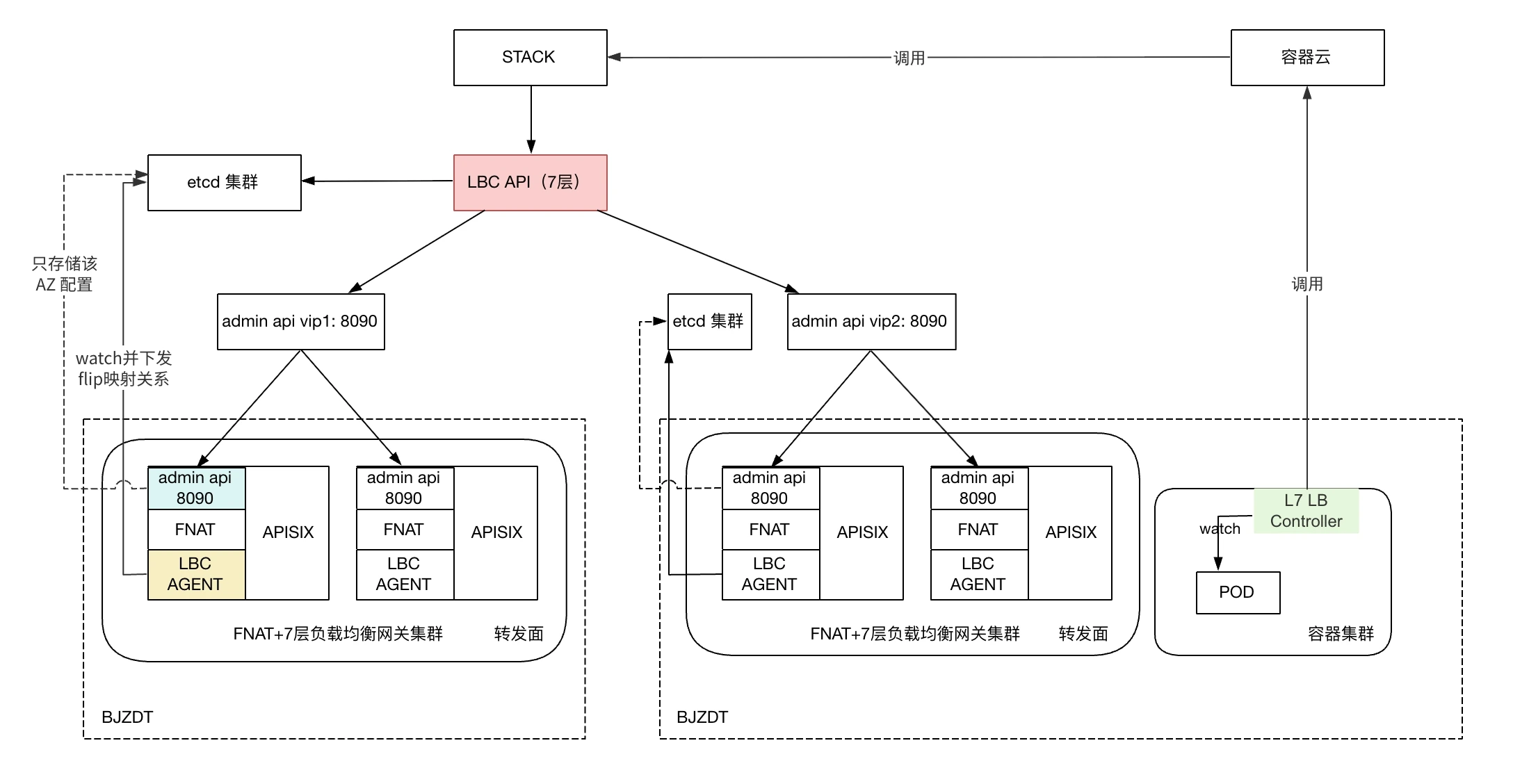
+服务部署架构如下图所示。
+
+- **统一接口**:stack 平台为统一请求入口,对外提供 OpenAPI
供业务方调用,容器云通过该入口进行七层负载均衡资源的接口操作,后续其他业务统一走 OpenAPI 接入。
+
+- **高可用**:控制面/存储地域级别部署,转发面可用区(AZ)粒度集群模式部署,单台服务器宕机,请求自动切到集群其他台。
+
+- **四七层混合部署**:复用四层已有能力,减少额外开发。
+
+
+
+## 流量路径
+
+流量分为云上云下两种场景:
+
+- **经典网络七层流量**:公网 EIP -> 四层负载均衡集群(idc vip)-> 七层负载均衡网关 -> IDC 可达 IP(包括虚机/POD等)。
+
+- **VPC 云上七层流量**:公网 EIP -> 四层负载均衡集群(vpc vip) -> 七层负载均衡网关(vxlan封装)-> VPC 内
IP(包括虚机/POD等)。
+
+<div align="center">
+<img alt="Traffic Path Diagram" style="width: 65%"
src="https://static.api7.ai/uploads/2025/09/04/BFDB1z4d_3.1-cn.webp";></img>
+</div>
+
+## 总结与展望
+
+当前统一七层负载均衡服务已经在 360 公司三个地域全部上线,容器服务也适配完成。目前统一七层负载均衡仅支持了较为基础的功能,还有更多的功能扩展,如:SSL
卸载优化、转发规则支持重定向、流量镜像、支持更多协议类型等,并逐步向智能化发展,从单纯的流量分发工具演变成智能调度中枢。