This is an automated email from the ASF dual-hosted git repository.

jianbin pushed a commit to branch docusaurus
in repository https://gitbox.apache.org/repos/asf/incubator-seata-website.git
The following commit(s) were added to refs/heads/docusaurus by this push:
new 6b7d23018a update: translate seata-raft-detailed-explanation.md to
english (#809)
6b7d23018a is described below
commit 6b7d23018a73dd551a527455351b86a4ec33cf27
Author: 云清 <[email protected]>
AuthorDate: Thu Jan 25 15:00:10 2024 +0800
update: translate seata-raft-detailed-explanation.md to english (#809)
---
.../docusaurus-plugin-content-blog/seata-1.5.2.md | 86 +++++++
.../seata-raft-detailed-explanation.md | 260 +++++++++++++++++++++
2 files changed, 346 insertions(+)
diff --git a/i18n/en/docusaurus-plugin-content-blog/seata-1.5.2.md
b/i18n/en/docusaurus-plugin-content-blog/seata-1.5.2.md
new file mode 100644
index 0000000000..958912fe46
--- /dev/null
+++ b/i18n/en/docusaurus-plugin-content-blog/seata-1.5.2.md
@@ -0,0 +1,86 @@
+---
+title: Seata 1.5.2 Released with XID Load Balancing Support
+author: Seata Community
+keywords: [seata, distributed transaction, 1.5.2]
+description: Seata 1.5.2 Released with XID Load Balancing Support
+date: 2022/07/12
+---
+
+### Seata 1.5.2 Released with XID Load Balancing Support
+
+Seata is an open-source distributed transaction solution that provides
high-performance and easy-to-use distributed transaction services.
+
+**seata-server Download Links:**
+
+[source](https://github.com/apache/incubator-seata/archive/v1.5.2.zip) |
+[binary](https://github.com/apache/incubator-seata/releases/download/v1.5.2/seata-server-1.5.2.zip)
+
+The key updates in this version include:
+
+### Features:
+- [[#4661](https://github.com/apache/incubator-seata/pull/4713)] Added support
for XID load balancing algorithm.
+- [[#4676](https://github.com/apache/incubator-seata/pull/4676)] Added support
for Seata server to expose services through SLB when using Nacos as the
registry center.
+- [[#4642](https://github.com/apache/incubator-seata/pull/4642)] Added support
for parallel processing of client batch requests.
+- [[#4567](https://github.com/apache/incubator-seata/pull/4567)] Added support
for the `find_in_set` function in the WHERE condition.
+
+### Bug Fixes:
+- [[#4515](https://github.com/apache/incubator-seata/pull/4515)] Fixed an
issue where SeataTCCFenceAutoConfiguration on the develop branch throws a
ClassNotFoundException when the client does not use a DB.
+- [[#4661](https://github.com/apache/incubator-seata/pull/4661)] Fixed SQL
exceptions when using PostgreSQL in the console.
+- [[#4667](https://github.com/apache/incubator-seata/pull/4682)] Fixed an
exception when updating the map in RedisTransactionStoreManager on the develop
branch.
+- [[#4678](https://github.com/apache/incubator-seata/pull/4678)] Fixed the
issue of cache penetration when the property
`transport.enableRmClientBatchSendRequest` is not configured.
+- [[#4701](https://github.com/apache/incubator-seata/pull/4701)] Fixed the
issue of missing command line parameters.
+- [[#4607](https://github.com/apache/incubator-seata/pull/4607)] Fixed a
defect in skipping global lock verification.
+- [[#4696](https://github.com/apache/incubator-seata/pull/4696)] Fixed the
insertion issue when using the Oracle storage mode.
+- [[#4726](https://github.com/apache/incubator-seata/pull/4726)] Fixed a
possible NPE issue when sending messages in batches.
+- [[#4729](https://github.com/apache/incubator-seata/pull/4729)] Fixed the
issue of incorrect setting of `AspectTransactional.rollbackForClassName`.
+- [[#4653](https://github.com/apache/incubator-seata/pull/4653)] Fixed the
exception of non-numeric primary key in INSERT_ON_DUPLICATE.
+
+### Optimizations:
+- [[#4650](https://github.com/apache/incubator-seata/pull/4650)] Fixed a
security vulnerability.
+- [[#4670](https://github.com/apache/incubator-seata/pull/4670)] Optimized the
number of threads in the `branchResultMessageExecutor` thread pool.
+- [[#4662](https://github.com/apache/incubator-seata/pull/4662)] Optimized the
monitoring metrics for rolling back transactions.
+- [[#4693](https://github.com/apache/incubator-seata/pull/4693)] Optimized the
console navigation bar.
+- [[#4700](https://github.com/apache/incubator-seata/pull/4700)] Fixed
failures in the execution of maven-compiler-plugin and maven-resources-plugin.
+- [[#4711](https://github.com/apache/incubator-seata/pull/4711)] Separated the
lib dependency during deployment.
+- [[#4720](https://github.com/apache/incubator-seata/pull/4720)] Optimized pom
descriptions.
+- [[#4728](https://github.com/apache/incubator-seata/pull/4728)] Upgraded the
logback version dependency to 1.2.9.
+- [[#4745](https://github.com/apache/incubator-seata/pull/4745)] Added support
for mysql8 driver in the distribution package.
+- [[#4626](https://github.com/apache/incubator-seata/pull/4626)] Used
`easyj-maven-plugin` plugin instead of `flatten-maven-plugin` to fix
compatibility issues between `shade` plugin and `flatten` plugin.
+- [[#4629](https://github.com/apache/incubator-seata/pull/4629)] Checked the
constraint relationship before and after updating the globalSession status.
+- [[#4662](https://github.com/apache/incubator-seata/pull/4662)] Optimized the
readability of EnhancedServiceLoader.
+
+### Tests:
+- [[#4544](https://github.com/apache/incubator-seata/pull/4544)] Optimized the
jackson package dependency issue in TransactionContextFilterTest.
+- [[#4731](https://github.com/apache/incubator-seata/pull/4731)] Fixed unit
test issues in AsyncWorkerTest and LockManagerTest.
+
+A big thanks to the contributors for their valuable code contributions. If
inadvertently omitted, please report.
+
+
+<!-- Make sure your GitHub ID is in the list below -->
+- [slievrly](https://github.com/slievrly)
+- [pengten](https://github.com/pengten)
+- [YSF-A](https://github.com/YSF-A)
+- [tuwenlin](https://github.com/tuwenlin)
+- [2129zxl](https://github.com/2129zxl)
+- [Ifdevil](https://github.com/Ifdevil)
+- [wingchi-leung](https://github.com/wingchi-leung)
+- [liurong](https://github.com/robynron)
+- [opelok-z](https://github.com/opelok-z)
+- [funky-eyes](https://github.com/funky-eyes)
+- [Smery-lxm](https://github.com/Smery-lxm)
+- [lvekee](https://github.com/lvekee)
+- [doubleDimple](https://github.com/doubleDimple)
+- [wangliang181230](https://github.com/wangliang181230)
+- [Bughue](https://github.com/Bughue)
+- [AYue-94](https://github.com/AYue-94)
+- [lingxiao-wu](https://github.com/lingxiao-wu)
+- [caohdgege](https://github.com/caohdgege)
+
+At the same time, we have received many valuable issues and suggestions from
the community, thank you very much.
+
+#### Link
+
+- **Seata:** https://github.com/apache/incubator-seata
+- **Seata-Samples:** https://github.com/apache/incubator-seata-samples
+- **Release:** https://github.com/apache/incubator-seata/releases
+- **WebSite:** https://seata.io
diff --git
a/i18n/en/docusaurus-plugin-content-blog/seata-raft-detailed-explanation.md
b/i18n/en/docusaurus-plugin-content-blog/seata-raft-detailed-explanation.md
new file mode 100644
index 0000000000..9e47424745
--- /dev/null
+++ b/i18n/en/docusaurus-plugin-content-blog/seata-raft-detailed-explanation.md
@@ -0,0 +1,260 @@
+---
+title: Seata-Raft Storage Mode in Depth and Getting Started
+description: From traditional storage and computing separation to integrated
storage and computing relying on distributed consensus algorithms to ensure
transaction data consistency under high availability mode, what changes has
Seata 2.x made? This article will provide a detailed introduction to the
architecture and performance comparison.
+keywords: [fescar, seata, distributed transactions, raft]
+author: funkye
+date: 2023/10/13
+---
+
+
+- [1. Overview](#)
+- [2. Architecture Introduction](#)
+- [3. Deployment and Usage](#)
+- [4. Benchmark Comparison](#)
+- [5. Conclusion](#)
+
+# 1. Overview
+
+Seata is an open-source distributed transaction solution with over 24000 stars
and a highly active community. It is dedicated to providing high-performance
and user-friendly distributed transaction services in microservices
architecture.
+
+Currently, Seata's distributed transaction data storage modes include file,
db, and redis. This article focuses on the architecture, deployment and usage,
benchmark comparison of Seata-Server Raft mode. It explores why Seata needs
Raft and provides insights into the process from research and comparison to
design, implementation, and knowledge accumulation.
+
+Presenter: Jianbin Chen(funkye) github id:
[funky-eyes](https://github.com/funky-eyes)
+
+# 2. Architecture Introduction
+
+## 2.1 What is Raft Mode?
+
+Firstly, it is essential to understand what the Raft distributed consensus
algorithm is. The following excerpt is a direct quote from the official
documentation of sofa-jraft:
+
+```
+RAFT is a novel and easy-to-understand distributed consensus replication
protocol proposed by Diego Ongaro and John Ousterhout at Stanford University.
It serves as the central coordination component in the RAMCloud project. Raft
is a Leader-Based variant of Multi-Paxos, providing a more complete and clear
protocol description compared to protocols like Paxos, Zab, View Stamped
Replication. It also offers clear descriptions of node addition and deletion.
As a replication state machine, Ra [...]
+
+In summary, Seata's Raft mode is based on the Sofa-Jraft component,
implementing the ability to ensure the data consistency and high availability
of Seata-Server itself.
+
+```
+## 2.2 Why Raft Mode is Needed
+
+After understanding the definition of Seata-Raft mode, you might wonder
whether Seata-Server is now unable to ensure consistency and high availability.
Let's explore how Seata-Server currently achieves this from the perspectives of
consistency and high availability.
+
+### 2.2.1 Existing Storage Modes
+
+In the current Seata design, the role of the Server is to ensure the correct
execution of the two-phase commit for transactions. However, this depends on
the correct storage of transaction records. To ensure that transaction records
are not lost, it is necessary to drive all Seata-RM instances to perform the
correct two-phase commit behavior while maintaining correct state. So, how does
Seata currently store transaction states and records?
+
+Firstly, let's introduce the three transaction storage modes supported by
Seata: file, db, and redis. In terms of consistency ranking, the db mode
provides the best guarantee for transaction records, followed by the
asynchronous flushing of the file mode, and finally the aof and rdb modes of
redis.
+
+To elaborate:
+
+- The file mode is Seata's self-implemented transaction storage method. It
stores transaction information on the local disk in a sequential write manner.
For performance considerations, it defaults to asynchronous mode and stores
transaction information in memory to ensure consistency between memory and disk
data. In the event of Seata-Server (TC) unexpected crash, it reads transaction
information from the disk upon restarting and restores it to memory for the
continuation of transaction [...]
+
+- The db mode is another implementation of Seata's abstract transaction
storage manager (AbstractTransactionStoreManager). It relies on databases such
as PostgreSQL, MySQL, Oracle, etc., to perform transaction information
operations. Consistency is guaranteed by the local transactions of the
database, and data persistence is the responsibility of the database.
+
+- Redis, similar to db, is a transaction storage method using Jedis and Lua
scripts. It performs transaction operations using Lua scripts, and in Seata
2.x, all operations (such as lock competition) are handled using Lua scripts.
Data storage is similar to db, relying on the storage side (Redis) to ensure
data consistency. Like db, redis adopts a computation and storage separation
architecture design in Seata.
+
+
+### 2.2.2 High Availability
+
+High availability is simply the ability of a cluster to continue running
normally after the main node crashes. The common approach is to deploy multiple
nodes providing the same service and use a registry center to real-time sense
the online and offline status of the main node for timely switching to an
available node.
+
+It may seem that deploying a few more machines is all that's needed. However,
there is a problem behind it – how to ensure that multiple nodes operate as a
whole. If one node crashes, another node can seamlessly take over the work of
the crashed node, including handling the data of the crashed node. The answer
to solving this problem is simple: in a computation and storage separation
architecture, store data in a shared middleware. Any node can access this
shared storage area to obtain t [...]
+
+However, the prerequisite is that computation and storage must be separated.
Why is the integration of computation and storage not feasible? This brings us
to the implementation of the File mode. As described earlier, the File mode
stores data on local disks and node memory, with no synchronization in data
writing operations. This means that the current File mode cannot achieve high
availability and only supports single-machine deployment. For basic quick start
and simple use, the File m [...]
+
+## 2.3 How is Seata-Raft Designed?
+
+### 2.3.1 Design Principles
+
+The design philosophy of Seata-Raft mode is to encapsulate the File mode,
which is unable to achieve high availability, and use the Raft algorithm to
synchronize data between multiple TCs. This mode ensures data consistency among
multiple TCs when using the File mode and replaces asynchronous flushing
operations with Raft logs and snapshots for data recovery.
+
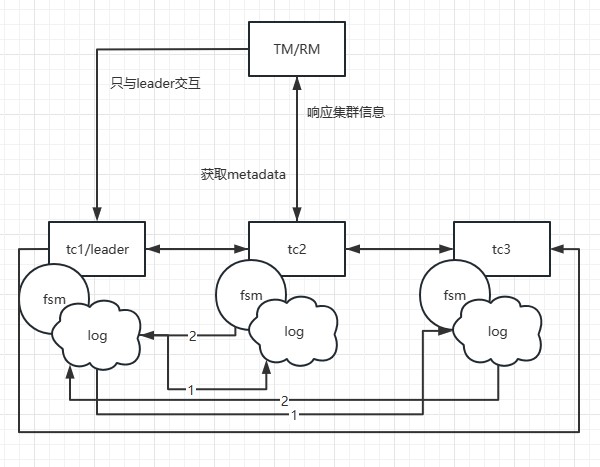
+
+
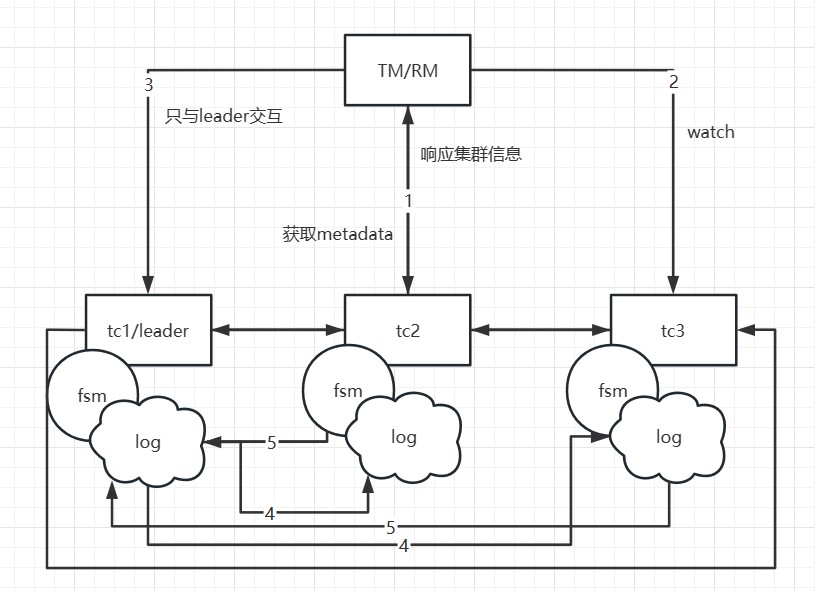
+In the Seata-Raft mode, the client-side, upon startup, retrieves its
transaction group (e.g., default) and the IP addresses of relevant Raft cluster
nodes from the configuration center. By sending a request to the control port
of Seata-Server, the client can obtain metadata for the Raft cluster
corresponding to the default group, including leader, follower, and learner
member nodes. Subsequently, the client monitors (watches) any member nodes of
non-leader nodes.
+
+Assuming that TM initiates a transaction, and the leader node in the local
metadata points to the address of TC1, TM will only interact with TC1. When TC1
adds global transaction information, through the Raft protocol, denoted as step
1 in the diagram, TC1 sends the log to other nodes. Step 2 represents the
response of follower nodes to log reception. When more than half of the nodes
(such as TC2) accept and respond successfully, the state machine (FSM) on TC1
will execute the action of [...]
+
+
+
+
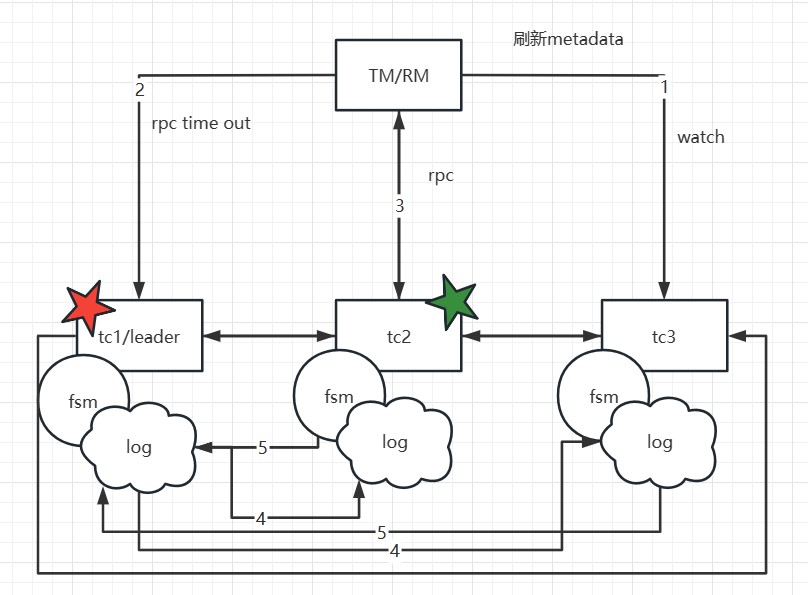
+If TC1 crashes or a reelection occurs, what happens? Since the metadata has
been obtained during the initial startup, the client will execute the watch
follower node's interface to update the local metadata information. Therefore,
subsequent transaction requests will be sent to the new leader (e.g., TC2).
Meanwhile, TC1's data has already been synchronized to TC2 and TC3, ensuring
data consistency. Only at the moment of the election, if a transaction happens
to be sent to the old leader, [...]
+
+It is important to note that in this mode, if a transaction is in the phase of
sending resolution requests or the one-phase process has not yet completed at
the moment of the election, and it happens exactly during the election, these
transactions will be actively rolled back. This is because the RPC node has
crashed or a reelection has occurred, and there is currently no implemented RPC
retry. The TM side has a default retry mechanism of 5 times, but due to the
approximately 1s-2s time [...]
+
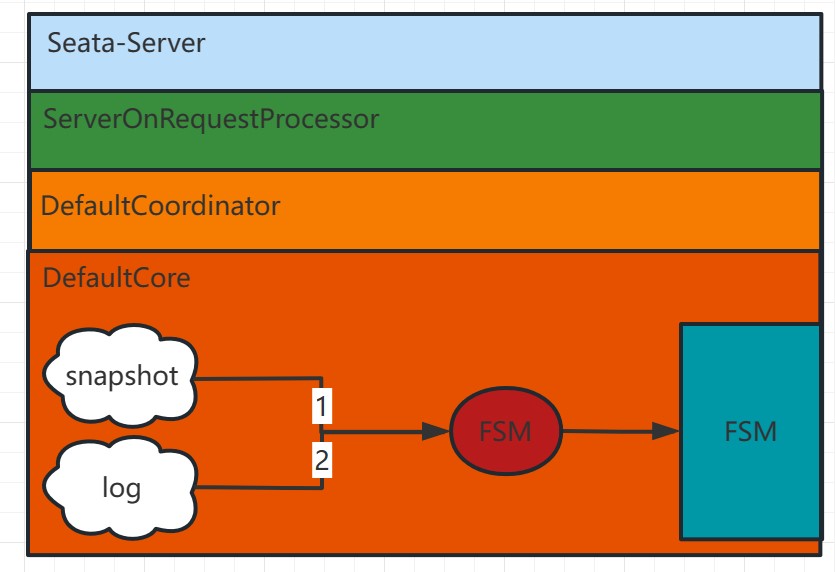
+### 2.3.2 Fault Recovery
+
+In Seata, when a TC experiences a failure, the data recovery process is as
follows:
+
+
+
+As shown in the above diagram:
+
+- Check for the Latest Data Snapshot: Firstly, the system checks for the
existence of the latest data snapshot file. The data snapshot is a one-time
full copy of the in-memory data state. If there is a recent data snapshot, the
system directly loads it into memory.
+
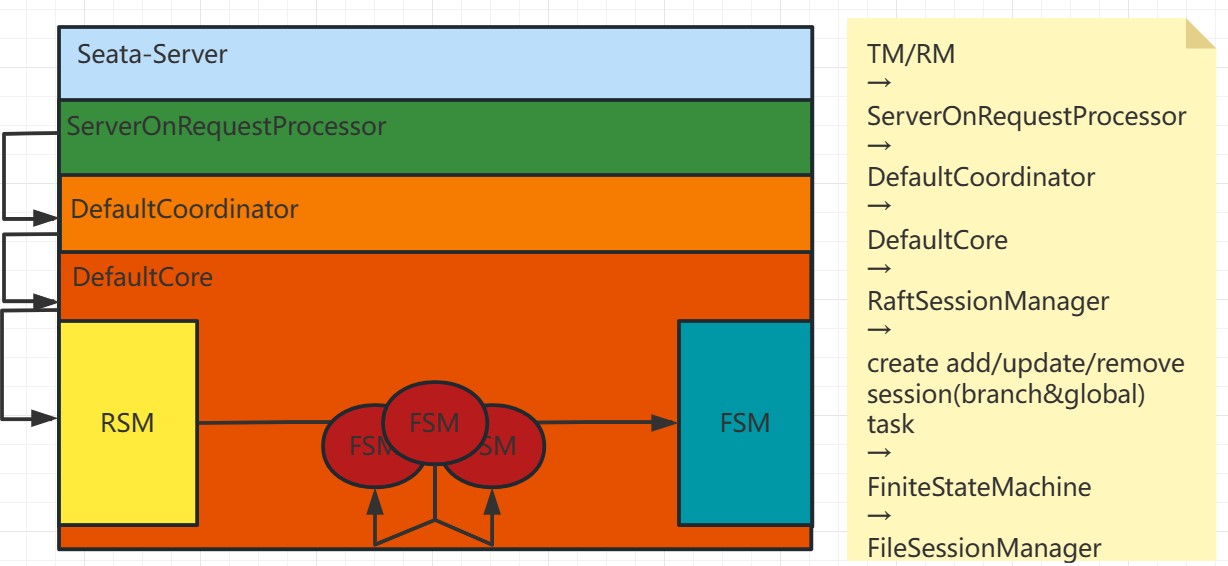
+- Replay Based on Raft Logs After Snapshot: If there is the latest snapshot or
no snapshot file, the system replays the data based on the previously recorded
Raft logs. Each request in Seata-Server ultimately goes through the
ServerOnRequestProcessor for processing, then moves to the specific coordinator
class (DefaultCoordinator or RaftCoordinator), and further proceeds to the
specific business code (DefaultCore) for the corresponding transaction
processing (e.g., begin, commit, rollback).
+
+- After the log replay is complete, the leader initiates log synchronization
and continues to execute the related transaction's add, delete, and modify
actions.
+
+Through these steps, Seata can achieve data recovery after a failure. It first
attempts to load the latest snapshot, if available, to reduce replay time.
Then, it replays based on Raft logs to ensure the consistency of data
operations. Finally, through the log synchronization mechanism, it ensures data
consistency among multiple nodes.
+
+### 2.3.3 Business Processing Synchronization Process
+
+
+For the case where the client side is obtaining the latest metadata while a
business thread is executing operations such as begin, commit, or registry,
Seata adopts the following handling:
+
+- On the client side:
+
+ - If the client is executing operations like begin, commit, or registry,
and at this moment, it needs to obtain the latest metadata, the RPC request
from the client might fail since the leader may no longer exist or is not the
current leader.
+ - If the request fails, the client receives an exception response, and in
this case, the client needs to roll back based on the request result.
+
+- TC side for detecting the old leader:
+
+ - On the TC side, if the client's request reaches the old leader node, TC
checks if it is the current leader. If it is not the leader, it rejects the
request.
+ - If it is the leader but fails midway, such as failing during the process
of submitting a task to the state machine, the creation of the task
(createTask) fails due to the current state not being the leader. In this case,
the client also receives a response with an exception.
+ - The old leader's task submission also fails, ensuring the consistency of
transaction information.
+
+Through the above handling, when the client obtains the latest metadata while
a business operation is in progress, Seata ensures data consistency and
transaction correctness. If the client's RPC request fails, it triggers a
rollback operation. On the TC side, detection of the old leader and the failure
of task submission prevent inconsistencies in transaction information. This
way, the client's data can also maintain consistency.
+
+## 3. Usage and Deployment
+In terms of usage and deployment, the community adheres to the principles of
minimal intrusion and minimal changes. Therefore, the overall deployment should
be straightforward. The following sections introduce deployment changes
separately for the client and server sides.
+
+### 3.1 Client
+Firstly, those familiar with the use of registry configuration centers should
be aware of the `seata.registry.type` configuration item in Seata's
configuration, supporting options like Nacos, ZooKeeper, etcd, Redis, etc.
After version 2.0, a configuration item for Raft was added.
+
+```
+ registry:
+ type: raft
+ raft:
+ server-addr: 192.168.0.111:7091, 192.168.0.112:7091,
192.168.0.113:7091
+```
+Switch the `registry.type` to 'raft' and configure the address for obtaining
Raft-related metadata, which is unified as the IP of the seata-server + HTTP
port. Then, it is essential to configure the traditional transaction group.
+
+```
+seata:
+ tx-service-group: default_tx_group
+ service:
+ vgroup-mapping:
+ default_tx_group: default
+```
+If the current transaction group used is `default_tx_group`, then the
corresponding Seata cluster/group is 'default'. There is a corresponding
relationship, and this will be further explained in the server deployment
section.
+With this, the changes on the client side are complete.
+
+### 3.2 Server
+For server-side changes, there might be more adjustments, involving
familiarity with some tuning parameters and configurations. Of course, default
values can be used without any modifications.
+
+```
+seata:
+ server:
+ raft:
+ group: default # This value represents the group of this raft cluster,
and the value corresponding to the client's transaction group should match it.
+ server-addr: 192.168.0.111:9091,192.168.0.112:9091,192.168.0.113:9091 #
IP and port of the 3 nodes, the port is the netty port of the node + 1000,
default netty port is 8091
+ snapshot-interval: 600 # Take a snapshot every 600 seconds for fast
rolling of raftlog. However, making a snapshot every 600 seconds may cause
business response time jitter if there is too much transaction data in memory.
But it is friendly for fault recovery and faster node restart. You can adjust
it to 30 minutes, 1 hour, etc., according to the business. You can test whether
there is jitter on your own, and find a balance point between rt jitter and
fault recovery.
+ apply-batch: 32 # At most, submit raftlog once for 32 batches of actions
+ max-append-bufferSize: 262144 # Maximum size of the log storage buffer,
default is 256K
+ max-replicator-inflight-msgs: 256 # In the case of enabling pipeline
requests, the maximum number of in-flight requests, default is 256
+ disruptor-buffer-size: 16384 # Internal disruptor buffer size. If it is
a scenario with high write throughput, you need to appropriately increase this
value. Default is 16384
+ election-timeout-ms: 1000 # How long without a leader's heartbeat to
start a new election
+ reporter-enabled: false # Whether the monitoring of raft itself is
enabled
+ reporter-initial-delay: 60 # Interval of monitoring
+ serialization: jackson # Serialization method, do not change
+ compressor: none # Compression method for raftlog, such as gzip, zstd,
etc.
+ sync: true # Flushing method for raft log, default is synchronous
flushing
+ config:
+ # support: nacos, consul, apollo, zk, etcd3
+ type: file # This configuration can choose different configuration centers
+ registry:
+ # support: nacos, eureka, redis, zk, consul, etcd3, sofa
+ type: file # Non-file registration center is not allowed in raft mode
+ store:
+ # support: file, db, redis, raft
+ mode: raft # Use raft storage mode
+ file:
+ dir: sessionStore # This path is the storage location of raftlog and
related transaction logs, default is relative path, it is better to set a fixed
location
+```
+In 3 or more nodes of seata-server, after configuring the above parameters,
you can directly start it, and you will see similar log output, which means the
cluster has started successfully:
+
+```
+2023-10-13 17:20:06.392 WARN --- [Rpc-netty-server-worker-10-thread-1]
[com.alipay.sofa.jraft.rpc.impl.BoltRaftRpcFactory] [ensurePipeline] []: JRaft
SET bolt.rpc.dispatch-msg-list-in-default-executor to be false for replicator
pipeline optimistic.
+2023-10-13 17:20:06.439 INFO --- [default/PeerPair[10.58.16.231:9091 ->
10.58.12.217:9091]-AppendEntriesThread0]
[com.alipay.sofa.jraft.storage.impl.LocalRaftMetaStorage] [save] []: Save raft
meta, path=sessionStore/raft/9091/default/raft_meta, term=4,
votedFor=0.0.0.0:0, cost time=25 ms
+2023-10-13 17:20:06.441 WARN --- [default/PeerPair[10.58.16.231:9091 ->
10.58.12.217:9091]-AppendEntriesThread0] [com.alipay.sofa.jraft.core.NodeImpl]
[handleAppendEntriesRequest] []: Node <default/10.58.16.231:9091> reject
term_unmatched AppendEntriesRequest from 10.58.12.217:9091, term=4,
prevLogIndex=4, prevLogTerm=4, localPrevLogTerm=0, lastLogIndex=0,
entriesSize=0.
+2023-10-13 17:20:06.442 INFO --- [JRaft-FSMCaller-Disruptor-0]
[io.seata.server.cluster.raft.RaftStateMachine] [onStartFollowing] []: groupId:
default, onStartFollowing: LeaderChangeContext [leaderId=10.58.12.217:9091,
term=4, status=Status[ENEWLEADER<10011>: Raft node receives message from new
leader with higher term.]].
+2023-10-13 17:20:06.449 WARN --- [default/PeerPair[10.58.16.231:9091 ->
10.58.12.217:9091]-AppendEntriesThread0] [com.alipay.sofa.jraft.core.NodeImpl]
[handleAppendEntriesRequest] []: Node <default/10.58.16.231:9091> reject
term_unmatched AppendEntriesRequest from 10.58.12.217:9091, term=4,
prevLogIndex=4, prevLogTerm=4, localPrevLogTerm=0, lastLogIndex=0,
entriesSize=0.
+2023-10-13 17:20:06.459 INFO --- [Bolt-default-executor-4-thread-1]
[com.alipay.sofa.jraft.core.NodeImpl] [handleInstallSnapshot] []: Node
<default/10.58.16.231:9091> received InstallSnapshotRequest from
10.58.12.217:9091, lastIncludedLogIndex=4, lastIncludedLogTerm=4,
lastLogId=LogId [index=0, term=0].
+2023-10-13 17:20:06.489 INFO --- [Bolt-conn-event-executor-13-thread-1]
[com.alipay.sofa.jraft.rpc.impl.core.ClientServiceConnectionEventProcessor]
[onEvent] []: Peer 10.58.12.217:9091 is connected
+2023-10-13 17:20:06.519 INFO --- [JRaft-Group-Default-Executor-0]
[com.alipay.sofa.jraft.util.Recyclers] [<clinit>] []:
-Djraft.recyclers.maxCapacityPerThread: 4096.
+2023-10-13 17:20:06.574 INFO --- [JRaft-Group-Default-Executor-0]
[com.alipay.sofa.jraft.storage.snapshot.local.LocalSnapshotStorage]
[destroySnapshot] []: Deleting snapshot
sessionStore/raft/9091/default/snapshot/snapshot_4.
+2023-10-13 17:20:06.574 INFO --- [JRaft-Group-Default-Executor-0]
[com.alipay.sofa.jraft.storage.snapshot.local.LocalSnapshotStorage] [close] []:
Renaming sessionStore/raft/9091/default/snapshot/temp to
sessionStore/raft/9091/default/snapshot/snapshot_4.
+2023-10-13 17:20:06.689 INFO --- [JRaft-FSMCaller-Disruptor-0]
[io.seata.server.cluster.raft.snapshot.session.SessionSnapshotFile] [load] []:
on snapshot load start index: 4
+2023-10-13 17:20:06.694 INFO --- [JRaft-FSMCaller-Disruptor-0]
[io.seata.server.cluster.raft.snapshot.session.SessionSnapshotFile] [load] []:
on snapshot load end index: 4
+2023-10-13 17:20:06.694 INFO --- [JRaft-FSMCaller-Disruptor-0]
[io.seata.server.cluster.raft.RaftStateMachine] [onSnapshotLoad] []: groupId:
default, onSnapshotLoad cost: 110 ms.
+2023-10-13 17:20:06.694 INFO --- [JRaft-FSMCaller-Disruptor-0]
[io.seata.server.cluster.raft.RaftStateMachine] [onConfigurationCommitted] []:
groupId: default, onConfigurationCommitted:
10.58.12.165:9091,10.58.12.217:9091,10.58.16.231:9091.
+2023-10-13 17:20:06.705 INFO --- [JRaft-FSMCaller-Disruptor-0]
[com.alipay.sofa.jraft.storage.snapshot.SnapshotExecutorImpl]
[onSnapshotLoadDone] []: Node <default/10.58.16.231:9091> onSnapshotLoadDone,
last_included_index: 4
+last_included_term: 4
+peers: "10.58.12.165:9091"
+peers: "10.58.12.217:9091"
+peers: "10.58.16.231:9091"
+
+2023-10-13 17:20:06.722 INFO --- [JRaft-Group-Default-Executor-1]
[com.alipay.sofa.jraft.storage.impl.RocksDBLogStorage]
[lambda$truncatePrefixInBackground$2] []: Truncated prefix logs in data path:
sessionStore/raft/9091/default/log from log index 1 to 5, cost 0 ms.
+```
+### 3.3 faq
+- Once the `seata.raft.server-addr` is configured, cluster scaling or
shrinking must be done through the server's openapi. Directly changing this
configuration and restarting won't take effect. The API for this operation is
`/metadata/v1/changeCluster?raftClusterStr=new_cluster_list`.
+
+- If the addresses in `server-addr:` are all on the local machine, you need to
add a 1000 offset to the netty ports of different servers on the local machine.
For example, if `server.port: 7092`, the netty port will be 8092, and the raft
election and communication port will be 9092. You need to add the startup
parameter `-Dserver.raftPort=9092`. On Linux, this can be specified using
`export JAVA_OPT="-Dserver.raftPort=9092"`.
+
+
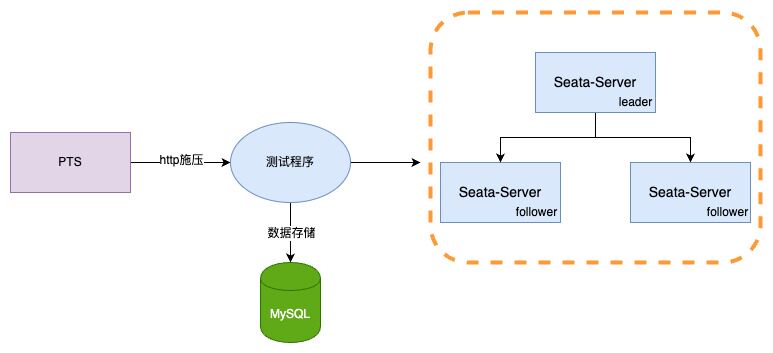
+## 4. Performance Test Comparison
+
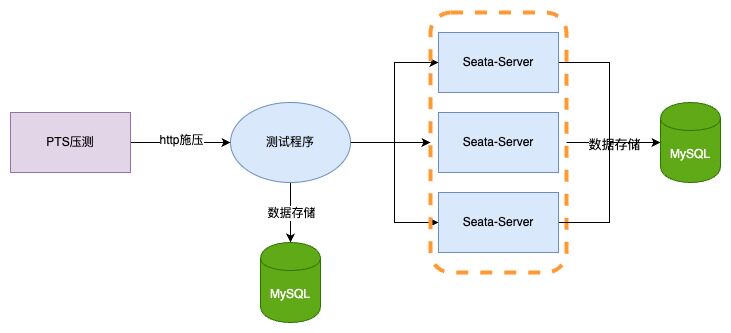
+Performance testing is divided into two scenarios. To avoid data hotspots and
thread optimization, the client side initializes 3 million items and uses jdk21
virtual threads + Spring Boot3 + Seata AT for testing. Garbage collection is
handled with the ZGC generational garbage collector. The testing tool used is
Alibaba Cloud PTS. Server-side is uniformly configured with jdk21 (not yet
adapted for virtual threads). Server configurations are as follows:
+- TC: 4c8g * 3
+- Client: 4c * 8G * 1
+- Database: Alibaba Cloud RDS 4c16g
+
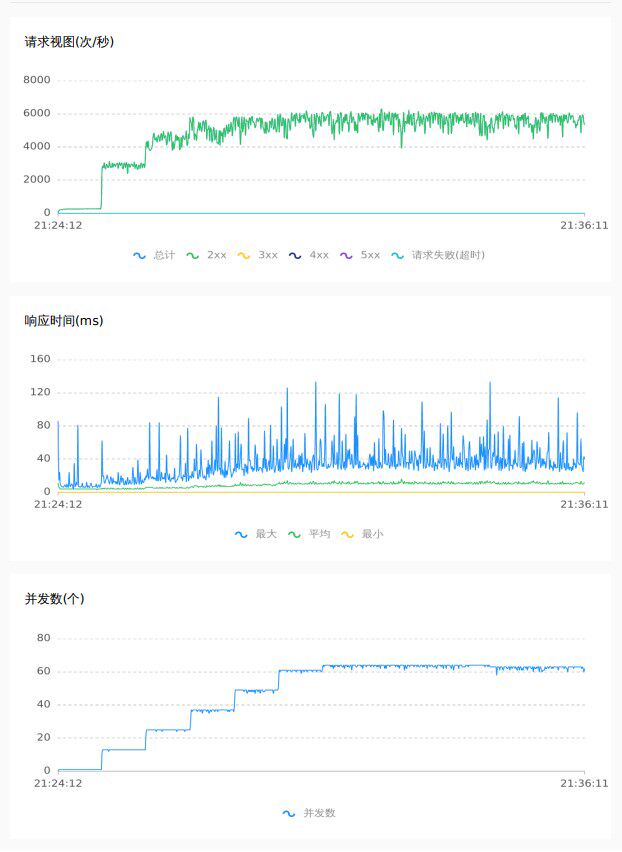
+- 64 concurrent performance test only increases the performance of the
`@GlobalTransactional` annotated interface with empty submissions.
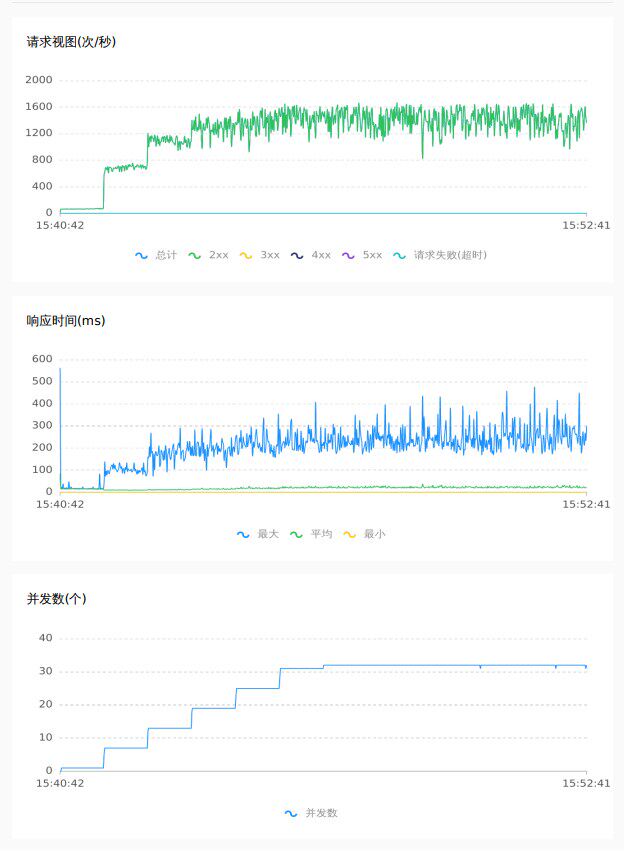
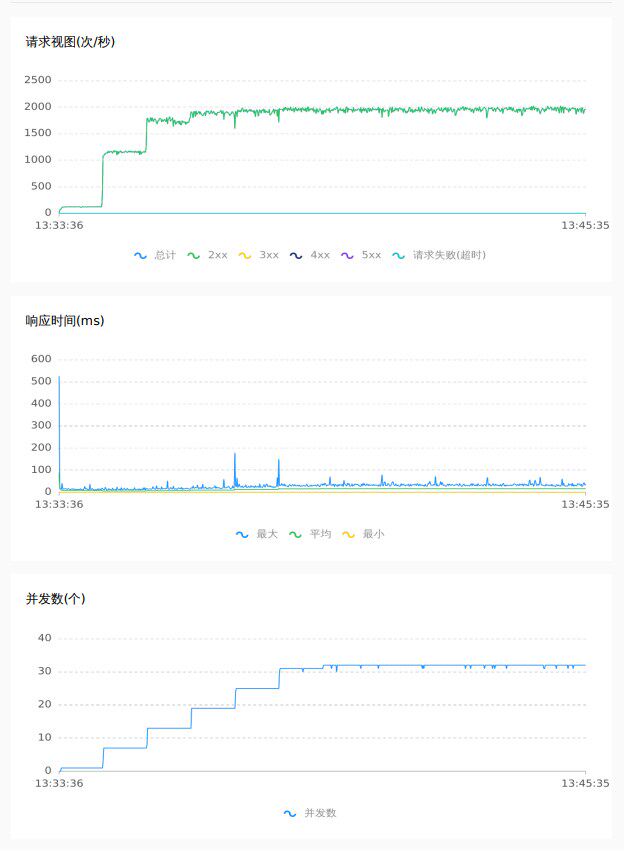
+- Random 3 million data items are used for inventory deduction in a 32
concurrent scenario for 10 minutes.
+
+### 4.1 1.7.1 db mode
+
+
+#### Empty submission 64C
+
+
+#### Random inventory deduction 32C
+
+
+### 4.2 2.0 raft mode
+
+
+#### Empty submission 64C
+
+
+#### Random inventory deduction 32C
+
+
+### 4.3 Test Result Comparison
+32 concurrent random inventory deduction scenario with 3 million items
+
+| tps avg | tps max | count | rt | error | Storage Type |
+| --- | --- | --- | --- | --- | --- |
+| 1709 (42%↑) | 2019 (21%↑) | 1228803 (42%↑) | 13.86ms (30%↓) | 0 | Raft |
+| 1201 | 1668 | 864105 | 19.86ms | 0 | DB |
+
+64 concurrent empty pressure on `@GlobalTransactional` interface (test peak
limit is 8000)
+
+| tps avg | tps max | count | rt | error | Storage Type |
+| --- | --- | --- | --- | --- | --- |
+| 5704 (20%↑) | 8062 (30%↑) | 4101236 (20%↑) | 7.79ms (19%↓) | 0 | Raft |
+| 4743 | 6172 | 3410240 | 9.65ms | 0 | DB |
+
+In addition to the direct comparison of the above data, by observing the
curves of the pressure test, it can be seen that under the raft mode, TPS and
RT are more stable, with less jitter, and better performance and throughput.
+
+
+## 5. Summary
+
+In the future development of Seata, performance, entry threshold, and
deployment and operation costs are directions that we need to pay attention to
and continuously optimize. After the introduction of the raft mode, Seata has
the following characteristics:
+
+1. In terms of storage, after the separation of storage and computation,
Seata's upper limit for optimization has been raised, making it more
self-controlled.
+2. Lower deployment costs, no need for additional registration centers,
storage middleware.
+3. Lower entry threshold, no need to learn other knowledge such as
registration centers; one can directly use Seata Raft.
+
+In response to industry trends, some open-source projects such as ClickHouse
and Kafka have started to abandon the use of ZooKeeper and instead adopt
self-developed solutions, such as ClickKeeper and KRaft. These solutions ensure
the storage of metadata and other information by themselves, reducing the need
for third-party dependencies, thus reducing operational and learning costs.
These features are mature and worth learning from.
+
+Of course, currently, solutions based on the Raft mode may not be mature
enough and may not fully meet the beautiful descriptions above. However,
precisely because of such theoretical foundations, the community should strive
in this direction, gradually bringing practice closer to the theoretical
requirements. Here, all students interested in Seata are welcome to join the
community, contributing to the development of Seata!
+
---------------------------------------------------------------------
To unsubscribe, e-mail: [email protected]
For additional commands, e-mail: [email protected]











