This is an automated email from the ASF dual-hosted git repository.

tuichenchuxin pushed a commit to branch master
in repository https://gitbox.apache.org/repos/asf/shardingsphere.git
The following commit(s) were added to refs/heads/master by this push:
new 878b96593c0 upload 1 article (#24364)
878b96593c0 is described below
commit 878b96593c0ef396e6833b2ec05306a7952b2252
Author: FPokerFace <[email protected]>
AuthorDate: Tue Feb 28 09:25:34 2023 +0800
upload 1 article (#24364)
---
...onable_requests_in_multi-shards_scenarios.en.md | 246 +++++++++++++++++++++
...sonable_requests_in_multi-shards_scenarios1.png | Bin 0 -> 20306 bytes
...sonable_requests_in_multi-shards_scenarios2.png | Bin 0 -> 92145 bytes
...sonable_requests_in_multi-shards_scenarios3.png | Bin 0 -> 21048 bytes
4 files changed, 246 insertions(+)
diff --git
a/docs/blog/content/material/2022_10_14_ShardingSphere_5.2.0_Audit_for_sharding_intercepts_unreasonable_requests_in_multi-shards_scenarios.en.md
b/docs/blog/content/material/2022_10_14_ShardingSphere_5.2.0_Audit_for_sharding_intercepts_unreasonable_requests_in_multi-shards_scenarios.en.md
new file mode 100644
index 00000000000..7446c94ecee
--- /dev/null
+++
b/docs/blog/content/material/2022_10_14_ShardingSphere_5.2.0_Audit_for_sharding_intercepts_unreasonable_requests_in_multi-shards_scenarios.en.md
@@ -0,0 +1,246 @@
++++
+title = " ShardingSphere 5.2.0: Audit for sharding intercepts unreasonable
requests in multi-shards scenarios"
+weight = 76
+chapter = true
+
++++
+
+
+
+## 1. Background
+
+Thanks to our continuous review of the
[ShardingSphere](https://shardingsphere.apache.org/)’s community feedback that
we use to develop features such as data sharding and read/write splitting, we
found that some users create a large number of shards when using the data
sharding feature.
+
+In such cases, there can be 1,000 physical tables corresponding to a sharding
logical table, which largely disturbs users.
+
+For instance, a `SELECT * FROM t_order` statement will lead to a full-route,
which is obviously not the case for
[OLTP](https://shardingsphere.apache.org/blog/en/material/2022_04_26_how_to_use_shardingsphere-proxy_in_real_production_scenarios_your_quick_start_guide/).
This SQL can be placed in another Proxy to avoid blocking other requests.
+
+However, if users are not familiar with Proxy, or write a `where` condition
and don't know that sharding is not supported in this condition, a full-route
is still required.
+
+A full route can lower the performance of Proxy and even result in the failure
of a reasonable request. Imagine that there are 1000 shards in a physical
database, if they are executed in parallel, 1,000 connections are needed — and
if in serial, the request can lead to a timeout. In this regard, community
users requested whether the unreasonable request can be intercepted directly.
+
+We’ve considered the issue for a while. If we simply block the full-route
operation, we just need to check it in the code and add a switch to the
configuration file. On the other hand, if the user later needs to set a table
to read-only or requires the update operation to carry a `limit`, does that
mean we need to change the code and configuration again? This obviously goes
against the pluggable logic of Proxy.
+
+In response to the above problems, the [recently released Apache
ShardingSphere
5.2.0](https://faun.pub/apache-shardingsphere-5-2-0-is-released-bringing-new-cloud-native-possibilities-8d674d964a93?source=your_stories_page-------------------------------------)
provides users with SQL audit for the sharding function. The audit can either
be an interception operation or a statistical operation. Similar to the
sharding and unique key generation algorithms, the audit algorithm is also
plugin- [...]
+
+Next, we will elaborate on the implementation logic for data sharding’s audit,
with specific SQL examples.
+
+## **2. Audit for sharding interface**
+
+The entrance to Apache ShardingSphere’s audit is in the
`org.apache.shardingsphere.infra.executor.check.SQLCheckEngine` class, which
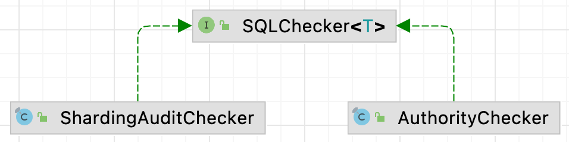
will invoke the `check` method of the `SQLChecker` interface. Currently,
ShardingSphere audit contains audit for permission (verify username and
password) and audit for sharding.
+
+Here we focus on the parent interface implemented in `ShardingAuditChecker` of
audit for sharding.
+
+
+
+We can learn its working principles quickly through viewing the `check` code
of `org.apache.shardingsphere.sharding.checker.audit.ShardingAuditChecker`.
+
+```java
+public interface ShardingAuditAlgorithm extends ShardingSphereAlgorithm {
+
+ /**
+ * Sharding audit algorithm SQL check.
+ *
+ * @param sqlStatementContext SQL statement context
+ * @param parameters SQL parameters
+ * @param grantee grantee
+ * @param database database
+ * @return SQL check result
+ */
+ SQLCheckResult check(SQLStatementContext<?> sqlStatementContext,
List<Object> parameters, Grantee grantee, ShardingSphereDatabase database);
+}
+```
+
+This method obtains the audit strategies of all the sharding tables involved
and invokes the audit algorithms configured in each sharding table audit
strategy. If an audit algorithm fails to pass, an exception is displayed to the
user.
+
+Some users may wonder what `disableAuditNames` does here. The audit for
sharding also allows users to skip this process. In some cases, users may need
to execute SQL that should have been blocked by the audit, and they are aware
of the impact of this SQL.
+
+For this reason, we provide `Hint: disableAuditNames` to skip audit
interception, which will be described with practical examples later on. The
Proxy Administrators can configure `allowHintDisable` to control whether to
allow users to skip this process. The default value is `true`, indicating that
Hint-based skip is allowed.
+
+## **3. Audit for sharding algorithm**
+
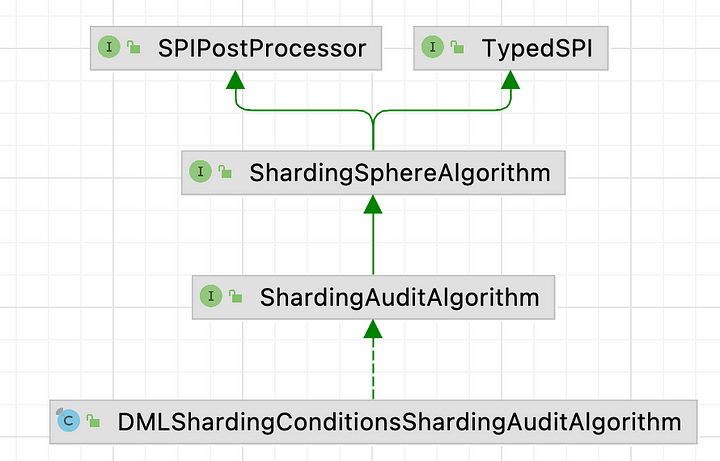
+The audit for sharding algorithm interface
`org.apache.shardingsphere.sharding.spi.ShardingAuditAlgorithm` is inherited
from SPI class `ShardingSphereAlgorithm`. It inherits `type` and `props`
properties and defines its own `check` method. If you‘re looking to customize
your own audit algorithm, just implement the interface and add it to
`INF.services`.
+
+
+
+```java
+public interface ShardingAuditAlgorithm extends ShardingSphereAlgorithm {
+
+ /**
+ * Sharding audit algorithm SQL check.
+ *
+ * @param sqlStatementContext SQL statement context
+ * @param parameters SQL parameters
+ * @param grantee grantee
+ * @param database database
+ * @return SQL check result
+ */
+ SQLCheckResult check(SQLStatementContext<?> sqlStatementContext,
List<Object> parameters, Grantee grantee, ShardingSphereDatabase database);
+}
+```
+
+Apache ShardingSphere implements a general audit for sharding algorithm
`org.apache.shardingsphere.sharding.algorithm.audit.DMLShardingConditionsShardingAuditAlgorithm`,
namely the above-mentioned SQL statement that intercepts the full-route.
+
+The algorithm makes decisions by determining whether the sharding condition is
`null`. Of course, it won't intercept broadcast tables and non-sharding tables.
+
+```java
+public final class DMLShardingConditionsShardingAuditAlgorithm implements
ShardingAuditAlgorithm {
+
+ @Getter
+ private Properties props;
+
+ @Override
+ public void init(final Properties props) {
+ this.props = props;
+ }
+
+ @SuppressWarnings({"rawtypes", "unchecked"})
+ @Override
+ public SQLCheckResult check(final SQLStatementContext<?>
sqlStatementContext, final List<Object> parameters, final Grantee grantee,
final ShardingSphereDatabase database) {
+ if (sqlStatementContext.getSqlStatement() instanceof DMLStatement) {
+ ShardingRule rule =
database.getRuleMetaData().getSingleRule(ShardingRule.class);
+ if
(rule.isAllBroadcastTables(sqlStatementContext.getTablesContext().getTableNames())
+ ||
sqlStatementContext.getTablesContext().getTableNames().stream().noneMatch(rule::isShardingTable))
{
+ return new SQLCheckResult(true, "");
+ }
+ ShardingConditionEngine shardingConditionEngine =
ShardingConditionEngineFactory.createShardingConditionEngine(sqlStatementContext,
database, rule);
+ if
(shardingConditionEngine.createShardingConditions(sqlStatementContext,
parameters).isEmpty()) {
+ return new SQLCheckResult(false, "Not allow DML operation
without sharding conditions");
+ }
+ }
+ return new SQLCheckResult(true, "");
+ }
+
+ @Override
+ public String getType() {
+ return "DML_SHARDING_CONDITIONS";
+ }
+}
+```
+
+Here we’d like to introduce another audit for sharding algorithm:
`LimitRequiredShardingAuditAlgorithm`. This algorithm can intercept SQL without
carrying `limit` in the `update` and `delete` operations.
+
+As this algorithm is less universal, it is not currently integrated into
Apache ShardingSphere. As you can see, it is very easy to implement a custom
algorithm, which is why we need to design the audit for sharding framework.
Thanks to its plugin-oriented architecture, ShardingSphere boasts great
scalability.
+
+```java
+public final class LimitRequiredShardingAuditAlgorithm implements
ShardingAuditAlgorithm {
+
+ @Getter
+ private Properties props;
+
+ @Override
+ public void init(final Properties props) {
+ this.props = props;
+ }
+
+ @SuppressWarnings({"rawtypes", "unchecked"})
+ @Override
+ public SQLCheckResult check(final SQLStatementContext<?>
sqlStatementContext, final List<Object> parameters, final Grantee grantee,
final ShardingSphereDatabase database) {
+ if (sqlStatementContext instanceof UpdateStatementContext &&
!((MySQLUpdateStatement)
sqlStatementContext.getSqlStatement()).getLimit().isPresent()) {
+ return new SQLCheckResult(false, "Not allow update without limit");
+ }
+ if (sqlStatementContext instanceof DeleteStatementContext &&
!((MySQLDeleteStatement)
sqlStatementContext.getSqlStatement()).getLimit().isPresent()) {
+ return new SQLCheckResult(false, "Not allow delete without limit");
+ }
+ return new SQLCheckResult(true, "");
+ }
+
+ @Override
+ public String getType() {
+ return "LIMIT_REQUIRED";
+ }
+}
+```
+
+## **4. Using audit for sharding**
+
+Audit for sharding requires you to configure audit strategy for logical
tables. To help you quickly get started, its configuration is the same with
that of the sharding algorithm and the sharding key value generator.
+
+There is an algorithm definition and strategy definition, and default audit
strategy is also supported. If the audit strategy is configured in the logical
table, it takes effect only for the logical table.
+
+If `defaultAuditStrategy` is configured in the logical table, it takes effect
fo all the logical tables under the sharding rule. `Auditors` are similar to
`ShardingAlgorithms`, `auditStrategy` to `databaseStrategy`, and
`defaultAuditStrategy` to `defaultDatabaseStrategy` or `defaultTableStrategy`.
+
+Please refer to the following configuration. Only the configuration of audit
for sharding is displayed. You need to configure the sharding algorithm and
data source by yourself.
+
+```sql
+rules:
+ - !SHARDING
+ tables:
+ t_order:
+ actualDataNodes: ds_${0..1}.t_order_${0..1}
+ auditStrategy:
+ auditorNames:
+ - sharding_key_required_auditor
+ allowHintDisable: true defaultAuditStrategy:
+ auditorNames:
+ - sharding_key_required_auditor
+ allowHintDisable: true auditors:
+ sharding_key_required_auditor:
+ type: DML_SHARDING_CONDITIONS
+```
+
+**Step 1:** Execute a query operation. An error is displayed as the audit
strategy for intercepting the full-database route is configured.
+
+```mysql
+mysql> select * from t_order;
+ERROR 13000 (44000): SQL check failed, error message: Not allow DML operation
without sharding conditions
+```
+
+**Step 2:** Add `HINT.` The name of the `HINT` is `/* ShardingSphere hint:
disableAuditNames */`,and `disableAuditNames` is followed by the
`auditorsNames` configured in the preceding command.
+
+If there are multiple names, separate them with spaces such as `/*
ShardingSphere hint: disableAuditNames=auditName1 auditName2*/`. After using
`HINT`, we can see that the SQL operation is successfully executed.
+
+```mysql
+mysql> /* ShardingSphere hint: disableAuditNames=sharding_key_required_auditor
*/ select * from t_order;
++----------+---------+------------+--------+
+| order_id | user_id | address_id | status |
++----------+---------+------------+--------+
+| 30 | 20 | 10 | 20 |
+| 32 | 22 | 10 | 20 |
++----------+---------+------------+--------+
+2 rows in set (0.01 sec)
+```
+
+**Note:** `HINT` requires you to modify the `server.yaml` configuration of
Proxy. In addition, if you are using MySQL terminal to connect to Proxy
directly, you need to add the `-c` property — otherwise, `HINT `comments will
be filtered out of the MySQL terminal and will not be parsed by Proxy on the
backend.
+
+```sql
+rules:
+ - !SQL_PARSER
+ sqlCommentParseEnabled: true
+ sqlStatementCache:
+ initialCapacity: 2000
+ maximumSize: 65535
+ parseTreeCache:
+ initialCapacity: 128
+ maximumSize: 1024
+props:
+ proxy-hint-enabled: truemysql -uroot -proot -h127.0.0.1 -P3307 -c
+```
+
+## **5. DistSQL with audit for sharding**
+
+Currently, as you can see from the [release
notes](https://github.com/apache/shardingsphere/releases/tag/5.2.0) Apache
ShardingSphere 5.2.0 supports the following
[DistSQL](https://shardingsphere.apache.org/document/5.1.0/en/concepts/distsql/)
with audit for sharding function.
+
+```sql
+CREATE SHARDING AUDITOR
+ALTER SHARDING AUDITOR
+SHOW SHARDING AUDIT ALGORITHMS
+```
+
+The following DistSQL will be supported in future releases:
+
+```sql
+DROP SHARDING AUDITOR
+SHOW UNUSED SHARDING AUDIT ALGORITHMS
+CREATE SHARDING TABLE RULE # including AUDIT_STRATEGY
+```
+
+This post introduced how audit for sharding works with specific examples. I
believe you already have basic understanding of this function, and you can use
it whenever you need or use custom algorithm.
+
+You are also welcome to submit general algorithms to the community. If you
have any ideas you’d like to contribute or you encounter any issues with your
ShardingSphere, feel free to post them on
[GitHub](https://github.com/apache/shardingsphere).
+
+# Author
+
+Huang Ting, a technology engineer at [Tencent](https://www.tencent.com/en-us/)
Financial Technology (FiT) & [ShardingSphere
Committer](https://shardingsphere.apache.org/community/en/team/).
+
+He is mainly responsible for the R&D of Proxy-related audit for sharding and
transaction features.
diff --git
a/docs/blog/static/img/2022_10_14_ShardingSphere_5.2.0_Audit_for_sharding_intercepts_unreasonable_requests_in_multi-shards_scenarios1.png
b/docs/blog/static/img/2022_10_14_ShardingSphere_5.2.0_Audit_for_sharding_intercepts_unreasonable_requests_in_multi-shards_scenarios1.png
new file mode 100644
index 00000000000..93243a1ec1d
Binary files /dev/null and
b/docs/blog/static/img/2022_10_14_ShardingSphere_5.2.0_Audit_for_sharding_intercepts_unreasonable_requests_in_multi-shards_scenarios1.png
differ
diff --git
a/docs/blog/static/img/2022_10_14_ShardingSphere_5.2.0_Audit_for_sharding_intercepts_unreasonable_requests_in_multi-shards_scenarios2.png
b/docs/blog/static/img/2022_10_14_ShardingSphere_5.2.0_Audit_for_sharding_intercepts_unreasonable_requests_in_multi-shards_scenarios2.png
new file mode 100644
index 00000000000..c01133d4e03
Binary files /dev/null and
b/docs/blog/static/img/2022_10_14_ShardingSphere_5.2.0_Audit_for_sharding_intercepts_unreasonable_requests_in_multi-shards_scenarios2.png
differ
diff --git
a/docs/blog/static/img/2022_10_14_ShardingSphere_5.2.0_Audit_for_sharding_intercepts_unreasonable_requests_in_multi-shards_scenarios3.png
b/docs/blog/static/img/2022_10_14_ShardingSphere_5.2.0_Audit_for_sharding_intercepts_unreasonable_requests_in_multi-shards_scenarios3.png
new file mode 100644
index 00000000000..f1e9d05973f
Binary files /dev/null and
b/docs/blog/static/img/2022_10_14_ShardingSphere_5.2.0_Audit_for_sharding_intercepts_unreasonable_requests_in_multi-shards_scenarios3.png
differ



