This is an automated email from the ASF dual-hosted git repository.

azexin pushed a commit to branch master
in repository https://gitbox.apache.org/repos/asf/shardingsphere.git
The following commit(s) were added to refs/heads/master by this push:
new 14259f71f2e Recent articles fixes. (#24521)
14259f71f2e is described below
commit 14259f71f2eac1510e01b9d03140c39d303ebd63
Author: FPokerFace <[email protected]>
AuthorDate: Thu Mar 9 15:02:03 2023 +0800
Recent articles fixes. (#24521)
* Upload 2 more blogs
* Fixes recent articles
---
...Database_Plus_and_Database_Mesh_concepts.en.md" | 210 ---------------------
..._Database_Plus_and_Database_Mesh_concepts1.png" | Bin
2 files changed, 210 deletions(-)
diff --git
"a/docs/blog/content/material/2022_11_15_Alibaba_Cloud\342\200\231s_OpenSergo_&_ShardingSphere_release_database_governance_standard_for_microservices_\342\200\224_combining_Database_Plus_and_Database_Mesh_concepts.en.md"
"b/docs/blog/content/material/2022_11_15_Alibaba_Cloud\342\200\231s_OpenSergo_&_ShardingSphere_release_database_governance_standard_for_microservices_\342\200\224_combining_Database_Plus_and_Database_Mesh_concepts.en.md"
deleted file mode 100644
index cc66e53329f..00000000000
---
"a/docs/blog/content/material/2022_11_15_Alibaba_Cloud\342\200\231s_OpenSergo_&_ShardingSphere_release_database_governance_standard_for_microservices_\342\200\224_combining_Database_Plus_and_Database_Mesh_concepts.en.md"
+++ /dev/null
@@ -1,210 +0,0 @@
-+++
-title = "Alibaba Cloud’s OpenSergo & ShardingSphere release database
governance standard for microservices — combining Database Plus and Database
Mesh concepts"
-weight = 79
-chapter = true
-+++
-
-# Background
-
-Recently, [Alibaba
Cloud](https://us.alibabacloud.com/?utm_key=se_1007722888&utm_content=se_1007722888&gclid=Cj0KCQiAyMKbBhD1ARIsANs7rEE71bHtu1aPbMS_E5-awHyWwTtyRn8CfmMU0qD1eH2hKSVEIDxcxaIaAuAVEALw_wcB)’s
[OpenSergo](https://opensergo.io/) and
[ShardingSphere](https://shardingsphere.apache.org/) jointly released the
database governance standard for microservices. By combining the [Database
Plus](https://medium.com/faun/whats-the-database-plus-concepand-what-challenges-can-it-solve-715920
[...]
-
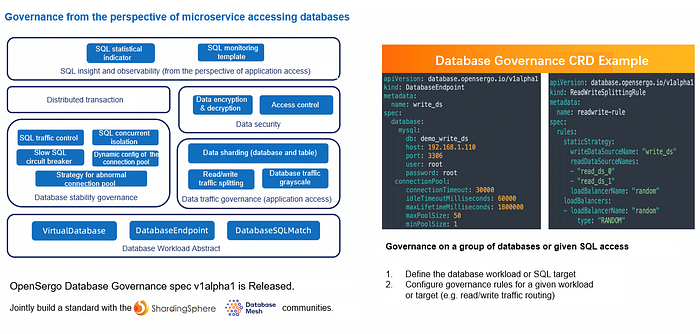
-
-
-***The founders of both communities expressed their opinions concerning the
collaboration between the ShardingSphere community and the OpenSergo
community:***
-
-**Zhang Liang, the PMC Chair of the Apache ShardingSphere community:**
-
-In the microservices field, the interaction and collaboration between services
have been gradually perfected, but there is still no effective standard for
services to access the database. Being, ShardingSphere has been continuously
following the **“connect, enhance, and pluggable”** design philosophy.
“Connect” refers to providing standardized protocols and interfaces, breaking
the barriers for development languages to access heterogeneous databases. It’s
forward-looking for OpenSergo to [...]
-
-**Zhao Yihao, the founder of the OpenSergo community:**
-
-In microservice governance, in addition to the governance of the microservices
itself, it is also a critical step to ensure business reliability and
continuity to deal with microservices’ access to databases. As a Top-Level
project in the database governance field, ShardingSphere has integrated a
wealth of best practices and technical experience, which complements OpenSergo.
In this context, we work with the ShardingSphere community to jointly build a
database governance standard from th [...]
-
-> **Note:** database governance in this article includes all aspects of
database governance in microservice systems. All business information and key
data need a robust and stable database system as it is the most important state
terminal.
-
-# The database is increasingly vital in the microservice system
-
-To meet flexible business requirements, the application architecture can be
transformed from monolithic to service-oriented and then to
microservice-oriented. In this case, the database used to store the core data
becomes the focus of the distributed system.
-
-Enterprises take advantage of microservices to separate services and adopt a
distributed architecture to achieve loose coupling among multiple services,
flexible adjustment and combination of services, and high availability of
systems. In particular, microservices indeed have delivered enormous benefits
in the face of rapidly changing businesses.
-
-However, after services are separated, their corresponding underlying
databases should also be separated to ensure the independent deployment of each
service. In this way, each service can be an independent unit, finally
achieving the microservices. In this context, the database is becoming
increasingly complicated:
-
-- The transformation from monolithic to microservice-oriented architecture
models leads to increasingly complicated services, diversified requirements,
larger scale infrastructure, complex call relations between services, and
higher requirements on the underlying database performance.
-- Different transactions usually involve multiple services - but it is a
challenge to ensure data consistency between services.
-- It is also challenging to query data across multiple services.
-
-With most backend applications, their system performance improvement is mainly
limited to databases. Particularly in a microservice environment, it is a
team’s top priority to deal with database performance governance. Database
governance naturally becomes an indispensable part of microservice governance.
-
-In database governance, we now mainly focus on **read/write splitting,
sharding, shadow databases, database discovery, and distributed transactions**.
At the same time, how to use databases and the actual database storage nodes
rely on **the virtual database and database endpoint**.
-
-In response to the above-mentioned problems, OpenSergo and ShardingSphere have
assimilated the latter’s database governance experience and released the
**database governance standard under microservices**. By doing so, they can
standardize the database governance method, lower the entry barriers of this
field, and improve the business applicability of microservices.
-
-# ShardingSphere’s strategies on database traffic governance
-
-**1. VirtualDatabase**
-
-In database governance, whether it is read/write splitting, sharding, shadow
database or encryption, audit, and access control, they all have to act on a
specific database. Here such a logical database is called a virtual database,
namely VirtualDatabase.
-
-From the application's viewpoint, VirtualDatabase refers to a set of specific
database access information, which can achieve governance capability by binding
corresponding governance strategies.
-
-**2. DatabaseEndpoint**
-
-In database governance, VirtualDatabase declares the logical database
available to applications, but actually, data storage depends on a physical
database. Here it is called database access endpoint, namely DatabaseEndpoint.
-
-DatabaseEndpoint is imperceptible to applications. It can only be bound to
VirtualDatabase by a specific governance strategy and then be connected and
used.
-
-**3. ReadWriteSplitting**
-
-Read/write splitting is a commonly used database extension method. The primary
database is used for transactional read/write operations, while the secondary
database is mainly used for queries.
-
-**4. Sharding**
-
-Data sharding is an extension strategy based on data attributes. Once data
attributes are calculated, requests are sent to a specific data backend.
Currently, sharding consists of sharding with shard keys and automatic
sharding. Sharding with shard keys needs to specify which table or column is to
be sharded and the algorithms used for sharding.
-
-**5. Encryption**
-
-To meet the requirements of audit security and compliance, enterprises need to
provide strict security measures for data storage, such as data encryption.
-
-Data encryption parses the SQL entered by users and rewrites SQL according to
the encryption rules provided by users.
-
-By doing so, the plaintext data can be encrypted, and plaintext data
(optional) and ciphertext data can be both stored in the underlying database.
-
-When the user queries the data, Encryption only takes the ciphertext data from
the database, decrypts it, and finally returns the decrypted original data to
the user.
-
-**6. Shadow**
-
-Shadow database can receive grayscale traffic or data test requests in a
grayscale environment or test environment, and flexibly configure multiple
routing methods combined with shadow algorithms.
-
-**7. DatabaseDiscovery**
-
-Database auto-discovery can detect the change of data source status according
to the high availability configuration of the database and then make
adjustments to traffic strategy accordingly.
-
-For example, if the backend data source is [MySQL](https://www.mysql.com/)
MGR, you can set the database discovery type as MYSQL.MGR, specify `group-name`
and configure corresponding heartbeat intervals.
-
-**8. DistributedTransaction**
-
-It can declare configurations related to distributed transactions. Users can
declare the transaction types without additional configuration.
-
-# Database Governance Example
-
-```sql
-# Virtual database configuration
-apiVersion: database.opensergo.io/v1alpha1
-kind: VirtualDatabase
-metadata:
- name: sharding_db
-spec:
- services:
- - name: sharding_db
- databaseMySQL:
- db: sharding_db
- host: localhost
- port: 3306
- user: root
- password: root
- sharding: "sharding_db" # Declare the desired sharding strategy.
----
-# The database endpoint configuration of the first data source
-apiVersion: database.opensergo.io/v1alpha1
-kind: DatabaseEndpoint
-metadata:
- name: ds_0
-spec:
- database:
- MySQL: # Declare the backend data source type and other
related information.
- url:
jdbc:mysql://192.168.1.110:3306/demo_ds_0?serverTimezone=UTC&useSSL=false
- username: root
- password: root
- connectionTimeout: 30000
- idleTimeoutMilliseconds: 60000
- maxLifetimeMilliseconds: 1800000
- maxPoolSize: 50
- minPoolSize: 1
----
-# The database endpoint configuration of the second data source
-apiVersion: database.opensergo.io/v1alpha1
-kind: DatabaseEndpoint
-metadata:
- name: ds_1
-spec:
- database:
- MySQL: # Declare the backend data source type
and other related information.
- url:
jdbc:mysql://192.168.1.110:3306/demo_ds_1?serverTimezone=UTC&useSSL=false
- username: root
- password: root
- connectionTimeout: 30000
- idleTimeoutMilliseconds: 60000
- maxLifetimeMilliseconds: 1800000
- maxPoolSize: 50
- minPoolSize: 1
----
-# Sharding configuration
-apiVersion: database.opensergo.io/v1alpha1
-kind: Sharding
-metadata:
- name: sharding_db
-spec:
- tables: # map[string]object type
- t_order:
- actualDataNodes: "ds_${0..1}.t_order_${0..1}"
- tableStrategy:
- standard:
- shardingColumn: "order_id"
- shardingAlgorithmName: "t_order_inline"
- keyGenerateStrategy:
- column: "order_id"
- keyGeneratorName: "snowflake"
- t_order_item:
- actualDataNodes: "ds_${0..1}.t_order_item_${0..1}"
- tableStrategy:
- standard:
- shardingColumn: "order_id"
- shardingAlgorithmName: "t_order_item_inline"
- keyGenerateStrategy:
- column: order_item_id
- keyGeneratorName: snowflake
- bindingTables:
- - "t_order,t_order_item"
- defaultDatabaseStrategy:
- standard:
- shardingColumn: "user_id"
- shardingAlgorithmName: "database_inline"
- # defaultTableStrategy: # Null means none
- shardingAlgorithms: # map[string]object type
- database_inline:
- type: INLINE
- props: # map[string]string type
- algorithm-expression: "ds_${user_id % 2}"
- t_order_inline:
- type: INLINE
- props:
- algorithm-expression: "d_order_${order_id % 2}"
- t_order_item_inline:
- type: INLINE
- props:
- algorithm-expression: "d_order_item_${order_id % 2}"
- keyGenerators: # map[string]object type
- snowflake:
- type: SNOWFLAKE
-```
-
-# About Apache ShardingSphere
-
-[Apache ShardingSphere](https://shardingsphere.apache.org/) is a distributed
database ecosystem that can transform any database into a distributed database
and enhance it with sharding, elastic scaling, encryption features & more.
-
-Apache ShardingSphere follows the Database Plus concept, designed to build an
ecosystem on top of fragmented heterogeneous databases. It focuses on how to
fully use the computing and storage capabilities of databases rather than
creating a brand-new database. It attaches greater importance to the
collaboration between multiple databases instead of the database itself.
-
-🔗 [**Apache ShardingSphere Useful
Links**](https://linktr.ee/ApacheShardingSphere)
-
-# About OpenSergo
-
-[OpenSergo](https://opensergo.io/) is an open and universal service governance
specification that is oriented toward distributed service architecture and
covers a full-link heterogeneous ecosystem.
-
-It is formed based on the industry's service governance scenarios and
practices. The biggest characteristic of OpenSergo is defining service
governance rules with a unified set of configuration/DSL/protocol and is
oriented towards multi-language heterogeneous architecture, achieving full-link
ecosystem coverage.
-
-No matter if the microservice language is Java, Go, Node.js, or some other
language, or whether it’s a standard microservice or Mesh-based access,
developers can use the same set of OpenSergo CRD standard configurations.
-
-This allows developers to implement unified governance and control for each
layer, ranging from the gateway to microservices, from database to cache, and
from registration and discovery to the configuration of services.
-
-🔗 [**OpenSergo GitHub**](https://github.com/opensergo/opensergo-specification)
\ No newline at end of file
diff --git
"a/docs/blog/static/img/2022_11_15_Alibaba_Cloud\342\200\231s_OpenSergo_&_ShardingSphere_release_database_governance_standard_for_microservices_\342\200\224_combining_Database_Plus_and_Database_Mesh_concepts1.png"
"b/docs/blog/static/img/2022_11_15_Alibaba_Cloud\342\200\231s_OpenSergo_&_ShardingSphere_release_database_governance_standard_for_microservices_-_combining_Database_Plus_and_Database_Mesh_concepts1.png"
similarity index 100%
rename from
"docs/blog/static/img/2022_11_15_Alibaba_Cloud\342\200\231s_OpenSergo_&_ShardingSphere_release_database_governance_standard_for_microservices_\342\200\224_combining_Database_Plus_and_Database_Mesh_concepts1.png"
rename to
"docs/blog/static/img/2022_11_15_Alibaba_Cloud\342\200\231s_OpenSergo_&_ShardingSphere_release_database_governance_standard_for_microservices_-_combining_Database_Plus_and_Database_Mesh_concepts1.png"

