This is an automated email from the ASF dual-hosted git repository.

jianglongtao pushed a commit to branch master
in repository https://gitbox.apache.org/repos/asf/shardingsphere.git
The following commit(s) were added to refs/heads/master by this push:
new a7cebf0df90 3.27 some small fixes to recent blogs (#24857)
a7cebf0df90 is described below
commit a7cebf0df900ff996d5aa01df515db62978aeb88
Author: FPokerFace <[email protected]>
AuthorDate: Mon Mar 27 16:00:27 2023 +0800
3.27 some small fixes to recent blogs (#24857)
* Some small fixes to recent Blogs and upload another 2
* fixes to recent 2 Blogs
---
...re_Proxy_High_Availability_Cluster_on_AWS.en.md | 6 +-
...y_Database_Protocol_Interaction_Explained.en.md | 251 +++++++++++++++++++++
...xy_Database_Protocol_Interaction_Explained1.png | Bin 0 -> 124621 bytes
...y_Database_Protocol_Interaction_Explained10.png | Bin 0 -> 252614 bytes
...y_Database_Protocol_Interaction_Explained11.png | Bin 0 -> 154791 bytes
...y_Database_Protocol_Interaction_Explained12.png | Bin 0 -> 44339 bytes
...y_Database_Protocol_Interaction_Explained13.png | Bin 0 -> 74390 bytes
...y_Database_Protocol_Interaction_Explained14.png | Bin 0 -> 207320 bytes
...xy_Database_Protocol_Interaction_Explained2.png | Bin 0 -> 130283 bytes
...xy_Database_Protocol_Interaction_Explained3.png | Bin 0 -> 85514 bytes
...xy_Database_Protocol_Interaction_Explained4.png | Bin 0 -> 84469 bytes
...xy_Database_Protocol_Interaction_Explained5.png | Bin 0 -> 115578 bytes
...xy_Database_Protocol_Interaction_Explained6.png | Bin 0 -> 76210 bytes
...xy_Database_Protocol_Interaction_Explained7.png | Bin 0 -> 138770 bytes
...xy_Database_Protocol_Interaction_Explained8.png | Bin 0 -> 45125 bytes
...xy_Database_Protocol_Interaction_Explained9.png | Bin 0 -> 230186 bytes
16 files changed, 254 insertions(+), 3 deletions(-)
diff --git
a/docs/blog/content/material/2023_02_09_Leverage_Terraform_to_Create_an_Apache_ShardingSphere_Proxy_High_Availability_Cluster_on_AWS.en.md
b/docs/blog/content/material/2023_02_09_Leverage_Terraform_to_Create_an_Apache_ShardingSphere_Proxy_High_Availability_Cluster_on_AWS.en.md
index 5b91df7c439..dcc17b4ac35 100644
---
a/docs/blog/content/material/2023_02_09_Leverage_Terraform_to_Create_an_Apache_ShardingSphere_Proxy_High_Availability_Cluster_on_AWS.en.md
+++
b/docs/blog/content/material/2023_02_09_Leverage_Terraform_to_Create_an_Apache_ShardingSphere_Proxy_High_Availability_Cluster_on_AWS.en.md
@@ -129,7 +129,7 @@ We used the `count` parameter to deploy the ZooKeeper
service, which indicates t
When creating a ZooKeeper instance, we use the `ignore_changes`parameter to
ignore artificial changes to the `tag` to avoid the instance being recreated
the next time Terraform is run.
-We use `cloud-init` to reboot the ZooKeeper-related configuration, as
described in
[here](https://raw.githubusercontent.com/apache/shardingsphere-on-cloud/main/terraform/amazon/zk/cloud-init.yml).
+We use `cloud-init` to reboot the ZooKeeper-related configuration, as
described in
[here](https://raw.githubusercontent.com/apache/shardingsphere-on-cloud/main/terraform/amazon/modules/zk/cloud-init.yml).
We create a domain name for each ZooKeeper service and the application only
needs to use the domain name to avoid problems with changing the IP address
when the ZooKeeper service is restarted.
@@ -313,7 +313,7 @@ We'll create an AutoScalingGroup to allow it to manage
ShardingSphere-Proxy inst
The changes to `load_balancers` and `target_group_arns` are ignored when
creating the AutoScalingGroup.
-We also use `cloud-init` to configure the ShardingSphere-Proxy instance, as
described
[here](https://raw.githubusercontent.com/apache/shardingsphere-on-cloud/main/terraform/amazon/shardingsphere/cloud-init.yml).
+We also use `cloud-init` to configure the ShardingSphere-Proxy instance, as
described
[here](https://raw.githubusercontent.com/apache/shardingsphere-on-cloud/main/terraform/amazon/modules/shardingsphere/cloud-init.yml).
```yaml
resource "aws_launch_template" "ss" {
@@ -447,7 +447,7 @@ We will go through the STS to create a role with CloudWatch
permissions, which w
The runtime logs of the ShardingSphere-Proxy will be captured by the
CloudWatch Agent on CloudWatch. A `log_group` named `shardingsphere-proxy.log`
is created by default.
-The specific configuration of CloudWatch is described
[here](https://raw.githubusercontent.com/apache/shardingsphere-on-cloud/main/terraform/amazon/shardingsphere/cloudwatch-agent.json).
+The specific configuration of CloudWatch is described
[here](https://raw.githubusercontent.com/apache/shardingsphere-on-cloud/main/terraform/amazon/modules/shardingsphere/cloudwatch-agent.json).
```yaml
resource "aws_iam_role" "sts" {
diff --git
a/docs/blog/content/material/2023_02_23_ShardingSphere-Proxy_Database_Protocol_Interaction_Explained.en.md
b/docs/blog/content/material/2023_02_23_ShardingSphere-Proxy_Database_Protocol_Interaction_Explained.en.md
new file mode 100644
index 00000000000..8dbcad54e8c
--- /dev/null
+++
b/docs/blog/content/material/2023_02_23_ShardingSphere-Proxy_Database_Protocol_Interaction_Explained.en.md
@@ -0,0 +1,251 @@
++++
+title = "ShardingSphere-Proxy Database Protocol Interaction Explained"
+weight = 89
+chapter = true
+
++++
+
+Database protocols are considered relatively unknown knowledge for most
developers. Generally, users and developers use databases through off-the-shelf
database clients and drivers, without manipulating database protocols directly.
+
+However, having some basic understanding of the features and processes of
database protocols can help developers provide some ideas to identify
troubleshooting problems when it comes to database functionality and
performance issues.
+
+In this post, we will introduce the features of commonly used open source
database protocols such as MySQL and PostgreSQL, and explain how
ShardingSphere-Proxy interacts with clients at the database protocol level.
+
+# Introduction to the ShardingSphere Access Side
+
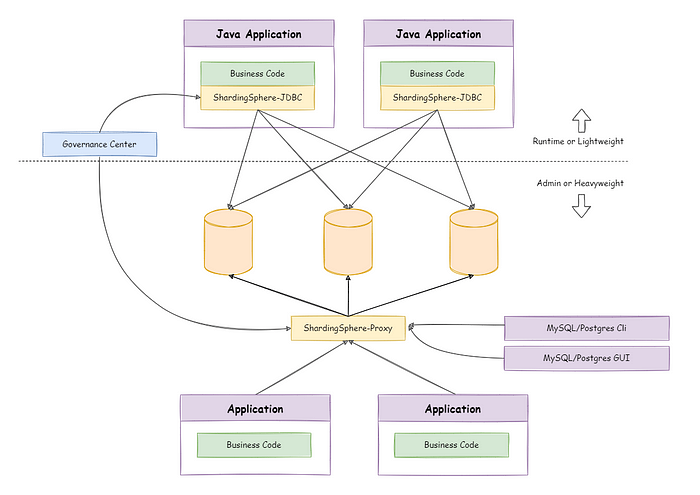
+The Apache ShardingSphere ecosystem includes ShardingSphere-JDBC and
ShardingSphere-Proxy, deployable independently or in a hybrid deployment.
+
+They both provide standardised incremental functionality based on databases as
storage nodes for a variety of application scenarios such as Java homogeneous,
heterogeneous languages, cloud native and more.
+
+
+
+ShardingSphere-JDBC is a Java-based SDK that implements the standard JDBC and
is lightweight and high performance, but also has obvious limitations.
Nevertheless, the limitations of ShardingSphere-JDBC in terms of access are
addressed by ShardingSphere-Proxy on the access side.
+
+- ShardingSphere-Proxy supports connections via any database client, database
driver, and is not limited to JVM-based languages such as Java.
+- Simplifies data management. In particular, in scenarios where data sharding
or encryption is used, ShardingSphere-Proxy can be used as a unified portal to
manipulate data without having to consider the actual node where the data is
stored or to manually decrypt it, etc.
+- Provides unified operation and maintenance control capabilities. In cluster
mode, ShardingSphere-Proxy can be used to unify the management of
ShardingSphere rules and configurations.
+- Heavyweight operations can be performed. ShardingSphere-JDBC is in the same
process as the application, where heavyweight computation and I/O operations
may impact application performance, while ShardingSphere-Proxy starts as a
separate process and supports horizontal scaling, and performing heavyweight
operations without impacting application performance.
+
+# Database Protocol Features
+
+There are already a number of specific interpretations of MySQL or PostgreSQL
protocols on the Internet, so we won't go into detail in this article.
+
+This section focuses on the features of each database protocol, such as its
support for Pipelining and how bulk operations are represented in the protocol.
+
+## MySQL Protocol
+
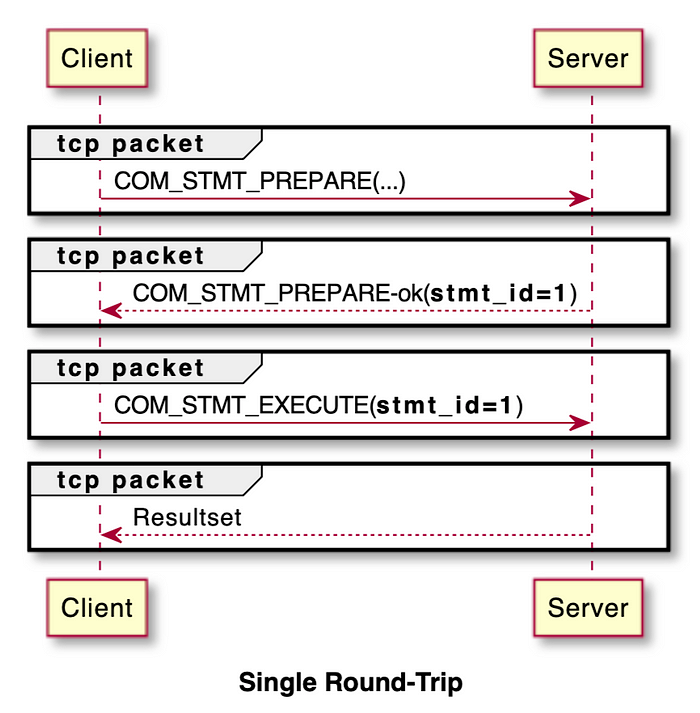
+The MySQL protocol is typically a “one question, one answer" protocol, e.g. to
execute SQL using Prepared Statement. At the protocol level, you need to
execute `COM_STMT_PREPARE` and `COM_STMT_EXECUTE` respectively.
+
+
+
+**Image source:** [MySQL
documentation](https://dev.mysql.com/doc/dev/mysql-server/latest/mysqlx_protocol_use_cases.html).
+
+MySQL has added an X Plugin since 5.7.12, which allows MySQL to add support
for document type stores while maintaining the original relational store.
+
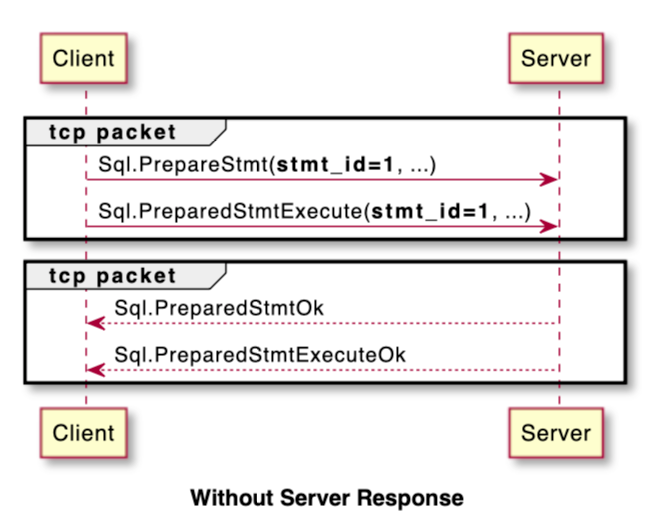
+The X Plugin uses a new communication protocol, X Protocol, which uses port
33060 by default and supports pipelining, i.e. the client can send a batch of
commands to the client at a time, reducing the RTT (Round-trip time) associated
with the “one question, one answer" model (Round-trip time).
+
+For example, if a SQL is executed using `Prepared Statement`, at the protocol
level there are `Prepare` and `Execute` steps, but at the network transport
level, these two steps can be combined and sent. This can theoretically reduce
the RTT by one compared to the original protocol.
+
+
+
+**Image source:** [MySQL
documentation](https://dev.mysql.com/doc/dev/mysql-server/latest/mysqlx_protocol_use_cases.html).
+
+However, the X Plugin for MySQL does not seem to be catching on at the moment,
and most scenarios are still based on the original MySQL protocol for client
and server communication.
+
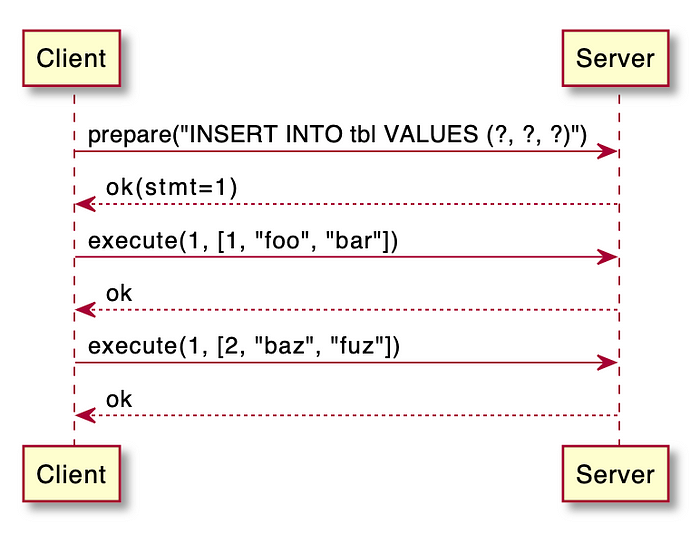
+In the case of batch operations, the MySQL protocol command
`COM_STMT_EXECUTE`, which executes the `Prepared Statement `statement, can only
send one set of parameters at a time, making the "one question, one answer"
approach somewhat inefficient:
+
+
+
+**Image source:** [MySQL
documentation](https://dev.mysql.com/doc/dev/mysql-server/latest/mysqlx_protocol_use_cases.html).
+
+The protocol itself is not designed to support batch operations, so they can
only be optimised at the client level.
+
+In the case of MySQL Connector/J, for example, when the parameter
`rewriteBatchedStatements` is enabled, MySQL Connector/J will internally take
the multiple sets of parameters set by the `addBatch` method, combine insert
values or compose update/delete into multiple statements, and send them at the
protocol level sent in one go.
+
+This is a small increase in CPU overhead in exchange for a reduction in RTT.
For example, for a Prepared Statement insert statement, add multiple parameters
to execute:
+
+```Mysql
+INSERT INTO tbl VALUES (?, ?, ?);
+addBatch [1, "foo", "bar"]
+addBatch [2, "baz", "fuz"]
+```
+
+MySQL Connector/J Actual Execution Statement:
+
+```Mysql
+INSERT INTO tbl VALUES (1, "foo", "bar"),(2, "baz", "fuz");
+```
+
+For bulk update / delete, MySQL Connector/J will execute multiple statements
via `COM_QUERY`, e.g:
+
+```Mysql
+UPDATE tbl SET name = ? WHERE id = ?;
+addBatch ["foo", 1]
+addBatch ["bar", 2]
+```
+
+MySQL Connector/J Actual Execution Statement:
+
+```Mysql
+UPDATE tbl SET name = "foo" WHERE id = 1;UPDATE tbl SET name = "bar" WHERE id
= 2;
+```
+
+## PostgreSQL Protocol
+
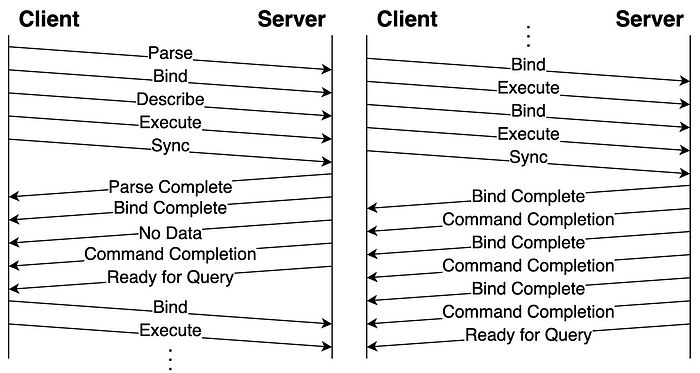
+Compared to the MySQL protocol, the PostgreSQL protocol definition looks
simpler and the PostgreSQL protocol supports Pipelining:
+
+PostgreSQL's Extended Query breaks up SQL execution into multiple steps, with
the following common operations.
+
+- **Parse:** parses the SQL into a `Prepared Statement`.
+- **Describe:** Get the metadata of a `Prepared Statement` or `Portal`.
+- **Bind:** Bind the actual parameters of the `Prepared Statement` to produce
an executable `Portal`; `Bind: Bind `the actual parameters of the `Prepared
Statement` to produce an executable `Portal`.
+- **Execute:** executing the `Portal`.
+- **Close:** closes the `Prepared Statement` or `Portal`.
+
+An example of the PostgreSQL JDBC protocol interaction with the database is as
follows:
+
+
+
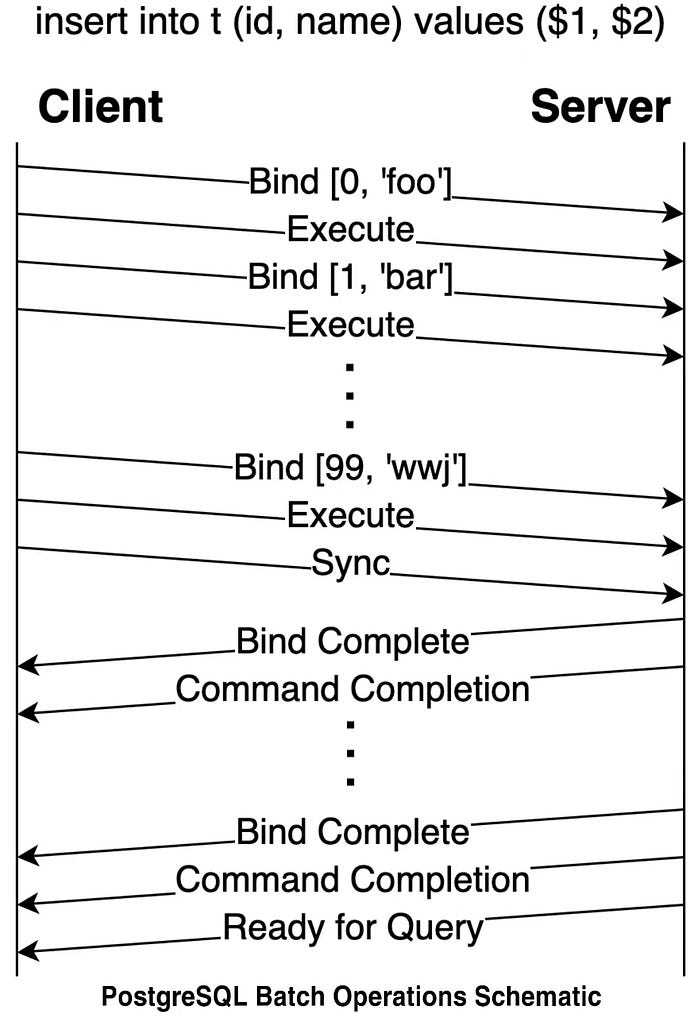
+In a bulk operation scenario, the client can send multiple sets of parameters
in one continuous `Bind`, `Execute`, which is multiple packets at the protocol
level, but at the TCP transport level, one batch of packets can be sent out at
a time.
+
+
+
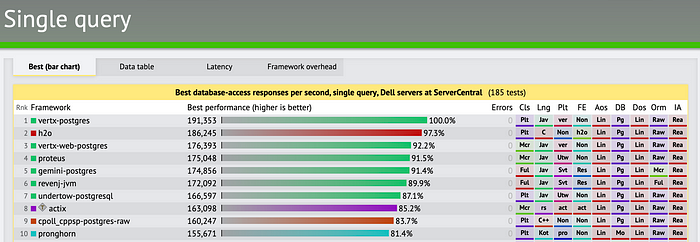
+Pipelining-enabled protocols, combined with I/O multiplexing, offer certain
advantages in terms of throughput. For example, Vert.x PostgreSQL, a database
driver based on multiplexed I/O, scored first place in the TechEmpower
Benchmark Round 15 test in the Single Query scenario (database spotting).
+
+
+
+Image source: [Tech
Empower](https://www.techempower.com/benchmarks/#section=data-r15&test=db).
+
+## openGauss Protocol
+
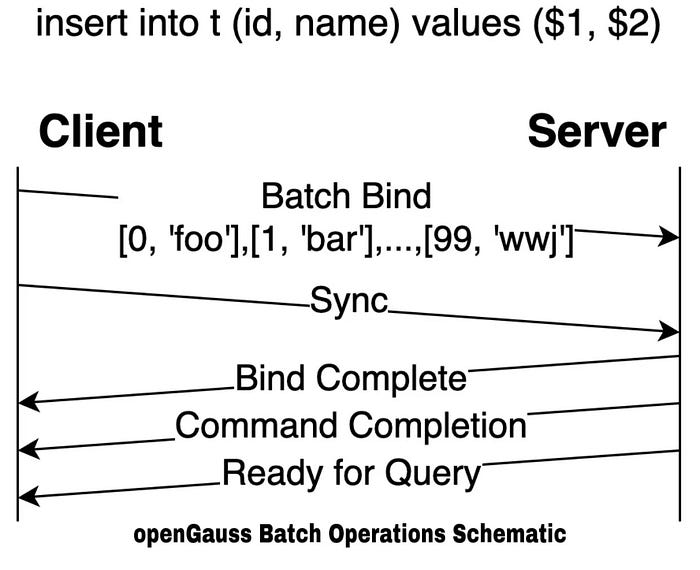
+openGauss adds a Batch Bind message to the PostgreSQL Protocol 3.0, which only
sends one set of parameters at a time.
+
+openGauss adds a Batch Bind message to support sending multiple sets of
parameters at the same time.
+
+
+
+Additionally, openGauss has been enhanced in terms of authentication security.
The general flow of the protocol is identical to that of PostgreSQL.
+
+# ShardingSphere-Proxy Front-End Interaction Flow Explained
+
+## Relationship between ShardingSphere-Proxy and Database Protocol
+
+Database protocols, like HTTP and other protocols, are the standard for
communication between the client and the server. Each database defines its own
protocol.
+
+For example, the MySQL database defines its own set of protocols, as well as
the Protobuf-based X Protocol; PostgreSQL also defines its own set of protocols
and etc.
+
+The average user or developer uses an off-the-shelf client or corresponding
driver and the protocol is relatively transparent to them. Therefore,
ShardingSphere-Proxy implements the database protocol and serves it to the
public, so that users can use ShardingSphere-Proxy as if it were a database.
+
+The specific database protocol versions currently supported by
ShardingSphere-Proxy are:
+
+- MySQL Protocol 4.1 (since MySQL 4.1)
+- PostgreSQL Protocol 3.0 (since PostgreSQL 7.4)
+- openGauss Protocol 3.00 / 3.50 / 3.51
+
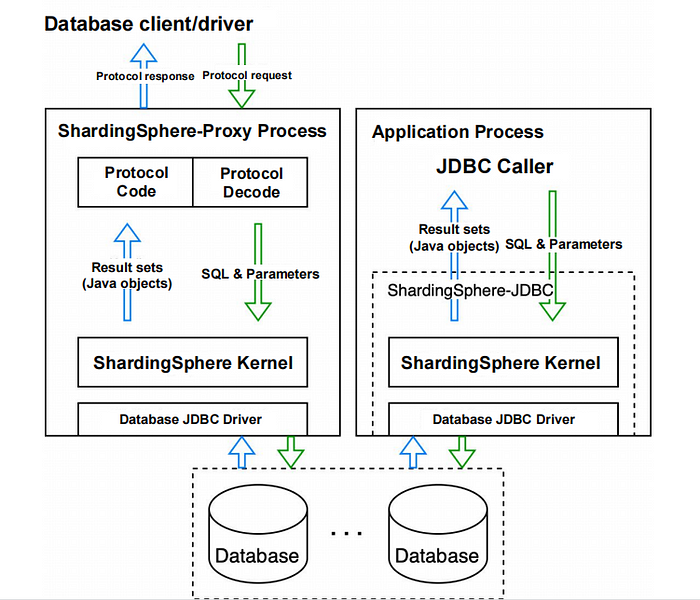
+## Overall Process for the Access Side
+
+ShardingSphere-Proxy and ShardingSphere-JDBC share the ShardingSphere kernel
module and provide different access to users.
+
+ShardingSphere-Proxy exists as a standalone process and provides services to
the outside world as a database protocol. ShardingSphere-JDBC is a set of SDKs
that can be called directly by users through code.
+
+
+
+## ShardingSphere-Proxy Front-end Process
+
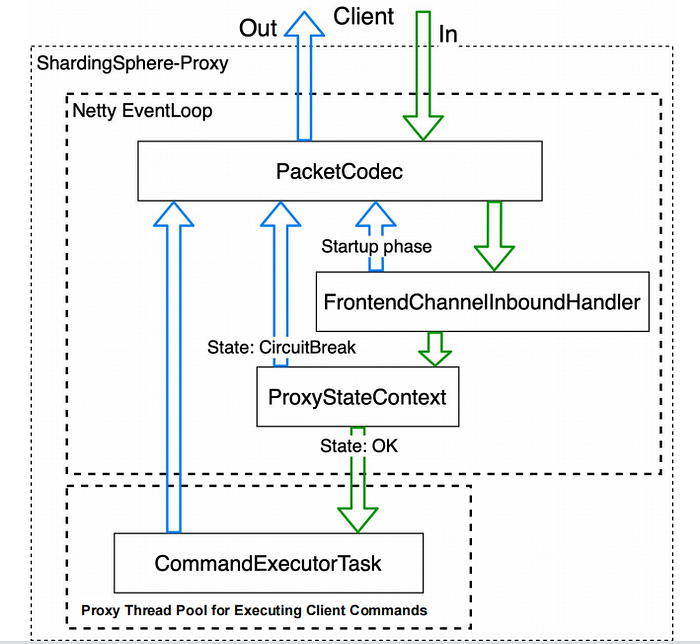
+The ShardingSphere-Proxy front-end uses Netty to implement the database
protocol. The Netty event-driven approach to front-end connections allows the
ShardingSphere-Proxy front-end to maintain a large number of client connections.
+
+The protocol unwrapping and encoding logic is mainly performed in the Netty
`EventLoop` thread. As the ShardingSphere-Proxy backend still uses JDBC to
interact with the database, a dedicated thread pool is used to execute the
ShardingSphere kernel logic and database interaction after the protocol data
has been unpacked to avoid blocking in the Netty `EventLoop` thread.
+
+
+
+`PacketCodecs` are mainly used for unpacking and encoding data. As mentioned
earlier in the introduction to database protocols, the PostgreSQL protocol
supports pipelining and can send a batch of packets at a time.
+
+## Example:
+
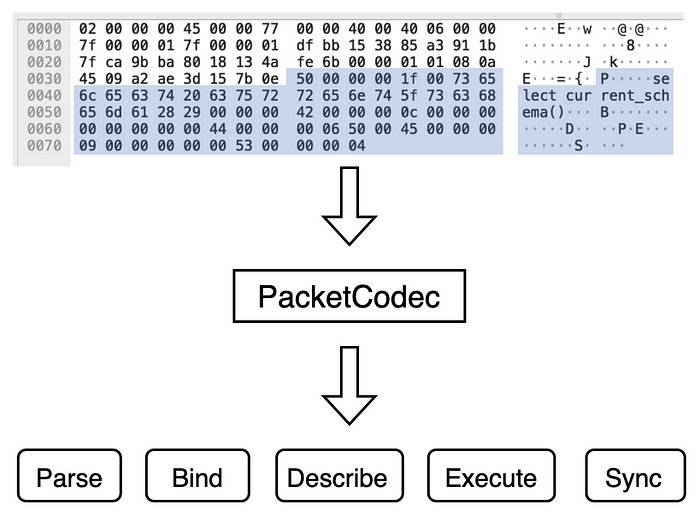
+The following diagram shows the request protocol for a PostgreSQL client to
execute the `select current_schema()` statement using `Prepared Statement`,
where the SQL parsing and execution steps of `Prepared Statement` are sent by
the client to the server for execution in one go.
+
+
+
+What the server receives is a stream of bytes. How can this stream be split
into multiple protocol packets?
+
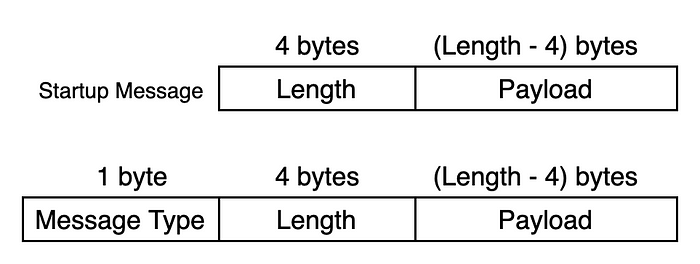
+Taking the PostgreSQL protocol format as an example, except for the Startup
Message, the format of each protocol packet is 1 byte of message type + 4 bytes
of data length (including the length itself) + data, with the following
structure:
+
+
+
+The MySQL protocol packet format is similar.
+
+The `PacketCodec` simply follows the protocol format definition and splits the
incoming byte stream correctly.
+
+After the byte stream has been split, the remaining steps are to parse the
data according to the database protocol and get the SQL and parameters to be
executed.
+
+Once the SQL and parameters are available, the rest of the execution process
is essentially the same as executing SQL via ShardingSphere-JDBC.
+
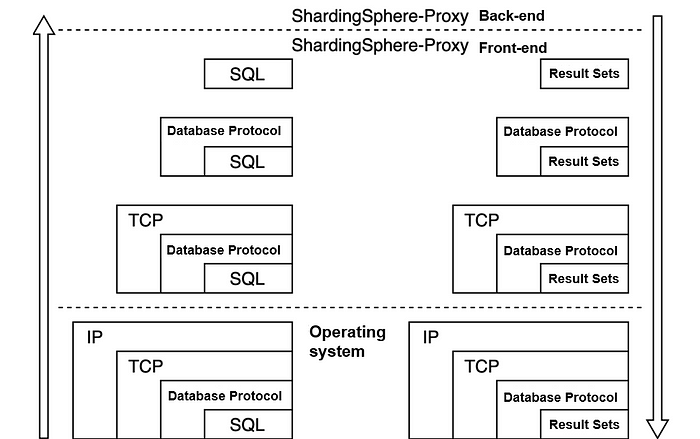
+After the ShardingSphere-Proxy backend executes SQL via JDBC, the result set
is a Java object and the `PacketCodec` calls the specific encoding logic to
convert the Java object into a byte stream according to the database protocol,
assembles it into a packet and responds to the client.
+
+
+
+This is the general flow of the ShardingSphere-Proxy front-end database
protocol interaction.
+
+## How to Feedback Suspected Proxy Protocol Issues to the ShardingSphere
Community?
+
+Due to the differences in computing power between ShardingSphere-Proxy and
databases, the Proxy does not yet have 100% support for database protocols, and
there are inevitably some unsupported cases in the process.
+
+This article gives some suggestions for feedback when users encounter problems
with Proxy that are suspected to be caused by imperfect implementation of the
Proxy protocol.
+
+## Demo Available for Simple Problem Replication
+
+If you have a problem that can be reproduced by constructing simple code (e.g.
just using Python and installing a few simple dependencies), you can provide
the code and steps to reproduce the problem directly in the Github issue.
+
+**Case:** a community member has submitted a problem with aDjango.db
[transaction to ShardingSphere-Proxy
MySQL](https://github.com/apache/shardingsphere/issues/18461).
+
+The author provided a reproduction in the issue to help the ShardingSphere
team fix the problem.
+
+## Directly Submit a Problem Fix PR
+
+For relatively simple issues, the ShardingSphere team can provide ideas for
fixing them, and community members who are in a position to do so can consider
submitting a PR to fix them directly.
+
+**Case:** a community member gave feedback on an issue with
ShardingSphere-Proxy that was reporting an error[ when connecting to it via
Python asyncpg](https://github.com/apache/shardingsphere/issues/23885).
+
+The problem is that the Python asyncpg database driver adds quotes to the
encoding name when sending `client_encoding` to ShardingSphere-Proxy. The
ShardingSphere-Proxy PostgreSQL does not take into account that the encoding
name contains quotes (which is supported by the PostgreSQL database), resulting
in an encoding recognition error.
+
+The issue's author was already in a position to reproduce the problem, and
submitted a PR to fix the problem directly under the guidance of the
ShardingSphere team.
+
+## Capture the Traffic Between the Client and the Proxy Using a Packet Capture
Tool
+
+Some heterogeneous languages users may encounter issues with
ShardingSphere-Proxy that are not related to a specific functionality and are
suspected to be at the protocol level.
+
+Due to differences in the technology stack between the user and the
ShardingSphere team, the ShardingSphere team may not be able to quickly
reproduce the issue locally. In this case, consider feeding back to the
ShardingSphere community by capturing network traffic between the client and
the ShardingSphere-Proxy.
+
+There is a lot of information available on the Internet on how to use this
tool, so we won't mention them here.
+
+**Case:** A .NET MySqlConnector using ShardingSphere-Proxy issue was submitted
by a community member some time ago [with the following
problem](https://github.com/apache/shardingsphere/issues/23857).
+
+There is an error about the .NET connection to ShardingSphere-Proxy reported
in the Issue. According to the stack, the error is caused during
`TryResetConnectionAsync` and the last exception is thrown under the
Protocol-related code, so this could be a ShardingSphere-Proxy protocol
implementation does not behave the same way as MySQL.
+
+```plaintext
+An error occurred using the connection to database .....
+
+ MySqlConnector.MySqlProtocolException: Packet received out-of-order. Expected
1; got 2.
+ at
MySqlConnector.Protocol.Serialization.ProtocolUtility.<DoReadPayloadAsync>g__AddContinuation|5_0(ValueTask`1
readPacketTask, BufferedByteReader bufferedByteReader, IByteHandler
byteHandler, F
+unc`1 getNextSequenceNumber, ArraySegmentHolder`1 previousPayloads,
ProtocolErrorBehavior protocolErrorBehavior, IOBehavior ioBehavior) in
/_/src/MySqlConnector/Protocol/Serialization/ProtocolUtility.cs:
+line 476
+ at
MySqlConnector.Core.ServerSession.ReceiveReplyAsyncAwaited(ValueTask`1 task) in
/_/src/MySqlConnector/Core/ServerSession.cs:line 943
+ at
MySqlConnector.Core.ServerSession.TryResetConnectionAsync(ConnectionSettings
cs, MySqlConnection connection, IOBehavior ioBehavior, CancellationToken
cancellationToken) in /_/src/MySqlConnect
+or/Core/ServerSession.cs:line 616
+```
+
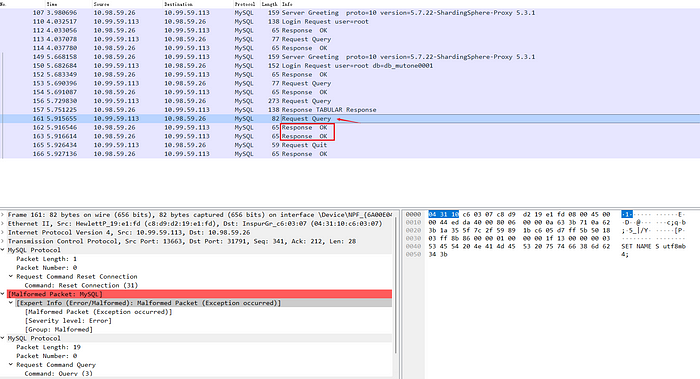
+As this issue is costly to reproduce, it's not easy for the ShardingSphere
team to reproduce the issue locally, and the community has provided protocol
traffic between the client and the Proxy.
+
+
+
+Based on the protocol packet capture results, the ShardingSphere team
immediately identified the issue as a problem with the implementation of the
ShardingSphere-Proxy MySQL packet encoding logic.
+
+## Relevant Links:
+
+**🔗** [**ShardingSphere Official Website**](https://shardingsphere.apache.org/)
+
+**🔗** [**ShardingSphere Official Project
Repo**](https://github.com/apache/shardingsphere)
+
+**🔗** [**ShardingSphere Twitter**](https://twitter.com/ShardingSphere)
+
+**🔗** [**ShardingSphere
Slack**](https://join.slack.com/t/apacheshardingsphere/shared_invite/zt-sbdde7ie-SjDqo9~I4rYcR18bq0SYTg)
\ No newline at end of file
diff --git
a/docs/blog/static/img/2023_02_23_ShardingSphere-Proxy_Database_Protocol_Interaction_Explained1.png
b/docs/blog/static/img/2023_02_23_ShardingSphere-Proxy_Database_Protocol_Interaction_Explained1.png
new file mode 100644
index 00000000000..9d16df7aa13
Binary files /dev/null and
b/docs/blog/static/img/2023_02_23_ShardingSphere-Proxy_Database_Protocol_Interaction_Explained1.png
differ
diff --git
a/docs/blog/static/img/2023_02_23_ShardingSphere-Proxy_Database_Protocol_Interaction_Explained10.png
b/docs/blog/static/img/2023_02_23_ShardingSphere-Proxy_Database_Protocol_Interaction_Explained10.png
new file mode 100644
index 00000000000..37ad5518c0c
Binary files /dev/null and
b/docs/blog/static/img/2023_02_23_ShardingSphere-Proxy_Database_Protocol_Interaction_Explained10.png
differ
diff --git
a/docs/blog/static/img/2023_02_23_ShardingSphere-Proxy_Database_Protocol_Interaction_Explained11.png
b/docs/blog/static/img/2023_02_23_ShardingSphere-Proxy_Database_Protocol_Interaction_Explained11.png
new file mode 100644
index 00000000000..2d7968aacb8
Binary files /dev/null and
b/docs/blog/static/img/2023_02_23_ShardingSphere-Proxy_Database_Protocol_Interaction_Explained11.png
differ
diff --git
a/docs/blog/static/img/2023_02_23_ShardingSphere-Proxy_Database_Protocol_Interaction_Explained12.png
b/docs/blog/static/img/2023_02_23_ShardingSphere-Proxy_Database_Protocol_Interaction_Explained12.png
new file mode 100644
index 00000000000..c3c8a947a8f
Binary files /dev/null and
b/docs/blog/static/img/2023_02_23_ShardingSphere-Proxy_Database_Protocol_Interaction_Explained12.png
differ
diff --git
a/docs/blog/static/img/2023_02_23_ShardingSphere-Proxy_Database_Protocol_Interaction_Explained13.png
b/docs/blog/static/img/2023_02_23_ShardingSphere-Proxy_Database_Protocol_Interaction_Explained13.png
new file mode 100644
index 00000000000..a9767ad4e42
Binary files /dev/null and
b/docs/blog/static/img/2023_02_23_ShardingSphere-Proxy_Database_Protocol_Interaction_Explained13.png
differ
diff --git
a/docs/blog/static/img/2023_02_23_ShardingSphere-Proxy_Database_Protocol_Interaction_Explained14.png
b/docs/blog/static/img/2023_02_23_ShardingSphere-Proxy_Database_Protocol_Interaction_Explained14.png
new file mode 100644
index 00000000000..d7e8377d860
Binary files /dev/null and
b/docs/blog/static/img/2023_02_23_ShardingSphere-Proxy_Database_Protocol_Interaction_Explained14.png
differ
diff --git
a/docs/blog/static/img/2023_02_23_ShardingSphere-Proxy_Database_Protocol_Interaction_Explained2.png
b/docs/blog/static/img/2023_02_23_ShardingSphere-Proxy_Database_Protocol_Interaction_Explained2.png
new file mode 100644
index 00000000000..94ba79264f7
Binary files /dev/null and
b/docs/blog/static/img/2023_02_23_ShardingSphere-Proxy_Database_Protocol_Interaction_Explained2.png
differ
diff --git
a/docs/blog/static/img/2023_02_23_ShardingSphere-Proxy_Database_Protocol_Interaction_Explained3.png
b/docs/blog/static/img/2023_02_23_ShardingSphere-Proxy_Database_Protocol_Interaction_Explained3.png
new file mode 100644
index 00000000000..30f957465dd
Binary files /dev/null and
b/docs/blog/static/img/2023_02_23_ShardingSphere-Proxy_Database_Protocol_Interaction_Explained3.png
differ
diff --git
a/docs/blog/static/img/2023_02_23_ShardingSphere-Proxy_Database_Protocol_Interaction_Explained4.png
b/docs/blog/static/img/2023_02_23_ShardingSphere-Proxy_Database_Protocol_Interaction_Explained4.png
new file mode 100644
index 00000000000..6c93fc0ebff
Binary files /dev/null and
b/docs/blog/static/img/2023_02_23_ShardingSphere-Proxy_Database_Protocol_Interaction_Explained4.png
differ
diff --git
a/docs/blog/static/img/2023_02_23_ShardingSphere-Proxy_Database_Protocol_Interaction_Explained5.png
b/docs/blog/static/img/2023_02_23_ShardingSphere-Proxy_Database_Protocol_Interaction_Explained5.png
new file mode 100644
index 00000000000..38d24f6c7f1
Binary files /dev/null and
b/docs/blog/static/img/2023_02_23_ShardingSphere-Proxy_Database_Protocol_Interaction_Explained5.png
differ
diff --git
a/docs/blog/static/img/2023_02_23_ShardingSphere-Proxy_Database_Protocol_Interaction_Explained6.png
b/docs/blog/static/img/2023_02_23_ShardingSphere-Proxy_Database_Protocol_Interaction_Explained6.png
new file mode 100644
index 00000000000..78a6ad4fbb7
Binary files /dev/null and
b/docs/blog/static/img/2023_02_23_ShardingSphere-Proxy_Database_Protocol_Interaction_Explained6.png
differ
diff --git
a/docs/blog/static/img/2023_02_23_ShardingSphere-Proxy_Database_Protocol_Interaction_Explained7.png
b/docs/blog/static/img/2023_02_23_ShardingSphere-Proxy_Database_Protocol_Interaction_Explained7.png
new file mode 100644
index 00000000000..b2ca628bed3
Binary files /dev/null and
b/docs/blog/static/img/2023_02_23_ShardingSphere-Proxy_Database_Protocol_Interaction_Explained7.png
differ
diff --git
a/docs/blog/static/img/2023_02_23_ShardingSphere-Proxy_Database_Protocol_Interaction_Explained8.png
b/docs/blog/static/img/2023_02_23_ShardingSphere-Proxy_Database_Protocol_Interaction_Explained8.png
new file mode 100644
index 00000000000..b06ca17a59a
Binary files /dev/null and
b/docs/blog/static/img/2023_02_23_ShardingSphere-Proxy_Database_Protocol_Interaction_Explained8.png
differ
diff --git
a/docs/blog/static/img/2023_02_23_ShardingSphere-Proxy_Database_Protocol_Interaction_Explained9.png
b/docs/blog/static/img/2023_02_23_ShardingSphere-Proxy_Database_Protocol_Interaction_Explained9.png
new file mode 100644
index 00000000000..55cb87d224f
Binary files /dev/null and
b/docs/blog/static/img/2023_02_23_ShardingSphere-Proxy_Database_Protocol_Interaction_Explained9.png
differ














