This is an automated email from the ASF dual-hosted git repository.

wuweijie pushed a commit to branch master
in repository https://gitbox.apache.org/repos/asf/shardingsphere.git
The following commit(s) were added to refs/heads/master by this push:
new d5f0e4315a3 feat(blog): update two articles in blogs (#19784)
d5f0e4315a3 is described below
commit d5f0e4315a3579ee2d732d82a744e2d3f66a0548
Author: Yumeiya <[email protected]>
AuthorDate: Tue Aug 2 15:32:34 2022 +0800
feat(blog): update two articles in blogs (#19784)
* articles and images
* images
* Revise MarkDown
* Update docs/blog/content/material/2022_03_09_SQL_Parse_Format_Function_A
_Technical_Deep_Dive_by_Apache_ShardingSphere.en.md
Co-authored-by: 吴伟杰 <[email protected]>
---
...hnical_Deep_Dive_by_Apache_ShardingSphere.en.md | 284 +++++++++++++++++++++
...nology_Budget_with_Apache_ShardingSphere.en.md" | 132 ++++++++++
...hnical_Deep_Dive_by_Apache_ShardingSphere1.jpeg | Bin 0 -> 69767 bytes
...hnical_Deep_Dive_by_Apache_ShardingSphere2.jpeg | Bin 0 -> 244732 bytes
...chnical_Deep_Dive_by_Apache_ShardingSphere3.png | Bin 0 -> 19665 bytes
...chnical_Deep_Dive_by_Apache_ShardingSphere4.png | Bin 0 -> 241734 bytes
...nology_Budget_with_Apache_ShardingSphere1.jpeg" | Bin 0 -> 298433 bytes
...nology_Budget_with_Apache_ShardingSphere2.jpeg" | Bin 0 -> 370002 bytes
...hnology_Budget_with_Apache_ShardingSphere3.jpg" | Bin 0 -> 81874 bytes
9 files changed, 416 insertions(+)
diff --git a/docs/blog/content/material/2022_03_09_SQL_Parse_Format_Function_A
_Technical_Deep_Dive_by_Apache_ShardingSphere.en.md
b/docs/blog/content/material/2022_03_09_SQL_Parse_Format_Function_A
_Technical_Deep_Dive_by_Apache_ShardingSphere.en.md
new file mode 100644
index 00000000000..812086c3670
--- /dev/null
+++ b/docs/blog/content/material/2022_03_09_SQL_Parse_Format_Function_A
_Technical_Deep_Dive_by_Apache_ShardingSphere.en.md
@@ -0,0 +1,284 @@
++++
+title = "SQL Parse Format Function — A Technical Deep Dive by Apache
ShardingSphere"
+weight = 40
+chapter = true
++++
+
+Complicted SQL statements are some of the most common problems that data
scientists and engineers encounter. For example, can you comprehend at first
glance the complex SQL statement below?
+
+```sql
+select a.order_id,a.status,sum(b.money) as money from t_order a inner join
(select c.order_id as order_id, c.number * d.price as money from t_order_detail
c inner join t_order_price d on c.s_id = d.s_id) b on a.order_id = b.order_id
where b.money > 100 group by a.order_id
+```
+
+How about formatting it? Is it easier to understand the formatted formatted
version below?
+
+```sql
+SELECT a . order_id , a . status , SUM(b . money) AS money
+FROM t_order a INNER JOIN
+(
+SELECT c . order_id AS order_id, c . number * d . price AS money
+FROM t_order_detail c INNER JOIN t_order_price d ON c . s_id = d . s_id
+) b ON a . order_id = b . order_id
+WHERE
+b . money > 100
+GROUP BY a . order_id;
+```
+
+The first step to parse such a complex SQL is always formatting, and then its
SQL semantics can be parsed based on the formatted content. SQL Formatter is,
therefore, one of the essential functions of for any database software.
+
+Accordingly, [Apache ShardingSphere](https://shardingsphere.apache.org/) now
offers a SQL formatting tool called SQL Parse Format that depends on
ShardingSphere’s SQL dialect parser.
+
+**SQL Parse Format is an important function of the ShardingSphere Parser
Engine, and also lays the foundation for ShardingSphere’s SQL Audit (TODO).**
This article offers a deep dive into the SQL Parse Format function:
+
+- What’s its core concept?
+- How you can use it?
+- How can you develop SQL Parse Format?
+
+## Parser Engine
+
+To begin, we need to introduce more about Apache ShardingSphere’s Parser
Engine because SQL Parse Format is a unique and relatively independent function
of the parser engine.
+
+Apache ShardingSphere developed the parser engine to extract key information
in SQL, such as fields of data shards and rewritten columns for data
encryption. So far, Apache ShardingSphere’s parser engine has undergone three
iterations.
+
+The initial parser engine leveraged [Druid](https://druid.apache.org/) as its
SQL parser and performed quite well before ShardingSphere Version 1.4.x.
+
+Later the ShardingSphere community decided to develop its second-generation
parser engine on its own. Since the use purpose was changed, ShardingSphere
adopted another approach to comprehend SQL: only the contextual information
that data sharding needs was extracted, without generating a parse tree or a
secondary traversal, to improve performance and compatibility.
+
+Currently, the third generation of ShardingSphere Parser Engine uses
[ANTLR](https://www.antlr.org/) as the parse tree generator and then extracts
the contextual information by doing a secondary tree traversal. It is
substantially compatible with more SQL dialects, which further accelerates
developing other functions in Apache ShardingSphere.
+
+In version 5.0.x, ShardingSphere developers further enhanced the performance
of the newest parser engine by changing its tree traversal method from Listener
to Visitor and adding parsing results cache for pre-compiled SQL statements.
+
+The implementation of SQL Parse Format is attributable to the new parser
engine. Next, let’s take a look at SQL Parse Format function.
+
+## SQL Parser Format
+SQL Parse Format is used to format SQL statements. Additionally, SQL Parse
Format function will be used in SQL Audit in the future to provide users with
viewing SQL history, displaying formatted SQL with reports, or further
analyzing or processing SQL.
+
+For instance, each part of the following SQL formatted by SQL Parse Format
becomes clearer with wrapping and keywords in all caps:
+
+```sql
+select age as b, name as n from table1 join table2 where id = 1 and name =
'lu';
+-- After Formatting
+SELECT age AS b, name AS n
+FROM table1 JOIN table2
+WHERE
+ id = 1
+ and name = 'lu';
+```
+
+So far, we have covered the basics of the SQL Parse Format.
+
+> Next, let’s answer the question: what is the concept of SQL Parse Format?
+
+How a SQL statement is formatted in Apache ShardingSphere? Take the following
SQL as an example:
+
+```sql
+select order_id from t_order where status = 'OK'
+```
+
+1. Apache ShardingSphere uses ANTLR4 as its parser engine generator. First, we
need to follow the ANTLR4 method to define the syntax of select in the .g4 file
(take MySQL as an example).
+
+```
+simpleSelect
+ : SELECT ALL? targetList? intoClause? fromClause? whereClause?
groupClause? havingClause? windowClause?
+ | SELECT distinctClause targetList intoClause? fromClause? whereClause?
groupClause? havingClause? windowClause?
+ | valuesClause
+ | TABLE relationExpr
+ ;
+ ```
+
+2. We can use IDEA’s ANTLR4 plugin to easily view the syntax tree of the SQL
statement.
+
+For more information of ANTLR4 , please refer to:
[https://plugins.jetbrains.com/plugin/7358-antlr-v4](https://plugins.jetbrains.com/plugin/7358-antlr-v4.).
+
+
+ANTLR4 can compile the syntax file we define: it first performs lexical
analysis on the SQL statement, splits it into indivisible parts, namely tokens,
and divides these tokens into keywords, expressions, according to the
dictionary values of different databases.
+
+For example, in the image above, we get the keywords `SELECT`, `FROM`,
`WHERE`, = and the variables `order_id`, `t_order`, `status`, `OK`.
+
+3. Then ANTLR4 converts the output of the parser engine into the syntax tree
as shown in the image above.
+
+Based on the source code of Apache ShardingSphere, the above-mentioned process
is reproduced as follows.
+```java
+String sql = "select order_id from t_order where status = 'OK'";
+CacheOption cacheOption = new CacheOption(128, 1024L, 4);
+SQLParserEngine parserEngine = new SQLParserEngine("MySQL", cacheOption,
false);
+ParseContext parseContext = parserEngine.parse(sql, false);
+```
+
+4. The SQL Parser Engine of Apache ShardingSphere encapsulates and abstracts
the ANTLR4 parser: it loads the SQL dialect parser through an SPI. Users can
also extend data dialects through extension points of SPI. In addition,
ShardingSphere adds a cache mechanism internally to improve performance. Take a
look at the relevant code for parsing as follows:
+```java
+public ParseContext parse(final String sql) {
+ ParseASTNode result = twoPhaseParse(sql);
+ if (result.getRootNode() instanceof ErrorNode) {
+ throw new SQLParsingException("Unsupported SQL of `%s`", sql);
+ }
+ return new ParseContext(result.getRootNode(), result.getHiddenTokens());
+}
+
+private ParseASTNode twoPhaseParse(final String sql) {
+ DatabaseTypedSQLParserFacade sqlParserFacade =
DatabaseTypedSQLParserFacadeRegistry.getFacade(databaseType);
+ SQLParser sqlParser = SQLParserFactory.newInstance(sql,
sqlParserFacade.getLexerClass(), sqlParserFacade.getParserClass(),
sqlCommentParseEnabled);
+ try {
+ ((Parser)
sqlParser).getInterpreter().setPredictionMode(PredictionMode.SLL);
+ return (ParseASTNode) sqlParser.parse();
+ } catch (final ParseCancellationException ex) {
+ ((Parser) sqlParser).reset();
+ ((Parser)
sqlParser).getInterpreter().setPredictionMode(PredictionMode.LL);
+ try {
+ return (ParseASTNode) sqlParser.parse();
+ } catch (final ParseCancellationException e) {
+ throw new SQLParsingException("You have an error in your SQL
syntax");
+ }
+ }
+}
+```
+
+`twoPhaseParse` is the core of the parser. First, it will be loaded into the
correct parser class according to the database type, and then a parser instance
of ANTLR4 will be generated due to the reflection mechanism. Then, ANTLR4
provides two parsing methods: fast parsing is performed first, and if it fails,
regular parsing will be performed. Users can obtain parsing results of most SQL
statements via quick parsing, improving parsing performance as well. After
parsing, we get the parse tree.
+
+So how does Apache ShardingSphere get the formatted SQL statement from the
parse tree?
+
+In fact, ShardingSphere uses the `Visitor` method. ANTLR4 provides two ways to
access syntax trees: Listener and `Visitor`. ShardingSphere chooses the latter
to access syntax trees. The code below shows how to get formatted SQL from the
syntax tree:
+```java
+SQLVisitorEngine visitorEngine = new SQLVisitorEngine("MySQL", "FORMAT", new
Properties());
+String result = visitorEngine.visit(parseContext);
+```
+Apache ShardingSphere’s `SQLVisitorEngine` also abstracts and encapsulates
various dialect visitors. The core method is shown below:
+
+```java
+public <T> T visit(final ParseContext parseContext) {
+ ParseTreeVisitor<T> visitor = SQLVisitorFactory.newInstance(databaseType,
visitorType, SQLVisitorRule.valueOf(parseContext.getParseTree().getClass()),
props);
+ T result = parseContext.getParseTree().accept(visitor);
+ appendSQLComments(parseContext, result);
+ return result;
+}
+```
+At first, in terms of the above-mentioned `Visitor` method, the visitor to be
used is decided according to the database type and the type of the visitor, and
the visitor is also internally instantiated by the reflection mechanism.
Currently, `visitorType` supports two methods: `FORMAT` and `STATEMENT`. The
latter is commonly used by Apache ShardingSphere and can convert SQL into
`Statement` information, extract relevant context information, and serve the
features such as data sharding. I [...]
+
+Next, let’s still take the SQL statement as an example and provide specific
code to show how `Visitor` formats it.
+
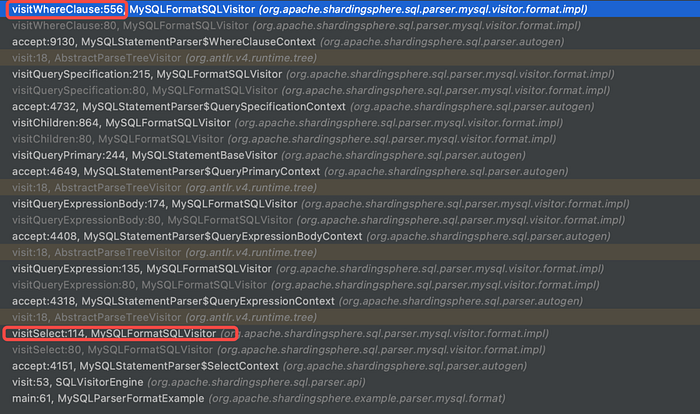
+`MySQLFormatSQLVisitor` is used to visit SQL. Based on the `DEBUG` code, we
can clearly see the execution path of this visit as shown in the figure below.
Visitor traverses all parts of the syntax tree, and ANTLR4 generates default
methods for visiting each node according to the defined grammar rules. Apache
ShardingSphere leverages key methods and successfully develops complete the SQL
formatting function.
+
+
+The following code can help us better understand how `Visitor` can format SQL.
+
+When the `Visitor` traverses to `select`, the `Visitor` will format it first,
and then visit `projection`. The internal formatting of `projection` will be
further implemented through the `visitProjections` method.
+
+Empty lines are handled before accessing `from`. The object instantiated by
the `Visitor` maintains a `StringBuilder` to store the formatted result. Since
the parser and visitor of each SQL are newly-created instantiated objects,
there are no thread issues. After the final traversal, Apache ShardingSphere
outputs the result in `StringBuilder`, and then we get formatted SQL.
+
+```java
+public String visitQuerySpecification(final QuerySpecificationContext ctx) {
+ formatPrint("SELECT ");
+ int selectSpecCount = ctx.selectSpecification().size();
+ for (int i = 0; i < selectSpecCount; i++) {
+ visit(ctx.selectSpecification(i));
+ formatPrint(" ");
+ }
+ visit(ctx.projections());
+ if (null != ctx.fromClause()) {
+ formatPrintln();
+ visit(ctx.fromClause());
+ }
+ if (null != ctx.whereClause()) {
+ formatPrintln();
+ visit(ctx.whereClause());
+ }
+ if (null != ctx.groupByClause()) {
+ formatPrintln();
+ visit(ctx.groupByClause());
+ }
+ if (null != ctx.havingClause()) {
+ formatPrintln();
+ visit(ctx.havingClause());
+ }
+ if (null != ctx.windowClause()) {
+ formatPrintln();
+ visit(ctx.windowClause());
+ }
+ return result.toString();
+}
+```
+
+Now, based on the process analysis and code snippets above, you can understand
the principle of SQL Parse Format.
+
+## User Guide for SQL Parse Format
+You may find it’s easy to use the SQL Parse Format function in Apache
ShardingSphere as long as you know its principle.
+
+As for Java applications, users only need to add dependencies and call the API.
+
+- Add the Dependency
+
+```xml
+<dependency>
+ <groupId>org.apache.shardingsphere</groupId>
+ <artifactId>shardingsphere-sql-parser-engine</artifactId>
+ <version>${project.version}</version>
+</dependency>
+
+<dependency>
+ <groupId>org.apache.shardingsphere</groupId>
+ <artifactId>shardingsphere-sql-parser-mysql</artifactId>
+ <version>${project.version}</version>
+</dependency>
+```
+
+- Call the API
+```java
+public static void main(String[] args) {
+ String sql = "select order_id from t_order where status = 'OK'";
+ CacheOption cacheOption = new CacheOption(128, 1024L, 4);
+ SQLParserEngine parserEngine = new SQLParserEngine("MySQL", cacheOption,
false);
+ ParseContext parseContext = parserEngine.parse(sql, false);
+ SQLVisitorEngine visitorEngine = new SQLVisitorEngine("MySQL", "FORMAT",
new Properties());
+ String result = visitorEngine.visit(parseContext);
+ System.out.println(result);
+}
+```
+
+- Parameters Supported by Properties
+
+
+You can also use DistSQL in ShardingSphere-Proxy to perform operations on the
SQL Parse Format function:
+```
+mysql> FORMAT select order_id from t_user where status = 'OK';
++-----------------------------------------------------+
+| formatted_result |
++-----------------------------------------------------+
+| SELECT order_id
+FROM t_user
+WHERE
+ status = 'OK'; |
++-----------------------------------------------------+
+```
+
+In terms of the above-mentioned `Statement` mode, it can also enable users to
easily view the results of `SQLStatement` converted from the SQL.
+```
+mysql> parse SELECT id, name FROM t_user WHERE status = 'ACTIVE' AND age > 18;
++----------------------+------------------------------------------------------------------------------------------------------------------------------------------------------------------------------------------------------------------------------------------------------------------------------------------------------------------------------------------------------------------------------------------------------------------------------------------------------------------------------------
[...]
+| parsed_statement | parsed_statement_detail
[...]
++----------------------+------------------------------------------------------------------------------------------------------------------------------------------------------------------------------------------------------------------------------------------------------------------------------------------------------------------------------------------------------------------------------------------------------------------------------------------------------------------------------------
[...]
+| MySQLSelectStatement |
{"projections":{"startIndex":7,"stopIndex":14,"distinctRow":false,"projections":[{"column":{"startIndex":7,"stopIndex":8,"identifier":{"value":"id","quoteCharacter":"NONE"}}},{"column":{"startIndex":11,"stopIndex":14,"identifier":{"value":"name","quoteCharacter":"NONE"}}}]},"from":{"tableName":{"startIndex":21,"stopIndex":26,"identifier":{"value":"t_user","quoteCharacter":"NONE"}}},"where":{"startIndex":28,"stopIndex":63,"expr":{"startIndex":34,"stopIndex":63,"le
[...]
++----------------------+------------------------------------------------------------------------------------------------------------------------------------------------------------------------------------------------------------------------------------------------------------------------------------------------------------------------------------------------------------------------------------------------------------------------------------------------------------------------------------
[...]
+```
+
+For more [DistSQL](https://opensource.com/article/21/9/distsql) functions,
please refer to the documentation:
[https://shardingsphere.apache.org/document/current/cn/concepts/distsql/](https://shardingsphere.apache.org/document/current/cn/concepts/distsql/)
+
+## Conclusion
+Currently, Apache ShardingSphere’s Format function only supports
[MySQL](https://www.mysql.com/). After understanding its concept and how to use
it, if you’re interested, you are welcome to contribute to developing the SQL
Parse Format function.
+
+### Apache ShardingSphere Open Source Project Links:
+[ShardingSphere Github
+](https://github.com/apache/shardingsphere/issues?page=1&q=is%3Aopen+is%3Aissue+label%3A%22project%3A+OpenForce+2022%22)
+[ShardingSphere Twitter](https://twitter.com/ShardingSphere)
+
+[ShardingSphere
Slack](https://join.slack.com/t/apacheshardingsphere/shared_invite/zt-sbdde7ie-SjDqo9~I4rYcR18bq0SYTg)
+
+[Contributor Guide](https://shardingsphere.apache.org/community/cn/contribute/)
+
+## Author
+**Chen Chuxin**
+
+
+> SphereEx Middleware Engineer & Apache ShardingSphere Committer
+
+> Currently, he devotes himself to developing the kernel module of Apache
ShardingSphere.
+
diff --git
"a/docs/blog/content/material/2022_03_11_Asia\342\200\231s_E-Commerce_Giant_Dangdang_Increases_Order_Processing_Speed_by_30%_Saves_Over_Ten_Million_in_Technology_Budget_with_Apache_ShardingSphere.en.md"
"b/docs/blog/content/material/2022_03_11_Asia\342\200\231s_E-Commerce_Giant_Dangdang_Increases_Order_Processing_Speed_by_30%_Saves_Over_Ten_Million_in_Technology_Budget_with_Apache_ShardingSphere.en.md"
new file mode 100644
index 00000000000..26e835d0b1c
--- /dev/null
+++
"b/docs/blog/content/material/2022_03_11_Asia\342\200\231s_E-Commerce_Giant_Dangdang_Increases_Order_Processing_Speed_by_30%_Saves_Over_Ten_Million_in_Technology_Budget_with_Apache_ShardingSphere.en.md"
@@ -0,0 +1,132 @@
++++
+title = "Asia’s E-Commerce Giant Dangdang Increases Order Processing Speed by
30% — Saves Over Ten Million in Technology Budget with Apache ShardingSphere"
+weight = 41
+chapter = true
++++
+
+> Apache ShardingSphere is an easy-to-use and stable product, making
Dangdang’s warehouse management system (WMS) even more powerful. Integrated
with WMS, ShardingSphere plays a vital role in reforming the supply chain
system.
+
+> - Li Yong, Head of WMS Technology, Dangdang
+
+Ffollowing [Apache ShardingSphere 5.0.0
GA](https://medium.com/codex/apache-shardingsphere-5-0-0-new-features-middleware-to-ecosystem-evolution-e69de00bfb1b)
release in November 2021, the [5.1.0
version](https://shardingsphere.medium.com/apache-shardingsphere-5-1-0-now-avaliable-4244ac470e77)
was released last month. Having gone through over two years of polishing,
ShardingSphere’s plugin-oriented ecosystem is beginning to take shape, and the
project embarks on the evolution from a simpl [...]
+
+Dangdang, established at the end of 1999, has become a leading e-commerce
platform selling books of any kind, and by integrating new Internet
technologies with the traditional book industry. Dangdang was founded during
the surge in China’s Internet industry in the early 2000s.
+
+Later, the e-commerce industry became exremely competitive in the country, and
the market saturated. Facing fierce market competition, e-commerce platforms
had to adapt to remain competitive.
+
+In response, Dangdang not only adjusted its business strategies and management
approaches, but also upgraded its technology architecture. Dangdang didn’t have
its warehouse management and transportation system at that time. However, with
growing business volume and technological capabilities, Dangdang needed to
rebuild its warehouse management system and transportation management system
(TMS) to better satisfy its business needs. For instance, in terms of hardware,
it replaced mini-compu [...]
+
+One of the biggest challenges was massive warehousing data storage. The
engineers wanted to adopt the data sharding technology that was often chosen by
other big Internet companies. Disappointingly, they failed to find a mature and
versatile open source database middleware in the marketplace, and
therefore,started to develop a new data sharding product. That’s the origin of
Sharding-JDBC. The product was created to bring more possibilities to data
services.
+
+Dangdang released its new WMS five years ago, which meant that it completed
its intelligent warehousing transformation. Since then, with Apache
ShardingSphere, the WMS has enabled Dangdang to hold large online shopping
events every year such as Dangdang’s April Reading Festival, Double-Eleven
Online Shopping Festival (aka Singles Day), and Mid-Year Shopping Festival, and
to manage over a dozen of smart warehouses.
+
+## Business Challenges
+When Dangdang adopted a third-party WMS, the database in use was
[Oracle](https://www.oracle.com/index.html) based on
[IBM](https://www.ibm.com/docs/en/informix-servers/14.10?topic=strategies-what-is-fragmentation)
minicomputers.
+
+However, considering the increasing business volume and warehouse order
requests, especially during the online shopping festivals, the traditional
centralized database architecture of the old WMS became inadequate because the
computing and storage capabilities were limited. Additionally, the scale-up
solution couldn’t support the system during online shopping festivals, and
therefore the developers must do scale-up and adjust the business layer several
times to alleviate the storage and [...]
+
+- **Limited computing and storage capabilities**
+
+A centralized architecture is less scalable, making database computing and
storage capabilities become the bottleneck.
+
+- **Expensive development and maintenance cost**
+
+Because of poor scalability, developers have to make concessions and scale-up,
which increases system development and maintenance costs.
+
+- **Exclusiveness**
+
+If the architecture is not open enough, the system is less flexible, with
fewer functions, and difficult to be transformed. The current architecture
makes it difficult to quickly adopt new business services such as cloud native
ones, SQL audit, data encryption, and distributed governance.
+
+## The Solution
+Based on the situation described above, Dangdang’s tech team proposed a
warehouse management system solution: in terms of hardware, IBM minicomputer
would be replaced with all-purpose x86, and [MySQL](https://www.mysql.com/)
would replace Oracle.
+
+However, at that time, there wasn’t a versatile and mature enough open source
database middleware living up to Dangdang’s expectations, so they created one
and named it Sharding-JDBC.
+
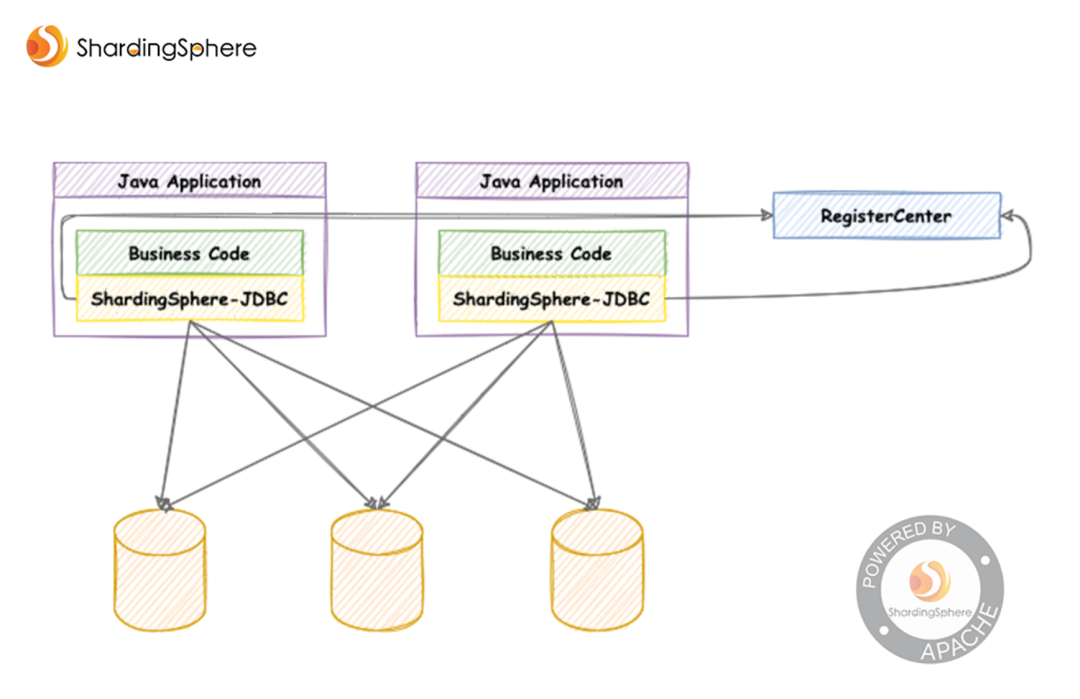
+[ShardingSphere-JDBC](https://shardingsphere.apache.org/document/current/en/concepts/adaptor/#shardingsphere-jdbc)
is positioned as a lightweight Java framework that provides additional
services at the Java Database Connectivity (JDBC) layer. It is lightweight,
efficient, easy to use, and compatible.
+
+With ShardingSphere providing services in the form of the `.jar` files
package, users can connect the client directly to the database without
additional deployment and dependencies. It can be seen as an enhanced JDBC
driver, fully compatible with JDBC and all ORM frameworks.
+
+- Compatible with JDBC and any JDBC-based ORM framework such as JPA,
Hibernate, Mybatis, Spring JDBC Template.
+- Supports all third-party database connection pools such as DBCP, C3P0,
BoneCP, HikariCP, etc.
+- Supports all databases implementing JDBC standards. Currently,
ShardingSphere-JDBC supports MySQL, PostgreSQL, Oracle, SQL Server, and any
database that can be accessed via JDBC.
+
+
+
+Currently, Apache ShardingSphere consists of three products, i.e. JDBC, Proxy,
and Sidecar (TODO). ShardingSphere-JDBC and ShardingSphere-Proxy can be
deployed independently or together.
+
+It is ShardingSphere-JDBC that is used in Dangdang’s warehouse management
system.
+
+> **So how is ShardingSphere-JDBC exactly utilized?**
+
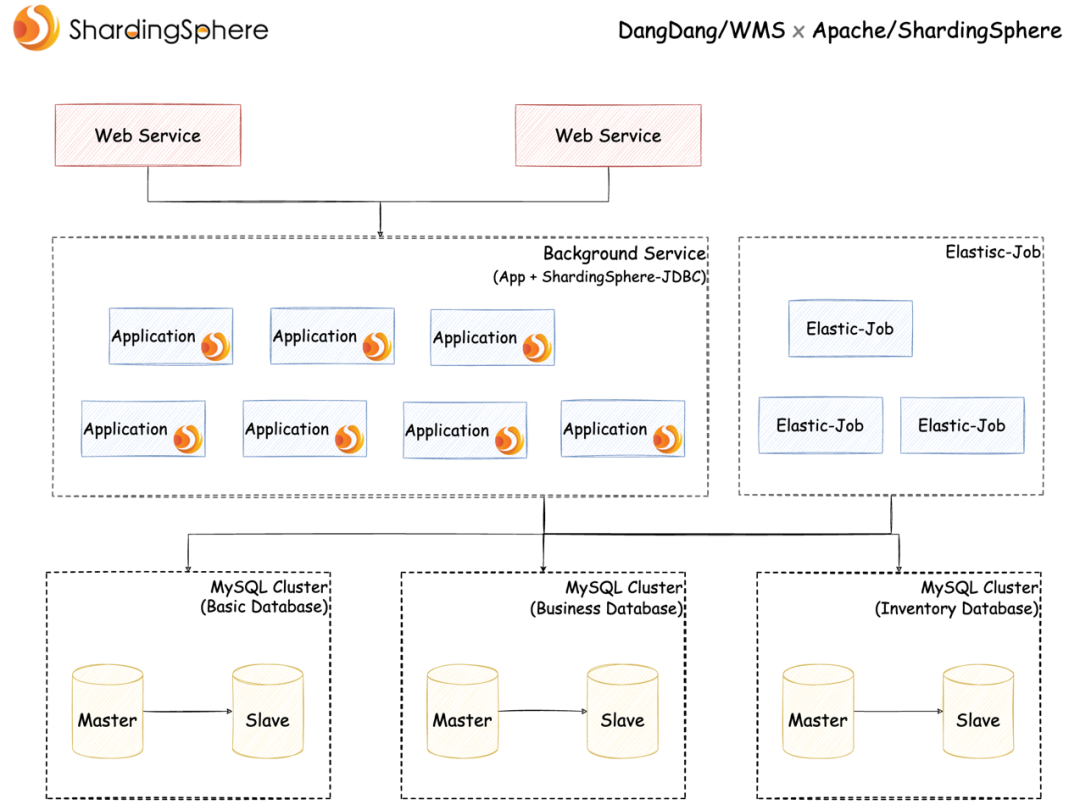
+In the warehouse management system, each warehouse positioned in a physical
city is referred to as a unit with its corresponding business system and
databases. Each warehouse has three sets of MySQL primary-secondary clusters to
load the warehousing data of the designated city. So far, Dangdang has more
than ten self-built warehouses all over China, mostly in cities where customers
place a large number of orders. This self-built warehouse model is flexible for
warehouse management and he [...]
+
+In terms of architecture, the WMS uses ShardingSphere-JDBC to do database
sharding according to their business types, and each cluster stores specified
business data. The three MySQL clusters of a single warehouse are divided into
three types as follows:
+
+- **Basic:** stores user, area, and menu data.
+- **Business:** stores order and package data.
+- **Inventory:** stores stock and working data.
+
+Before the release, the system was initialized based on the basic data of a
warehouse, such as storage locations.
+
+Next, by deploying the distributed database middleware, Dangdang successfully
solved a series of problems such as limited storage and computing capabilities,
high costs, and lack of flexibility.
+
+
+
+## User Advantages
+Apache ShardingSphere played a significant role in helping Dangdang develop
its WMS. There are five main benefits:
+
+- **Extraordinary performance**
+
+The ShardingSphere-JDBC lightweight framework makes its performance close to a
native JDBC. Apart from its great database sharding capability, it helps
database performance be taken to the extreme, which allows the WMS to work at
full capacity.
+
+- **Keep the system stable**
+
+WMS has been functioning well since its release in 2016.
+
+- **Low risk & zero invasion**
+
+The underlying system of Dangdang has been evolving since 2000. Thanks to its
zero-intrusion nature, Apache ShardingSphere can be compatible with others with
small modifications to meet Dangdang’s business requirements.
+
+- **Allow developers to focus on the business side**
+
+The developer team does not need to worry about sharding any more and can
concentrate on developing the system to meet business needs.
+
+- **Cost effective and efficient**
+
+Since ShardingSphere is known for its high compatibility, to satisfy
increasing business needs, developers don’t have to reconstruct or upgrade the
system, minimizing the migration cost.
+
+Warehousing order processing speed is increased by 30% and accordingly, tens
of millions of manpower costs are reduced due to the smart warehouses and the
auto storage location matching technology.
+
+## Apache ShardingSphere’s Roadmap
+
+Some said that ShardingSphere is a product created by Dangdang. To be precise,
ShardingSphere was derived from the company and it also donated ShardingSphere
to the Apache Software Foundation (ASF) on November 10, 2018.
+
+After 17-months in the ASF incubator, Apache ShardingSphere successfully
graduated on April 15, 2020, as a Top-Level Apache Project.
+
+Recently, to celebrate the third anniversary of ShardingSphere entering Apache
Software Foundation(ASF), the community released ShardingSphere 5.0.0. Below is
a brief review of Apache ShardingSphere.
+
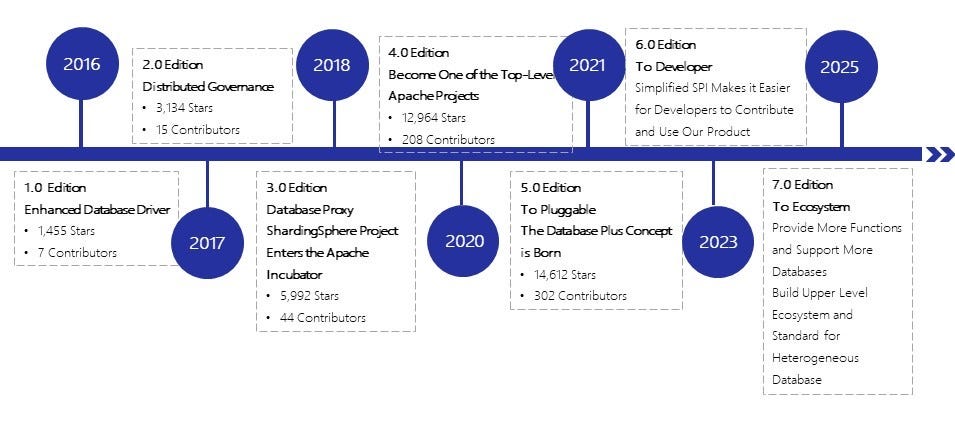
+- In 2014, Dangdang introduced a centralized development framework targeting
at its e-commerce platform called dd-frame. It was created to unify the
development framework, standardize its technical components, and achieve
efficient cross-team communication by separating business code from technical
code. In this way, engineers can devote all their efforts to the business side.
The relational database module named dd-rdb in the framework was developed to
handle data access and implement t [...]
+- In 2015, Dangdang decided to rebuild its WMS and TMS. As it needed a data
sharding plan, the team launched the project in September. In December, 2015,
Sharding-JDBC 1.0.0 was released and used within Dangdang.
+- In early 2016, Sharding-JDBC was separated from dd-rdb and became open
source. The product is an enhanced JDBC driver providing service in .jar files.
+- At the end of 2017, Version 2.0.0 was released with the new data governance
function.
+- In 2018, ShardingSphere was enrolled into Apache Incubator. The release of
Version 3.0.0 was a notable turnaround: Sharding-Proxy was released as an
independent service. It supported heterogeneous languages, and the project was
renamed from Sharding-JDBC to ShardingSphere. It’s in 2018 that the community
decided to build the criteria and ecosystem above databases.
+- In 2019, Version 4.0.0 was released capable of supporting more database
products.
+- In 2020, ShardingSphere graduated as a Top-Level Project of the ASF.
+- On November 10, 2021, Version 5.0.0 GA was released as a third-anniversity
celebration with the whole Apache ShardingSphere community, and the distributed
database industry.
+
+
+Since Version 5.0.0, Apache ShardingSphere has embarked on its new journey:
with the plugin oriented architect at its core, it evloved from a data sharding
application to a comprehensive and enhanced data governance tool applicable to
various complex application scenarios. Concurrently, Apache ShardingSphere also
has more features, and big data solutions.
+
+## Conclusion
+Digitization motivated Dangdang to achieve high-quality development and
fulfill its mission. ShardingSphere is glad to support Dangdang’s WMS with its
cutting-edging data services.
+
+Having gone through two years‘ development, Apache ShardingSphere 5.0.0 GA has
been released. The pluggable ecosystem marks an evolution from a data sharding
middleware tool to a pioneer in the industry following the “Database Plus”
concept.
+
+## Apache ShardingSphere Project Links:
+[ShardingSphere
Github](https://github.com/apache/shardingsphere/issues?page=1&q=is%3Aopen+is%3Aissue+label%3A%22project%3A+OpenForce+2022%22)
+
+[ShardingSphere Twitter](https://twitter.com/ShardingSphere)
+
+[ShardingSphere
Slack](https://join.slack.com/t/apacheshardingsphere/shared_invite/zt-sbdde7ie-SjDqo9~I4rYcR18bq0SYTg)
+
+[Contributor Guide](https://shardingsphere.apache.org/community/cn/contribute/)
\ No newline at end of file
diff --git a/docs/blog/static/img/2022_03_09_SQL_Parse_Format_Function_A
_Technical_Deep_Dive_by_Apache_ShardingSphere1.jpeg
b/docs/blog/static/img/2022_03_09_SQL_Parse_Format_Function_A
_Technical_Deep_Dive_by_Apache_ShardingSphere1.jpeg
new file mode 100644
index 00000000000..414a569b355
Binary files /dev/null and
b/docs/blog/static/img/2022_03_09_SQL_Parse_Format_Function_A
_Technical_Deep_Dive_by_Apache_ShardingSphere1.jpeg differ
diff --git a/docs/blog/static/img/2022_03_09_SQL_Parse_Format_Function_A
_Technical_Deep_Dive_by_Apache_ShardingSphere2.jpeg
b/docs/blog/static/img/2022_03_09_SQL_Parse_Format_Function_A
_Technical_Deep_Dive_by_Apache_ShardingSphere2.jpeg
new file mode 100644
index 00000000000..87c462c5d55
Binary files /dev/null and
b/docs/blog/static/img/2022_03_09_SQL_Parse_Format_Function_A
_Technical_Deep_Dive_by_Apache_ShardingSphere2.jpeg differ
diff --git a/docs/blog/static/img/2022_03_09_SQL_Parse_Format_Function_A
_Technical_Deep_Dive_by_Apache_ShardingSphere3.png
b/docs/blog/static/img/2022_03_09_SQL_Parse_Format_Function_A
_Technical_Deep_Dive_by_Apache_ShardingSphere3.png
new file mode 100644
index 00000000000..26b70243291
Binary files /dev/null and
b/docs/blog/static/img/2022_03_09_SQL_Parse_Format_Function_A
_Technical_Deep_Dive_by_Apache_ShardingSphere3.png differ
diff --git a/docs/blog/static/img/2022_03_09_SQL_Parse_Format_Function_A
_Technical_Deep_Dive_by_Apache_ShardingSphere4.png
b/docs/blog/static/img/2022_03_09_SQL_Parse_Format_Function_A
_Technical_Deep_Dive_by_Apache_ShardingSphere4.png
new file mode 100644
index 00000000000..1fd92615227
Binary files /dev/null and
b/docs/blog/static/img/2022_03_09_SQL_Parse_Format_Function_A
_Technical_Deep_Dive_by_Apache_ShardingSphere4.png differ
diff --git
"a/docs/blog/static/img/2022_03_11_Asia\342\200\231s_E-Commerce_Giant_Dangdang_Increases_Order_Processing_Speed_by_30%_Saves_Over_Ten_Million_in_Technology_Budget_with_Apache_ShardingSphere1.jpeg"
"b/docs/blog/static/img/2022_03_11_Asia\342\200\231s_E-Commerce_Giant_Dangdang_Increases_Order_Processing_Speed_by_30%_Saves_Over_Ten_Million_in_Technology_Budget_with_Apache_ShardingSphere1.jpeg"
new file mode 100644
index 00000000000..0db5497791c
Binary files /dev/null and
"b/docs/blog/static/img/2022_03_11_Asia\342\200\231s_E-Commerce_Giant_Dangdang_Increases_Order_Processing_Speed_by_30%_Saves_Over_Ten_Million_in_Technology_Budget_with_Apache_ShardingSphere1.jpeg"
differ
diff --git
"a/docs/blog/static/img/2022_03_11_Asia\342\200\231s_E-Commerce_Giant_Dangdang_Increases_Order_Processing_Speed_by_30%_Saves_Over_Ten_Million_in_Technology_Budget_with_Apache_ShardingSphere2.jpeg"
"b/docs/blog/static/img/2022_03_11_Asia\342\200\231s_E-Commerce_Giant_Dangdang_Increases_Order_Processing_Speed_by_30%_Saves_Over_Ten_Million_in_Technology_Budget_with_Apache_ShardingSphere2.jpeg"
new file mode 100644
index 00000000000..ce7397dc822
Binary files /dev/null and
"b/docs/blog/static/img/2022_03_11_Asia\342\200\231s_E-Commerce_Giant_Dangdang_Increases_Order_Processing_Speed_by_30%_Saves_Over_Ten_Million_in_Technology_Budget_with_Apache_ShardingSphere2.jpeg"
differ
diff --git
"a/docs/blog/static/img/2022_03_11_Asia\342\200\231s_E-Commerce_Giant_Dangdang_Increases_Order_Processing_Speed_by_30%_Saves_Over_Ten_Million_in_Technology_Budget_with_Apache_ShardingSphere3.jpg"
"b/docs/blog/static/img/2022_03_11_Asia\342\200\231s_E-Commerce_Giant_Dangdang_Increases_Order_Processing_Speed_by_30%_Saves_Over_Ten_Million_in_Technology_Budget_with_Apache_ShardingSphere3.jpg"
new file mode 100644
index 00000000000..441ec6a26f0
Binary files /dev/null and
"b/docs/blog/static/img/2022_03_11_Asia\342\200\231s_E-Commerce_Giant_Dangdang_Increases_Order_Processing_Speed_by_30%_Saves_Over_Ten_Million_in_Technology_Budget_with_Apache_ShardingSphere3.jpg"
differ






