<https://chisineu.files.wordpress.com/2016/02/utm_web_800px.jpg>
https://chisineu.wordpress.com/2016/02/16/urbanism-tactic-2/
<https://chisineu.wordpress.com/2016/02/16/urbanism-tactic-2/>
– – – scroll down for English version – – –
RO
– – – – –

PRACTICI ACTUALE DE ARHITECTURĂ ȘI URBANISM TACTIC
18 februarie 2016, ora 14:00
Facultatea de Arhitectură, Universitatea Tehnică din Moldova
(bd. Dacia 39, Chișinău / blocul 9, et. 2, sala 212)

În perioada sovietică statul deținea controlul în materie de planificare
urbană, acest lucru avînd tangențe cu ideologia și securitatea lui. Populația
era exclusă din acest proces, doar arhitecții principali erau cei inițiați în
proiectele strategice ale statului, fiind instrumentalizați de un sistem
autoritar. Ei erau implicați, deseori, în realizarea unor proiecte
megalomanice, care depășeau cu mult dimensiunea umană.

Prezentările ce vor urma reprezintă un alt tip de practică arhitecturală, axată
pe comunitate și obținerea unui rezultat cît mai real. Pornind de la amenajări
temporare, intervenții efemere în spațiile publice, completări ale vidurilor
depistate în textura urbană, proiectele colectivelor de arhitecți oferă un
cadru democratic nou pentru implicarea locuitorilor și altor actori, urmărind
să identifice soluții creative pentru satisfacerea unor nevoi comunitare.

ÎN ACȚIUNE: ÎN CĂUTAREA ORAȘULUI INTERMEDIAR
studioBASAR (Alex AXINTE), București

Spaţiile intermediare, împreună cu utilizările lor, sunt unele dintre cele mai
importante resurse în activarea spaţiilor publice prin implicarea comunităţii.
Uitându-ne la intermediar din diferite unghiuri, a generat o practică nouă, pe
care am investigat-o prin câteva tipologii de unelte şi proceduri.

ÎNAPOI SPRE AGORA: SPAȚIUL PUBLIC ÎN SEC. XXI
Straddle3 și WWB / rețeaua Arquitecturas Colectivas (David JUAREZ și Ale
GONZALEZ), Barcelona

O analiză a proceselor participative radicale sub aspectul gândirii, designului
şi construcţiei spaţiului public. Vom vedea diversele tipuri de mijloace şi
proceduri care s-au dovedit utile pentru grupuri de cetăţeni cu divesre poveşti
de viaţă şi necesităţi, în efortul lor de a construi spaţii colective. Vom
analiza de asemenea noile roluri pe care şi le asumă arhitecţii şi alţi
profesionişti în acest proces de transformare a peisajului.

ARTĂ(E) / ARHITECTURĂ(I) / TERITORIU(I) / PUBLIC(URI) / SPAȚIU(I)
PIXEL [13] (Sabine THUILIER și Alexandre CUBIZOLLES), Marsilia

– Experimentarea spaţiilor publice în cel mai larg sens;
– Analiza spaţiilor locative sub toate aspectele;
– Realizarea unei creaţii contextualizate;
– Plasarea transdisciplinarităţii, decompartimentalizării, descoperirile
artistice, schimbul uman, convivialitatea, transmiterea şi experimentarea în
inima procesului creativ.

O ÎNTRODUCERE ÎN NOȚIUNEA DE MOBILITATE
Un atelier cu Ștefan RUSU de elaborare a unei structuri mobile pentru
intervenții și colaborare cu comunitățile din zona cartierelor rezidențiale,
Chișinău

Un atelier de elaborare a unei structuri mobile pentru intervenții și
colaborare cu comunitățile din zona cartierelor rezidențiale.

Prezentarea se va axa pe practica unor colective de arhitecți și artiști activi
în zone urbane – RAUMLABOR (Berlin), Ewa Rudnicka (Varșovia), colectivul de
arhitecți EXYZT (Paris) și alții, care în perioade diferite au abordat tema
mobilității ca pe o componentă de interacțiune cu spațiul public. În cazul
proiectului “Platforma Mobilă” a Ewei Rudnicka, realizat în 2014 pentru
proiectul “Spaces on the Run” (Spații în Mișcare) în Dushanbe/Tajikistan,
mobilitatea devine un element esențial pentru crearea unui spațiu generator de
evenimente publice într-un oraș aflat în perpetuă schimbare, într-un regim
ad-hoc.

ŞVAIP-2015 / ARHITECTURĂ. INSTALAȚII. PEISAGISTICĂ
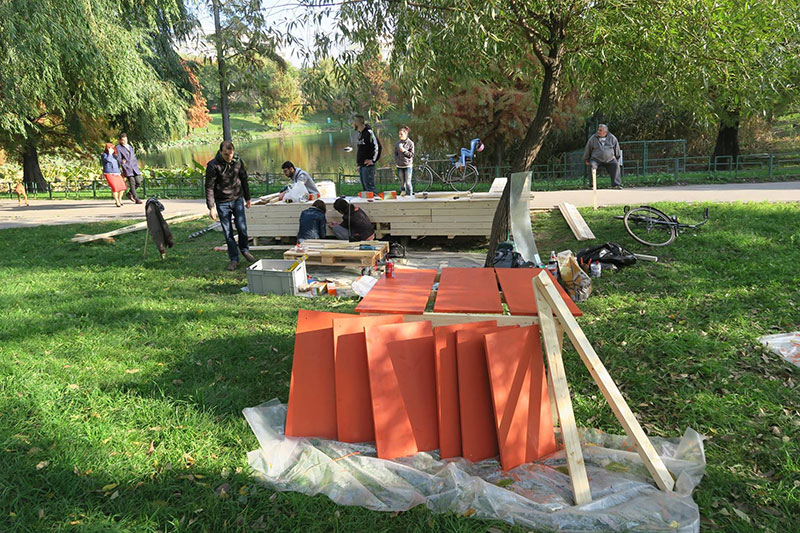
Prima şcoală de vară în arhitectură cu Asociaţia Archilitic

În ediția ȘVAIP-2015, echipa Archilitic, împreună cu participanții școlii cât
și invitații asociației, și-au propus să amenajeze un spațiu recreativ pe malul
stâng al Nistrului, pentru toate categoriile de vârstă. Va fi prezentat în
detaliu programul școlii de vară și procesului de învățare, locul unde s-au
desfășurat activitățile, obiectele pe care le-au meșterit participanții,
colegii cu care au stat la taclale și rezultatele obținute în urma acestei
colaborări cu participarea unor oameni ce nu se cunoșteau, însă care au devenit
în final prieteni.

– – –

studioBASAR a fost înfiinţat în 2006 de către Alex Axinte şi Cristi Borcan atât
ca un studio de arhitectură, cât şi ca o echipă de observaţie şi intervenţie
urbană. Preocupaţi de dinamica culturii urbane contemporane şi de degradarea
spaţiului public, proiectele studioBASAR variază de la intervenţii în spaţiul
public, instalaţii artistice, cercetări urbane, ateliere de educaţie
nonformală, până la concursuri şi diferite tipologii de clădiri rezidenţiale şi
publice.
http://www.studiobasar.ro <http://www.studiobasar.ro/>
Straddle3 reprezintă o echipa multidisciplinară unită de un interes comun
pentru arhitectura open-source și dedicată realizării unor proiecte și
instrumente în conexiune ce aceasta. Ei activează în domeniul construcției
locuințelor, amenajării spațiilor publice, dezvoltării domeniului public
digital și urbanismului participativ.
http://straddle3.net/ <http://straddle3.net/>
WWB este o cooperativă din Andaluzia, care dezvoltă programe și tehnologii de
calculator libere, susține standarde deschise și oferă servicii tehnologice și
comunicaționale în domeniul artei, arhitecturii și mișcărilor sociale.
http://wwb.cc/ <http://wwb.cc/>
ARQUITECTURAS COLECTIVAS este o reţea de oameni şi grupuri interesate în
dezvoltarea participativă a mediului urban. Această reţea asigură un cadru
instrumental pentru colaborare în diverse tipuri de proiecte şi iniţiative.
Fondată în 2007, reţeaua a crescut datorită unor contribuţii din partea unor
agenţi, locuitori preocupaţi, activişti urbani, studenţi, profesori, artişti şi
manageri culturali, arhitecţi peisagiști, activişti în domeniul mediului,
planificatori urbani şi arhitecţi, avocaţi, antropologi şi sociologi – pe
scurt, un spectru larg de persoane care doresc să se simtă ceva mai aproape de
mediul în care trăiesc.
http://arquitecturascolectivas.net/ <http://arquitecturascolectivas.net/>
Asociaţia PIXEL este un colectiv francez multidisciplinar, a cărui abordare
globală decompartimentează discipline şi publicuri prin contextualizarea unor
lucrări specifice, alimentate de reflecţia continuă asupra urbanismului,
spaţiului public, teritoriilor şi locuitorilor lor. Lucrările artistice ale
colectivului Pixel [13] se bazează pe următoarele principii: experimentarea
spaţiului public, interogarea tuturor dimensiunilor a mediilor de trai,
producerea creaţiilor contextualizate, transdisciplinaritatea,
decompartimentarea, întîlnirea artistică.
http://www.pixel13.org/ <http://www.pixel13.org/>
Ştefan RUSU (1964, Kâietu, Moldova) este un artist vizual şi curator,
actualmente stabilit la Bishkek, Kyrgyzstan. Agenda sa artistică și curatorială
este strâns legată de procesele și schimbările survenite în societățile
post-socialiste după 1989. Între anii 2005-06 a urmat Programul Curatorial în
cadrul Institutului de Artă Contemporană Stichting DE APPEL din Amsterdam, unde
a co-produs proiectul “Mercury in Retrograde”. În 2010 a făcut o resedință
artistică la Centre International d’Accueil et d’Echanges des Récollets, Paris
unde a realizat proiectul – “Drifting Identity Station”, în cursul aceluiaș an
urmează o resedință în SUA în cadrul programului ARTSLINK unde face o o
cercetare și un schimb de experiență în cadrul programul curatorial de la
California College of the Arts din San Francisco.
Transformări urbane și schimbările fundamentale survenite în sfera publică au
stat la baza unui alt demers curatorial – CHIȘINĂU – Arta, Cercetare in Sfera
Publică (2010) – o platformă trans-disciplinară de investigare a discursurilor
instituționale și politice dominante care au modelat peisajul urban al orașului
în decursul istoriei recente.
Printre proiectele sale notabile se număra “Apartamentul Deschis” – o replică
la scara reală a unui apartament de tip socialist realizat la Chișinău (2009)
în colaborare cu Asociatia Oberliht și “Block-89”(2010) în cadrul proiectului
KNOT din Warsovia. Aceasta serie de interventii a continuat cu
proiectul“Balconul Flotant” (2011) – o intervenție în cartierul residential
Husby din Stokholm, care a abordat problema segregarii populației migrante,
gentrificarea cartierului, laolaltă cu chestiunea privatizării „fâșiei verzi”
din preajma cartierului ce urmează a fi radiată din țesutul urban.
În 2012 a participat la Bienala din Berlin (ediția 7), unde a prezentat
“Reclaiming the City” – un documentar de investigație și o reflecție asupra
schimbărilor socio-economice dramatice, transformărilor structurale pe care
le-a suportat orașul după căderea zidului de la Berlin și a impactului
proceselor de gentrificare asupra spațiului public.
https://vimeo.com/user1816220 <https://vimeo.com/user1816220>
Asociația Arhitecților Archilitic este o organizație profesionistă din
Chișinău, fondată în 2015 de către un grup de arhitecți din Republica Moldova.
Membrii AAA sunt arhitecți cu drept de semnătură, arhitecți stagiari și tineri
absolvenți ai Facultății de Urbanism și Arhitectură. În activitatea sa,
„Archilitic” urmărește să implementeze un șir de proiecte cu participarea
instituțiilor locale, dar și internaționale, care ar contribui, prin implicarea
tinerilor arhitecți, la dezvoltarea arhitecturii din Republica Moldova.
http://archilitic.com/ <http://archilitic.com/>
– – –

Acest atelier este organizat în parteneriat cu Universitatea Tehnică a Moldovei
/ Facultatea Arhitectură și Urbanism și este susținut de către Fundaţia
Culturală Europeană în cadrul programului “Acţiune Colectivă pentru Bunurile
Comune <http://www.culturalfoundation.eu/connected-action>”.

 <https://chisineu.files.wordpress.com/2016/02/utm2_web_800px.jpg>
EN
– – – – –

ACTUAL PRACTICES OF ARHITECTURE AND TACTICAL URBANISM
Febrary 18, 2016, 2 pm
Faculty of Architecture, Moldova Technical University
(bd. Dacia 39, Chisinau / blocul 9, et. 2, sala 212)

During the Soviet period the state was in control of urban planning, having
connection with ideology and its security. While the population was excluded
from the urban planning process, the state-employed leading architects were the
only ones initiated in the strategic projects of the state, being
instrumentalized by an authoritarian regime. Often they were involved in
megalomanic projects that were exceeding the human scale size.

The presentations that follow represent another type of architectural practice,
focused on the community and having in mind realistic goals, ranging from
temporary facilities, producing transient interventions in public spaces or
just filling the gaps found in urban structure. The projects of the
architecture collectives provide a new democratic framework for involving
residents and other actors, seeking to identify creative solutions in order to
satisfy the community needs.

IN ACTION: SEARCHING FOR THE INTERMEDIARY CITY
studioBASAR (Alex AXINTE & Cristi BORCAN), Bucharest

Intermediary spaces, along with their related uses, are one of the most
important resources in the activation of public spaces through community
engagement. Looking at the intermediary from different angles generates a new
urban practice, which we investigate through several typologies of tools and
protocols.

BACK TO THE AGORA: PUBLIC SPACE IN THE 21ST CENTURY
Straddle3 & WWB / Arquitecturas Colectivas network (David JUAREZ & Ale
GONZALEZ), Barcelona

A review of radical participatory processes in regard to thinking, designing
and building public space. We will look at the different kinds of tools and
procedures that have been useful to groups of citizens with different histories
and needs, in their efforts to set up collective spaces. We’ll also look at the
new roles that architects and other professionals are taking on in this
changing landscape.”

ART(S) / ARCHITECTURE(S) / TERRITORY(S) / PUBLIC(S) / SPACE(S)
PIXEL [13] (Sabine THUILIER & Alexandre CUBIZOLLES), Marseille

– Experimenting public spaces in the broadest sense;
– Questioning the living environments in all their dimensions;
– Producing a contextualized creation;
– Placing transdisciplinarity, decompartmentalization, artistic encounter,
human exchanges, conviviality, transmission and experimentation in the heart of
the creative process.

AN INTRODUCTION TO THE NOTION OF MOBILITY
A workshop with Stefan RUSU for designing a Mobile Structure for interventions
and collaboration with the communities in residential districts, Chisinau

A workshop for designing a Mobile Structure for interventions and collaboration
with the communities from residential districts.

The presentation will focus on the practice of some collectives of architects
and artists active in urban areas – RAUMLABOR (Berlin), Eva Rudnicka (Warszaw),
the collective of architects EXYZT (Paris), and others who in various periods
have tackled the issue of mobility as a component of interaction with public
space. In the case of project „Mobile Platform” by Eva Rudnicka, made in 2014
for project „Spaces on the run” in Dushanbe, Tajikistan, mobility becomes an
essential element in creating a space that would generate public events, in a
city in constant motion, as a spontaneous process.

ŞVAIP-2015 / ARCHITECTURE. INSTALLATION. LANDSCAPE ARCHITECTURE
First architecture summer school by Archilitic Association (Dumitru EREMCIUC),
Chisinau

At the 2015 edition of SVAIP, the Archilitic team along with participants from
the school and the guests of the association, intended to organize a
recreational space on the left bank of river Nistru, for different groups.
There shall be presented in detail the program of the summer school and of the
process of learning, the place where the activities have been conducted, the
objects that were produced by the participants, the colleagues with whom we
chatted and the results obtained following this collaboration with some people
who didn’t know each other but who in the end became friends.

– – –

studioBASAR was established in 2006 by Alex Axinte and Cristi Borcan, both as
an architectural studio and a Search-and-Rescue team, that acts as an agent of
urban observation and intervention. Being preoccupied by the dynamics of
contemporary urban culture and the degradation of public space, the projects of
studioBASAR range from public space interventions, art installations, urban
research to competitions and different typologies of residential and public
buildings.
http://www.studiobasar.ro <http://www.studiobasar.ro/>
Straddle3 is a multidisciplinary team united by their common interest in open
source architecture, and devoted to developing projects and tools related to
it. They work in the fields of housing, public space, digital public domain and
participatory urbanism.
http://straddle3.net/ <http://straddle3.net/>
WWB is an Andalusian cooperative that works with free software, free hardware
and open standards, offering technological and communication services in the
fields of art, architecture and social movements.
http://wwb.cc/ <http://wwb.cc/>
ARQUITECTURAS COLECTIVAS is a network of people and groups interested in the
participatory development of the urban environment. This network provides an
instrumental framework for collaboration in different types of projects and
initiatives. Founded in 2007, the network has grown by contributions from
various agents, restless inhabitants, urban activists, students, teachers,
artists and cultural managers, landscape architects and environmentalists,
urban planners and architects lawyers, anthropologists, sociologists… in short,
a wide range of human beings, wanting to feel a little closer the environment
in which we live.
http://arquitecturascolectivas.net/ <http://arquitecturascolectivas.net/>
PIXEL[13] is a french multidisciplinary and multi-shaped artistic collective
whose global approach decompartmentalizes disciplines and publics through
contextualized site specific works, fed by a continuous reflection on the
urbanity, the public spaces, the territories and their inhabitants. The
artistic works of the collective are based on the following principles:
experimenting public spaces, questioning the living environments in all their
dimensions, producing a contextualized creation, placing transdisciplinarity,
decompartmentalization, artistic encounter.
http://www.pixel13.org/ <http://www.pixel13.org/>
Stefan RUSU (b. 1964 in Kâietu, Moldova) is a visual artist, curator, editor,
and filmmaker, currently based in Bishkek, Kyrgyzstan. His artistic/curatorial
agenda is geared towards the processes of transformation and changes in
post-socialist societies after 1989. In 2005-2006 he attended the Curatorial
Training Program at De Appel art center from Amsterdam where he co-curated
Mercury in Retrograde. In the course of the same year (2010) he was in
residence at Centre International d’Accueil et d’Echanges des Récollets, Paris
where he realised a curatorial research project – Drifting Identity Station.
The same year he was awarded a CEC Artslink Fellowship and completed the
residence at the Graduate Program in Curatorial Practice of the California
College of the Arts, San Francisco.
Urban transformations and the changes occurred in the public sphere where the
subjects of his other curatorial endeavour – CHIȘINĂU – Art, Research in the
Public Sphere (2010) – a cross-disciplinary platform that investigated the
dominant institutional and political discourses that have shaped the society
and the urban landscape of town in the course of its recent history.
Beginning with 2009 he developed a number of interventions in the public space,
among which is Flat Space – a functional replica of socialist apartment
commissioned by Oberliht Young Artists Association from Chisinau and Block
89(2010) – a site-specific intervention realised in the frame of KNOT Project
in Ursinov district from Warsaw. Following this path he designed Floating
Balcony (2011) – an intervention in Husby district from Stockholm that deals
with the segregation of the migrant population, gentrification of the Husby
housing area and a threat of privatising “green line” and its following erasure
from the urban fabric.
In 2012 participated in the 7th Berlin Biennial with Reclaiming the City – an
investigative documentary, which reflects on dramatic social-economic
structural changes, the physical transformation of the city following the
dismantling of Berlin wall and the impact of gentrification processes on public
space.
https://vimeo.com/user1816220 <https://vimeo.com/user1816220>
Architects Association Archilitic is a professional organization from Chisinau,
founded in 2015 by a group of architects from the Republic of Moldova. The
members of AAA are architects with right of signing, probation architects, and
young graduates from the Faculty of Urbanism and Architecture. In its activity
Archilitic aims to implement a series of projects with the participation of
local and international institutions, which would contribute to the development
of architecture in Republic of Moldova with the involvement of young architects.
http://archilitic.com/ <http://archilitic.com/>
– – –

This workshop is organized in partnership with Moldova Technical University /
Architecture and Urban Planning Department and is supported by the European
Cultural Foundation as part of “Collective Action for the Commons
<http://www.culturalfoundation.eu/connected-action>” program.

oberliht
[email protected]
http://oberliht.com
_______________________________________________
oberlist mailing list
[email protected]
https://lists.idash.org/cgi-bin/mailman/listinfo/oberlist