Hi Lisa,

Le 10/07/2014 15:40, Lisa a écrit :
> Hi Joe,
>
> we know the Amazon's hot market is based on a economic model. Suppose to
> assign to each group a virtual money amount for renting hot instances.
> So, the money may reflect the "share" concept in our model. This means that a
> big money amount may rent potentially more resources (actually it depends by
> the current resource price, the offer, etc).
> As in the real World, this economic model emphasizes the difference between
> rich and poor. So a rich group may rent all resources available for long time.
> For sure this approach maximizes the resource utilization but it is not so
> fair. It should guarantees that the usage of the resources is fairly
> distributed among users and teams according to their mean number of VMs they
> have got by considering the portion of the resources allocated to them (i.e.
> share) and the evaluation of the effective resource usage consumed in the
> recent past.
> Probably this issue may be solved by defining fair lease contracts between
> the user and the resource provider. What  do you think?
> To make it more clear, for simplicity let's say that we have only two teams,
> "A" and "B" who are undertaking activities of Type3. The site administrator
> assigns 1000$ to the group "A" and just 100$ to "B". Suppose "A" and "B" need
> both more resources at the same time. So, for sure "B" will be able to rent
> something only when "A" releases its resources or when "A" becomes poor.
> Instead, with a fair-share algorithm, "B" would be able to rent some
> resources because the purchasing power of "A" is adjusted by the recent
> trading.
> At the moment I'm still not really sure that this approach can cover this use
> case.
The idea behind what you mention is that there are possibly different
policies for overcommitting the resources, but the contract remains the
same : by accepting a Type 3 lease, users from either group A or group B
accepts that an external event can terminate its lease.

>From what is coming the event, and how the event is triggered is a
question of policy to me. Ideally, it should be operator-driven thanks
to a choice in the policies he wants to play with.

In any way, that doesn't change how the workflow is made, nor the
contract (ie. the API, as Joe said).

-Sylvain


> thanks a lot.
> Cheers,
> Lisa
>
>
>
>
> On Tue, Jul 8, 2014 at 4:18 AM, Lisa <lisa.zangrando at pd.infn.it
> <http://lists.openstack.org/cgi-bin/mailman/listinfo/openstack-dev>> wrote:
>
> >/  Hi Sylvain,
> />/
> />/
> />/ On 08/07/2014 09:29, Sylvain Bauza wrote:
> />/
> />/ Le 08/07/2014 00:35, Joe Gordon a écrit :
> />/
> />/
> />/ On Jul 7, 2014 9:50 AM, "Lisa" <lisa.zangrando at pd.infn.it
> <http://lists.openstack.org/cgi-bin/mailman/listinfo/openstack-dev>> wrote:
> />/ >
> />/ > Hi all,
> />/ >
> />/ > during the last IRC meeting, for better understanding our proposal (i.e
> />/ the FairShareScheduler), you suggested us to provide (for the tomorrow
> />/ meeting) a document which fully describes our use cases. Such document is
> />/ attached to this e-mail.
> />/ > Any comment and feedback is welcome.
> />/
> />/ The attached document was very helpful, than you.
> />/
> />/ It sounds like Amazon's concept of spot instances ( as a user facing
> />/ abstraction) would solve your use case in its entirety. I see spot
> />/ instances as the general solution to the question of how to keep a cloud
> at
> />/ full utilization. If so then perhaps we can refocus this discussion on the
> />/ best way for Openstack to support Amazon style spot instances.
> />/
> />/
> />/
> />/
> />/ Can't agree more. Thanks Lisa for your use-cases, really helpful for
> />/ understand your concerns which are really HPC-based. If we want to
> />/ translate what you call Type 3 in a non-HPC world where users could
> compete
> />/ for a resource, spot instances model is coming to me as a clear model.
> />/
> />/
> />/ our model is similar to the Amazon's spot instances model because both try
> />/ to maximize the resource utilization. The main difference is the mechanism
> />/ used for assigning resources to the users (the user's offer in terms of
> />/ money vs the user's share). They differ even on how they release the
> />/ allocated resources. In our model, the user, whenever requires the
> creation
> />/ of a Type 3 VM, she has to select one of the possible types of "life time"
> />/ (short = 4 hours, medium = 24 hours, long = 48 hours). When the time
> />/ expires, the VM is automatically released (if not explicitly released by
> />/ the user).
> />/ Instead, in Amazon, the spot instance is released whenever the spot price
> />/ rises.
> />/
> />/
> /I think you can adapt your model your use case to the spot instance model
> by allocating different groups 'money' instead of a pre-defined share. If
> one user tries to use more then there share they will run out of 'money.'
>  Would that fully align the two models?
>
> Also why pre-define the different life times for type 3 instances?
>
>
>  >/
> />/
> />/
> />/ I can see that you mention Blazar in your paper, and I appreciate this.
> />/ Climate (because that's the former and better known name) has been
> kick-off
> />/ because of such a rationale that you mention : we need to define a
> contract
> />/ (call it SLA if you wish) in between the user and the platform.
> />/ And you probably missed it, because I was probably unclear when we
> />/ discussed, but the final goal for Climate is *not* to have a start_date
> and
> />/ an end_date, but just *provide a contract in between the user and the
> />/ platform* (see
> />/ https://wiki.openstack.org/wiki/Blazar#Lease_types_.28concepts.29 )
> />/
> />/ Defining spot instances in OpenStack is a running question, each time
> />/ discussed when we presented Climate (now Blazar) at the Summits : what is
> />/ Climate? Is it something planning to provide spot instances ? Can Climate
> />/ provide spot instances ?
> />/
> />/ I'm not saying that Climate (now Blazar) would be the only project
> />/ involved for managing spot instances. By looking at a draft a couple of
> />/ months before, I thought that this scenario would possibly involve Climate
> />/ for best-effort leases (see again the Lease concepts in the wiki above),
> />/ but also the Nova scheduler (for accounting the lease requests) and
> />/ probably Ceilometer (for the auditing and metering side).
> />/
> />/ Blazar is now in a turn where we're missing contributors because we are a
> />/ Stackforge project, so we work with a minimal bandwidth and we don't have
> />/ time for implementing best-effort leases but maybe that's something we
> />/ could discuss. If you're willing to contribute to an Openstack-style
> />/ project, I'm personnally thinking Blazar is a good one because of its
> />/ little complexity as of now.
> />/
> />/
> />/
> />/ Just few questions. We read your use cases and it seems you had some
> />/ issues with the quota handling. How did you solved it?
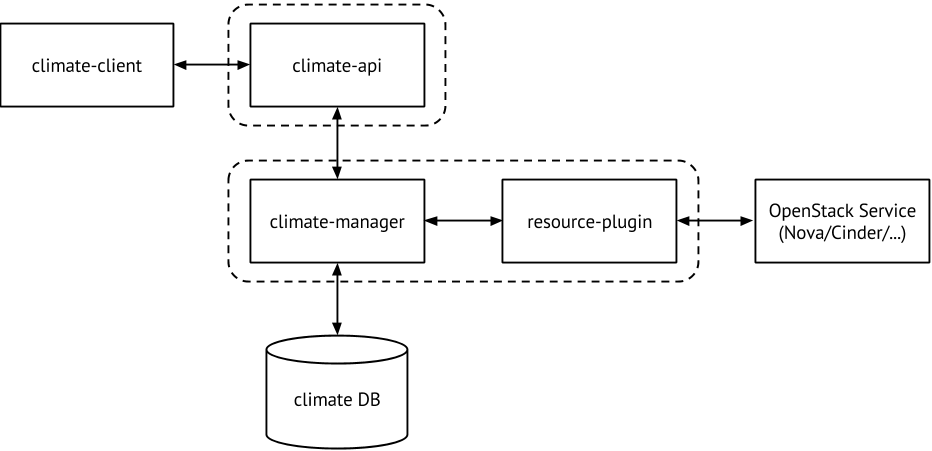
> />/ About the Blazar's architecture (
> />/ https://wiki.openstack.org/w/images/c/cb/Climate_architecture.png): the
> />/ resource plug-in interacts even with the nova-scheduler?
> />/ Such scheduler has been (or will be) extended for supporting the Blazar's
> />/ requests?
> />/ Which relationship there is between nova-scheduler and Gantt?
> />/
> />/ It would be nice to discuss with you in details.
> />/ Thanks a lot for your feedback.
> />/ Cheers,
> />/ Lisa
> />/
> />/
> />
>
>
> _______________________________________________
> OpenStack-dev mailing list
> [email protected]
> http://lists.openstack.org/cgi-bin/mailman/listinfo/openstack-dev
_______________________________________________
OpenStack-dev mailing list
[email protected]
http://lists.openstack.org/cgi-bin/mailman/listinfo/openstack-dev