The natives are restless and looking for sex...

The native orchids in Florida tend to bloom in two main clusters, spring and
fall, with a few blooming in summertime and a few in winter in deepest
southern Florida.  Here at the end of August and the beginning of September,
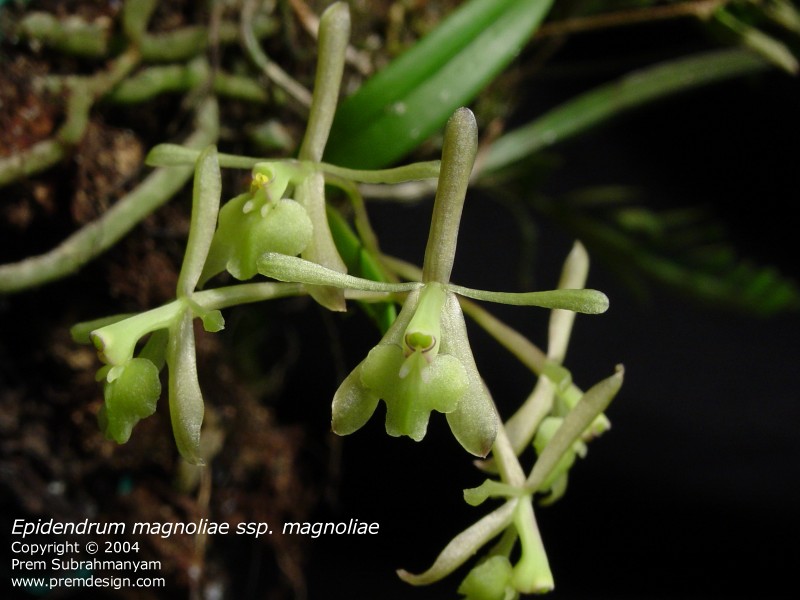
Epidendrum magnoliae may still throw a spike or two, although its main
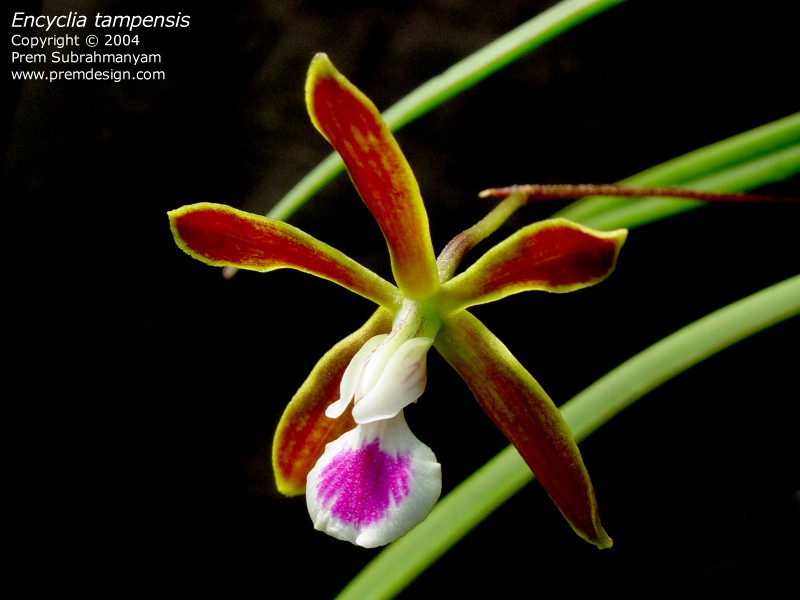
blooming was in early summertimem and Encyclia tampensis may still have a
straggling spike at this time of year, although its chief blooming time was in
early-mid June.
http://www.premdesign.com/orchidpics/epidendrum_magnoliae02.jpg

http://www.premdesign.com/orchidpics/encyclia_tampensis02.jpg

but the main thrust of the summer-fall blooming is in the wetlands.  Many
species of Habenaria and the related Platanthera put forth their blooms,
making for some of the showiest displays of any of the terrestrial orchids.

But first, let's take a look at one of the less showy (and perhaps even weedy)
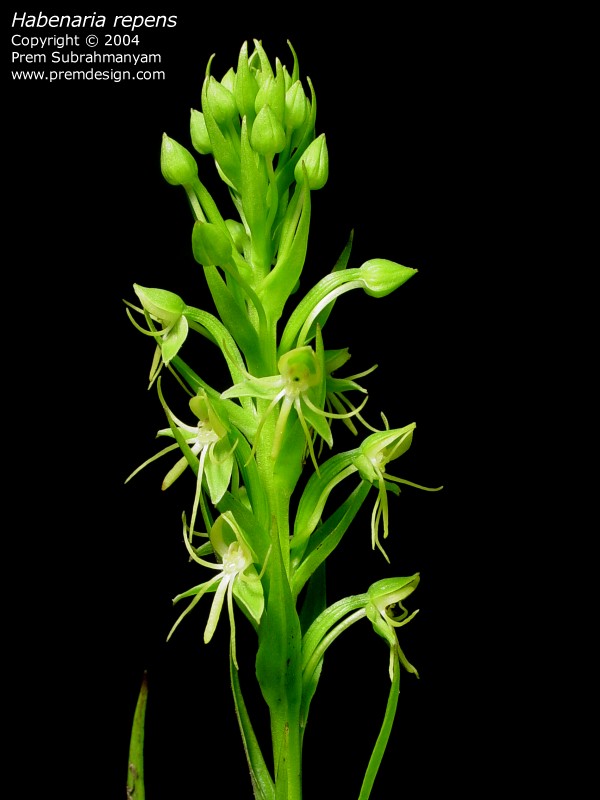
of the Habenarias, H. repens, aka the Water Spider Orchid.  It is one of the
few Florida orchids that could truly be considered aquatic, often growing in
standing water, and sometimes even growing in mats of floating vegetation.
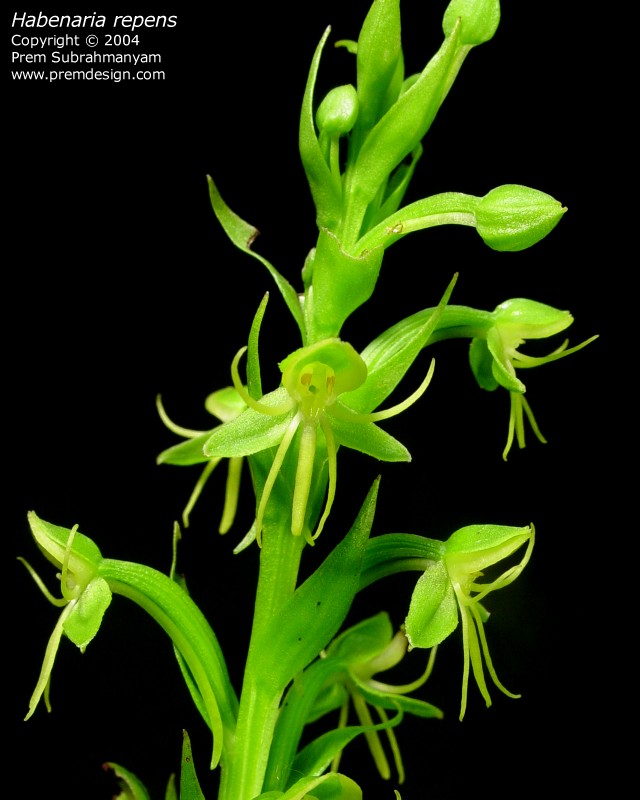
The flowers are about a half inch (1.25 cm) across.  At first blush, the
structure of these flowers may be difficult to decipher, seeming to be
composed of eight floral parts.  In actuality, it is just the normal six
parts.  The dorsal and two lateral sepals form a hood and wings, respectively
and the tri-lobed lip hangs downward.  What is interesting about this flower
(and somewhat unusual for the orchid world) is that the petals are deeply
bilobed--one lobe wraps around the edge of the sepaline hood while the other
lobe juts out into the air.  The inconspicuous flowers become powerfully and
sweetly fragrant at night, belying their true pollinator--a night-flying moth.
These orchids produce numerous offshoots via stolons as well as growing from
seed, allowing them to multiply rapidly in a suitable habitat.

http://www.premdesign.com/orchidpics/habenaria_repens_spike.jpg

http://www.premdesign.com/orchidpics/habenaria_repens_closeup.jpg

We turn our attention next to the moist pinelands, savannahs, and roadsides.
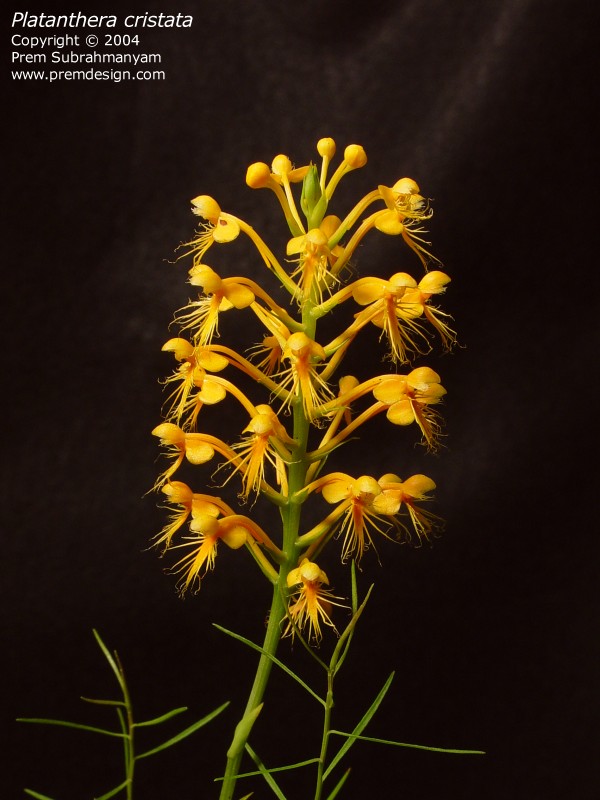
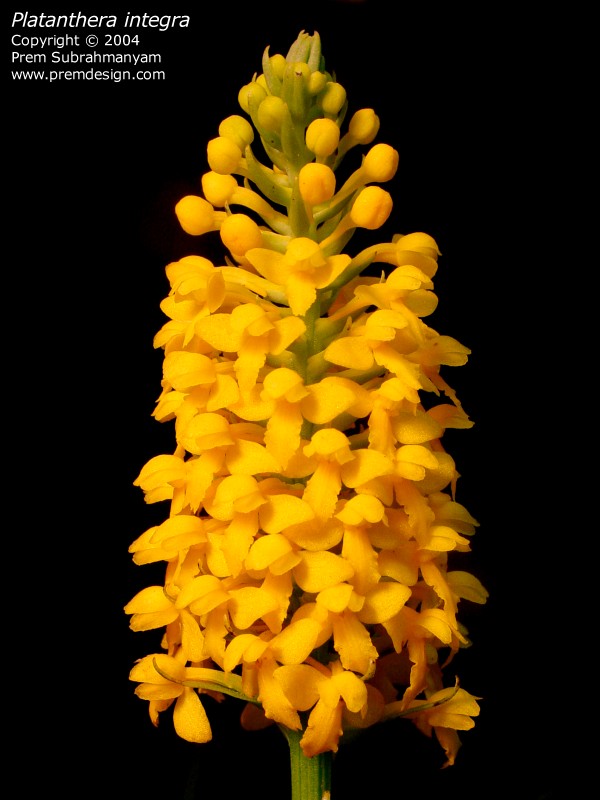
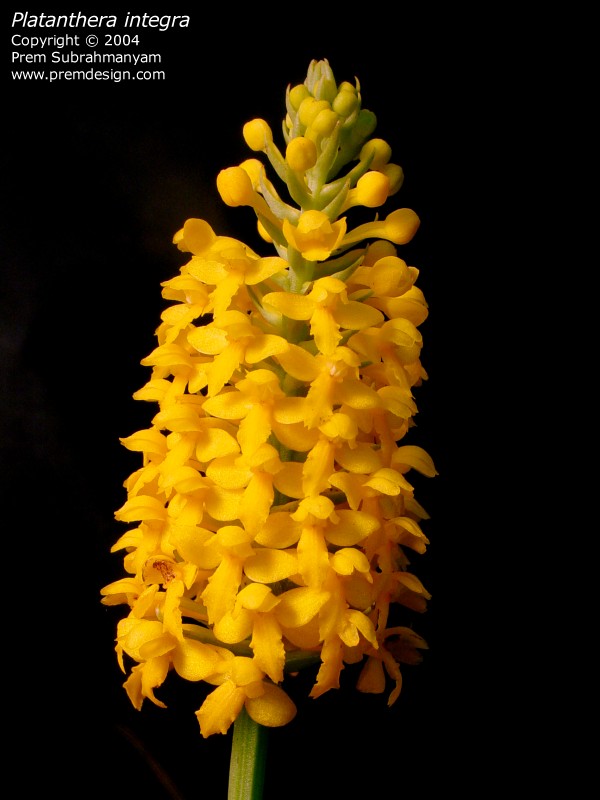
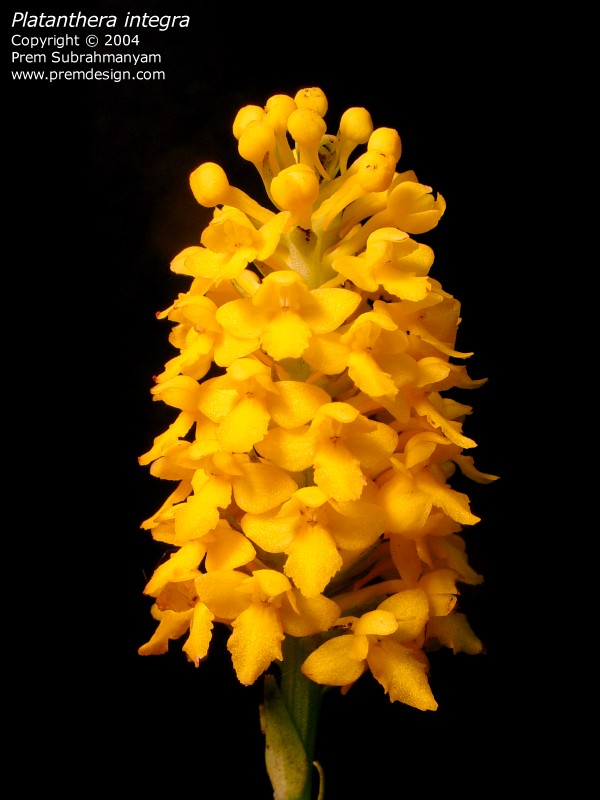
It is here that two of the smaller of the Platantheras grow.  Platanthera
cristata, or the crested fringed orchid, is not a very big plant, having a
raceme of flowers usually only 2-4 inches tall on a plant that might stand up
to 30 inches tall, but it's usually a lot shorter, probably around 12 inches
in height.  Platanthera integra, or the orange fringeless orchid, is about the
same size as P. cristata, but has a more compact raceme and, true to its name,
no fringe on the lip.  Both species have flowers that are usually a bright
yellowish-orange in color:

http://www.premdesign.com/orchidpics/platanthera_cristata.jpg

http://www.premdesign.com/orchidpics/platanthera_integra_01.jpg

http://www.premdesign.com/orchidpics/platanthera_integra_02.jpg

http://www.premdesign.com/orchidpics/platanthera_integra_small_spike.jpg

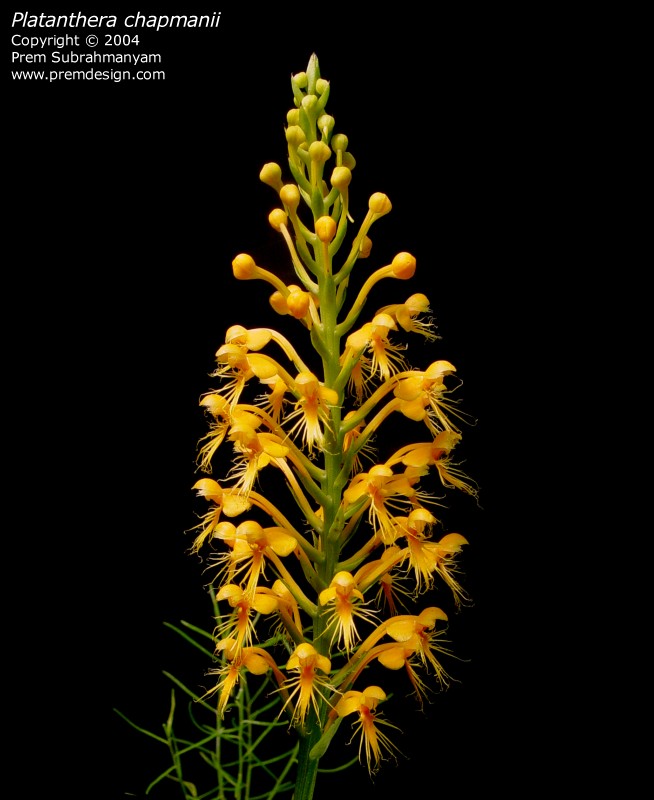
We now progress in size to Platanthera chapmanii (also known as P. x
chapmanii, a natural hybrid designation), which is intermediate in size
between P. cristata and the largest of the fringe orchids, P. ciliaris.  In
fact, it is considered by many to be a natural hybrid or otherwise intergrade
between the two species.  It, however, maintains stable populations in places
where both parents are absent and is elevated in some works to be a species in
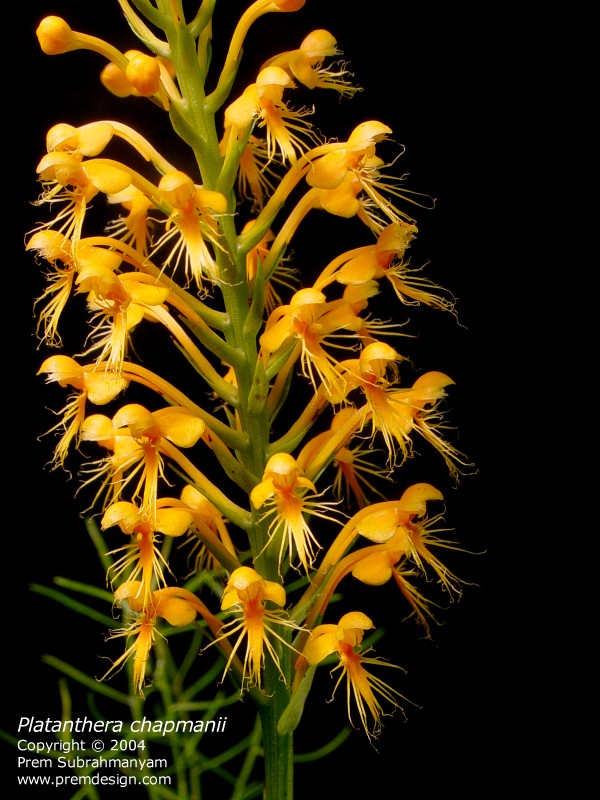
its own right.  The flower is intermediate in size between the half-inch of P.
cristata and the 1-plus inch of P. ciliaris.  The petals are small, staying
sheltered under the dorsal sepalline hood.  The deeply fringed lip protrudes
below, its back end forming into a long spur (evidently to force butterflies
to probe deeply and stick their faces right into the waiting column):

http://www.premdesign.com/orchidpics/platanthera_chapmanii_0804.jpg

http://www.premdesign.com/orchidpics/platanthera_chapmanii_0804_closeup.jpg

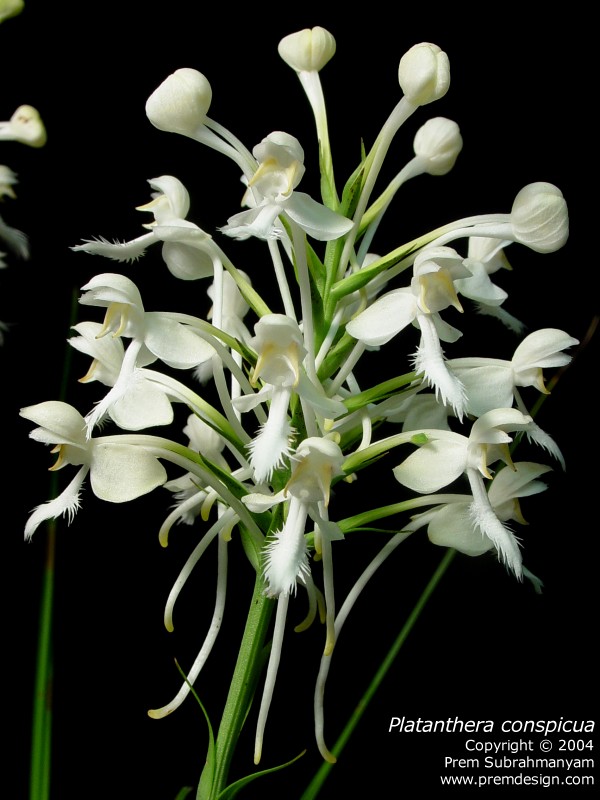
Our final orchids are the giants of the bog.  The white fringed orchid,
Platanthera conspicua (aka P. blephariglottis v. conspicua), raises its head
of white flowers as high as three feet off the bog soil, but usually about
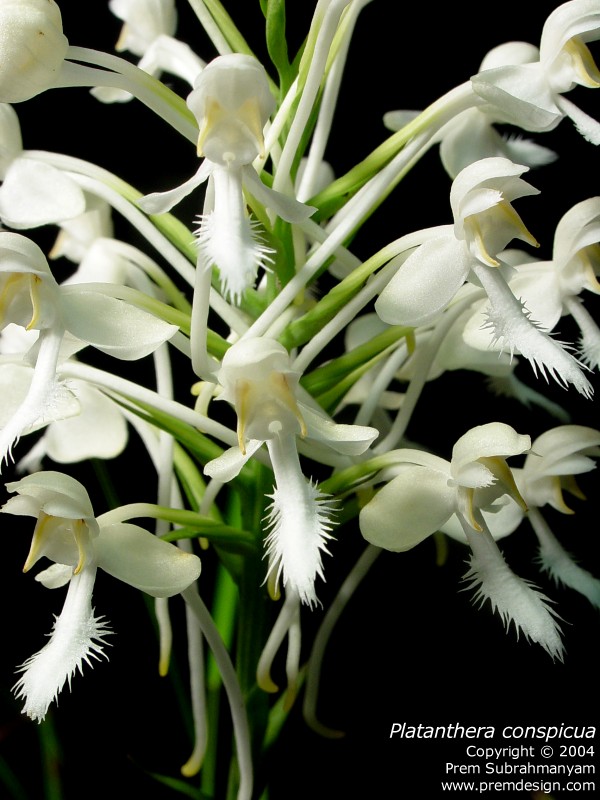
half that height.  The lip of the flower is around an inch long, giving the
flower a vertical span of nearly 1.5 inches.  The flower structure is similar
to P. cristata and P. chapmanii, although on a larger (and whiter) scale:

http://www.premdesign.com/orchidpics/platanthera_conspicua_spike01.jpg

http://www.premdesign.com/orchidpics/platanthera_conspicua_closeup01.jpg

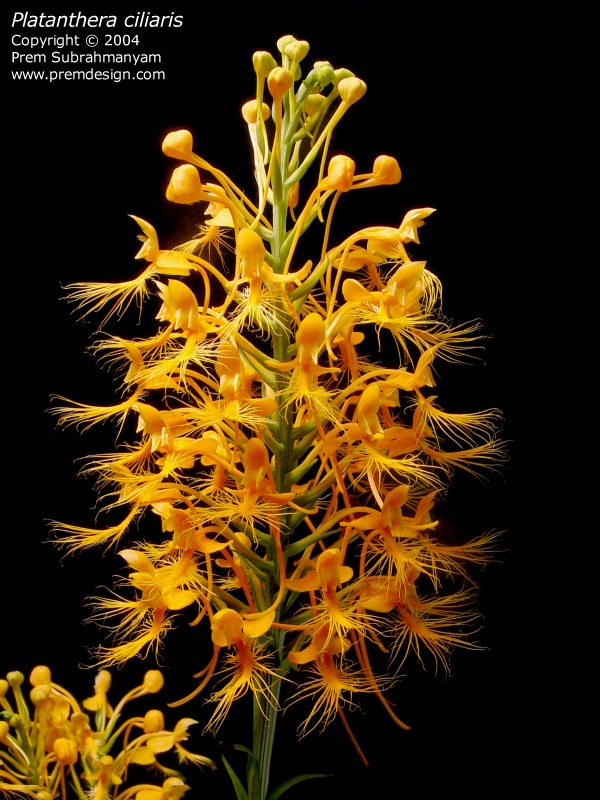
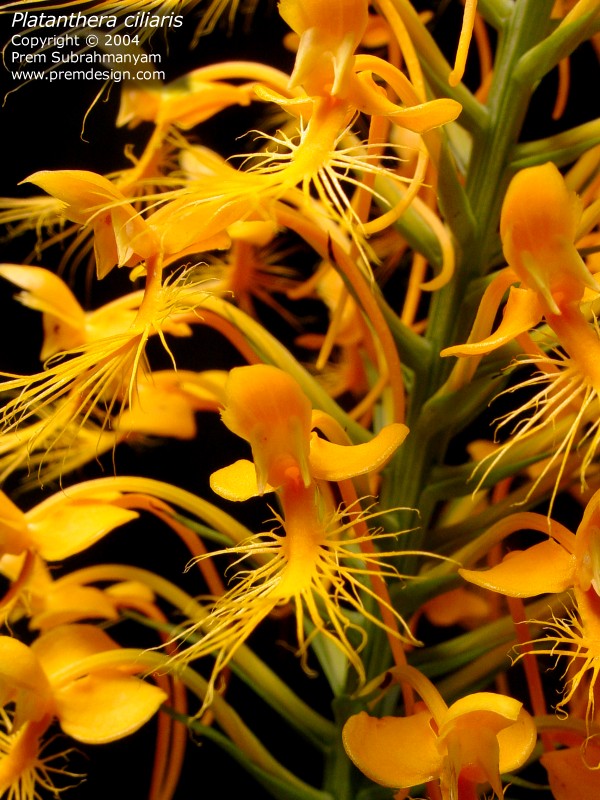
Our final bog orchid, Platanthera ciliaris, is the true giant of the bog, with
flowers just a touch larger than its cousin, P. conspicua/blephariglottis.
The flower head itself can be up to 8 inches tall and carry up to 60 buds and
flowers.  It's usually a bit smaller than that, but when one sees an
impressive specimen at near its full height, the experience cannot be
forgotten:

http://www.premdesign.com/orchidpics/platanthera_ciliaris_full_spike.jpg

http://www.premdesign.com/orchidpics/platanthera_ciliaris_closeup.jpg

More native orchid images can be seen on my orchid gallery:

http://www.premdesign.com/orchidpics/orchidpicshq.htm


---Prem
www.premdesign.com
_______________________________________________
the OrchidGuide Digest (OGD)
[EMAIL PROTECTED]
http://lists.orchidguide.com/mailman/listinfo/orchids