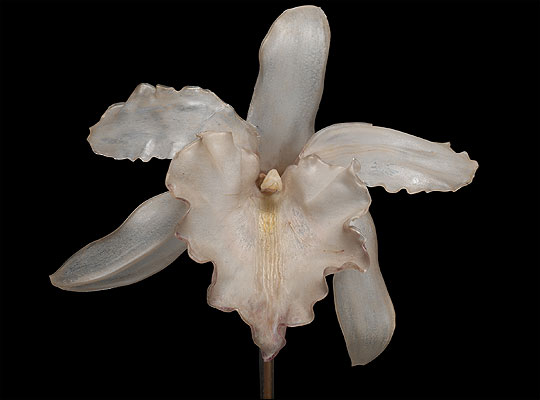
"In 1886, Harvard botany professor George Lincoln Goodale was given an
empty building and told to make a teaching museum...
Back in the late 19th century, botanical teaching models were mostly made of wax or papier maché. Or they were actual plants that had been dried and pressed. But the replicas were inexact, the pressed specimens faded and flat. So professor Goodale asked the Blaschkas [Leopold and Rudolf ] to make glass plants. Fifty years later... they'd finished 4,000 models. ... poet Mark Doty marveled at how Leopold Blaschka and his son captured impermanence: He's built a perfection out of hunger fused layer upon layer, swirled until what can't be swallowed, won't yield almost satisfies, an art mouthed to the shape of how soft things are, how good, before they disappear. ... Over time, some the glass flowers... have broken or cracked. So Harvard has partnered with the Corning Museum of Glass to restore the models. This summer, 17 specimens, ranging from an orchid... have been plucked from Harvard and sent to Corning. ... the Corning exhibition highlights the flowers' beauty by showing them alongside the Blaschkas'... sketches, their simple tools and their... workbench." URL : http://www.npr.org/templates/story/story.php?storyId=11363926 see photo : [caption : Rhynchostele rossii (Lindl.) Soto Arenas and Salazar... Leopold Blaschka (Bohemian, 18221895) and Rudolf Blaschka (Bohemian, 18571939). Harvard University Herbaria/Harvard Museum of Natural History] http://media.npr.org/programs/atc/features/2007/jun/glassart/orchid_540.jpg ***************** Regards, VB _______________________________________________ the OrchidGuide Digest (OGD) [email protected] http://orchidguide.com/mailman/listinfo/orchids_orchidguide.com