"cranefly orchid, Tipularia discolor...
once-a-year flowering recurrence...
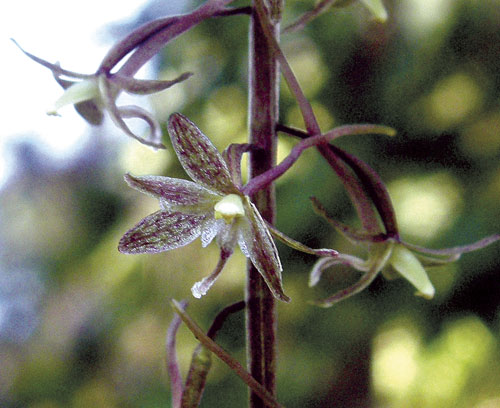
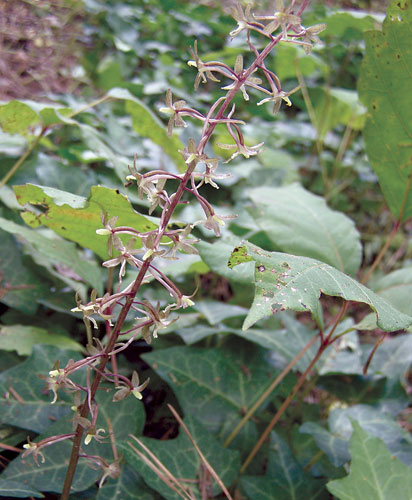
search for them now while theyre in peak bloom. This... native terrestrial orchid is common in both piney woods and deciduous forests... single two-to-four-inch leaf green above, burgundy below grows close to the ground from September through March. It captures the winter sunlight. Without that leaf showing, the 12-to-18-inch-tall stem of 20 to 40 tiny greenish-brown orchid flowers are... difficult to spot... Last week, I was thrilled to discover 37 plants in a shady front yard under my care. They were emerging from a dense cover of poison ivy and English ivy. ...The English ivy... is an evergreen, non-native plant that eventually smothers all vegetation beneath it, even covering and breaking tree limbs and shrubs. Several years ago, in this yard now full of cranefly orchids, I made a deliberate effort to eliminate the English ivy. English ivy only bears flowers and fruit when it is allowed to climb high in trees. Otherwise, it spreads along the ground smothering every plant in its forward crawl. I stopped the production of seed by severing all the high-climbing vines on the trees. I thought I had effectively smothered most of the ivy on the ground by laying down cardboard and covering it with several inches of wood chips. I deliberately left a few openings, hand pulling the ivy in those spots, where there were a couple of winter leaves of the cranefly orchid. The decaying cardboard and wood chip mulch must have been good for the orchids. I have enjoyed watching the orchid population increase during the past couple of years. I was only casually aware that the evergreen ivy was slowly creeping back from the edges where it had not been covered. Accompanying my delight with this seasons abundance of orchids was a realization that last years sparse covering of ivy had, just within the current growing season, reclaimed the entire ground with a thick layer of foliage ready to smother all those orchid leaves that will emerge at summers end to search in vain for winter sunlight. Never turn your back on English ivy. I have already renewed my assault on that ivy patch. This time, I will persist, knowing that my reward will be the rescuing of a robust population of that beautiful little orchid." URL : http://www.carrborocitizen.com/main/2008/08/14/rescuing-cranefly-orchids-from-english-ivy/ photos : 1) [caption : "Stem of native, terrestrial cranefly orchid penetrating a layer of poison and English ivies."] http://www.carrborocitizen.com/main/wp-content/uploads/2008/08/cranefly-orchid-dave-ottos.jpg 2) [caption : "lie on the ground with a hand lens to get a closer look at a single cranefly orchid flower"] http://www.carrborocitizen.com/main/wp-content/uploads/2008/08/orchid-in-the-ivies.jpg ******************* Regards, VB _______________________________________________ the OrchidGuide Digest (OGD) [email protected] http://orchidguide.com/mailman/listinfo/orchids_orchidguide.com