Hi Lindsay,

see my comment below.
Am 15.03.2011 um 01:40 schrieb Lindsay Smith:

> Something on the ‘OSGI thesis’ topic piqued my interest – he mentioned
> ‘source bundles’ where a bundle contains java source that is compiled to form
> the executable part of the bundle.   That interested me because we do
> something similar in my project and I wanted to share the details to see if
> anything similar is being done elsewhere.
>
>
>
> My project is a web-based application platform, where applications are
> defined by metadata, and can include java source.  The platform reads the
> metadata and compiles the java source as part of loading the application.
> It’s all dynamic, so we have a web-based IDE for defining application
> components, editing Java etc, and the platform recompiles it when needed.
> Using OSGI for the isolation of each applications means we can insulate the
> applications from the environment that the platform is running on, making it
> much easier to move applications between servers that may be running on
> different java versions or web containers.
>
>
>
> We switched to using OSGI under the hood because we saw the benefit of
> isolating each application using the OSGI class visibility system.  The
> classloader used to compile the source for each application comes from a
> bundle that we dynamically create (using tinybundles) based on metadata
> defined in the application.     Basically what we do is create a bundle whose
> manifest is determined by the application metadata, then use the classloader
> of that bundle to compile the java source.  The resulting class files are
> used to create a bundle fragment that is attached to the first bundle we
> made, which brings the compiled classes into that bundle.
>
>
>
> What’s interesting to me is how the system does or does not fit in to the
> OSGI world view.   The thing about all the OSGI tools (like bnd) is that they
> generate manifests based on class files by inspecting the packages required
> by the classes.   We can’t do this because we don’t have any way of working
> out which packages the java files need for compilation until after we’ve
> compiled them, which is obviously too late.
>
>
>
> The manifest that is used in the bundle that supplies the classloader for
> compilation therefore has to be very general.  Our applications always use
> certain APIs that are defined in other standard OSGI bundles in the system,
> so what we have to do is use require-bundle to ensure that during compilation
> all those packages will be there.  In addition, we have to import all the
> standard java packages.    The application metadata can also specify specific
> additional imports that it knows it needs.
>
>
>
> I know this is against the OSGI grain of only importing what you need, but I
> don’t see any way around it.  I guess it’s kind of similar to the way that
> OSGI bundles are built on the command line – you still have a very large set
> of classes available when you compile java source, then bnd comes along and
> makes the minimal list of packages to form the manifest.  Eclipse takes the
> other route, which is to force you to say up front what your manifest
> imports, and uses that list of packages for compilation.
>
>
>
> Does anyone else have experience doing this kind of thing?  Any other
> examples of compiling java source to form classes used within OSGI would be
> great.
>
>
>
> Is there a any way to work out imports of java source files?  Any other
> comments about the system are very much appreciated.
>
Maybe I am stupid, but does each Java-file not contain package import
statements?

import foo.bar.*;
import com.bar.myClass;
...

Here are some alternatives to get those parsed:
  - You could write a dumb parser in Java
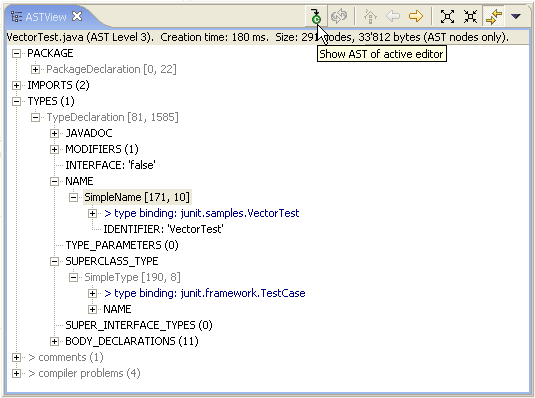
  - The Eclipse JDT project does provide an access to the Java Abstract Syntax
Tree (AST). There is also a nice GUI:
http://www.eclipse.org/jdt/ui/astview/view.gif
  - And if you want to stay away from Eclipse, you could (mis)use CheckStyle
(which implements a Java-Sourcefile Parser based on ANTLR)
http://checkstyle.sourceforge.net

But I'm sure I missed something in your story.


Cheers,
Siamak
>
>
> Cheers
>
>
>
> Lindsay
>
>
>
> _______________________________________________
> OSGi Developer Mail List
> [email protected]
> https://mail.osgi.org/mailman/listinfo/osgi-dev

--

Dipl. Inf. (FH) Siamak Haschemi
Humboldt-Universität zu Berlin
Dept. of Computer Science
Room: III.417
Rudower Chaussee 25
12489 Berlin, Germany
+49 30 2093 3121 (phone)
+49 30 2093 3112 (fax)
[email protected]

Website: http://informatik.hu-berlin.de/~haschemi
Private Website: http://www.haschemi.org
Xing profile: Siamak_Haschemi
Skype: siamak.haschemi
_______________________________________________
OSGi Developer Mail List
[email protected]
https://mail.osgi.org/mailman/listinfo/osgi-dev