http://www.rediff.com/news/2004/jul/20spec1.htm

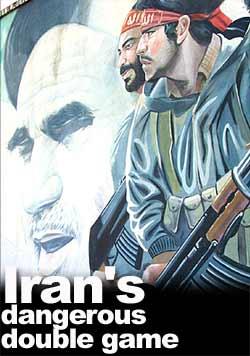
Iran's dangerous double game
Hamid Mir | July 20, 2004 | 13:42 IST


  <http://im.rediff.com/news/2004/jul/19spec1.jpg>

Part I: Al Qaeda and  <http://www.rediff.com/news/2004/jul/16spec1.htm> the
Iranian connection
Part II: Iran's hand in  <http://www.rediff.com/news/2004/jul/19spec2.htm>
the Afghan mess

Another Al Qaeda leader in Iran is Sulaiman Jasim Abu Ghaith. He was Al
Qaeda's spokesman until the summer of 2002. According to US sources, this
former Kuwaiti citizen is in the custody of the Iranian authorities, but the
Iranians have never confirmed his detention.

I heard in Baghdad that one son of Osama bin Laden, Saad, is also being
allowed to operate from Iran. He is in contact with Al Qaeda fighters hiding
in Afghanistan, Pakistan, Saudi Arabia and other Middle Eastern countries.

Al Qaeda told its fighters in September 2003 to enter Iraq. I visited Kunar
province of Afghanistan that month to meet Al Qaeda operatives. I met a man
named Abu Basir near the mountains of Asadabad. He told me that several Arab
fighters of Al Qaeda had been asked by their leaders to reach Iraq. These
fighters have been slipping into Pakistan from different points in eastern
Afghanistan and Al Qaeda's network in Pakistan is arranging their safe
onward journey to Iraq through Iran on fake passports.

The Pakistani authorities have arrested two officials of the country's
passport agency in Peshawar for allegedly providing fake passports to these
Al Qaeda operators.

Further investigations revealed that Al Qaeda leader Saif al-Adil and Yazz
bin Sifat had slipped into Iran from the Afghan town of Taftan. Both are
wanted in connection with the September 11 attacks.

Taftan is in the southwestern part of Afghanistan. The Herat province in
western Afghanistan is governed by the pro-Iran warlord Haji Ismail Khan.
The US ambassador to Afghanistan, Zalmay Khalilzad, confirmed to some
journalists in Kabul recently that he had evidence of Iranian interference
in western Afghanistan. Yusuf Pashtun, spokesman for a pro-Karzai warlord in
southern Afghanistan, has claimed many times that Iranian agents have been
smuggling arms into the southern Helmand province and that Iranians are
providing training to the troops of Haji Ismail Khan.

Haji Ismail received thousands of Iranian AK-74 automatic rifles produced at
a Russian-built factory outside Tehran. Sources close to Afghanistan
President Hamid Karzai claimed that some Iran Army officers are part of the
Haji's powerful 20,000 strong militia. Sources claimed that one of his
military advisers is General Ali Blokian, a former adviser of Hizbullah in
Lebanon and actually an officer of Iranian military intelligence.

Ismail Khan is a threat to President Karzai's authority. He has objected to
the deployment of coalition troops in his province. Now, he is encouraging
the remnants of the Taliban to attack coalition forces in southern
Afghanistan under instructions from Tehran.

Cofer Black, the US state department's counter-terrorism chief, confirmed to
me recently that they have evidence of the collaboration between Al Qaeda
and Iran. Some defectors from Iranian intelligence have provided a lot of
information to the American authorities. According to this information, the
Iranian Pasdaran (Revolutionary Guards) are in regular contact with Al
Qaeda. The Pasdaran are not under President Khatami's control. They report
directly to Ayatollah Khamenei, Iran's supreme leader.

Iran's Minister for Intelligence Ali Fallahian and Quds Force chief Ahmad
Vahidi are also said to be in contact with Dr Ayman al-Zawahiri. According
to very reliable sources, Zawahiri was arrested by mistake in Iran in 2002.
News of his arrest was published in a newspaper called Hayat-e-Nau (or New
Life), but the very next day the report was contradicted by Iran's foreign
ministry. It is believed that Zawahiri was released on Ali Fallahian's
order.

The big question is: why are the Iranians playing a double game with the
Americans in Iraq and Afghanistan? The answer is simple: The Iranians want
to convert Iraq into another Shia state because Shias are the majority in
Iraq. Secondly, they want control over Iraq's oil to give a boost to their
deteriorating economy. But the US will not allow Iran to establish a
pro-Tehran Shia state in Iraq and the Iranians believe that the American
military presence in Iraq and Afghanistan is a grave threat to their agenda.

The Iranians also want control in Afghanistan for economic and political
reasons. Afghanistan is the gateway to the Central Asian states, which are
rich in natural resources. Tehran wants to capture that gateway to establish
an indirect monopoly on the oil and gas reserves of Central Asia.

Third, the Iranians want American forces expelled from the Middle East. This
is Al Qaeda's aim as well. The Iranians have established the 'Quds Force'
for the liberation of Al Quds, or Jerusalem. Al Qaeda has the same
objective.

For achieving these common goals, the Iranians and Al Qaeda are cooperating
with each other. Many people in Kabul these days openly blame the
pro-Iranian warlords in western and northern Afghanistan, who are trying
their best to delay the elections planned for September this year.

Diplomatic circles in Kabul fear a possible increase in attacks on the
coalition forces. These sources are sure that Al Qaeda is planning a big,
deadly attack inside Kabul with Iran's help. Both hate President Karzai whom
they see as a great hurdle for their agenda in the region.

It is also important that some fighters of Gulbuddin Hekmatyar have been
arrested from Kabul. They were planning bomb blasts in the capital.
Hekmatyar left Tehran after September 11, 2001, but his close association
with Iran and Al Qaeda is not a secret. Many people in Kabul believe
Hekmatyar will play an important role in the expected deadly attacks against
coalition forces in the days to come.

The CIA got evidence of Iran's links with Al Qaeda in the spring of 2002,
but CIA Director?George Tenet remained silent on the issue. He was then more
interested in establishing a link between Al Qaeda and Iraq, but he
eventually failed to establish that link and had to quit.

Many people believe Tenet did a great job for the Islamic militants under
the leadership of George W Bush. The militants were divided on sectarian
lines for more than 1,400 years. But for the first time bad American
policies and weak intelligence have resulted in a deadly alliance between
Shia and Sunni militants in Iraq.

The American media claimed that Al Qaeda was responsible for a car bomb
attack on August 7, 2003, in Najaf in which Iraqi Shia leader Ayatollah
Baqir el-Hakim was killed along with 82 other people. For many days there
was confusion about who was responsible for that attack. Finally the
government-run Tehran Times rescued Al Qaeda on September 9, 2003, with a
front-page story in which it blamed the Israeli intelligence agency Mossad.
The paper claimed that the explosives used in the attack were smuggled from
Israel to Iraq by Mossad agents. Hizbullah leader Hassan Nasrallah also
blamed Israel while addressing a gathering in Beirut.

Now Shias and Sunnis are offering prayers in each other's mosques. The
Iranians are encouraging that kind of unity in Afghanistan and Pakistan.
Recently they invited some pro-Taliban leaders from Pakistan to Tehran.
Prominent among them were Maulana Sami-ul Haq and Fazalur Rehman, who have
both openly opposed the war on terror in Afghanistan. They met important
Iranian leaders.

After their return from Tehran, Maulana Sami-ul Haq organised a seminar in
Islamabad in the last week of May. This religious leader had close links
with hardline anti-Iran Sunni extremists, but he invited not only some Shia
leaders but also some Iranian diplomats to the seminar where he appealed to
all Shia and Sunni leaders to emulate the Shia-Sunni unity in Iraq. The
participants in the seminar adopted resolutions against US operations in
Iraq and Afghanistan and condemned the operation against Al Qaeda by
Pakistani forces in the tribal areas bordering Afghanistan.

The Americans now know more about Iran's links with Al Qaeda than Saddam's.
So why aren't they making more of a fuss about it?

Simple: because they have lost credibility. Al Qaeda lost Afghanistan in
2001, but they are regaining their power from Iran in 2004.

The Iranians have removed their enemy, the Taliban, from Kabul using the
Americans. Then they removed another enemy, Saddam Hussein, from Iraq, again
using the Americans through Ahmad Chalabi. Now they are using Al Qaeda in
Afghanistan and Iraq against the Americans.

It is the Iranians who are the real winners of the wars in Afghanistan and
Iraq, not America.

Hamid Mir, the well-known Pakistani journalist and rediff.com
contributor,?has interviewed Osama bin Laden, US Secretary of State Colin
Powell, and General Richard B Myers, then?chairman of the US Joint Chiefs of
Staff, after 9/11. He travelled through Afghanistan, Iraq and Iran recently.
He is currently working for Pakistan's Geo TV network and is also
writing?bin Laden's biography.

Photograph: HENGHAMEH FAHIMI/AFP/Getty Images | Image: Uttam Ghosh


[Non-text portions of this message have been removed]


------------------------ Yahoo! Groups Sponsor --------------------~-->
1.2 million kids a year are victims of human trafficking. Stop slavery.
http://us.click.yahoo.com/U6CDDD/izNLAA/cUmLAA/TySplB/TM
--------------------------------------------------------------------~->

--------------------------
Want to discuss this topic?  Head on over to our discussion list, [EMAIL
PROTECTED]
--------------------------
Brooks Isoldi, editor
[EMAIL PROTECTED]

http://www.intellnet.org

  Post message: [email protected]
  Subscribe:    [EMAIL PROTECTED]
  Unsubscribe:  [EMAIL PROTECTED]


*** FAIR USE NOTICE. This message contains copyrighted material whose use has
not been specifically authorized by the copyright owner. OSINT, as a part of
The Intelligence Network, is making it available without profit to OSINT
YahooGroups members who have expressed a prior interest in receiving the
included information in their efforts to advance the understanding of
intelligence and law enforcement organizations, their activities, methods,
techniques, human rights, civil liberties, social justice and other
intelligence related issues, for non-profit research and educational purposes
only. We believe that this constitutes a 'fair use' of the copyrighted material
as provided for in section 107 of the U.S. Copyright Law. If you wish to use
this copyrighted material for purposes of your own that go beyond 'fair use,'
you must obtain permission from the copyright owner.
For more information go to:
http://www.law.cornell.edu/uscode/17/107.shtml
Yahoo! Groups Links

<*> To visit your group on the web, go to:
    http://groups.yahoo.com/group/osint/

<*> To unsubscribe from this group, send an email to:
    [EMAIL PROTECTED]

<*> Your use of Yahoo! Groups is subject to:
    http://docs.yahoo.com/info/terms/