_____
From:  Don Tipton
Sent: Saturday, May 20, 2006 11:54 AM
To:  [EMAIL PROTECTED]
Subject: Re:  Allah - the Moon God


Hi Bruce:
               I am trying to spread this Article all over the USA.....any
help will be appreciated....I don't mind if any poster of this article uses
my name as sender.

Best regards,

Don

                         ____________________________________________


  <http://www.biblebelievers.org.au/images/crescent.gif>

Allah - the Moon God


The Archeology of The Middle East


The religion of Islam has as its focus of worship a deity by the name of
"Allah." The Muslims claim that Allah in pre-Islamic times was the biblical
God of the Patriarchs, prophets, and apostles. The issue is thus one of
continuity. Was "Allah" the biblical God or a pagan god in Arabia during
pre-Islamic times? The Muslim's claim of continuity is essential to their
attempt to convert Jews and Christians for if "Allah" is part of the flow of
divine revelation in Scripture, then it is the next step in biblical
religion. Thus we should all become Muslims. But, on the other hand, if
Allah was a pre-Islamic pagan deity, then its core claim is refuted.
Religious claims often fall before the results of hard sciences such as
archeology. We can endlessly speculate about the past or go and dig it up
and see what the evidence reveals. This is the only way to find out the
truth concerning the origins of Allah. As we shall see, the hard evidence
demonstrates that the god Allah was a pagan deity. In fact, he was the
Moon-god who was married to the sun goddess and the stars were his
daughters.

  <http://www.biblebelievers.org.au/images/muslim.jpg>

See The reader  <http://geocities.com/jesuselcristos/hoaxology_09.html> must
know that Ismael was a Hebrew.
Archaeologists have uncovered temples to the Moon-god throughout the Middle
East. From the mountains of Turkey to the banks of the Nile, the most
wide-spread religion of the ancient world was the worship of the Moon-god.
In the first literate civilization, the Sumerians have left us thousands of
clay tablets in which they described their religious beliefs. As
demonstrated by Sjoberg and Hall, the ancient Sumerians worshipped a
Moon-god who was called many different names. The most popular names were
Nanna, Suen and Asimbabbar. His symbol was the crescent moon. Given the
amount of artifacts concerning the worship of this Moon-god, it is clear
that this was the dominant religion in Sumeria. The cult of the Moon-god was
the most popular religion throughout ancient Mesopotamia. The Assyrians,
Babylonians, and the Akkadians took the word Suen and transformed it into
the word Sin as their favorite name for the Moon-god. As Prof. Potts pointed
out, "Sin is a name essentially Sumerian in origin which had been borrowed
by the Semites."
In ancient Syria and Canna, the Moon-god Sin was usually represented by the
moon in its crescent phase. At times the full moon was placed inside the
crescent moon to emphasize all the phases of the moon. The sun-goddess was
the wife of Sin and the stars were their daughters. For example, Istar was a
daughter of Sin. Sacrifices to the Moon-god are described in the Pas Shamra
texts. In the Ugaritic texts, the Moon-god was sometimes called Kusuh. In
Persia, as well as in Egypt, the Moon-god is depicted on wall murals and on
the heads of statues. He was the Judge of men and gods. The Old Testament
constantly rebuked the worship of the Moon-god (see: Deut. 4:19;17:3; II
Kngs. 21:3,5; 23:5; Jer. 8:2; 19:13; Zeph. 1:5, etc.) When Israel fell into
idolatry, it was usually the cult of the Moon-god. As a matter of fact,
everywhere in the ancient world, the symbol of the crescent moon can be
found on seal impressions, steles, pottery, amulets, clay tablets,
cylinders, weights, earrings, necklaces, wall murals, etc. In Tell-el-Obeid,
a copper calf was found with a crescent moon on its forehead. An idol with
the body of a bull and the head of man has a crescent moon inlaid on its
forehead with shells. In Ur, the Stela of Ur-Nammu has the crescent symbol
placed at the top of the register of gods because the Moon-god was the head
of the gods. Even bread was baked in the form of a crescent as an act of
devotion to the Moon-god. The Ur of the Chaldees was so devoted to the
Moon-god that it was sometimes called Nannar in tablets from that time
period.
A temple of the Moon-god has been excavated in Ur by Sir Leonard Woolley. He
dug up many examples of moon worship in Ur and these are displayed in the
British Museum to this day. Harran was likewise noted for its devotion to
the Moon-god. In the 1950's a major temple to the Moon-god was excavated at
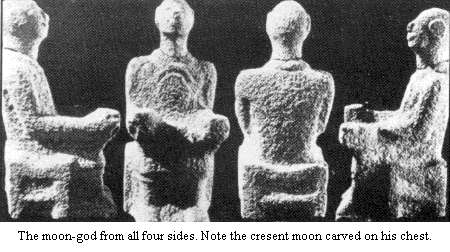
Hazer in Palestine. Two idols of the moon god were found. Each was a stature
of a man sitting upon a throne with a crescent moon carved on his chest .
The accompanying inscriptions make it clear that these were idols of the
Moon-god. Several smaller statues were also found which were identified by
their inscriptions as the "daughters" of the Moon-god. What about Arabia? As
pointed out by Prof. Coon, "Muslims are notoriously loath to preserve
traditions of earlier paganism and like to garble what pre-Islamic history
they permit to survive in anachronistic terms."
During the nineteenth century, Amaud, Halevy and Glaser went to Southern
Arabia and dug up thousands of Sabean, Minaean, and Qatabanian inscriptions
which were subsequently translated. In the 1940's, the archeologists G.
Caton Thompson and Carleton S. Coon made some amazing discoveries in Arabia.
During the 1950's, Wendell Phillips, W.F. Albright, Richard Bower and others
excavated sites at Qataban, Timna, and Marib (the ancient capital of Sheba).
Thousands of inscriptions from walls and rocks in Northern Arabia have also
been collected. Reliefs and votive bowls used in worship of the "daughters
of Allah" have also been discovered. The three daughters, al-Lat, al-Uzza
and Manat are sometimes depicted together with Allah the Moon-god
represented by a crescent moon above them. The archeological evidence
demonstrates that the dominant religion of Arabia was the cult of the
Moon-god.
In Old Testament times, Nabonidus (555-539 BC), the last king of Babylon,
built Tayma, Arabia as a center of Moon-god worship. Segall stated, "South
Arabia's stellar religion has always been dominated by the Moon-god in
various variations." Many scholars have also noticed that the Moon-god's
name "Sin" is a part of such Arabic words as "Sinai," the "wilderness of
Sin," etc. When the popularity of the Moon-god waned elsewhere, the Arabs
remained true to their conviction that the Moon-god was the greatest of all
gods. While they worshipped 360 gods at the Kabah in Mecca, the Moon-god was
the chief deity. Mecca was in fact built as a shrine for the Moon-god.
This is what made it the most sacred site of Arabian paganism. In 1944, G.
Caton Thompson revealed in her book, The Tombs and Moon Temple of Hureidha,
that she had uncovered a temple of the Moon-god in southern Arabia. The
symbols of the crescent moon and no less than twenty-one inscriptions with
the name Sin were found in this temple. An idol which may be the Moon-god
himself was also discovered. This was later confirmed by other well-known
archeologists.
The evidence reveals that the temple of the Moon-god was active even in the
Christian era. Evidence gathered from both North and South Arabia
demonstrate that Moon-god worship was clearly active even in Muhammad's day
and was still the dominant cult. According to numerous inscriptions, while
the name of the Moon-god was Sin, his title was al-ilah, i.e. "the deity,"
meaning that he was the chief or high god among the gods. As Coon pointed
out, "The god Il or Ilah was originally a phase of the Moon God." The
Moon-god was called al-ilah, i.e. the god, which was shortened to Allah in
pre-Islamic times. The pagan Arabs even used Allah in the names they gave to
their children. For example, both Muhammad's father and uncle had Allah as
part of their names.
The fact that they were given such names by their pagan parents proves that
Allah was the title for the Moon-god even in Muhammad's day. Prof. Coon goes
on to say, "Similarly, under Mohammed's tutelage, the relatively anonymous
Ilah, became Al-Ilah, The God, or Allah, the Supreme Being."
This fact answers the questions, "Why is Allah never defined in the Qur'an?
Why did Muhammad assume that the pagan Arabs already knew who Allah was?"
Muhammad was raised in the religion of the Moon-god Allah. But he went one
step further than his fellow pagan Arabs. While they believed that Allah,
i.e. the Moon-god, was the greatest of all gods and the supreme deity in a
pantheon of deities, Muhammad decided that Allah was not only the greatest
god but the only god.
In effect he said, "Look, you already believe that the Moon-god Allah is the
greatest of all gods. All I want you to do is to accept that the idea that
he is the only god. I am not taking away the Allah you already worship. I am
only taking away his wife and his daughters and all the other gods." This is
seen from the fact that the first point of the Muslim creed is not, "Allah
is great" but "Allah is the greatest," i.e., he is the greatest among the
gods. Why would Muhammad say that Allah is the "greatest" except in a
polytheistic context? The Arabic word is used to contrast the greater from
the lesser. That this is true is seen from the fact that the pagan Arabs
never accused Muhammad of preaching a different Allah than the one they
already worshipped. This "Allah" was the Moon-god according to the
archeological evidence. Muhammad thus attempted to have it both ways. To the
pagans, he said that he still believed in the Moon-god Allah. To the Jews
and the Christians, he said that Allah was their God too. But both the Jews
and the Christians knew better and that is why they rejected his god Allah
as a false god.
Al-Kindi, one of the early Christian apologists against Islam, pointed out
that Islam and its god Allah did not come from the Bible but from the
paganism of the Sabeans. They did not worship the God of the Bible but the
Moon-god and his daughters al-Uzza, al-Lat and Manat. Dr. Newman concludes
his study of the early Christian-Muslim debates by stating, "Islam proved
itself to be...a separate and antagonistic religion which had sprung up from
idolatry." Islamic scholar Caesar Farah concluded "There is no reason,
therefore, to accept the idea that Allah passed to the Muslims from the
Christians and Jews." The Arabs worshipped the Moon-god as a supreme deity.
But this was not biblical monotheism. While the Moon-god was greater than
all other gods and goddesses, this was still a polytheistic pantheon of
deities. Now that we have the actual idols of the Moon-god, it is no longer
possible to avoid the fact that Allah was a pagan god in pre-Islamic times.
Is it any wonder then that the symbol of Islam is the crescent moon? That a
crescent moon sits on top of their mosques and minarets? That a crescent
moon is found on the flags of Islamic nations? That the Muslims fast during
the month which begins and ends with the appearance of the crescent moon in
the sky?


CONCLUSION


The pagan Arabs worshipped the Moon-god Allah by praying toward Mecca
several times a day; making a pilgrimage to Mecca; running around the temple
of the Moon-god called the Kabah; kissing the black stone; killing an animal
in sacrifice to the Moon-god; throwing stones at the devil; fasting for the
month which begins and ends with the crescent moon; giving alms to the poor,
etc.
The Muslim's claim that Allah is the God of the Bible and that Islam arose
from the religion of the prophets and apostles is refuted by solid,
overwhelming archeological evidence. Islam is nothing more than a revival of
the ancient Moon-god cult. It has taken the symbols, the rites, the
ceremonies, and even the name of its god from the ancient pagan religion of
the Moon-god. As such, it is sheer idolatry and must be rejected by all
those who follow the Torah and Gospel. moongod.htm


Yeshua Communications Network.
Copyright 1997-8,  All Rights Reserved.
http://www.yeshua.co.uk


http://www.biblebelievers.org.au/


[Non-text portions of this message have been removed]


------------------------ Yahoo! Groups Sponsor --------------------~-->
Everything you need is one click away.  Make Yahoo! your home page now.
http://us.click.yahoo.com/AHchtC/4FxNAA/yQLSAA/TySplB/TM
--------------------------------------------------------------------~->

--------------------------
Want to discuss this topic?  Head on over to our discussion list, [EMAIL
PROTECTED]
--------------------------
Brooks Isoldi, editor
[EMAIL PROTECTED]

http://www.intellnet.org

  Post message: [email protected]
  Subscribe:    [EMAIL PROTECTED]
  Unsubscribe:  [EMAIL PROTECTED]


*** FAIR USE NOTICE. This message contains copyrighted material whose use has
not been specifically authorized by the copyright owner. OSINT, as a part of
The Intelligence Network, is making it available without profit to OSINT
YahooGroups members who have expressed a prior interest in receiving the
included information in their efforts to advance the understanding of
intelligence and law enforcement organizations, their activities, methods,
techniques, human rights, civil liberties, social justice and other
intelligence related issues, for non-profit research and educational purposes
only. We believe that this constitutes a 'fair use' of the copyrighted material
as provided for in section 107 of the U.S. Copyright Law. If you wish to use
this copyrighted material for purposes of your own that go beyond 'fair use,'
you must obtain permission from the copyright owner.
For more information go to:
http://www.law.cornell.edu/uscode/17/107.shtml
Yahoo! Groups Links

<*> To visit your group on the web, go to:
    http://groups.yahoo.com/group/osint/

<*> To unsubscribe from this group, send an email to:
    [EMAIL PROTECTED]

<*> Your use of Yahoo! Groups is subject to:
    http://docs.yahoo.com/info/terms/