Lebanese support of Nasrallah wanes
http://ws.giyus.org/points/point?id=xQNByBlS48Xs
Public support Hizbullah enjoyed during war weakens as residents of southern
Lebanon grow embittered over their ruined homes with no compensation in
sight. Hizbullah denies claims, but says 'mistakes may have been made by
compensation committees'
Roee Nahmias


They supported Hizbullah during the war - whether by free will or the
constraints of the times - and Hizbullah promised them no end in
compensation for their loyalty. But now the residents of southern Lebanon
say they feel abandoned by the organization that swore to rebuild their
homes and lives.


Umm Qasem had just finished preparing lunch for her family on July 12th when
a Hizbullah fighter burst into her home in the southern Lebanese town of
Bint Jbeil and instructed the family to flee their home at once. His
organization has just seized two Israeli soldiers, he announced, and a harsh
retaliation was expected.


Umm Qasem remained silent, and her family decided to stay. Had she decided
differently her fate would likely have been different. During the war she
lost two of her sons and her house on the same day. At the time, she was
quick to respond, saying that this was "deliverance in the name of the
'Sayyed' (Hizbullah chief Hassan Nasrallah's nickname)."


But now, seven months after the war the rhetoric seems to have changed. Umm
Qasem, and with her numerous other residents of southern Lebanon are no
longer afraid to question the necessity of Hizbullah's action to kidnap the
Israeli soldiers.


The critique is implied, hesitant, but outside Lebanon's borders it is clear
and desive. A recent article in the London-based 'Al-Hayat' newspaper
focused on the issue of bringing different voices from southern Lebanon.


The paper shed light on the stories of residents who lost their homes and
businesses, and who struggled to cope with the cold winter; forgotten while
Hizbullah focused its efforts on waging political battle against Prime
Minister Fouad Siniora in Beirut.


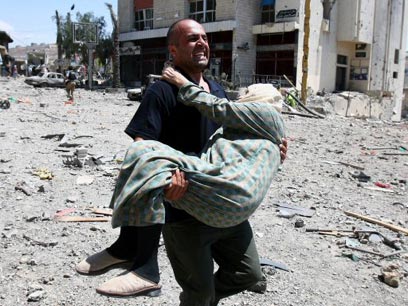
  <http://www.ynetnews.com/PicServer2/20122005/851770/SHN650_wa.jpg>

Bint Jbeil during the war (Photo: Reuters)


'Deliverance in the name of the Sayyed,' said the residents, is no longer
the most popular saying. Residents also told the paper they believed that
after the Israel's withdrawal in 2000, they never believed they would see
the IDF again.


"The 'Sayyed' promised us that our homes would never be destroyed, and that
our sons would never be killed. We removed the concept of 'war' from out
inner dictionary, and suddenly, war broke out," said Hassan, a southern
villager, while standing on the ruins of what used to be his home.


Hizbullah corruption

And what about the compensation they promised Lebanese citizens? Hizbullah
did in fact distribute some $10,000 in reparations to every family to rent a
furnished apartment for one year, but this is not nearly sufficient and
residents are still waiting for the compensation promised by the Siniora
administration, turning their bitterness towards him.


Piles of ruins remain, and there is no sign of their impending removal.
Regional council chairman for the of Bint Jbeil area tried to explain: "The
reason for delaying the removal of the debris is an agreement by which Bint
Jbeil will be built out of the same type of stone that was used in the past.
It must retain its character. Qatar took it upon itself to rebuild the
houses out the very same stones rather than give the money directly to the
people."


But this isn't the only reason for the tough criticism of Hizbullah. The
group, which is heading a political battle against Siniora's government in
Beirut, is naturally less present in the south. "The 'Resistance' youth
(Hizbullah) provided us with food and water during the war. Thanks to the
'Resistance', south Lebanon was liberated and we could hold our heads high
among the Arabs," Bint Jbeil resident Um Hussein explained. In the same
breath she added: "But we don't see them anymore. After the war they forgot
us and went to Beirut. They forgot the south and started seeking power."


Others fear Hizbullah is discriminating against them regarding dispensing
reparation money. Haj Bazi, who was in Bint Jbeil during the war with his
family, lost his home and two shops under his ownership. Besides the
immediate aid, he hasn't gotten any more money, and he sees both Hizbullah
and the government responsible for the situation.


"After the war, there was not a single one of us left who wasn't hurt in
some way. We looked death in the eye, and we're living with a great deal of
suffering," he says. He claims Hizbullah isn't handing out compensation in a
uniform fashion. "We wouldn't have thought Hizbullah's leaders would hold
onto wealth, but those left here have been compensated not nearly worth half
of what they lost," he said.


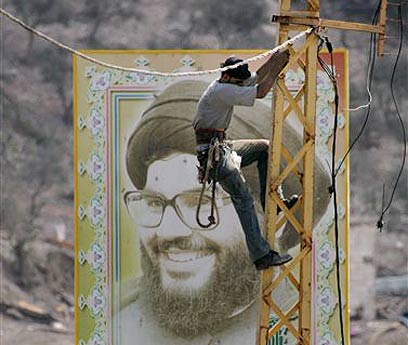
  <http://www.ynetnews.com/PicServer2/20122005/898883/PDJ104_wa.jpg>

Enjoyed massive support during war (Photo: AP)


Hizbullah spokesperson Hussein Rahaal completely rejected the criticism. "It
may be the (compensation) committees have made mistakes, but we always
correct our mistakes," he said.


Ali, who owns a candy and clothing stand, criticized Siniora and Hizbullah
both. "The state doesn't know that there's a village called Bint Jbeil that
suffered more than the rest. None of them visited us. We don't trust them. A
few opposition members (Hizbullah parliamentarians) came to visit but then
disappeared. None of them listened to our requests. I don't know what's
worse - the coalition or the opposition," Ali said.


He got $400 "as a present for the store I lost", and he isn't afraid to slam
Hizbullah. "They have other concerns. They're busy in Beirut," he said.


Funding Hizbullah's rivals

Bold criticism of Hizbullah and Iran's support of the Lebanese group was
heard this week in Iran itself. "On the one hand, supporting Hizbullah isn't
just a question of monetary support, but supporting your brothers. On the
other hand, due to the poor economic state (in Iran), many Iranians have
started to think twice and wonder - how does Iran benefit from this aid?" an
Iranian youth told London-based pan-Arab newspaper a-Sharq al-Awsat, under
condition of anonymity.


Recalling the Iran-Iraq war, he said: "Why are we determined to deal with
Arab problems? I still remember when I was young, my mother sent me and my
sister to the cellar so we wouldn't hear the sound of Saddam Hussein's
rockets flying overhead."


However, regarding Lebanon, it appears that there is more than meets the
eye. Experts and retired intelligence agents told Reuters that all the Gulf
nations, and Saudi Arabia in particular, funnel money to radical
Islamic-Sunni groups in Lebanon to strengthen the Sunni's stance against
Hizbullah.


The experts noted that the funding started last December, to gather power
against Hizbullah and "as part of Saudi Arabia's effort to strengthen Sunni
Islam in the developing conflict against Shiites in the Middle East and
Africa."


"Saudi money flows to radical Sunni groups with one sole purpose - to stand
against the Shiites and Hizbullah in Lebanon," they said.


What is Iran's view of the matter? Iran's deputy Foreign Minister Mahdi
Mustafa told a-Sharq al-Awsat that his nation supports Hizbullah only "from
the moral and diplomatic perspective."


Regarding funds provided by Iran, which is suffering economic hardship,
Mustafa explained that the aid was sent by individuals to Hizbullah, not
through the state. "Iranians have always supported Hizbullah on an
individual and volunteer basis," he clarified.

(F)AIR USE NOTICE: All original content and/or articles and graphics in this
message are copyrighted, unless specifically noted otherwise. All rights to
these copyrighted items are reserved. Articles and graphics have been placed
within for educational and discussion purposes only, in compliance with
"Fair Use" criteria established in Section 107 of the Copyright Act of 1976.
The principle of "Fair Use" was established as law by Section 107 of The
Copyright Act of 1976. "Fair Use" legally eliminates the need to obtain
permission or pay royalties for the use of previously copyrighted materials
if the purposes of display include "criticism, comment, news reporting,
teaching, scholarship, and research." Section 107 establishes four criteria
for determining whether the use of a work in any particular case qualifies
as a "fair use". A work used does not necessarily have to satisfy all four
criteria to qualify as an instance of "fair use". Rather, "fair use" is
determined by the overall extent to which the cited work does or does not
substantially satisfy the criteria in their totality. If you wish to use
copyrighted material for purposes of your own that go beyond 'fair use,' you
must obtain permission from the copyright owner. For more information go to:
http://www.law.cornell.edu/uscode/17/107.shtml

THIS DOCUMENT MAY CONTAIN COPYRIGHTED MATERIAL. COPYING AND DISSEMINATION IS
PROHIBITED WITHOUT PERMISSION OF THE COPYRIGHT OWNERS.


[Non-text portions of this message have been removed]


--------------------------
Want to discuss this topic?  Head on over to our discussion list, [EMAIL
PROTECTED]
--------------------------
Brooks Isoldi, editor
[EMAIL PROTECTED]

http://www.intellnet.org

  Post message: [email protected]
  Subscribe:    [EMAIL PROTECTED]
  Unsubscribe:  [EMAIL PROTECTED]


*** FAIR USE NOTICE. This message contains copyrighted material whose use has
not been specifically authorized by the copyright owner. OSINT, as a part of
The Intelligence Network, is making it available without profit to OSINT
YahooGroups members who have expressed a prior interest in receiving the
included information in their efforts to advance the understanding of
intelligence and law enforcement organizations, their activities, methods,
techniques, human rights, civil liberties, social justice and other
intelligence related issues, for non-profit research and educational purposes
only. We believe that this constitutes a 'fair use' of the copyrighted material
as provided for in section 107 of the U.S. Copyright Law. If you wish to use
this copyrighted material for purposes of your own that go beyond 'fair use,'
you must obtain permission from the copyright owner.
For more information go to:
http://www.law.cornell.edu/uscode/17/107.shtml
Yahoo! Groups Links

<*> To visit your group on the web, go to:
    http://groups.yahoo.com/group/osint/

<*> Your email settings:
    Individual Email | Traditional

<*> To change settings online go to:
    http://groups.yahoo.com/group/osint/join
    (Yahoo! ID required)

<*> To change settings via email:
    mailto:[EMAIL PROTECTED]
    mailto:[EMAIL PROTECTED]

<*> To unsubscribe from this group, send an email to:
    [EMAIL PROTECTED]

<*> Your use of Yahoo! Groups is subject to:
    http://docs.yahoo.com/info/terms/