<http://www.longwarjournal.org/archives/2007/10/general_petraeus_ira.php>
General Petraeus: Iran's ambassador to Iraq "is a Qods force member"
http://www.longwarjournal.org/archives/2007/10/general_petraeus_ira.php
<http://billroggio.com/atom.xml>
Today, October 07, 2007, 3 hours ago | [EMAIL PROTECTED] (Bill Roggio)
<http://www.longwarjournal.org/archives/2007/10/general_petraeus_ira.php> Go
to full article
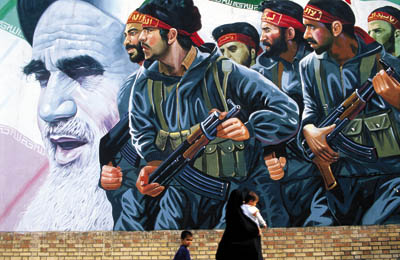
 IRGC-poster.jpg <http://www.longwarjournal.org/images/IRGC-poster.jpg>


An Iranian Revolutionary Guards Corps poster. Photo from Trends
<http://www.trendsmagazine.net/article_focus.php?cle=3> Magazine.

The war of words between the US military and Iran over Iran's involvement in
terrorist activity in Iraq heated up on Sunday after General David Petraeus,
the commander of Multinational Forces Iraq, said the Iranian ambassador was
an Iranian intelligence agent.

"The ambassador is a Qods force member," Petraeus told a group of reporters
near the Iranian border in Diyala province. Ambassador Hassan Kazemi-Qomi's
rank in Qods Force was not disclosed. Qods Force is the covert foreign wing
of the Iranian Revolutionary Guards Corps which has set up and supported
terrorist groups such as Lebanese Hezbollah, Hamas and several terrorist
entities in northern and eastern Africa.

While many nations have and continue to use diplomatic cover for
intelligence activities, Iran has appointed an intelligence officer to the
most senior diplomatic position in Iraq. "Now he has diplomatic immunity and
therefore he is obviously not subject (to arrest)," Petraeus said. "He is
acting as a diplomat."

Iran has repeatedly used diplomatic covers for its intelligence agents sent
into Iraq. Iran maintains
<http://www2.irna.com/en/news/view/line-22/0710073845193005.htm>  that
Mahmud
<http://www.longwarjournal.org/archives/2007/10/captured_iranian_qod.php>
Farhadi, a senior Qods Force officer captured
<http://www.longwarjournal.org/archives/2007/09/iranian_qods_force_a.php> in
Sulimaniyah on September 20, was a deputy governor on a diplomatic trade
mission to the Kurdish Regional Government. The US military has positively
identified Farhadi as the commander of the Zafr Command, one of three units
subordinate to the Ramazan Corps, the Qods Force operational command for
Iraq.

In January 2007, US forces captured
<http://www.longwarjournal.org/archives/2007/01/iranian_quds_force_a.php>
five Qods Force officers in Irbil. The Iranian government still maintains
the men were consular officials. The "Irbil Five" are currently in US
custody.

While General Petraeus did not disclose the intelligence used to identify
Ambassador Hassan Kazemi-Qomi as a Qods Force agent, a combination of
signals and human intelligence are the likely sources of information on his
activities. US intelligence is closely shadowing Qomi's activities in Iraq.
In addition to Farhadi and the Irbil Five, the US has captured numerous
Iranian supported operatives inside Iraq.

In March 2007, Coalition forces captured
<http://www.longwarjournal.org/archives/2007/03/the_baghdad_security_2.php>
Qais Qazali, his brother Laith Qazali, and several other members of the
Qazali network, an Iranian-backed terrorist group. Qazali was a spokesperson
and senior aide to Muqtada al Sadr. In July, US forces captured
<http://www.longwarjournal.org/archives/2007/05/azhar_aldulaimi_the.php>
Azhar al Dulaimi, the tactical commander behind the Karbala Provincial Joint
Communications Center attack which resulted in the kidnapping and murder of
five US soldiers. The Qazali network organized this attack, which was
ordered
<http://www.longwarjournal.org/archives/2007/04/iran_qods_force_and.php> and
directed by Iran. In early September 2007, Multinational Forces Iraq
announced
<http://www.mnf-iraq.com/index.php?option=com_content&task=view&id=13773&Ite
mid=128> the capture of "a highly-sought individual suspected of being an
Iranian Revolutionary Guards Corps-Qods Force" operative in Karbala.

The most significant capture occurred in the spring of 2007, when the
<http://www.longwarjournal.org/archives/2007/07/iran_hezbollah_train.php> US
detained Mussa Ali Daqduq. Daqduq is a senior Hezbollah operative who was
tasked by Iran to organize the Special Groups and "rogue" Mahdi Army cells
along the lines of Lebanese Hezbollah. Documents seized during Daqduq's
capture, along with statements made during interrogations and information
given by other captured Special Groups operatives confirmed Iran's
significant role in the Shia terrorist insurgency. Daqduq met with senior
Qods Force officers inside Iran.

General Petraeus also touched on Iranian involvement in arming, training,
funding, and commanding the Shia insurgency in Iraq. "[The Iranian
government is] responsible for providing the weapons, the training, the
funding and in some cases the direction for operations that have indeed
killed U.S. soldiers," Petraeus said. "There is no question about the
connection between Iran and these components [the Special Groups], attacks
that have killed our soldiers."

Multinational Forces Iraq designated the Iranian-backed terror organizations
such as the Sheibani and Qazali Networks, the "rogue" Mahdi Army, and others
as the "Special Groups" and began
<http://www.longwarjournal.org/archives/2007/06/targeting_the_irania.php>
aggressively targeting these terror groups in mid-spring. Most recently, US
forces killed
<http://www.longwarjournal.org/archives/2007/10/us_kills_25_special.php> 25
Special Groups fighters in Diyala province and captured
<http://www.longwarjournal.org/archives/2007/09/captured_iranian_age.php> 15
in Baghdad. Three Special Groups operatives were
<http://www.mnf-iraq.com/index.php?option=com_content&task=view&id=14481&Ite
mid=128> captured today during a raid in Sadr City.

(F)AIR USE NOTICE: All original content and/or articles and graphics in this
message are copyrighted, unless specifically noted otherwise. All rights to
these copyrighted items are reserved. Articles and graphics have been placed
within for educational and discussion purposes only, in compliance with
"Fair Use" criteria established in Section 107 of the Copyright Act of 1976.
The principle of "Fair Use" was established as law by Section 107 of The
Copyright Act of 1976. "Fair Use" legally eliminates the need to obtain
permission or pay royalties for the use of previously copyrighted materials
if the purposes of display include "criticism, comment, news reporting,
teaching, scholarship, and research." Section 107 establishes four criteria
for determining whether the use of a work in any particular case qualifies
as a "fair use". A work used does not necessarily have to satisfy all four
criteria to qualify as an instance of "fair use". Rather, "fair use" is
determined by the overall extent to which the cited work does or does not
substantially satisfy the criteria in their totality. If you wish to use
copyrighted material for purposes of your own that go beyond 'fair use,' you
must obtain permission from the copyright owner. For more information go to:
http://www.law.cornell.edu/uscode/17/107.shtml

THIS DOCUMENT MAY CONTAIN COPYRIGHTED MATERIAL. COPYING AND DISSEMINATION IS
PROHIBITED WITHOUT PERMISSION OF THE COPYRIGHT OWNERS.


[Non-text portions of this message have been removed]


--------------------------
Want to discuss this topic?  Head on over to our discussion list, [EMAIL
PROTECTED]
--------------------------
Brooks Isoldi, editor
[EMAIL PROTECTED]

http://www.intellnet.org

  Post message: [email protected]
  Subscribe:    [EMAIL PROTECTED]
  Unsubscribe:  [EMAIL PROTECTED]


*** FAIR USE NOTICE. This message contains copyrighted material whose use has
not been specifically authorized by the copyright owner. OSINT, as a part of
The Intelligence Network, is making it available without profit to OSINT
YahooGroups members who have expressed a prior interest in receiving the
included information in their efforts to advance the understanding of
intelligence and law enforcement organizations, their activities, methods,
techniques, human rights, civil liberties, social justice and other
intelligence related issues, for non-profit research and educational purposes
only. We believe that this constitutes a 'fair use' of the copyrighted material
as provided for in section 107 of the U.S. Copyright Law. If you wish to use
this copyrighted material for purposes of your own that go beyond 'fair use,'
you must obtain permission from the copyright owner.
For more information go to:
http://www.law.cornell.edu/uscode/17/107.shtml
Yahoo! Groups Links

<*> To visit your group on the web, go to:
    http://groups.yahoo.com/group/osint/

<*> Your email settings:
    Individual Email | Traditional

<*> To change settings online go to:
    http://groups.yahoo.com/group/osint/join
    (Yahoo! ID required)

<*> To change settings via email:
    mailto:[EMAIL PROTECTED]
    mailto:[EMAIL PROTECTED]

<*> To unsubscribe from this group, send an email to:
    [EMAIL PROTECTED]

<*> Your use of Yahoo! Groups is subject to:
    http://docs.yahoo.com/info/terms/