"Based on Iranian criminal laws, the age of liability for girls is nine and
for boys 15. That means that if a child commits a crime, he or she would be
treated as if a 40-year-old person committed that crime,"
http://www.rferl.org/featuresarticle/2008/01/a39067b7-6a7f-40d6-831c-f6d84d0
c0dca.html

Iran: Child Offenders Face 'Imminent Execution' On Death Row

By Golnaz Esfandiari


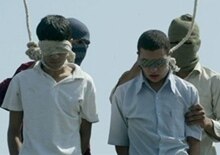
 Iran -- child executions 15Jan2008
<http://gdb.rferl.org/5b2310e5-bcba-45c7-a728-bed54f65f20a_w220.jpg>
Mahmud Asgari, 16, (right) and Ayaz Marhoni, 18, were convicted of raping a
young boy and executed in July 2005
(AFP)
Mohammad Latif has spent three years waiting to be hanged.


He was only 14 years old when, in October 2004, a scuffle outside school
landed him in prison. It was a cold afternoon in Saveh, southwest of Tehran.
Latif says a 16-year-old boy he didn't know attacked him with a knife.

He says the attacker, later identified as Mansur, slashed his hand. Latif
says he fought back and then grabbed the knife. He doesn't recall how the
knife entered Mansur's neck -- and led to the boy's death.

Latif was arrested and convicted of murder.

Human rights activists in Iran are expressing concern over the fate of
several child offenders who have been sentenced to death. They say several
of them are facing imminent execution. Iran is one of the only countries
that executes individuals for crimes committed when they were minors.

And Iran's judiciary has come under greater international scrutiny, with
Amnesty International on January 15 calling on Tehran to abolish death by
stoning. Amnesty said that nine women and two men are currently waiting to
be stoned to death in Iran.

In most countries, minors under 18 convicted of capital crimes face less
severe sentences than adults. There is a broad consensus, reflected in the
UN's International Convention on the Rights of the Child (CRC), that minors
cannot fully grasp the consequences of all their actions -- and so, are
legally less liable for them than adults.

Growing Up Too Soon

But Nobel Peace Prize laureate and lawyer Shirin Ebadi, who is representing
Latif in court, tells RFE/RL's Radio Farda the situation is different in
Iran.

"Based on Iranian criminal laws, the age of liability for girls is nine and
for boys 15. That means that if a child commits a crime, he or she would be
treated as if a 40-year-old person committed that crime," Ebadi says.

Ebadi says that despite her efforts to save Latif's life, he can be executed
any time.

"Unfortunately [the death sentence] has been finalized, our appeal demand
was rejected. Now the sentence [depends on] the head of Iran's judiciary,
Mahmud Shahrudi," Ebadi says.

"I call on him, based on the quality of the case and also on the fact that
Iran has joined the [UN's] International Convention On the Rights of the
Child, to prevent the execution of a person who wasn't even 15 at the time
of the crime."

Latif is just one of many child offenders on death row in Iran, a country
that the New York-based organization Human Rights Watch calls the world's
leading executor of children and juvenile offenders.

Drewery Dyke of Amnesty International says his organization and other rights
groups believe that between 70 and 80 child offenders are facing the death
penalty in the Islamic Republic.

"The particular concern with regard to these sort of developments is that
there was forward movement in the sixth [parliament] to stop this practice
to bring Iran in line with the international obligation that it itself said
it would live up to," Dyke says.

Human rights groups say that by executing child offenders, Iran violates its
obligations under the CRC. Under the UN convention, any person under the age
of 18 is considered a child.

Iran's judiciary often issues death sentences for minors and executes them
once they turn 18. There have been also cases where criminal offenders have
been executed while they are still minors.

In 2005, a 16-year-old girl was hanged in public for having what was called
"illegitimate sexual relations."

But the most recent known case of juvenile execution was the hanging of
21-year-old Makwan Moloudzadeh in December 2007. Moloudzadeh was hanged for
a rape he had allegedly committed when he was 13. He had pleaded not guilty
and witnesses had reportedly retracted their testimonies.

Stonings

His execution led to protests and condemnation by human rights groups and
the United Nations.

Human rights activists and lawyers representing minor offenders including
Moloudzadeh say that sentences against them were handed down following quick
and hurried decisions and despite flaws and shortcomings in the proceedings.


Nasrin Sotudeh, a Tehran-based lawyer who represents Soghra Najafpur, a
young woman sentenced to death for a murder committed when she may have been
only 13 years old, says that despite calls by human rights advocates to ban
child executions, Iran's judiciary continues to issue death sentences
against juvenile offenders convicted of capital crimes.

"[The judiciary] sends a message to rights activists that not only it
doesn't value their activities, but also that it is determined to ignore
their calls and demands," Sotudeh says.

During the last year, Amnesty International recorded the execution of five
juvenile offenders in Iran. Over the past two years, Iran has stepped up its
overall use of the death penalty.

In 2007, some 300 people were reportedly executed, an increase over the 177
known executions that took place in 2006.

Iranian authorities defend their use of the death penalty by saying that it
is an effective deterrent and increases security. Rights activists, who say
the death penalty is a cruel punishment that breeds violence, reject that
claim.

Usually, executions in Iran are by hanging. But according to recent Iranian
press reports, two men convicted of homosexual rape in Fars, southern Iran,
were sentenced to death by putting them in a sack and throwing it off the
top of a cliff.

According to Iran's form of Islamic Shari'a law, homosexuality is punishable
by death and the judge can choose from five methods including throwing off a
height and demolishing a wall on the offender, a method whose use has not
been reported in the past 30 years.

About six months ago, a man convicted of adultery was stoned to death in
Ghazvin.


[Non-text portions of this message have been removed]


--------------------------
Want to discuss this topic?  Head on over to our discussion list, [EMAIL
PROTECTED]
--------------------------
Brooks Isoldi, editor
[EMAIL PROTECTED]

http://www.intellnet.org

  Post message: [email protected]
  Subscribe:    [EMAIL PROTECTED]
  Unsubscribe:  [EMAIL PROTECTED]


*** FAIR USE NOTICE. This message contains copyrighted material whose use has
not been specifically authorized by the copyright owner. OSINT, as a part of
The Intelligence Network, is making it available without profit to OSINT
YahooGroups members who have expressed a prior interest in receiving the
included information in their efforts to advance the understanding of
intelligence and law enforcement organizations, their activities, methods,
techniques, human rights, civil liberties, social justice and other
intelligence related issues, for non-profit research and educational purposes
only. We believe that this constitutes a 'fair use' of the copyrighted material
as provided for in section 107 of the U.S. Copyright Law. If you wish to use
this copyrighted material for purposes of your own that go beyond 'fair use,'
you must obtain permission from the copyright owner.
For more information go to:
http://www.law.cornell.edu/uscode/17/107.shtml
Yahoo! Groups Links

<*> To visit your group on the web, go to:
    http://groups.yahoo.com/group/osint/

<*> Your email settings:
    Individual Email | Traditional

<*> To change settings online go to:
    http://groups.yahoo.com/group/osint/join
    (Yahoo! ID required)

<*> To change settings via email:
    mailto:[EMAIL PROTECTED]
    mailto:[EMAIL PROTECTED]

<*> To unsubscribe from this group, send an email to:
    [EMAIL PROTECTED]

<*> Your use of Yahoo! Groups is subject to:
    http://docs.yahoo.com/info/terms/