http://www.longwarjournal.org/archives/2010/10/iran_sends_another_d.php
Iran sends another dangerous Shia terror commander back to Iraq


By Bill RoggioOctober 18, 2010


 <http://www.longwarjournal.org/maps/Ramazan-Corps-Southern-ratlines1.php>
http://www.longwarjournal.org/maps/Ramazan-Corps-Southern-ratlines-thumb.jpg


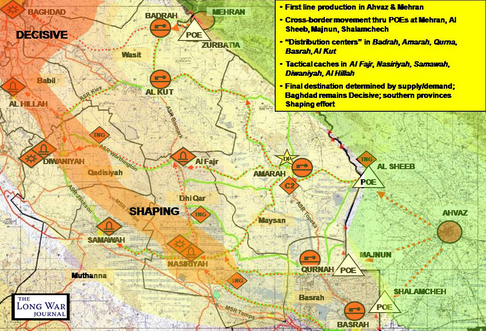
A US military map of Iran's operations inside southern Iraq, from 2007. This
map formed the basis of the LWJ report,
<http://www.longwarjournal.org/archives/2007/12/irans_ramazan_corps.php> The
Ramazan Corps and the ratlines into Iraq. Click to view full size.

Another Shia terror commander who takes orders from Iran has recently
returned to Iraq, heightening fears that violence in the quiet Iraqi south
may spike.

Iran has sent Abu Mustafa al Sheibani, the commander of the notorious
Sheibani Network, back to Iraq to reorganize his fighters, US military and
intelligence officials told The Long War Journal. The exact date of
Sheibani's return is not known, but he is believed to have returned to Iraq
sometime in the late summer.

US Forces - Iraq would neither confirm nor deny the reports of Sheibani's
return to Iraq. "This is a highly sensitive topic," a USF-I public affairs
official told The Long War Journal. Further inquiries into the status of
Sheibani went unanswered.

Sheibani is believed to have been sheltering in Iran since early 2008, when
the Iraqi government, backed by the US military, launched offensives against
Iran's networks based in central in southern Iraq. In 2008, the US Treasury
Department claimed that Sheibani was based out of Tehran, Iran.

Sheibani is known to have planned and executed attacks against US, British,
and Iraqi forces, as well as Iraqi political and civic leaders as early as
2005 <http://www.time.com/time/printout/0,8816,1093747,00.html> . At that
time, Sheibani was thought to have 280 members in his network, which was
divided into 17 cells. His fighters were known to carry out attacks with the
deadly, armor-piercing explosively-formed projectiles, or EFPs, as well with
mortars, Katyusha and other rockets, and small-arms assaults.

in 2005, Sheibani was one of the only Shia terror leaders to be placed on
the
<http://www.usf-iraq.com/?option=com_content&task=view&id=572&Itemid=128>
Iraqi government's most-wanted list. Sheibani was number 24 of 41
most-wanted terrorists, and the Iraqi government offered a $200,000 reward
for information leading to his capture.

Sheibani was also placed on the US Treasury Department's list that targets
individuals and entities aiding the Iraqi insurgency. Sheibani was added
along with Ahmad Foruzandeh, the Commanding Officer of the Iranian Islamic
Revolutionary Guard Corps-Qods Force Ramazan Corps, and Abu Dura, the
violent leader of a faction of the Mahdi Army. Qods Force's Ramazan Corps is
responsible for Iran's covert operations in Iraq. [For more information on
Qods Force activities in Iraq, see Iran's
<http://www.longwarjournal.org/archives/2007/12/irans_ramazan_corps.php>
Ramazan Corps and the ratlines into Iraq.]

"Al Sheibani's Iran-sponsored network was created to affect the Iraqi
political process in Iran's favor," Treasury stated. "The network's first
objective is to fight US forces, attacking convoys and killing soldiers. Its
second objective is to eliminate Iraqi politicians opposed to Iran's
influence."

Sheibani's network was "ordered by IRGC headquarters to create disorder,"
Treasury stated.

Qods Force sent Ali Mussa Daqduq, a senior Lebanese Hezbollah military
leader, to Iraq to train Sheibani and Qais Qazali, another Shia terror
leader. Daqduq was tasked by Qods Force to organize Sheibani and Qazali's
networks in ways that mirrored how Hezbollah was organized in Lebanon. The
US military captured
<http://www.longwarjournal.org/archives/2007/07/iran_hezbollah_train.php>
Daqduq in the winter of 2007.

Second known terror leader sent back to Iraq

Sheibani is the second dangerous Shia terror commander known to have
returned to Iraq since last summer. Ismail Hafiz al Lami, who is also known
Abu Dura and the "Shiite Zarqawi" for his brutality towards Iraqis, was
<http://www.longwarjournal.org/archives/2010/08/shiite_zarqawi_retur.php>
also sent back to Iraq by Qods Force's Ramazan Corps sometime last summer.
Abu Dura is a commander in the notorious Asaib al Haq, or the League of the
Righteous, a Mahdi Army splinter group that is also backed by Iran's Qods
Force.

The return of Sheibani and Abu Dura to Iraq signals that Iran is preparing
to increase the pressure on the dwindling number of US forces operating in
the south and Baghdad, while attempting to exert influence over Iraqi
affairs, US officials said.

"Let's be clear, Sheibani, Abu Dura, and others promoted by Qods [Force]
serve a purpose: to kill people and sow chaos," a US military intelligence
officer told The Long War Journal.

Last summer, US military officers began to sound the alarm on Iran's move to
reignite the Shia insurgency.

"The Iranians... continue to fund, train and provide weapons and ammunition
to Shiite extremist groups," General Ray Odierno, then the commander of US
Forces Iraq, said
<http://www.longwarjournal.org/archives/2010/07/iran_backs_three_shi.php>
in a press conference on July 21. "It's very difficult to say if the
extremist groups are directly connected to the Iranian government. But we do
know that many of them live in Iran, many of them get trained in Iran, and
many of them get weapons from Iran."

Over the summer, Odierno singled out the League of the Righteous, Hezbollah
Brigades, and the Promised Day Brigade as being the three Shia terror groups
receiving backing from Iran. These groups have been carrying out attacks on
US forces in the south, and have been releasing videos of the attacks on the
Internet.

Iran ramps up and the US draws down

As Iran has been rebuilding its network in Iraq, the US has been attempting
to promote reconciliation with the League of the Righteous, the largest and
most dangerous Shia terror group. The US acceded to the group's demands and
last year began releasing its top leaders and hundreds of fighters from US
custody.

In July 2009, the US freed
<http://www.longwarjournal.org/archives/2009/06/us_releases_shia_ter.php>
Laith Qazali, a senior commander; more than 100 other members of the League;
and five Iranian Qods Force officers, including
<http://www.longwarjournal.org/archives/2009/07/us_released_senior_iranian_q
ods_force_commander.php>  Mahmud Farhadi, the leader of the Zafr Command,
one of three units subordinate to the Qods Force's Ramazan Corps, in an
attempt to appease the terror group.

Laith is the brother of Qais Qazali, the founder of the League of the
Righteous. Qais was Muqtada al Sadr's top aide and spokesman. Qais was
behind the kidnapping and murder of five US soldiers in Karbala in January
2007 and numerous other acts of terrorism before he was captured by US
forces in March 2007.

Qais was then released in late December 2009, purportedly as part of a
reconciliation process. But his release came at the same time that a British
contractor, who had been captured by the League of the Righteous in May of
2007, was turned over to the British. The Shia terror group previously
executed four other British contractors who had also been held hostage.

The release of Qais, Laith, Farhadi, and other members of the League of the
Righteous and Qods Force infuriated US military officers and intelligence
officials who follow the Iranian-backed terror groups. Officials told The
Long War Journal that reconciliation was a farce used to carry out a
"prisoner swap."

The skepticism quickly proved to be well placed. The League of the Righteous
backtracked on reconciliation, and suspended talks with the Iraqi government
in early January 2010, just weeks after Qais' release. And in mid-January,
the League of the Righteous kidnapped
<http://www.longwarjournal.org/archives/2010/02/iranianbacked_shia_t.php>
Issa T. Salomi, a US Defense Department contractor, in Baghdad.

"We've been had," a senior military officer told
<http://www.longwarjournal.org/archives/2010/02/iranianbacked_shia_t.php>
The Long War Journal in January 2010. "Anyone who closely followed the
League of the Righteous should have known this was inevitable."

Salomi was
<http://www.longwarjournal.org/archives/2009/06/us_releases_shia_ter.php>
freed in late March, purportedly as part of yet another prisoner swap. The
US military denied that such a swap had been made, however.

The League of the Righteous still holds one US citizen hostage: Sergeant
Ahmed Altaie, who was kidnapped in Baghdad in 2006. Altaie's status is
unknown, but it is thought that he died in captivity. The League of the
Righteous claimed <http://www.reuters.com/article/idUSTRE61515Z20100206>  it
recovered Altaie's remains from another insurgent group. A group called the
Ahel al Beit Brigades claimed to have kidnapped Altaie in 2007. The US
military would not officially comment on inquiries on Altaie or the Ahel al
Beit Brigades. But a US intelligence official told The Long War Journal that
the Ahel al Beit Brigades is part of the League of the Righteous.


For more information on Iran's support of Shia terror groups in Iraq, see
Iranian-backed
<http://www.longwarjournal.org/archives/2010/07/iranianbacked_shia_t_1.php>
Shia terror group remains a threat in Iraq: General Odierno and Iran's
<http://www.longwarjournal.org/archives/2007/12/irans_ramazan_corps.php>
Ramazan Corps and the ratlines into Iraq.


Read more:
<http://www.longwarjournal.org/archives/2010/10/iran_sends_another_d.php#ixz
z12ijJVawb>
http://www.longwarjournal.org/archives/2010/10/iran_sends_another_d.php#ixzz
12ijJVawb


[Non-text portions of this message have been removed]


------------------------------------

--------------------------
Want to discuss this topic?  Head on over to our discussion list,
[email protected].
--------------------------
Brooks Isoldi, editor
[email protected]

http://www.intellnet.org

  Post message: [email protected]
  Subscribe:    [email protected]
  Unsubscribe:  [email protected]


*** FAIR USE NOTICE. This message contains copyrighted material whose use has
not been specifically authorized by the copyright owner. OSINT, as a part of
The Intelligence Network, is making it available without profit to OSINT
YahooGroups members who have expressed a prior interest in receiving the
included information in their efforts to advance the understanding of
intelligence and law enforcement organizations, their activities, methods,
techniques, human rights, civil liberties, social justice and other
intelligence related issues, for non-profit research and educational purposes
only. We believe that this constitutes a 'fair use' of the copyrighted material
as provided for in section 107 of the U.S. Copyright Law. If you wish to use
this copyrighted material for purposes of your own that go beyond 'fair use,'
you must obtain permission from the copyright owner.
For more information go to:
http://www.law.cornell.edu/uscode/17/107.shtmlYahoo! Groups Links

<*> To visit your group on the web, go to:
    http://groups.yahoo.com/group/osint/

<*> Your email settings:
    Individual Email | Traditional

<*> To change settings online go to:
    http://groups.yahoo.com/group/osint/join
    (Yahoo! ID required)

<*> To change settings via email:
    [email protected]
    [email protected]

<*> To unsubscribe from this group, send an email to:
    [email protected]

<*> Your use of Yahoo! Groups is subject to:
    http://docs.yahoo.com/info/terms/