Turmoil in Egypt
by Daniel Pipes
The Washington Times
February 1, 2011

http://www.danielpipes.org/9391/turmoil-in-egypt


 <http://www.danielpipes.org/article_send.php?id=9391>
http://www.danielpipes.org/img/item_email.gifSend

 <http://www.danielpipes.org/9391/turmoil-in-egypt#comment_submit>
http://www.danielpipes.org/img/item_comment.gifComment

 <http://www.danielpipes.org/rss.xml>
http://www.danielpipes.org/img/item_rss.gifRSS

Share:
<http://www.facebook.com/share.php?u=http%3A%2F%2Fwww.danielpipes.org%2F9391%2Fturmoil-in-egypt>
 Facebook
<http://api.tweetmeme.com/share?url=http%3A%2F%2Fwww.danielpipes.org%2F9391%2Fturmoil-in-egypt&service=bit.ly&source=DanielPipes>
 Twitter
<http://www.google.com/buzz/post?url=http%3A%2F%2Fwww.danielpipes.org%2F9391%2Fturmoil-in-egypt>
 Google Buzz
<http://digg.com/submit?phase=2&url=http%3A%2F%2Fwww.danielpipes.org%2F9391%2Fturmoil-in-egypt&title=Turmoil+in+Egypt&bodytext=As+Egypt%27s+much-anticipated+moment+of+crisis+arrived+and+popular+rebellions+shook+governments+across+the+Middle+East%2C+Iran+stands+as+never+before+at+the+center+of+the+region.+Its+Islamist+rulers+are+within+sight+of+dominating+the+region.+But+revolutions...>
 Digg


<http://www.danielpipes.org/facebook_like.php?ref_id=9391&ref_url=http%3A%2F%2Fwww.danielpipes.org%2F9391%2Fturmoil-in-egypt>

http://www.danielpipes.org/img/icons/fb_like/fb_like_en.gifhttp://www.danielpipes.org/img/icons/fb_like/fb.pngBe
 the first of your friends to like this.

As Egypt's much-anticipated moment of crisis arrived and popular rebellions
shook governments across the Middle East, Iran stands as never before at the
center of the region. Its Islamist rulers are within sight of dominating the
region. But revolutions are hard to pull off and I predict that Islamists will
not achieve a Middle East-wide breakthrough and Tehran will not emerge as the
key powerbroker. Some thoughts behind this conclusion:


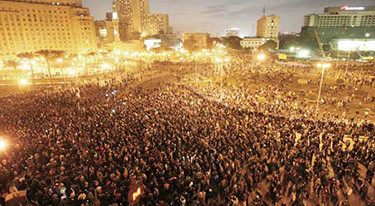
http://www.danielpipes.org/pics/new/large/1380.jpg

Cairo's Tahrir Square on January 25, 2011.

An echo of the Iranian revolution: On reaching power in 1979, Ayatollah
Ruhollah Khomeini sought to spread Islamist insurrection to other countries but
failed almost everywhere
<http://www.danielpipes.org/266/death-to-america-in-lebanon> . Three decades
had to go by, it appears, before the self-immolation of a vendor in an obscure
Tunisia town could light the conflagration that Khomeini aspired to and Iranian
authorities still seek <http://english.farsnews.com/newstext.php?nn=8911091629>
.

Part of a Middle Eastern cold war: The Middle East has for years been divided
into two large blocs engaged in a regional cold war
<http://www.danielpipes.org/6406/middle-eastern-cold-war>  for influence. The
Iranian-led resistance bloc includes Turkey, Syria
<http://www.memri.org/report/en/0/0/0/0/0/0/4957.htm> , Gaza, and Qatar. The
Saudi-led
<http://services.inquirer.net/print/print.php?article_id=20110129-317355>
status quo bloc includes Morocco, Algeria, Tunisia, Egypt, the West Bank
<http://www.jpost.com/MiddleEast/Article.aspx?id=205766> , Jordan
<http://www.asharq-e.com/news.asp?section=1&id=23951> , Yemen
<http://english.aljazeera.net/news/middleeast/2011/01/2011129112626339573.html>
, and the Persian Gulf emirates. Note that Lebanon these very days is moving to
resistance from status quo and that unrest is taking place only in status quo
places.

Israel's peculiar situation: Israeli leaders are staying mum
<http://www.washingtonpost.com/wp-dyn/content/article/2011/01/27/AR2011012705102_pf.html>
  and its near-irrelevance underlines Iranian centrality. While Israel has much
to fear from Iranian gains, these simultaneously highlight the Jewish state as
an island of stability and the West's only reliable ally in the Middle East.

Lack of ideology: The sloganeering and conspiracy theories
<http://www.nytimes.com/2011/01/30/world/middleeast/30arab.html?_r=1&pagewanted=print>
  that dominate Middle Eastern discourse are largely absent from crowds
gathered outside of government installations demanding an end to stagnation,
arbitrariness, corruption, tyranny, and torture.

Military vs. mosque: Recent events confirm that the same two powers, the armed
forces and the Islamists, dominate some 20 Middle Eastern countries: the
military deploys raw power and Islamists offer a vision. Exceptions exist – a
vibrant Left in Turkey, ethnic factions in Lebanon and Iraq, democracy in
Israel, Islamist control in Iran – but this pattern widely holds.

Iraq: The most volatile country of the region, Iraq, has been conspicuously
absent from the demonstrations because its population is not facing a
decades-old autocracy.

A military putsch? Islamists wish to repeat their success in Iran by exploiting
popular unrest to take power. Tunisia's experience bears close examination for
a pattern that may be repeated elsewhere. The military leadership there
apparently concluded that its strongman, Zine El Abidine Ben Ali, had become
too high maintenance – especially with his wife's family's flamboyant
corruption – to maintain in power, so it ousted him and, for good measure, put
out an international arrest warrant
<http://www.bbc.co.uk/news/world-africa-12286650>  for his and his family's
arrest.


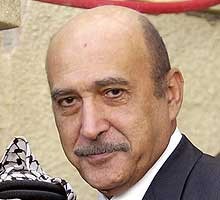
http://www.danielpipes.org/pics/new/large/1381.jpg

Gen. Omar Suleiman – Egypt's fourth military ruler since 1952?

That done, nearly the entire remaining old guard remains in power, with the top
military man, Chief of Staff Rachid Ammar
<http://www.ft.com/cms/s/e01ffbc4-27e5-11e0-8abc-00144feab49a,dwp_uuid=fc3334c0-2f7a-11da-8b51-00000e2511c8,print=yes.html>
 , apparently having replaced Ben Ali as the country's powerbroker. The old
guard hopes that tweaking the system, granting more civil and political rights,
will suffice for it to hold on to power. If this gambit succeeds, the seeming
revolution of mid-January will end up as a mere coup d'état.

This scenario could be repeated elsewhere, especially in Egypt, where soldiers
have dominated the government since 1952 and intend to maintain their power
<http://www.nytimes.com/2010/09/12/world/middleeast/12egypt.html?_r=1&sq=egyptian%20military&st=cse&scp=1&pagewanted=print>
  against the Muslim Brethren they have suppressed since 1954. Strongman Hosni
Mubarak's appointment of Omar Suleiman
<http://www.nytimes.com/2011/01/30/world/middleeast/30suleiman.html?src=twrhp&pagewanted=print>
  terminates the Mubarak family's dynastic pretensions and raises the prospect
of Mr. Mubarak resigning in favor of direct military rule.

More broadly, I bet on the more-continuity-than-change model that has emerged
so far in Tunisia. Heavy-handed rule will lighten somewhat in Egypt and
elsewhere but the militaries will remain the ultimate powerbrokers.

U.S. policy: The U.S. government has a vital role helping Middle Eastern states
transit from tyranny to political participation without Islamists hijacking the
process. George W. Bush had the right idea in 2003 in calling for democracy
<http://www.danielpipes.org/1304/bush-the-radical>  but he ruined this effort
by demanding instant results
<http://www.danielpipes.org/2447/a-neo-conservatives-caution> . Barack Obama
initially reverted to the failed old policy of making nice with tyrants
<http://www.washingtonpost.com/wp-dyn/content/article/2011/01/27/AR2011012705934_pf.html>
 ; now he is myopically siding with the Islamists
<http://www.whitehouse.gov/the-press-office/2011/01/28/remarks-president-situation-egypt>
  against Mr. Mubarak. He should emulate Bush but do a better job,
understanding that democratization is a decades-long process
<http://www.danielpipes.org/2248/us-needs-to-learn-patience-in-iraq>  that
requires the inculcation of counter-intuitive ideas about elections, freedom of
speech, and the rule of law.

Mr. Pipes, director of the Middle East Forum and Taube distinguished visiting
fellow at the Hoover Institution, lived in Egypt for three years.


[Non-text portions of this message have been removed]


------------------------------------

--------------------------
Want to discuss this topic?  Head on over to our discussion list,
[email protected].
--------------------------
Brooks Isoldi, editor
[email protected]

http://www.intellnet.org

  Post message: [email protected]
  Subscribe:    [email protected]
  Unsubscribe:  [email protected]


*** FAIR USE NOTICE. This message contains copyrighted material whose use has
not been specifically authorized by the copyright owner. OSINT, as a part of
The Intelligence Network, is making it available without profit to OSINT
YahooGroups members who have expressed a prior interest in receiving the
included information in their efforts to advance the understanding of
intelligence and law enforcement organizations, their activities, methods,
techniques, human rights, civil liberties, social justice and other
intelligence related issues, for non-profit research and educational purposes
only. We believe that this constitutes a 'fair use' of the copyrighted material
as provided for in section 107 of the U.S. Copyright Law. If you wish to use
this copyrighted material for purposes of your own that go beyond 'fair use,'
you must obtain permission from the copyright owner.
For more information go to:
http://www.law.cornell.edu/uscode/17/107.shtmlYahoo! Groups Links

<*> To visit your group on the web, go to:
    http://groups.yahoo.com/group/osint/

<*> Your email settings:
    Individual Email | Traditional

<*> To change settings online go to:
    http://groups.yahoo.com/group/osint/join
    (Yahoo! ID required)

<*> To change settings via email:
    [email protected]
    [email protected]

<*> To unsubscribe from this group, send an email to:
    [email protected]

<*> Your use of Yahoo! Groups is subject to:
    http://docs.yahoo.com/info/terms/