http://bit.ly/hldA1s

Libyan “Rebel Commander” Gives Interview Describing His Connections With
Al-Qaeda
<http://publicintelligence.net/libyan-rebel-commander-gives-interview-descri
bing-his-connections-with-al-qaeda/>
March 26, 2011 in Featured
<http://publicintelligence.net/category/news/featured-news-2/>

 <http://publicintelligence.net/wp-content/uploads/2011/03/libyan-rebel.jpg>


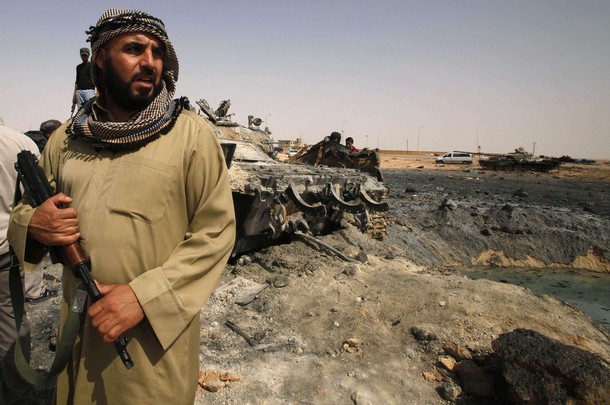
A rebel holds onto a weapon in front of tanks belonging to forces loyal to
Libyan leader Muammar Gaddafi after an air strike by coalition forces in
Ajdabiyah March 26, 2011. Libyan rebels backed by allied air strikes retook
the strategic town of Ajdabiyah on Saturday after an all-night battle that
suggests the tide is turning against Gaddafi's forces in the east.
REUTERS/Suhaib Salem

Libyan rebel commander admits his fighters have al-Qaeda links
(Telegraph.co.uk
<http://www.telegraph.co.uk/news/worldnews/africaandindianocean/libya/840704
7/Libyan-rebel-commander-admits-his-fighters-have-al-Qaeda-links.html> ):

Abdel-Hakim al-Hasidi, the Libyan rebel leader, has said jihadists who
fought against allied troops in Iraq are on the front lines of the battle
against Muammar Gaddafi’s regime.

In an interview with the Italian newspaper Il Sole 24 Ore, Mr al-Hasidi
admitted that he had recruited “around 25″ men from the Derna area in
eastern Libya to fight against coalition troops in Iraq. Some of them, he
said, are “today are on the front lines in Adjabiya”.

Mr al-Hasidi insisted his fighters “are patriots and good Muslims, not
terrorists,” but added that the “members of al-Qaeda are also good Muslims
and are fighting against the invader”.

His revelations came even as Idriss Deby Itno, Chad’s president, said
al-Qaeda had managed to pillage military arsenals in the Libyan rebel zone
and acquired arms, “including surface-to-air missiles, which were then
smuggled into their sanctuaries”.

Mr al-Hasidi admitted he had earlier fought against “the foreign invasion”
in Afghanistan, before being “captured in 2002 in Peshwar, in Pakistan”.
He was later handed over to the US, and then held in Libya before being
released in 2008.

US and British government sources said Mr al-Hasidi was a member of the
Libyan Islamic Fighting Group, or LIFG, which killed dozens of Libyan troops
in guerrilla attacks around Derna and Benghazi in 1995 and 1996.

Even though the LIFG is not part of the al-Qaeda organisation, the United
States military’s West Point academy has said the two share an
“increasingly co-operative relationship”. In 2007, documents captured by
allied forces from the town of Sinjar, showed LIFG emmbers made up the
second-largest cohort of foreign fighters in Iraq, after Saudi Arabia.

Earlier this month, al-Qaeda issued a call for supporters to back the Libyan
rebellion, which it said would lead to the imposition of “the stage of
Islam” in the country.

British Islamists have also backed the rebellion, with the former head of
the banned al-Muhajiroun proclaiming that the call for “Islam, the Shariah
and jihad from Libya” had “shaken the enemies of Islam and the Muslims
more than the tsunami that Allah sent against their friends, the Japanese”.

Libyan Islamists stand to gain with or without Gadhafi (Duetsche Welle
<http://www.dw-world.de/dw/article/0,,14934994,00.html> ):

An alleged dual British-Libyan jihadist has been paraded in front of the
international media to support the regime’s claim that the revolt against
Gadhafi’s 41-year rule was being directed by al-Qaeda.

Libya has put the spotlight on the fact that it may be one of the Middle
Eastern and North African countries where militant Islamists emerge
strengthened from the Arab struggle to throw off the yoke of authoritarian
rule.

Salah Mohammed Ali Abu Obah, a 43-year old Manchester resident, said he was
a member of the Libyan Islamic Fighting Group (LIFG), an al-Qaeda affiliate
founded by Libyan fighters in Afghanistan. He said he had been detained
earlier this month by Libyan security forces in the town of Zawiya, west of
the capital Tripoli. Abu Obah described himself as a low-level LIFG
fundraiser.

Abu Obah’s statements did little to substantiate Gadhafi’s claim but
fuelled Western concerns that jihadists and militant Islamists were playing
a key role in the Libyan revolt unlike elsewhere in the world where they
have largely been relegated to the sidelines. Abu Obah noted that the LIFG
had broken its ties to al-Qaeda in 2007 around the time that its imprisoned
leaders engaged in serious dialogue with the regime as part of the
government’s rehabilitation program.

“The part of the LIFG that I am with does not belong to al-Qaeda,” Abu
Obah said.

The LIFG alongside dissident elements of the Libyan armed forces are the
only two groups within the Libyan opposition with battle experience. The
Libyan jihadists fought a bitter insurgency in eastern Libya in the 1990s.

Many of the Islamist fighters who are facing off against Gadhafi’s forces
were released from prison last year as part of the government rehabilitation
program that was overseen by Gadhafi’s son, Saif al-Islam, in which they
repented their ways, but did not fully renounce violence.

Analysts said the jihadists’ role in the struggle to topple Gadhafi would
strengthen their position irrespective of what the outcome is of the battle
for Libya. They said the fighters’ attitudes once the battle is over would
constitute a litmus test for government rehabilitation programs in several
Arab countries, including Saudi Arabia, Yemen and Mauritania. The Saudi
program has so far had an 80 percent success rate.

09TRIPOLI955 LIBYAN ISLAMIC FIGHTING GROUP REVISES JIHADIST IDEOLOGY
(WikiLeaks <http://wikileaks.se/cable/2009/12/09TRIPOLI955.html> ):

1.(S/NF) Summary: Six leading members of the Libyan Islamic Fighting Group
(LIFG) imprisoned in Libya recently issued a 417-page document renouncing
the use of violence and establishing a new “code” for jihad. The group
includes LIFG’s “founding fathers,” individuals with ties to Al Qaeda in
the Islamic Maghreb’s (AQIM) senior leadership, including the elder brother
of Abu Yahya al-Libi, a leading AQIM figure. The recantation claims to
represent a clearer understanding of the “ethics” of Islamic shari’a law
and jihad and specifically refutes the LIFG’s decades-long jihad against
Muammar al-Qadhafi. The document is the result of a two-year initiative led
by Saif al-Islam al-Qadhafi through his Qadhafi International Charity and
Development Foundation (QDF), and supported by Libya’s internal and
external security services. As a result of the initiative, more than 200
jihadists (approximately half of the imprisoned LIGF members) have been
released from prison, with more releases expected soon. The initiative has
been highlighted by local and international media as a potential model in
counter-radicalization and touted by the Libyan government as a
“revolutionary new method to combat terrorism and the influence of Al Qaeda
in the region.” While Libya’s terrorist rehabilitation program has drawn
skepticism from some quarters, who view the recantation as coerced and
politically motivated, the work is reportedly being reviewed by foreign
governments and has received praise as a positive GOL contribution to
regional counterterrorism efforts. While the initiative is significant for
Libya’s internal politics - simultaneously shoring up regime stability and
Saif al-Islam’s credentials - its long-term effects as a
counter-radicalization effort remain to be seen. End summary.

SAIF AL-ISLAM AND LIBYAN SECURITY FORCES FACILITATE CODE, RELEASE OF LIFG

2.(SBU) In late September, six leading members of the Libyan Islamic
Fighting Group, being held in the Abu Salim prison, issued a document
outlining a revised interpretation of their jihadist ideology - one which
renounces violence and claims to adhere to a more sound Islamic theology
than that of Al Qaeda and other jihadist organizations. The authors
represent the group’s historic senior leadership, including Abd al-Hakim
Balhaj (aka, Abu Abd Allah al-Sadiq, Emir of the LIFG), Abu al-Munder
al-Saidi (Jurisprudence Official of the LIFG/most senior shari’a
authority), Abd al-Wahab al-Qayed (the elder brother of Abu Yahya al-Libi, a
leading AQIM figure), Khalid al-Sharif, Miftah al-Duwdi, and Mustafa
Qanaifid. In the 417-page, Arabic-language document, entitled “Revisionist
Studies of the Concepts of Jihad, Verification, and Judgment of People,”
the authors point to ignorance and a misinterpretation of Islamic
jurisprudence as the basis for their formerly violent expression of Islamic
jihad. The authors state that “The lack of religious knowledge, whether it
was a result of an absence of ‘ulama’ (religious scholars) or the neglect
of people in receiving it and attaining it, or due to the absence of its
sources, is the biggest cause of errors and religious violations.” They
credit a deep evaluation of their lives’ experiences, coupled with a closer
study of shari’a law for their ideological reform.

3.(SBU) The study is characterized as an attempt to recant former LIFG
doctrine and to establish a new “code” for jihad for the benefit of the
modern Muslim community. In the text, the authors directly challenge Al
Qaeda, addressing the recantation to “anyone who we might have once had
organizational or brotherly ties with.” The document gives detailed
interpretations of the “ethics and morals to jihad,” which include the
rejection of violence as a means to change political situations in Muslim
majority countries whose leader is a Muslim and condemns “the killing of
women, children, the elderly, monks/priests, wage earners, messengers,
merchants and the like.” It claims that “The reduction of jihad to
fighting with the sword is an error and shortcoming.”

4.(S/NF) The revised LIFG ideology is the result of a two-year initiative,
led by Saif al-Islam al-Qadhafi in his capacity as QDF chairman and brokered
on behalf of the Libyan government. According to press reports and Libyan
officials, Saif worked closely with the UK-based former LIFG leader, Noman
Benotman, on the effort to work on a revised ideology with the LIFG in
exchange for amnesty. QDF’s lead negotiator, Salah Abdelsalam Salah,
director of the QDF’s Human Rights Committee, (who also heads Saif
al-Islam’s al-Ghad Media Group, ref A), said that he had met with al-Sadiq
“4-5″ times in 2007, before reconciliation TRIPOLI 00000955 002.2 OF 003
discussions began in earnest. At that time, al-Sadiq seemed “ready to
reconcile” and had indicated that his cohort shared his serious desire to
break with their violent past.

5.(S/NF) Salah detailed the two-year negotiation in a meeting with Pol/Econ
Chief, sharing several handwritten letters from al-Sadiq to Saif al-Islam
al-Qadhafi, requesting assistance. After the initial communication, a series
of meetings began, along two tracks: the first involving imprisoned LIFG
leadership conversing with their members; the second involving LIFG
leadership, the QDF, leading Islamic scholars, and prison officials (from
Libya’s Internal Security Organization). Libya’s External Security
Organization reportedly took on a supporting role, coordinating a
“reconciliation and rehabilitation” movement among Libyan opposition
figures (including LIFG members and others) living abroad. The meetings
continued over the course of two years, and al-Sadiq wrote letters to Saif
al-Islam throughout that period with updates on the LIFG position. In a
letter dated January 16, 2009, al-Sadiq informed Saif of the LIFG’s
intention to draft the recantation work by August 1, 2009, to announce
revisions to its jihadist ideology and to reconcile with the Libyan regime.
On February 23, 2009, al-Sadiq issued a press statement on behalf of the
LIFG leaders in prison, announcing the continuation of a reconciliation
dialogue with the QDF and GOL. Salah refused to comment on international
press reports that Saif faced challenges from old guard regime officials who
reportedly did not want to pardon the prisoners.

6.(S/NF) As reported in ref B, QDF’s Executive Director told us in August
that the QDF had facilitated consultations between LIFG leadership and
leading Islamic scholars, such as Qatar-based Egyptian cleric Yusuf
al-Qardawi and Sheikh Ali Asalabi. In response to an early-2009 letter from
al-Sadiq to Saif requesting by title a list of more than 10 books on Islamic
jurisprudence, the QDF provided reading and reference materials for the LIFG
to study in prison. On August 1, al-Sadiq informed Saif that the revisionist
study was complete and submitted it for review.

7.(S/NF) On August 23, to mark the beginning of Ramadan and the Libyan
leader’s 40th anniversary in power, LIFG leadership issued another press
statement, this time apologizing to Muammar al-Qadhafi for their past acts
of violence against him. The first of two rounds of prison releases took
place shortly after the statement was published, with 91 LIFG prisoners
pardoned and released. A second amnesty was announced in mid-October, with
another 43 LIFG members reportedly being released. According to Salah, these
releases constitute approximately half of the imprisoned LIFG members, all
of whom were imprisoned at Abu Salim prison. (Saif al-Islam has publicly
stated his intention to demolish the facility, infamous for a 1996 uprising
that left 1200 prisoners dead, after the last prisoners have been released.)
Salah reported that another round of amnesties would take place in the
coming weeks, with Saif’s ultimate goal being 100-percent prisoner release.
In a separate effort, Salah said that the GOL has released some 62 members
of other “jihadist groups” from Abu Salim prison based on their
recantations of violent jihad.

8.(S/NF) According to Salah, the revisionist study represented the
dissolution of the LIFG organization in Libya. Upon release, each former
LIFG member becomes a “regular” citizen and is allowed to “do what
regular Libyans do,” including unrestricted movement and the freedom to
travel abroad. Salah vehemently denied the assertion among some analysts
that the LIFG leaders reconciled due to lucrative incentive packages offered
by the GOL. He claimed that the only benefits given to former LIFG prisoners
upon release were “job training and employment assistance, financial
support for medical care, if needed, and living expenses until the prisoners
are able to find jobs.” Some press reports indicate that as a condition of
the pardon, former militants are required to pledge not to participate in
Libyan politics, although they are able to speak in mosques. [Comment: Even
if they wanted to participate in politics, how they would do so is unclear,
given that political parties are outlawed in Libya. End comment.]

9.(SBU) Saif al-Islam’s involvement in the reconciliation effort has
received widespread local and international media attention - state-run
print media has published excerpts of the text and praised Saif for his
work, and CNN recently broadcast a feature report on the efforts. The CNN
report praises the initiative, describing Saif’s motivation as not only
ending the TRIPOLI 00000955 003.2 OF 003 violent movement against the regime
but also combating Al Qaeda’s “growing influence in the region.” CNN
further claimed that, “In essence the new code for jihad is exactly what
the West has been waiting for: a credible challenge from within jihadist
ranks to Al Qaeda’s ideology.” International think-tanks such as the
Quilliam Foundation and Jihadica have analyzed the efforts and the LIFG
document, with the latter calling it a “very sweeping repudiation not just
of Salafi jihadism but of all forms of revolutionary Islamism in general.”

10.(C) Some observers believe the Libyan counter-radicalization experiment
could be used as a model across the region and state that it differs from
similar efforts, such as those in Saudi Arabia, Yemen, and Egypt in its
methods and target audience. The September 17 edition of the US-based
“Terrorism Monitor” credited the initiative’s success to the “full
institutional participation of the LIFG and its leadership,” in the reform
project. By contrast, the Saudi Arabian and Yemeni models, for example,
relied on “the conversion of militant individuals who may remain drawn
(willingly or otherwise) to their former organizations.” In Egypt, the work
of the Egyptian Islamic Jihad, while renouncing violence, maintained a
fairly extreme ideology, propounded primarily by a single leader of the
organization.

11.(S/NF) The Libyan government proudly explained the efforts to reconcile
with LIFG members during a September 6 meeting with NEA A/S Feltman. During
the meeting, Director of Military Intelligence and Muammar al-Qadhafi
confidante, Abdullah al-Sanussi, described the effort as a “revolutionary
new method to combat terrorism and the influence of Al Qaeda in the
region,” and presented a pre-published copy of the recantation study. UK
diplomats have told us that the Libyans have also given them a copy of the
work, which they are translating in full and analyzing as a possible model
for counter-radicalization efforts. Other diplomats have praised the program
as a positive GOL contribution to regional counterterrorism efforts.

12.(S/NF) Amidst the positive international attention currently focused on
Saif al-Islam’s LIFG counter-radicalization program, some observers have
expressed skepticism to emboffs about the project. One Western diplomat
confided his personal view that the efforts were purely political and that
even the Islamic scholars involved in the effort, such as Yusuf al-Qardawi,
had political agendas. A number of private Libyan citizens agreed with the
opinions expressed on some foreign-based blogs, that Libya’s security
organizations forced the LIFG leaders to write the recantation and that some
LIFG members - imprisoned in Abu Salim prison for decades - were simply
motivated by the prospect of pardon and the hope of reuniting with their
families.

COMMENT

13.(S/NF) While local and international opinions are still being formulated
on the initiative, the LIFG’s renouncement of violent jihad and extremist
ideology, and the document’s direct challenge to Al Qaeda, represents a
significant achievement for Saif al-Islam in particular and the Libyan
government as a whole. The primary motivation for Muammar al-Qadhafi’s
backing of the initiative was undoubtedly regime security, and for Saif
al-Islam, it may also have been political, designed to shore up his
credentials both at home and abroad. We suspect that the Libyan Government
may well have contributed significant resources in the form of “financial
assistance” to help ensure that the newly released fighters maintain their
end of the bargain. The GOL’s immediate payoff on this investment is
significant: the elimination of one of Qadhafi’s most staunch opposition
groups and a high-profile public relations coup in Libya’s ongoing quest to
position itself as a leader in the Islamic world. However, the long-term
effects of the initiative, particularly with respect to the ideology of
jihad and global counter-radicalization efforts, remains to be seen


<http://publicintelligence.net/libyan-rebel-commander-gives-interview-descri
bing-his-connections-with-al-qaeda/?utm_source=twitterfeed&utm_medium=twitte
r>


 <http://bit.ly/hldA1s>


[Non-text portions of this message have been removed]


------------------------------------

--------------------------
Want to discuss this topic?  Head on over to our discussion list,
[email protected].
--------------------------
Brooks Isoldi, editor
[email protected]

http://www.intellnet.org

  Post message: [email protected]
  Subscribe:    [email protected]
  Unsubscribe:  [email protected]


*** FAIR USE NOTICE. This message contains copyrighted material whose use has
not been specifically authorized by the copyright owner. OSINT, as a part of
The Intelligence Network, is making it available without profit to OSINT
YahooGroups members who have expressed a prior interest in receiving the
included information in their efforts to advance the understanding of
intelligence and law enforcement organizations, their activities, methods,
techniques, human rights, civil liberties, social justice and other
intelligence related issues, for non-profit research and educational purposes
only. We believe that this constitutes a 'fair use' of the copyrighted material
as provided for in section 107 of the U.S. Copyright Law. If you wish to use
this copyrighted material for purposes of your own that go beyond 'fair use,'
you must obtain permission from the copyright owner.
For more information go to:
http://www.law.cornell.edu/uscode/17/107.shtmlYahoo! Groups Links

<*> To visit your group on the web, go to:
    http://groups.yahoo.com/group/osint/

<*> Your email settings:
    Individual Email | Traditional

<*> To change settings online go to:
    http://groups.yahoo.com/group/osint/join
    (Yahoo! ID required)

<*> To change settings via email:
    [email protected]
    [email protected]

<*> To unsubscribe from this group, send an email to:
    [email protected]

<*> Your use of Yahoo! Groups is subject to:
    http://docs.yahoo.com/info/terms/