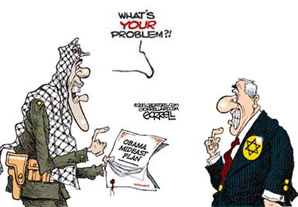
The gullible, the guilty, and the ignorance of truth are crucial in
advancing Obama's New Middle East
By Jonathan Rosenblum


http://jewishworldreview.com/op-art/israel_obama_borders.jpg


http://www.JewishWorldReview.com <http://www.JewishWorldReview.com/>  | In
his June 24, 2002 Rose Garden speech, President George W. Bush made clear
that the purpose of Oslo was not the creation of a Palestinian state, but
peace. He disabused the Palestinians of the notion that a Palestinian state
is inevitable, and let them know that it must be earned. That state would
have to be based on governmental financial transparency, freedom of citizens
to criticize the government without fear of repercussions, the rule of law,
and division of governmental power. He made clear that a Palestinian state
would not be born from terrorism.

Bush was not refuting a straw man, but rather the traditional position of
the EU. Western Europe has long viewed the very creation of Israel as, at
best, a mistake creating myriad unnecessary headaches with the Arab world,
and, at worst, a grave injustice inflicted on the hapless Palestinians. For
the Europeans the formation of a Palestinian state has long been the central
goal of the peace process. Israel is always called upon to take brave steps
for peace, and criticized for failing to do so, whereas the Palestinians are
given a complete pass when they fail to live up to their own commitments.

To further the goal of a Palestine state, the EU has consistently urged a
fixed timetable by which the Israelis and Palestinians should enter into a
final negotiated settlement or a Palestinian state would be declared. (Such
a deadline for the declaration of a Palestinian state effectively ensures
that the Palestinians will not negotiate with Israel in good faith, just as
they are refusing to negotiate at present in anticipation of a declaration
of a Palestinian state by the UN General Assembly in September.)

At the outset of the Roadmap, President Bush had to stand firm against the
other members of the so-called Quartet in demanding a set of performance
based measures that both sides needed to meet at each stage of the process
before proceeding to the next stage. The other members of the Quartet
favored a deadline for the declaration of Palestinian statehood.

http://www.jewishworldreview.com/../cols2/dingbat.gif

FROM THE OUTSET, the Obama administration leaned far closer to the European
position than that staked out by President Bush. Thus Secretary of State
Hilary Clinton declared "non-binding" the letter from Bush to Prime Minister
Ariel Sharon in which Bush acknowledged that "new realities on the ground"
since 1967 made a complete withdrawal to the armistice lines as of June 4
1967 unthinkable, even though the letter was ratified by large majorities in
both houses of Congress.

President Obama's expressed his conviction that the time was ripe for the
achievement of a final status agreement, and made the appointment of a
special envoy to advance the "peace" process, Senator George Mitchell, his
first major act in office. The President's confidence about his ability to
succeed where all previous presidents had failed was predicated on the
belief that the final borders of Palestine were already well-known, and that
the rest could be achieved by American pressure on Israel. That is certainly
how the Palestinians read him, especially after he demanded a halt to all
Israeli "settlement" activity, including building in the new Jewish
neighborhoods of Jerusalem built after 1967. Mahmoud Abbas told the
Washington Post editorial board, after his first meeting with Obama, that he
saw no need to negotiate with Israel, and preferred to simply see what
progress could be achieved through American pressure on Israel.

Israeli security concerns received scant attention from the new
administration. National Security Advisor Gen. James Jones followed the
traditional European prescription to allay Israeli concerns about weapons
and terrorists entering the West Bank via the Jordan River: international
peacekeepers. After its experience with U.N. peacekeepers in southern
Lebanon, under whose watchful eye, Hizbullah has amassed an arsenal of
50,000 missiles since the end of the Second Lebanon War, Israel was hardly
reassured.

http://www.jewishworldreview.com/../cols2/dingbat.gif

FOR THOSE INCLINED TO BE DOUBTFUL of the President Obama's warmth for Israel
and concern for her existence, there was plenty of cause for concern in last
week's speech. For starters, there was the timing of the speech itself.
Though nominally a speech about Arab Spring, the President had little to say
of practical consequence on that subject. It is far too late for the United
States to get ahead of the curve or effect events in any significant
fashion. Had Obama responded with some vigor to the brutal suppression in
Iran after the stolen elections of summer 2009 or when the Assad regime in
Syria started mowing down civilians, he might have had an impact on the
course of events in those two countries. But at this point his potential
influence is negligible.

Only within the context of Prime Minister Binyamin Netanyahu's visit to the
United States the next day and his scheduled appearance before a joint
session of Congress did the timing of the President's speech make sense. The
impression given was that Obama hoped to constrain Netanyahu in advance and
intimidate him from presenting Israel's case too strongly in Congress.

Then there is the matter of President's vision of a final settlement based
upon the 1967 lines - i.e., the 1949 armistice lines - with certain border
adjustments and land swaps. The President is probably right that those lines
formed the basis of negotiations at Camp David in 2000 under President
Clinton, and that as a practical matter they might include the settlement
blocs alluded to by President Bush in his letter to Ariel Sharon.

But reference to the 1967 lines as the starting point casts a shadow of
illegitimacy over all Israel building beyond those lines, including in the
new Jewish areas of Jerusalem, and represents a departure from UN Security
Council Resolution 242. Making the 1967 lines the basis for swaps suggests
that those armistice lines reflect the maximum area Israel may cover, and
that compensation must be given for any area developed beyond that. The
drafters of 242, however, explicitly rejected Arab language demanding a
retreat from "all" the captured territories. They implicitly recognized that
the retention of territory captured from an aggressor, especially when the
aggressor was not an internationally recognized sovereign, could be
retained, indeed had to be retained in order to create the possibility of
"secure and recognized" borders for Israel. Nothing in the resolution
contemplates land swaps or suggests that the 1949 armistice lines
established Israel's maximum area.

http://www.jewishworldreview.com/../cols2/dingbat.gif

PERHAPS EVEN MORE IMPORTANT than what the President said about the 1967
lines, which sucked up most of the attention, was his treatment of Israel's
security needs. On the one hand, he committed himself to preserving Israel's
ability to "defend itself - by itself - against any threat." That language
is based on President Bush's April 14 2004 letter to Prime Minister Ariel
Sharon. According to former National Security Council official Elliot
Abrams, Sharon considered Bush's commitment that Israel be given the means
to defend itself, by itself, the most important aspect of the letter. It
meant that Israel would not be asked to rely on the kindness of strangers -
in the form of foreign peacekeepers - to preserve its existence.

On the other hand, the President called for the "full and phased withdrawal
of Israeli military forces" from the entire West Bank. In short, he
envisions no Israeli military presence in the Jordan Rift Valley, protecting
Israel's eastern flank and guarding the border with Jordan against the
invasion of weapons and terrorists from Jordan.

These two promises cannot be reconciled. Even today, the Palestinian
Authority forces could not maintain their rule in the West Bank were it not
for the continued presence of the IDF. They certainly could not guarantee a
long and porous border, even if they were so inclined, which they are not.
Thus one day before Netanyahu's visit to America, Obama deliberately placed
himself on a collision course with the Israeli prime minister, who has
insisted many times on the necessity of an Israeli military presence in the
Jordan Rift Valley.

http://www.jewishworldreview.com/../cols2/dingbat.gif

AS USUAL, THE PRESIDENT URGED ISRAEL to take "act boldly" (modified to make
"hard choices" at the AIPAC convention) for peace. And as always, the
counsel was offered in a spirit of friendship - out of recognition that the
status quo is "unsustainable." Or, at least, it is unsustainable for Israel,
despite its thriving democracy, vital entrepreneurial class, and powerful
military. The President warned that without peace Israel would face
increasing isolation, about which, it would appear, there is little that he
or the United States can do.

Apparently, the status quo is not unsustainable for the supposedly
downtrodden Palestinians. They were not asked to make any hard choices or
take bold actions. Quite the opposite. The President argued that the issue
of Palestinian refugees be put off until after borders are agreed upon. In
other words, the Palestinians were not urged to recognize Israel as a Jewish
state. All up-front concessions are to come from Israel.


By demanding "hard choices" only from Israel, President in effect, if not
intent, placed the onus on Israel for the failure to achieve peace. Yet
there are no choices Israel could make that would further peace, absent a
Palestinian renunciation of the "right of return" and the desire to reclaim
Israel, something for which no Palestinian leader has ever educated his
people.

The closest the President came to a criticism of the Palestinians was to
label it a "legitimate question" how Israel can be expected to negotiate
with a government made up of Fatah and Hamas, when the latter does not
recognize Israel's right to exist. It's a lot more than a legitimate
question; it's a question to which there is no answer. Hamas does not
confine itself to refusing to recognize Israel's right to exist. Its charter
calls for the murder of Jews (Article 7) and the destruction of Israel
(Article 12). These are not political stances, but expressions of
theological necessity, and as such not subject to amendment, something that
those who call for Hamas to renounce terrorism or recognize Israel's right
to exist consistently ignore.

Nor is the distance between Fatah and Hamas so wide on this point. Only by
comparison to Hamas does Fatah look moderate. Yet Fatah has always rejected
out of hand any recognition of Israel as a Jewish state and had never
indicated the slightest willingness to compromise on the right of return.
Just last week the Palestinian National Assembly voted to provide monthly
stipends to the terrorists held in Israeli jails - the more heinous the
crimes (i.e., the longer the sentence), the higher the stipend. And the
Palestinian Authority continues to name schools, summer camps, and town
squares, and celebrate such arch-terrorists as Samar Kuntar, George Habash,
the pioneer of air hijacking, and Dalal Mughrabi, the leader of the coastal
highway massacre of 37 Israelis.

Official Palestinian Authority schoolbooks and media continue to portray the
entirety of Israel as Palestine. Not surprisingly, every Palestinian poll
shows a large majority rejecting anything resembling the peace outlined by
Obama, which is why the Palestinians prefer unilateral declarations of
Palestinian statehood over any negotiation process. It is also why no "hard
choices" Israel could make would bring peace any closer.

Obama's speech was typically long on generalities and short on specific
actions that the United States might take. Rather than just admit that the
Israelis have a "legitimate question" about the Fatah-Hamas pact, it would
have been more reassuring to Israel to hear that the United States is
cutting off funding to the Palestinian Authority, in light of its
partnership with a recognized terrorist organization, i.e., Hamas.

http://www.jewishworldreview.com/../cols2/dingbat.gif

THOUGH THE PRESIDENT'S remarks on the Palestinian-Israel conflict were
offered in the context of much longer speech on the current turmoil in the
Arab world, he failed to draw any of the lessons of the latter for the
former. True, he did not claim, as he has done so many times before, that
resolution of the Palestinian-Israel conflict is the magical key to peace
and prosperity in the region.

But neither did he admit how irrelevant the Palestinian-Israel conflict is
to the larger regional picture. Israel is now surrounded by three failed
states. The streets of Egypt are barely policed; the writ of the Lebanese
government does not extend in any fashion to the Hizbullah-controlled south
(though the opposite is not the case); and in Syria, the Assad regime has no
choice but to gun down civilians daily or give up power and witness the
slaughter of the Alawite minority. In addition, two Iranian-proxy terrorist
mini-states, sit on Israel's northern and southern borders - Hizbullah-land
to the North and Hamas-controlled Gaza Strip to the South.

Syria and Egypt are dirt poor, and the large parts of the population face
near starvation due to the rise in world wheat prices. An
Israeli-Palestinian peace agreement would not enable the Syrian or Egyptian
governments, or any imaginable succesors, to feed their people, nor end the
endemic second-class status of women in Muslim lands, or the raise rates of
literacy.

Somehow calls for Palestinian "self-determination" ring increasingly hollow
in a region where the citizens of no Arab state enjoy democratic rights,
particularly the right to criticize the government as they want without fear
of reprisals. Only Israeli Arabs enjoy that right. Nor is the urgency of
Palestinian statehood self-evident given that the Palestinians could have
had a state in 1948 had they accepted partition, or in 2000 had Arafat
accepted the Clinton parameters at Camp David, or again in 2009 had Mahmoud
Abbas not walked away from negotiations with Prime Minister Olmert.
Palestinian claims pale compared to those of Kurds and Tibetans, two
linguistically distinct people with ancient histories.

A Palestinian state would inevitably be a failed state. About one thing
Fatah and Hamas agree: Neither want technocrat Palestinian Authority prime
minister Salam Fayaad nor anyone like him running the show. Their goal is
not building a state but claiming another. Three years ago, Fatah and Hamas
forces were busy throwing one another off of roofs, and they would soon be
back at it. Whatever state came into being would not exercise a monopoly on
weapons within its borders. Nor would it be able to secure those borders
from the infiltration of arms and terrorists.

Failed states provide the haven that terrorist organizations need. And those
organizations would flock to a newly created Palestine, especially if, as
envisioned by Obama, Israeli security control were absent. Rather than
serving as the beacon of peace described by President Obama such a state
would be the trip-wire for all-out Middle East war.


JWR contributor Jonathan Rosenblum is founder of Jewish Media Resources and
a widely-read columnist for the Jerusalem Post's domestic and international
editions and for the Hebrew daily Maariv. He is also a respected commentator
on Israeli politics, society, culture and the Israeli legal system, who
speaks frequently on these topics in the United States, Europe, and Israel.
His articles appear regularly in numerous Jewish periodicals in the United
States and Israel. Rosenblum is the author of seven biographies of major
modern Jewish figures. He is a graduate of the University of Chicago and
Yale Law School. Rosenblum lives in Jerusalem with his wife and eight
children.


[Non-text portions of this message have been removed]


------------------------------------

--------------------------
Want to discuss this topic?  Head on over to our discussion list,
[email protected].
--------------------------
Brooks Isoldi, editor
[email protected]

http://www.intellnet.org

  Post message: [email protected]
  Subscribe:    [email protected]
  Unsubscribe:  [email protected]


*** FAIR USE NOTICE. This message contains copyrighted material whose use has
not been specifically authorized by the copyright owner. OSINT, as a part of
The Intelligence Network, is making it available without profit to OSINT
YahooGroups members who have expressed a prior interest in receiving the
included information in their efforts to advance the understanding of
intelligence and law enforcement organizations, their activities, methods,
techniques, human rights, civil liberties, social justice and other
intelligence related issues, for non-profit research and educational purposes
only. We believe that this constitutes a 'fair use' of the copyrighted material
as provided for in section 107 of the U.S. Copyright Law. If you wish to use
this copyrighted material for purposes of your own that go beyond 'fair use,'
you must obtain permission from the copyright owner.
For more information go to:
http://www.law.cornell.edu/uscode/17/107.shtmlYahoo! Groups Links

<*> To visit your group on the web, go to:
    http://groups.yahoo.com/group/osint/

<*> Your email settings:
    Individual Email | Traditional

<*> To change settings online go to:
    http://groups.yahoo.com/group/osint/join
    (Yahoo! ID required)

<*> To change settings via email:
    [email protected]
    [email protected]

<*> To unsubscribe from this group, send an email to:
    [email protected]

<*> Your use of Yahoo! Groups is subject to:
    http://docs.yahoo.com/info/terms/