http://artofmanliness.com/2008/07/14/complete-guide-to-snakes/#grv_q=1
The Art of Manliness Guide to Snakes Part 1: Know Thine Enemy


by Brett & Kate McKay on July 14, 2008 . 52 comments
<http://artofmanliness.com/2008/07/14/complete-guide-to-snakes/#comments>

in Manly Skills <http://artofmanliness.com/category/manly-skills/>

http://content.artofmanliness.com/uploads/2008/07/indiana.jpg

You and your buddies are out on a camping trip reconnecting with nature and
your masculinity
<http://artofmanliness.com/2008/04/03/4-ways-nature-restores-your-manly-vigo
r/> . You're taking a day hike to see some ancient Indian hieroglyphics,
when all of sudden you feel the acute pain of two razor sharp fangs entering
your flesh. You've just been bitten by a snake. Do you know what to do?

Just the sight of a slithering snake can send a shiver down even the
manliest spine. And with good reason-with just one nibble, and in only a few
hours, these feetless, cold-blooded serpents can snuff out your life. While
only 9-15 people in the United States die every year from snake bites, if
you don't know how to treat them correctly, you or your loved one could
become part of those statistics. Knowing how to deal with snakes and
snakebites is essential man knowledge.

The best way to "treat" a snakebite is to avoid getting bitten in the first
place. So in Part 1 of the Art of Manliness' Guide to Snakes, we'll give you
a dossier on all the bad boys you need to look out for.

In  <http://artofmanliness.com/2008/07/15/complete-guide-to-snakes-part-2/>
Part 2, we'll discuss ways to avoid becoming some snake's snack and how to
treat a bite if you do get bitten.


Know Your Enemy


If you were a Boy Scout, you were probably taught an old mnemonic to help
you identify venomous snakes:

Red and black, friend of Jack. Red and yellow, kill a fellow.

Or in other words, if a snake has adjacent red and black colors on its skin,
it's not venomous. If red and yellow are adjacent, that snake is venomous.
But as a man, you're past simple maxims. You want to know how to identify
and name a snake. You want to know the habits of your nemeses. So, here's a
description of the various poisonous snakes found in North America and
around the world.

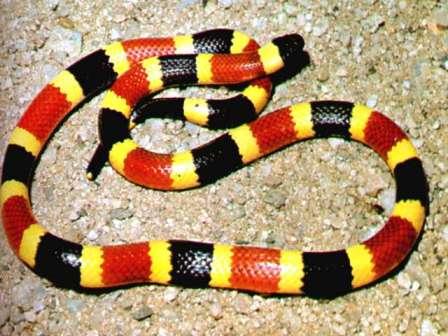
Coral Snake

http://content.artofmanliness.com/uploads/2008/07/coral-snake.jpg

Know Thine Enemy: Coral snakes are easy to spot by their distinctive
coloring. They have alternating, red, yellow, and black bands. Did you get
that? Red and yellow are touching each other, meaning this bad boy is
poisonous. Be on the look out. There are counterfeit corals that have
alternating red, black, and yellow bands. These aren't poisonous.
Coral snakes are shorter than other venomous snakes. They average about 40
inches and have smaller mouths and fangs.

Their hideout: Corals are found in the southern and eastern United States,
and in other places around the world. They can usually be found slithering
in dry areas with lots of shrubs. They frequently spend their time
underground or buried under leaf litter, and don't pop out to say hello very
often. You'll see them most frequently after it rains or during breeding
season. There are also some aquatic species that loiter in your favorite
swimming hole.

How mean are they? They're not aggressive or prone to biting, but if they do
bite-watch out. Their venom takes longer to deliver, so when they bite, they
hold on and won't let go.

Rattlesnakes

Rattlesnakes are easy to identify because, well, they have a rattle at the
end of their tail. When threatened, the rattlesnake shakes its rattle as a
warning to his would-be nemeses. Luckily for us, it's a pretty damn loud
warning; its peak frequency is equivalent to that of an ambulance siren. Did
you ever wonder what a rattlesnake's rattle was made of? Yeah? Me too. It's
basically composed of modified scales that slough off from the tail. Each
time a rattlesnake sheds its skin, a new segment is added. When the snake
shakes its tail in the air, the segments rattle against each other. Contrary
to popular belief you can't tell a rattlesnake's age from counting the
number of rattle segments; while they do add more segments on a regular
basis, they also lose them during travels. Word of warning: if the rattle
gets soaked from wet weather, it will no longer emit its noisy warning. So
tread lightly in those conditions.

Several varieties of rattlesnakes exist and their habitats range from Canada
to South America. The diamondback rattlesnake, the mojave rattlesnake, the
sidewinder rattlesnake, and the timber rattlesnake are three species common
to the United States

The Diamondback Rattlesnake

http://content.artofmanliness.com/uploads/2008/07/diamondback_rattlesnake.jp
g

Know Thine Enemy: The different species of rattlesnakes have varied
colorings, but all can be identified by their skin's telltale diamond
pattern. Most diamondbacks are about 3.5-5.5 feet long, although the Eastern
diamondbacks, the biggest of the bunch, have been found in the 7 ft range.

Their hideout: Diamondbacks are generally found along the southern border of
the United States, from Florida to Baja California and into Mexico.
Rattlesnakes like to sun themselves and come out in the early morning or
afternoon to bask in the sun's rays. You therefore often find them sunning
themselves on rocky ledges. While not typically adept climbers, species like
the eastern diamond back have been found 32 ft off the ground. Some are
excellent swimmers as well; eastern diamondbacks slither for miles
in-between islands in the Florida Keys.

How mean are they? Some diamondbacks will retreat if given a chance. But
often they will stand their ground and may strike repeatedly. They can
strike from a distance up to 2/3 their body size and strike faster then the
human eye can see, so stay as far away as possible. They have some of the
fiercest venom of any snake; victims can die within hours of being bitten.

The Mojave Rattlesnake

http://content.artofmanliness.com/uploads/2008/07/mojave-rattlesnake.jpg

Know Thine Enemy: Generally 3-4.5 ft long, it has grayish diamond shape
markings on its back like the diamondback, but it's overall coloration is
more green than brown.

Their hideout: The mojave rattlesnake primarily lives in the desert of the
southwestern United States, so be on the look out for it when you're riding
a burro down the Grand Canyon. They are common in wide expanses of desert
and can often be found near scrub brush. They hibernate during the winter.

How mean are they? Although there isn't scientific date to back it up,
mojaves have a reputation for being quite aggressive, especially towards
people.

The Sidewinder Rattlesnake

http://content.artofmanliness.com/uploads/2008/07/sidewinder.jpg

Know Thine Enemy: The sidewinder gets its name from its trademark sideways
locomotion. The reason they do this is to reduce the amount of contact they
have with the hot desert sands and to increase their movement's efficiency.
Just watching this thing move puts you on notice that it's a killing
machine. Smaller than its rattling cousins, the sidewinder usually is 1.5-2
feet long. The sidewinder is light in color with darker bands on its back.
In addition to its trippy sideways movement, evolution has given the
sidewinder another killer advantage: it can survive in the desert without a
single drop of water. They get all the water they need from the prey they
devour. That's right. When a sidewinder sees you walking along, you're not
only lunch, but also a canteen. Watch out.

Their hideout: These snakes can be found in the desert of the southwestern
United States and northern Mexico. During the cooler months (about December
to February) the sidewinder is nocturnal. They are diurnal the rest of the
year.

How mean are they? Their venom is weaker than their cousins, but still can
cause a serious health threat. Tread lightly.

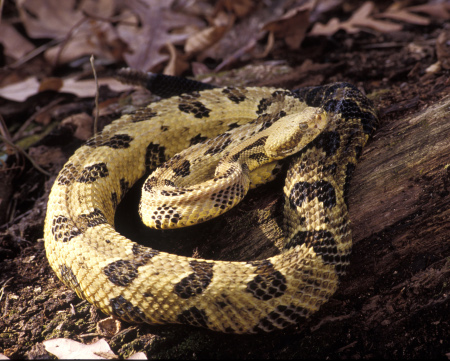
Timber Rattlesnake

http://content.artofmanliness.com/uploads/2008/07/timber-rattlesnake.jpg

Know Thine Enemy: Timber rattlesnakes have a yellow, brown, and rust orange
coloring and are typically 3-4 ft in length. The timber rattler was
immortalized during the American Revolution where it served as the symbol in
the "Don't Tread on Me Flag." It also serves as the First Navy Jack.

Their hideout: Unlike many of its rattlesnake cousins who live in the
deserts of the West, the timber rattlesnake is found in the eastern United
States; it's the only rattlesnake to make its home in the Northeast.

How mean are they? Timber rattlers are a much mellower breed of
rattlesnakes, so they don't bite too often. And they tend to rattle a lot
before striking, giving you time to hightail it out of there.

Cottonmouth Snakes

http://content.artofmanliness.com/uploads/2008/07/cottonmouth-snake.jpg

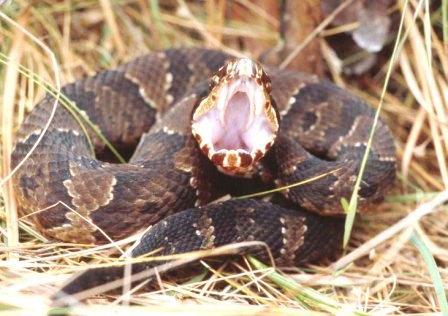
Know Thine Enemy: The Cottonmouth is one scary snake. No one wants to see it
slithering toward them at their favorite watering hole. Cottonmouth snakes
are usually around 2 ft in length, although some have grown to a size of
nearly 6 ft. Their brown, gray, tan, yellowish olive or blackish coloring,
is segmented by dark crossbands. When threatened, cottonmouths will throw
their head back and open their mouth wide, displaying the white interior
from whence it derives the name "cottonmouth."

Their hideout: The cottonmouth is an aquatic snake found in the south and
southeast part of the United States. Cottonmouths make creeks, streams,
marshes, and lakes their home, although they can also be found on dry land.
Because of their affinity to water, cottonmouths are also known as water
moccasins. Cottonmouths can be active during the day and night. But when
it's hot, they are usually found coiled or stretched out in the shade.

How mean are they? Despite their vicious reputation, in many cases the
cottonmouth's hiss is worse than its bite. Cottonmouths often engage in a
showy threat display without attacking. This routine includes shaking their
tail and letting a musky secretion rip from their anal glands. The scent of
this snake fart has been compared to that of a billy goat; so if you smell
goat, flee in the other direction.

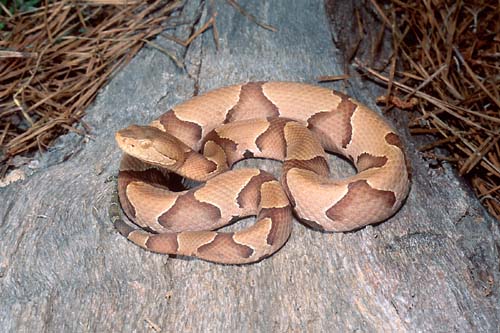
Copperhead Snakes

http://content.artofmanliness.com/uploads/2008/07/copperhead.jpg

Know Thine Enemy: Copperhead snakes are identified by their coppery colored
head and neck. Adults reach lengths of 2 to 4 feet.

Their hideout: Copperheads are mainly found in the eastern part of the U.S.
They make forest and woodlands their home. However, they do prefer to live
closer to water.

How mean are they? Copperheads will only bite if they feel directly
threatened, i.e., if you try to pick up or touch them. But this contact can
happen inadvertently. Unlike many venomous snakes that usually slither away
when humans are around, copperheads will freeze in place, often resulting in
humans stepping on them and getting bitten. A bite from a copperhead is
extremely painful but is not fatal if treated properly.

Cobras

Cobras are probably the most famous of all the venomous snakes, thanks in
part to Johnny and the gang at Cobra Kai Dojo in the Karate Kid. (I hate
Johnny. What a prick.) Several species of cobras exist. What they all have
in common is the distinct "hood" they make when they are threatened. In
order to create this distinct cobra hood, cobras will flatten their body by
spreading their ribs.

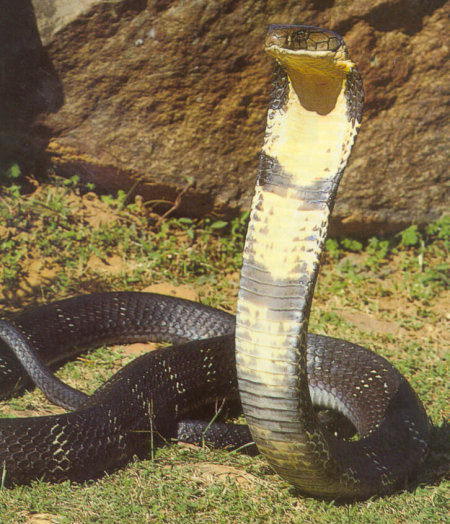
The King Cobra

http://content.artofmanliness.com/uploads/2008/07/king_cobra.jpg

Know Thine Enemy: The King Cobra is the world's longest venomous snake,
growing to a length of between 12 and 13 feet Wowza! Their olive green, tan,
or black skin has pale yellow cross bands down the length of the body.

Their hideout: King Cobras are found in South and Southeast Asia. They can
also be found in some parts of India. King Cobras typically live in dense
highland forests near rivers and streams.

How mean are they? The King Cobra is one scary mother. The King Cobra
doesn't just feed on small rodents, this bad boy is cannibalistic- it eats
other snakes. While the King Cobra is shy, it will attack if it is provoked.
The venom from a King Cobra consists of extremely potent neurotoxins that
attack the victim's central nervous system. A single bite from a King Cobra
can kill a full grown Asian Elephant. It can kill a man in half an hour.

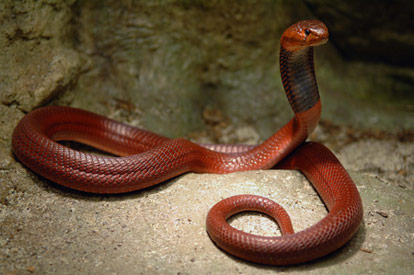
The Red Spitting Cobra

http://content.artofmanliness.com/uploads/2008/07/red-spitting-cobra.jpg

Know Thine Enemy: Red Spitting Cobras vary in color from red to gray. They
can grow to about 4 feet in length. What makes this cobra unique is its
ability to "spit" or project their venom at their prey. Watch out!

Their hideout: Red Spitting Cobras are native to Africa are most common in
that continent's northeast region. They make their homes in brush and
forests. The red spitting cobra is nocturnal, so make sure you zip up your
tent!

How mean are they? Like the King Cobra, the Red Spitting Cobra is a timid
and shy snake and will only attack when threatened. Unlike the King Cobra
with its ultra toxic venom, the Red Spitting Cobra's venom is much milder.
While it may cause extreme sickness, a bite from a Red Spitting Cobra will
probably not cause death. However, if the venom gets in your eyes and is not
treated quickly, it can cause blindness so still take caution.

The Black Mamba Snake

 <http://content.artofmanliness.com/uploads/2008/07/black_mamba.jpg>
http://content.artofmanliness.com/uploads/2008/07/black_mamba.jpg

Know Thine Enemy: The black mamba is the largest and most deadly snake in
Africa. It also happens to be the fastest moving snake in the world. In
short, this snake is a killing machine. The Black Mamba gets its name not
from the fact that it has black skin, but because it is black on the inside
of its mouth. The skin of a black mamba is actually gray to olive green.
Black mambas can grow to a length of between 7 and 13 feet.

Their hideout: Black mambas make their home in the grasslands of Africa. You
can find them primarily in the Democratic Republic of Congo.

How mean are they? Black Mambas are mean mothers. They will readily attack
when threatened. They'll make multiple attacks, aiming at the head and body.
With each bite, they inject their super deadly venom. One bite from a black
mamba has enough venom to kill 120-140 men. The venom paralyzes the muscles
used for breathing and the victim consequently dies from suffocation.

An important note: While all this "enemy" language is in good fun, snakes
actually play a vital role in our ecosystem. Without them, vermin and
critters of many kinds would overrun us. These tips should help you avoid
snakes, not seek them out for destruction. Unless it's a do or die
situation, leave the snake alone and move in the other direction.


The Art of Manliness Guide To Snakes Part 2: How To Avoid & Treat A
Snakebite


by Brett & Kate McKay on July 15, 2008 . 41 comments
<http://artofmanliness.com/2008/07/15/complete-guide-to-snakes-part-2/#comme
nts>

in Manly Skills <http://artofmanliness.com/category/manly-skills/>

http://content.artofmanliness.com/uploads/2008/07/snakebite.jpg

Yesterday, in Part 1 of the Art of Manliness
<http://artofmanliness.com/2008/07/14/complete-guide-to-snakes/> ' Guide to
Snakes, we discussed how to identify various poisonous serpents. But knowing
your enemy is only half the battle. You should also know how to avoid being
bitten and what to do if you are. Therefore, today in Part 2 we present more
necessary man vs. snake knowledge: how to avoid and treat a snakebite.


How to Avoid a Snake Bite


While the behavior of snakes is obviously not 100% predictable, you can
minimize your chances of being bitten by taking several basic precautions.
If you want to avoid being at the receiving end of a pair of venomous fangs,
follow these simple guidelines while out romping in the wilderness:

Avoid tall grass. Many of the snakes mentioned in Part 1 of this post like
to hang out in grassy areas and heavy underbrush. If you can, stick to the
trails so you can clearly see what you're stepping on. If you have to go off
trail, be attentive lest you inadvertently step on a sleeping rattlesnake.
If you must venture through tall grass, carry a stick and use it to probe
the ground in front of you. And remember, there are always exceptions to the
rule; a snake could very well be curled up in the middle of a well groomed
trail. Always be aware of your surroundings.

Remember that snakes can climb. While they're not squirrels, snakes can
slither up trees and bushes. Most people never imagine they'll see a snake
at eye level, and are thus quite vulnerable to an aerial attack. The last
thing you want is to feel that forked tongue on your face, so keep your wits
about you.

Check before you stick your hand into a crevasse. Because snakes are pure
evil, they like to hang out in the dark. Holes, a hollow log, or a crevasse
in a rock are perfect places for a snake to hide. So before you go sticking
your hand in any dark hole, check to make sure there isn't a snake (or
another critter) in there.

Zombie snake attack. Say you find a dead snake that you want to take and
turn into a pair of snakeskin boots. Right on. But be careful when picking
it up. Freshly dead snakes still have reflexes and can still bite you if
you're not careful. I've seen a dead snake slither around firsthand. It's
really creepy. Plus, many snakes are pretty sloth-like during the daytime.
And they're quite skillful at keeping completely still; it's how they catch
their prey. So a snake sunning himself may look good and dead, but may very
well be sleeping with one beady eye open, its little reptilian brain
thinking, "Just try it buddy."

Don't sleep in the enemy's lair. Most snakes are nocturnal, so you don't
want to let down your guard come sunset. Don't make your camp in snake
territory. Avoid sleeping near a log or large branch, in tall grass, or next
to rocky areas. And of course zip up your tent tight. Snakes may have those
fierce fangs, but alas, they lack an opposable thumb. Keep your boots inside
the tent (most tents come with shoe pockets) and make sure to zip the tent
up again in the morning, lest a snake invite himself in while you're on a
hike.

Wear heavy boots and pants. If you're going to be out exploring in the
uncivilized wilderness, make sure your lower extremities are protected.
Heavy boots and pants not only protect against fierce snakes but also your
ankle's other nemesis-ticks.

http://content.artofmanliness.com/uploads/2008/07/snakesonaplane.jpg

Bonus Tip: Always Check The Overhead Compartment For Snakes


The Do's and Don'ts of How to Treat a Snake Bite


http://content.artofmanliness.com/uploads/2008/07/snakebite2.jpg

No amount of precaution can prevent every bite. Sometimes accidents happen.
And if it does happen, it's important for you to immediately know what to
do. Don't be caught with a snakebite in the middle of the woods, scratching
your head trying to remember this stuff; sear it into your brain. Getting
bitten by a venomous snake is serious business. While the reactions vary
from snake to snake, all venom is essentially designed to immobilize the
victim and start the process of digestion. Venom is basically toxic snake
saliva, ready to turn you into dinner. So if you're bitten, seek medical
attention immediately, even if you don't think the snake is poisonous.
Better to be safe than sorry.

Do:

1. Wash the bite with soap and water as soon as possible. You want to remove
as much of the snake's spit as you can.

2. Keep the bitten area below the heart. This is done to slow the flow of
the venom.

3. Take off any rings or watches. The venom is going to make you swell, and
jewelry might cut off your circulation.

4. Tightly wrap a bandage two to four inches above the bite. If you can't
reach medical care within 30 minutes, wrap a bandage around the bitten
appendage. This is to assist in reducing the flow of venom. You want to make
it tight, but not too tight as to completely cut off the appendage's
circulation. That will only cause tissue damage.

5. If you have a snake bite kit, place the suction device over the bite to
help draw the venom out of the wound. Leave on for a maximum of ten minutes.
If used properly, a suction device can remove up to 30% of the venom.


Interesting Fact: "Antivenin" is made by first milking a snake's fangs for
its venom and then injecting a non-lethal dose of that venin into a horse.
The horse naturally builds up antibodies to the venom. Its blood is then
collected and the antibodies are extracted and made into antivenin for
humans. Cool.


Don't:

1. Cut the wound. While watching an old Western, you might have seen a
cowboy making an incision above the snakebite in order to "drain" the venom.
This isn't a smart move because you increase the chances of causing an
infection in the area.

2. Suck the venom. Another remedy we all have seen in the movies is people
sucking the venom out with their mouth. You don't want the venom in your
mouth where it can get back into your bloodstream.

3. Apply ice to the wound. Ice can cause tissue and skin damage and inhibits
the removal of venom when using a suction device.

4. Panic. If you've been bitten, try to avoid freaking out. If you're with
someone who has been bitten, try to keep them calm. The more you move and
the faster your heart beats, the quicker the venom is going to be circulated
throughout your body. So do your best to stay calm and remain as still as
humanely possible.


[Non-text portions of this message have been removed]


------------------------------------

--------------------------
Want to discuss this topic?  Head on over to our discussion list,
[email protected].
--------------------------
Brooks Isoldi, editor
[email protected]

http://www.intellnet.org

  Post message: [email protected]
  Subscribe:    [email protected]
  Unsubscribe:  [email protected]


*** FAIR USE NOTICE. This message contains copyrighted material whose use has
not been specifically authorized by the copyright owner. OSINT, as a part of
The Intelligence Network, is making it available without profit to OSINT
YahooGroups members who have expressed a prior interest in receiving the
included information in their efforts to advance the understanding of
intelligence and law enforcement organizations, their activities, methods,
techniques, human rights, civil liberties, social justice and other
intelligence related issues, for non-profit research and educational purposes
only. We believe that this constitutes a 'fair use' of the copyrighted material
as provided for in section 107 of the U.S. Copyright Law. If you wish to use
this copyrighted material for purposes of your own that go beyond 'fair use,'
you must obtain permission from the copyright owner.
For more information go to:
http://www.law.cornell.edu/uscode/17/107.shtmlYahoo! Groups Links

<*> To visit your group on the web, go to:
    http://groups.yahoo.com/group/osint/

<*> Your email settings:
    Individual Email | Traditional

<*> To change settings online go to:
    http://groups.yahoo.com/group/osint/join
    (Yahoo! ID required)

<*> To change settings via email:
    [email protected]
    [email protected]

<*> To unsubscribe from this group, send an email to:
    [email protected]

<*> Your use of Yahoo! Groups is subject to:
    http://docs.yahoo.com/info/terms/