http://junkscience.com/2011/06/02/cosmic-rays-as-climate-driver-the-svensmar
k-demonstrated/
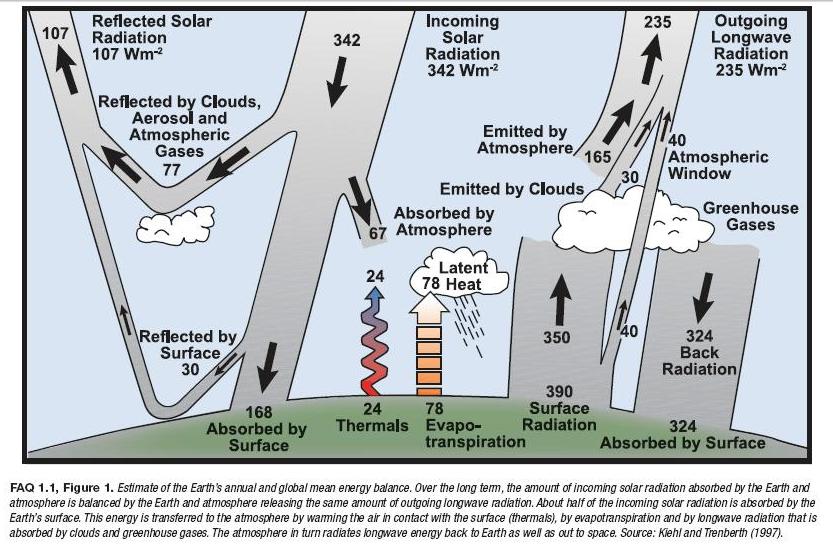
Evidence that cosmic rays seed clouds Most followers of the so-called climate debate are at least aware of what has been labeled, inter alia, the Svensmark Effect and regular readers will recall our brief feature Cosmic rays and climate <http://junksciencearchive.com/Greenhouse/Cosmic_rays_and_climate.html> . Of course Svensmark et al are not alone in associating solar activity and cloudiness. See for example, Influence of Solar Activity on State of Wheat Market in Medieval England <http://xxx.lanl.gov/abs/astro-ph/0312244> (Pustilnik, 2003), a seemingly radical hypothesis dating from British astronomer William Herschel, who suggested a link between sunspots and wheat prices in 1801. The importance of the SKY experiment was that it demonstrated the physical mechanism for the proposed solar/cosmic ray modulation of earths climate. Because it diminished the available role for changes in atmospheric carbon dioxide and enhanced greenhouse effect this new demonstration was not well received, in fact it was attacked by elements of what we call the climate industry. Somewhat bizarrely it has been suggested this is not an important effect because total solar irradiance (TSI) does not change very much and this is merely a subset of a very small change. That is a complete misunderstanding of solar/galactic cosmic ray (S/GCR) climate modulation. Let us cite numbers from the IPCCs Assessment Report 4, Working Group 1 (Chapter 2, Changes in Atmospheric Constituents and in Radiative Forcing, page 131): § The combined anthropogenic RF [Radiative Forcing] is estimated to be +1.6 [+0.6 - +2.4] W m2 § The global mean concentration of CO2 in 2005 was 379 ppm, leading to an RF of +1.66 [±0.17] W m2 In other words, since 1750 the net balance of anthropogenic climate forcing (warming and cooling) is estimated to be roughly the equivalent of increased atmospheric carbon dioxide: ~1.6 W/m2, so we use this figure as a guide. Probably everyone is familiar with this graphic from Earth <http://junksciencearchive.com/Greenhouse/RadiationBudget.pdf> s Annual Global Mean Energy Budget (Kiehl and Trenberth, 1997): <http://junksciencearchive.com/Greenhouse/Kiehl-Trenberth-1997-color.jpg> http://junksciencearchive.com/Greenhouse/Kiehl-Trenberth-1997-color.jpg The figure of interest here is the 77 W/m2 reflected by clouds, aerosol and atmospheric gases. Going by this figure alone, atmospheric albedo the reflectance of incoming solar radiation by clouds, aerosols and atmospheric gases is approximately 50 times greater than the estimated change in down-welling radiation from increased atmospheric carbon dioxide over two and one-half centuries. Changes in cloud albedo then are a really big deal, more than capable of overwhelming the effect of increased atmospheric CO2, some (or most) of which has already equilibrated over the last 250-odd years. If only cloud effects were as simple and clear cut as the reflectance figure provided by Kiehl and Trenberth but alas, they are not. Clouds also have an effect on the outgoing longwave radiation: Kiehl et al 1994 <http://junksciencearchive.com/Greenhouse/Kiehl1994(ERBE_forcing_vs_model).p df> shows data from the ERBE measurements in their table 1 where the Short Wave Cloud Forcing (SWCF) is -48.2 W/m2 and the corresponding Long Wave Cloud Forcing (LWCF) +29.2 W/m2, so net cloud forcing is -19 W/m2. The direct radiative effects for aerosols (natural + manmade) is estimated to be -5.4 W/m2 (IPCC AR4, chap. 2). The 77 W/m2 also appears to contain a poorly specified contribution from unnamed gases. Moreover, altering available cloud droplet nucleation has the additional effect of altering conversion of the most abundant greenhouse gas, water vapor, from net warmer to net cooling influence as droplet components of bright clouds, thus further amplifying the climate influence available from varying atmospheric penetration of GCRs. Unlike CO2, which is mere hundredths part of one percent of the atmosphere, water occupies 1%-4% and its climatic effect varies with altitude, latitude and physical state (vapor, liquid or solid). Perhaps the greatest significance of the so-called Svensmark Effect is that it implies an alteration of the ratio of reflected shortwave (incoming solar) radiation to absorbed longwave (outgoing earth) radiation. Note that a mere 2% change in bright cloud formation, itself quite trivial given day by day variation in global cloud cover, is sufficient to make the net balance SWCF-LWCF -20.6 W/m2, equivalent to eliminating estimated increased forcing from added CO2. Here then is a demonstrated amplifier effect for solar variations direct effect on earths climate. Consequently it would seem the burden of proof remains on the enhanced greenhouse alarmists to explain the observed absence of posited enhanced greenhouse multiplier effects the much touted 2.5 times positive feedback from water vapor incorporated into climate models to make the known physical properties of CO2 fit climate observations. Certainly skeptics of that hypothesis are under no obligation to explain climate change (although why anyone would ignore the big yellow ball in the sky in favor of an invisible trace gas is beyond us here at JunkScience.com); rather it is incumbent upon proponents to prove that CO2 is the driver of catastrophic climate change they claim it to be. Now there is a new paper describing experiments by M.B. Enghoff, J. O. Pepke Pedersen, U. I. Uggerhøj, S. M. Paling, and H. Svensmark, Aerosol nucleation induced by a high energy particle beam <http://www.agu.org/pubs/crossref/2011/2011GL047036.shtml> , Geophysical Research Letters, 38, L09805, doi:10.1029/2011GL047036. See the Aarhus University release: Scientists At Aarhus University (AU) And The National Space Institute (DTU Space) Show That Particles From Space Create Cloud Cover <http://science.au.dk/en/news-and-events/news-article/artikel/forskere-fra-a u-og-dtu-viser-at-partikler-fra-rummet-skaber-skydaekke/> New input to the United Nations climate model: Ulrik Ingerslev Uggerhøj, Physics and Astronomy, AU, along with others including Jens Olaf Pepke Pedersen and Martin Bødker Enghoff, DTU Space, have directly demonstrated in a new experiment that cosmic radiation can create small floating particles so-called aerosols in the atmosphere. By doing so, they substantiate the connection between the Suns magnetic activity and the Earths climate. With the new results just published in the recognised journal Geophysical Research Letters, scientists have succeeded for the first time in directly observing that the electrically charged particles coming from space and hitting the atmosphere at high speed contribute to creating the aerosols that are the prerequisites for cloud formation. The more cloud cover occurring around the world, the lower the global temperature and vice versa when there are fewer clouds. The number of particles from space vary from year to year partly controlled by solar activity. An understanding of the impact of cosmic particles consisting of electrons, protons and other charged particles on cloud formation and thereby the number of clouds, is therefore very important as regards climate models. With the researchers new knowledge, it is now clear that here is a correlation between the Suns varying activity and the formation of aerosols in the Earths atmosphere. Initially, the researchers have demonstrated that there is a correlation, and they will therefore now carry out systematic measurements and modellings to determine how important it is to the climate. The new studies will be made at DTU Space in Copenhagen, with support that includes a new grant of DKK 2 million (approximately EUR 270,000) from the Danish National Research Councils. (AU release) Further description is available here <http://physicsworld.com/cws/article/news/45982> at PhysicsWorld Those defeated by GRLs pay wall and with a desperate need to examine the full paper can borrow my copy, click here <mailto:[email protected]?subject=Borrow%20Enghoff%20(2011)> . Please state in the body text whether you require the supplementary information as well. The immediate take-home points of this are that the use of the particle accelerator directly answers critics of the original SKY experiment and comparison of results from a gamma ray source show the original criticism unfounded this will also likely lead to a proliferation of GCR cloud nucleation experiments using the simpler and significantly cheaper array. Doubtless the results will be spun as contentious, not least because there was an observable step result between runs (likely induced by some difference in impurities between clean air tanks) and particularly because the introduced SO2 was available at a rate an order of magnitude higher than typically found in the open, clean air atmosphere. Nonetheless the researchers have confirmed the effect is real. They have demonstrated that it can be investigated with much simpler and cheaper arrays, so we can expect numerous attempts to replicate results (highly desirable in any field of science) and thus an expanding set of results to help quantify the effect in the real world. In the end experiments are perhaps best defined by how they persuade critics and skeptics and it looks as though Enghoff et al might be on a winner: Indirect Solar Forcing of Climate by Galactic Cosmic Rays: An Observational Estimate <http://www.drroyspencer.com/2011/05/indirect-solar-forcing-of-climate-by-ga lactic-cosmic-rays-an-observational-estimate/> While I have been skeptical of Svensmarks cosmic ray theory up until now, it looks like the evidence is becoming too strong for me to ignore. The following results will surely be controversial, and the reader should remember that what follows is not peer reviewed, and is only a preliminary estimate. Ive made calculations based upon satellite observations of how the global radiative energy balance has varied over the last 10 years (between Solar Max and Solar Min) as a result of variations in cosmic ray activity. The results suggest that the total (direct + indirect) solar forcing is at least 3.5 times stronger than that due to changing solar irradiance alone. If this is anywhere close to being correct, it supports the claim that the sun has a much larger potential role (and therefore humans a smaller role) in climate change than what the scientific consensus states. The results, I must admit, are enough for me to now place at least one foot solidly in the cosmic ray theory camp. (Roy W. Spencer) We tend to agree, it looks like critics have their work cut out for them. [Non-text portions of this message have been removed] ------------------------------------ -------------------------- Want to discuss this topic? Head on over to our discussion list, [email protected]. -------------------------- Brooks Isoldi, editor [email protected] http://www.intellnet.org Post message: [email protected] Subscribe: [email protected] Unsubscribe: [email protected] *** FAIR USE NOTICE. This message contains copyrighted material whose use has not been specifically authorized by the copyright owner. OSINT, as a part of The Intelligence Network, is making it available without profit to OSINT YahooGroups members who have expressed a prior interest in receiving the included information in their efforts to advance the understanding of intelligence and law enforcement organizations, their activities, methods, techniques, human rights, civil liberties, social justice and other intelligence related issues, for non-profit research and educational purposes only. We believe that this constitutes a 'fair use' of the copyrighted material as provided for in section 107 of the U.S. Copyright Law. If you wish to use this copyrighted material for purposes of your own that go beyond 'fair use,' you must obtain permission from the copyright owner. For more information go to: http://www.law.cornell.edu/uscode/17/107.shtmlYahoo! Groups Links <*> To visit your group on the web, go to: http://groups.yahoo.com/group/osint/ <*> Your email settings: Individual Email | Traditional <*> To change settings online go to: http://groups.yahoo.com/group/osint/join (Yahoo! ID required) <*> To change settings via email: [email protected] [email protected] <*> To unsubscribe from this group, send an email to: [email protected] <*> Your use of Yahoo! Groups is subject to: http://docs.yahoo.com/info/terms/