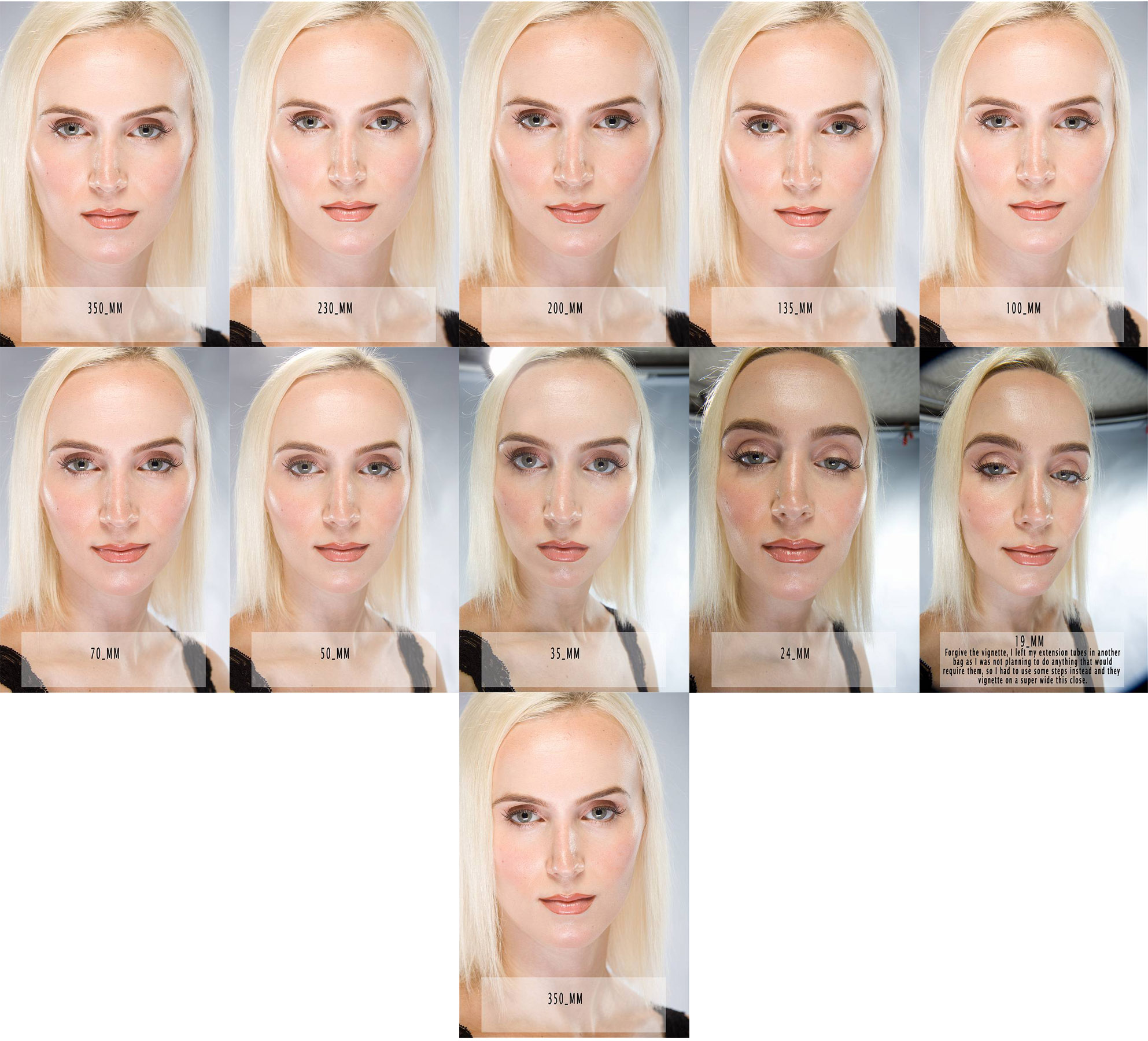
Wow, such a heated debate!
As a scientist, I like pationed civilized discussions!
As a scientist, I also feel obligated to clarify the possible confusions
that occured in the process.
A. Perspective and compression.
First, I would provide a sort of "rabbinistic" response:
Bruce's point is correct. Ann is also correct.

Let me followup on Bruce's point:
Only about 50 (or, IIRC, more exactly 40-some) mm lens on a "FF" sensor
provides the perspective comparable to that seen by humans. That's why for
several decades, 50mm lens was a "standard" on many film cameras. On
APS-C, that role has shifted to about 35mm. As it is obvious from the
different focal lengths for different sensors, it is not the focal length
per se, but the angle at which the object is seen through a particular
lens. More on this is below.
The change of the perspective is much more pronounced if we go the
wide-angle lenses. Try shooting portraits with a 24 or even 28 mm lens,
and you'll see that they look weird: the distance between the eyes on the
face, compared to other facial features looks weird, almost an alien-like.
That's why there is a notion of a "portrait" lens. The potraits lenses are
typically a bit "longer" than the "normal" lens (roughly 70-115mm on the
FF, and 50-85 on APS-C), as that produces the compression that is slight,
which makes it noticeable but not unnatural. This compression makes the
portraits a bit flattering.
B. Now, one has to distinguish two different settings:
1. Shooting with two lenses (say, 50mm and 135mm) from different
distances, while preserving the coverage (filling) of the frame with the
object (face).
2. Shooting with the same two lenses from the SAME distance to the object.
First is more typical and practical, and that's what people refer to when
they are talking about compression. The second one, is what Ann has
mentioned. And, of course, there is no difference in the perspective there
(but obviously, if you make a crop, you might not get sufficient
quality/resolution).
The discussion in "A" above, refers to the case #1.
A frequently referenced photo demonstrating the effect in the first case
is here:
http://stepheneastwood.com/tutorials/lensdistortion/
http://stepheneastwood.com/tutorials/lensdistortion/IMAGES/tile1.jpg
And here is the tutorial discussing it:
http://stepheneastwood.com/tutorials/Tutorials_Lens_Perspective.htm

C. Additional clarifying comments:
The periferal vision has nothing to do with the distortion:
It is the angle at which we see a non-flat object that matters, not how
widely we can see.
And to avoid a confusion, yet another important clarification is due here:
This compression effect would not be seen if you were to look not at a 3D
object (such as a face) but at a flat image on whose surface is
perpendicular to the line of vision. I.e. if you are shooting somebody's
portrait through different rectilinear lenses, you will not see any
difference, as long as it is at 90 degrees to the line of viewing.
The corollary of this is that it doesn't matter from which distance you
look at a portait, the proportions are always the same. But looking
at a face (or shooting a photo) from two inches away give you a weird
view.
D. Now, on non-scientific aspect:
Experimental or conservative approach is a personal preference, and I
appreciate and respect both. And that's why I asked people here, expecting
a spectrum of opinions.
And when even people, who generally don't like fish-eye photos, like the
particular photo, that speaks stronger about that image.
Here is an example where Ann "kinda like[d] ... one":
http://pdml.net/pipermail/pdml_pdml.net/2014-May/378059.html
Bruce, and I share your sentiment about "why bother" and experimenting
beyond the "comfort zone" of "usual". That's exactly what drives me in
these experiments.
Again, many thanks to all people who contributed their opinions about the
image!
Igor


 Bruce Walker Fri, 13 Feb 2015 06:23:02 -0800 wrote:

On Thu, Feb 12, 2015 at 10:15 PM, Ann Sanfedele <[email protected]> wrote:
On 2/12/2015 21:52, Bruce Walker wrote:
Ann, if we take the telephoto example, you will get pronounced
compression that your eyes would not have given the scene.
I'm not sure that is true - it is something I used to think but then
somewhere someone showed something taken with a 50 mm lens and cropped
down to what the 135 tele had captured and the crop and the tele photo
looked the same...
You could well be right about the compression, Ann. But we certainly
can't see what the tele is showing us with the unaided eye. That's why
we use binoculars. :)
If I stand on a chair above two people, the taller of who I place
behind the shorter one, using a wide angle lens I can make them both
look about the same size. I used this trick during a recent shoot.
It's an optical distortion that my eye did not make but the
lens/camera did.And their heads appear much bigger than their feet
too.
You didn't see it looking through the viewfinder?
Through the viewfinder, and so through the distorting glass, yes. With
my eyes, no.
*** Not extreme distortions, but "unnatural" nonetheless. Our eyes have
a
35mm equivalent focal length of around 50mm so any lens wider or
longer than that is going to distort scenes compared to what your eyes
see.***
Which is why a 50mm lens has always been my preferred one.:-) but that
is
the 50 mm lens with a fixed periferal vision - one's own eyes may
have more or less.

I think it is a complicated optical matter... but at the bottom of it is
that I don't like seeing something beautiful made ugly, that's all
Well that I cannot and will not argue with. That is personal
preference and personal interpretation of course.

My own personal interpretation of Igor's shot is more positive as I
like the shot playing with my expectations. I don't expect buildings
and tram lines to be bending like putty, so it surprises me and makes
me look more closely. Would I put it up on my wall? Unsure; I might,
to see other's reactions.

My argument was really with the notion that what the photographer has
done "should not be done", or "why bother?"


--
PDML Pentax-Discuss Mail List
[email protected]
http://pdml.net/mailman/listinfo/pdml_pdml.net
to UNSUBSCRIBE from the PDML, please visit the link directly above and follow
the directions.