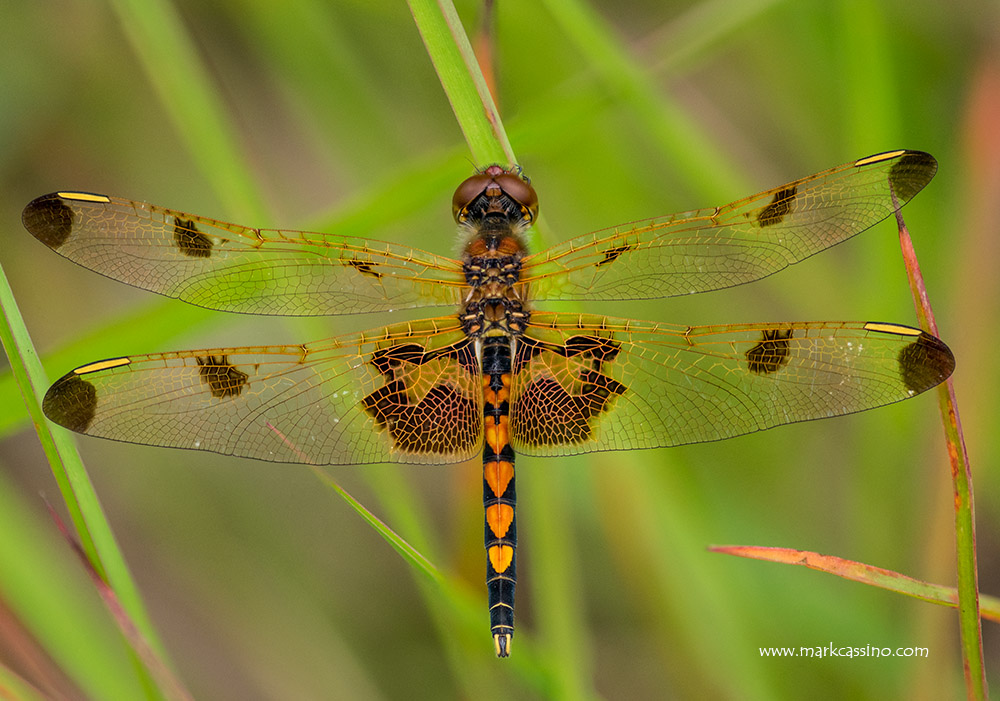
The dragon fly is exquisite Mark!

-----Original Message-----
>From: Mark C <[email protected]>
>Subject: Re: OOF rendering in focus stacks
>
>Collin -
>
>I'm not familiar with the lenses you reference or implications for lens
>design, but the sudden transition from in focus to out of focus that you
>get when focus stacking can be used to manipulate the bokeh. For
>example, I did not need ot stack this shot but did to put the background
>of out of focus, and only stacked the images needed to get the dragonfly
>in focus:
>
>http://www.markcassino.com/b2evolution/media/blogs/calarti/2014/IMGP1396-1409_L.jpg
>
>The abrupt transition is obvious in the blade of grass just to the left
>of the dragonfly's abdomen, near the bottom of the image. With some
>selective layering or cloning from one image to another that could have
>been easily addressed.
>
>A couple other samples and comments about the images and stacking
>technique are here:
>
>http://www.markcassino.com/b2evolution/index.php/stack-focused-dragonflies
>
>Mark
>
>On 4/29/2016 7:50 AM, Collin B wrote:
>> This has me curious. Can we use this technology to emulate a variety of lens
>> designs?
>> Take, for instance the old Pentax-A 70-210/4 vs the Takumar-A 70-200.  The
>> Tak-A has a much shorter transition from in-focus to out-of-focus.
>> Might one also use stacking with a mirror lens to eliminate the doughnut
>> bokeh?
>> Perhaps through stacking someone might emulate the unique character of a
>> Petzval or a Protar. They certainly can't be done in a single layer.
>> Will be interesting to see what the future holds.  An engineer might use
>> such technology with appropriate (mathematical) filters to predict lens
>> design behavior without ever building it. Like an optical add-in for catia.
>>
>> Collin
--
PDML Pentax-Discuss Mail List
[email protected]
http://pdml.net/mailman/listinfo/pdml_pdml.net
to UNSUBSCRIBE from the PDML, please visit the link directly above and follow
the directions.