Hello Adrienne, and great discussion topic!

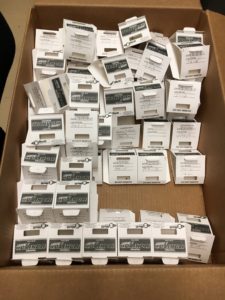
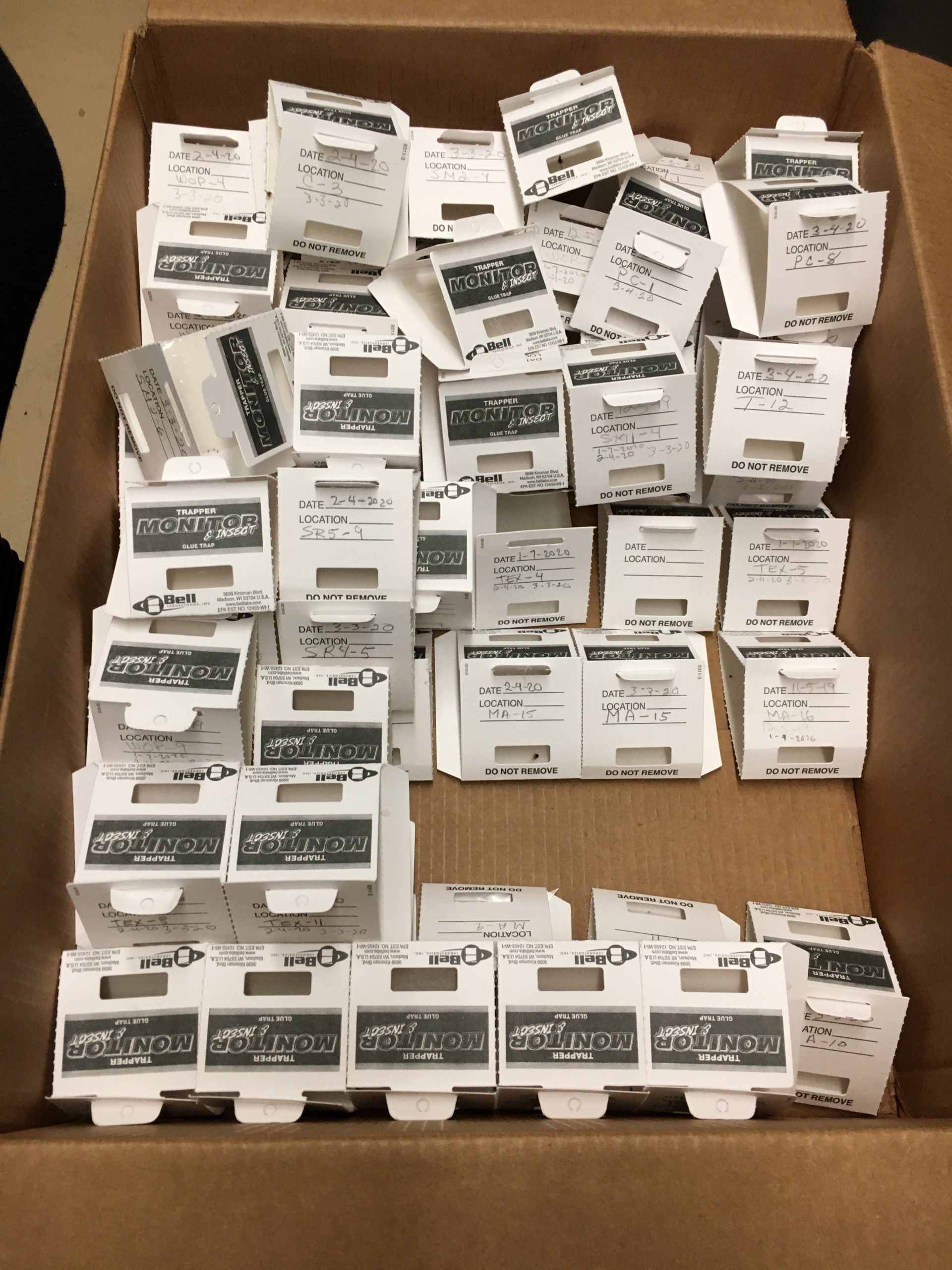
I have a collections maintenance assistant who views our 150 monitor traps in
situ every month and pulls those that have any catches and replaces them. This
is spread over a few days but takes less than 8 hours total.
I find that reduces my time spent on IPM identification/data entry/reporting to
one day a month, unless there are issues/infestations that warrant more time.
I use the "SWEEP AND REPLACE CHECKING" method listed on MuseumPests.net
website. See https://museumpests.net/monitoring-trapping/
Here's the segment describing my method:
"Depending on your trap layout and staffing numbers, you may consider the sweep
and replace checking strategy:

 1.  Collect all traps that have captures and replace them with new traps
 2.  Identify pests from each trap after all traps have been picked up.
 3.  Traps without any captures can be left to use for another period, unless
they are dirty/dusty, ruined by heat, or collapsed.

[https://museumpests.net/wp-content/uploads/2024/03/box-of-monitors-225x300.jpg]<https://museumpests.net/wp-content/uploads/2024/03/box-of-monitors-scaled.jpg>
Note: This method will be a greater investment in monitor traps (and pheromones
if used), but you can justify that expenditure with a possible reduced labor
cost. [Currently this is less than $35 a month in traps used/replaced].
This workflow can be delegated to multiple staff by separating the work of pest
identification from trap collection. For example, maintenance assistants, techs
or interns can be trained to remove and replace the traps in their work area.
In this scenario, the accuracy of placement against the wall and correct
labeling of the traps must be stressed. Once all traps are collected, the IPM
Coordinator or Representative can then move the traps to a microscope for
identification<https://museumpests.net/identification/> and recording.
Some people record the identity and quantity of pests as they identify them.
Another option is to note the number of each type of insect on a notepad or on
the flap of the trap with the trap number written on it. This notebook or trap
flaps can then be taken to a computer for data
entry<https://museumpests.net/monitoring-record-keeping-and-reporting/>."

I use the ZPest Tracker https://zpesttracker.com/ and find it is user friendly
and only $99 per year. This program allows for download of a spreadsheet into
Excel in order to pull data for comparison (I do a comparison to 4 previous
years and 6 months, making an easy-to-understand chart and summary).  Plus
there are a number of reports that ZPest has available as well.
Zpest Tracker | Pest tracking for museums, libraries and other
institutions<https://zpesttracker.com/>
ZpestTracker is a great integrated pest managment (IPM) system for tracking
pests in museums, libraries, processing plants and other institutes. It is the
key part of a good integrated pest management system. ZpestTracker follows the
Integrated Pest Management Working Group (https://museumpests.net)
recommendations. Get reports on pest counts, types and locations.
zpesttracker.com


Wishing you good luck!
-Mary Nicolett


Mary Nicolett | she/her/hers

Senior Preparator, IPM Coordinator

DMA

Cell: 214-620-8858 | Office: 214-922-1244

Dallas Museum of Art | 1717 N. Harwood St. | Dallas TX 75201


_____________________________________

MARY NICOLETT  |  she/her/hers
Collections Assistant

[cid:dmalogo_emailsignature_v2_b234c062-e98a-4511-b565-5744dbbb5269.png]
<https://dma.org>

Office: 214-922-1244 Cell: 214-620-8858
1717 N. Harwood St. | Dallas, TX 75201

[cid:faccebook_28x28_0a708e8a-5618-4407-9665-adda2053637e.png]<https://www.facebook.com/DallasMuseumofArt>
  [cid:instagram_28x28_be2d24dc-e5eb-4f61-8247-8c12235621f6.png]
<https://www.instagram.com/dallasmuseumart/>
[cid:twitter_28x28_3c51007d-33ce-42e9-9520-cfacad4e80f7.png]
<https://twitter.com/DallasMuseumArt>
[cid:tiktok_28x28_c91d13f7-e6d4-4376-b6a2-a1981bed8b44.png]
<https://www.tiktok.com/@dallasmuseumart>
[cid:youtube_28x28_3a8b325d-bebc-4ce6-b067-046693e64456.png]
<https://www.youtube.com/user/dallasmuseumofart>
[cid:linkedin_28x28_a330e5fd-e56e-40ea-b2f0-c0059c1749a4.png]
<https://www.linkedin.com/company/dallas-museum-of-art>


NOTICE: The information contained in this electronic mail message and any
attachments hereto is intended only for the personal and confidential use of
the designated recipients. This message and any attachments hereto may contain
confidential information and communications. If the reader of this message is
not the intended recipient or an agent responsible for delivering it to the
intended recipient, you are hereby notified that you have received this message
in error, and that any review, dissemination, distribution, use or copying of
this message and any attachments hereto is strictly prohibited. If you have
received this message in error, please notify the sender immediately.


________________________________
From: [email protected] <[email protected]> on behalf of Helen
Smith <[email protected]>
Sent: Friday, August 1, 2025 11:33 AM
To: [email protected] <[email protected]>
Subject: Re: [PestList] IPM database or app


You don't often get email from [email protected]. Learn why this is
important<https://aka.ms/LearnAboutSenderIdentification>

Have you considered switching to quarterly monitoring? So checking traps once
every three months, which is standard for general IPM. Monthly is only usually
necessary when there is an active infestation you are tracking.

You might continue monthly monitoring, capturing data every month but only
analysing and reporting every three months.

You could potentially have quarterly monitoring across the whole estate and use
selective monthly monitoring just in problem areas when necessary. Consider
what extra information you are really getting from monthly checks. I use
monthly monitoring to answer specific questions. I'm currently using monthly
monitoring to track an active Tineola bisselliella infestation across a 6-floor
building. Adult Tineola moths live for about a month and we are actively
tweaking treatments, which makes monthly moth counts useful. Other insect pests
in this building don't need monthly counting and so I only ID and count them
every three months. It takes me 6 hours on site to visit / change all the traps
plus 1-2 days every three months with a microscope and a laptop to produce a
quarterly report (about a day for ID and a day to write the report). I have
just done an end of year report which took me about a week, a few hours at a
time, because it requires lots of focus and thinking time. I am very much
looking forward to switching to quarterly monitoring once we have the
infestation under control and have some year-on-year comparative data to prove
it.

Another thing to consider is to change the number of traps used to better meet
the amount of time you have available to check them. I would not deploy more
traps than I have the resources/budget to check, ID and report on.

One disadvantage of only checking quarterly is the higher risk that the traps
will be moved, lost or squashed but there are other ways to deal with those
issues than just more frequent checks.

I have previously trained "IPM Champions" to collect and swap out traps which I
then did the ID and analysis for. IPM Champions can also be trained to do basic
identification, being careful to ensure they know when to say that they aren't
sure and pass those on to you for checking. Using IPM Champions spreads the
load across lots of people, each of whom has responsibility for the traps in a
fixed geographic area. Eg. one per building.

Helen Smith ACR
Independent Preventive Conservator and IPM specialist
https://www.helensmith-acr.co.uk/


On Fri, 1 Aug 2025 at 16:33, Adrienne Dastgir
<[email protected]<mailto:[email protected]>> wrote:
Hi,  everyone.

I know this question was asked about a month ago.  However, I cannot find the
emails on this subject.      I through I saved them because they had great
information that I might need for later.   Well, later is now.  My manager
asked me for a suggestion on ways to decrease time on IPM.   Make things more
streamlined.  We check the pests traps  once a month; however, it takes  2-3
days to complete the process.   We have almost 200 traps spread out over three
buildings.   Coming up with trends,  areas of concern,  etc. is done by a human
(me).    I have one technician who is still learning the pests.    He also
found the Excel file very long and confusing.  He did suggest using ChatGPT.

Any suggestions that are low-cost or user-friendly?


Yakkookay chimanhili ,


Adrienne Dastgir

Curator of Collections

Work: (580) 622-7156 Ex. 65078

Work Cell: (580) 618-8339

Personal Cell (405) 513-1822

Email: [email protected]<mailto:[email protected]>

Chickasaw Cultural Center

867 Charles Cooper Memorial Drive

Sulphur, OK 73086

[cid:ii_198666459b39899c2031]

“The world can be divided into the people who like to look under the rock and
the people who don’t. I’ve always said, since birth, ‘Let’s look under the
rock” –Unknown


CHIKASHSHANOMPA’ILANOMPOLI’!

Let’s speak Chickasaw!


--
You received this message because you are subscribed to the Google Groups
"MuseumPests" group.
To unsubscribe from this group and stop receiving emails from it, send an email
to
[email protected]<mailto:[email protected]>.
To view this discussion visit
https://groups.google.com/d/msgid/pestlist/PH0PR09MB8330F8E5F8EA12638D5794F18B26A%40PH0PR09MB8330.namprd09.prod.outlook.com<https://groups.google.com/d/msgid/pestlist/PH0PR09MB8330F8E5F8EA12638D5794F18B26A%40PH0PR09MB8330.namprd09.prod.outlook.com?utm_medium=email&utm_source=footer>.


--
[https://ci3.googleusercontent.com/mail-sig/AIorK4zHQD5XyATRrNK94VbEMGVfJgDEeMJuyUgh913Mx-b8IkaOh8NxkxkS6X49msYwFkgfEpKHSY48tMyo]


--
You received this message because you are subscribed to the Google Groups
"MuseumPests" group.
To unsubscribe from this group and stop receiving emails from it, send an email
to
[email protected]<mailto:[email protected]>.
To view this discussion visit
https://groups.google.com/d/msgid/pestlist/CAHTtWj-qU-3RjQ6KU-DzoD-0u2q7QBYxmALnphpKANTvrc-ULA%40mail.gmail.com<https://groups.google.com/d/msgid/pestlist/CAHTtWj-qU-3RjQ6KU-DzoD-0u2q7QBYxmALnphpKANTvrc-ULA%40mail.gmail.com?utm_medium=email&utm_source=footer>.

--
You received this message because you are subscribed to the Google Groups
"MuseumPests" group.
To unsubscribe from this group and stop receiving emails from it, send an email
to [email protected].
To view this discussion visit
https://groups.google.com/d/msgid/pestlist/PH7PR08MB84257B6FE4C0F7E756C647FFA926A%40PH7PR08MB8425.namprd08.prod.outlook.com.