Hi Rene Paul -I hope my reply wasn’t condescending. That wasn’t the intent, but
we sometimes find that students are asking you to do their homework and rather
than a directly answering, it’s more instructive to try and help them reason on
the code - particularly as Smalltalk is a language where you can reason on the
code.
Anyway, I hope the concept of how a BlockClosure works has got you hooked (it
was the light bulb moment for me, many years ago - and I still marvel at it
today - it’s so elegant).

Tim

> On 19 Sep 2025, at 19:43, stephane ducasse <[email protected]> wrote:
>
> Hi tim
>
> Rene Paul is long time follower of Pharo. He is now a retired mathematician
> and this is nice to see
> him coding in Pharo :)
>
> S
>
>> On 18 Sep 2025, at 09:49, Tim Mackinnon via Pharo-users
>> <[email protected]> wrote:
>>
>> Hi - is this a homework question? While anyone here can tell you what it
>> does - its probably more helpful to you to work through it and properly
>> understand it.
>>
>> You haven't shown what the output is when you try it - which will give you a
>> clue. Equally - in Smalltalk, the names of selectors like: #do:separatedBy:
>> convey meaning (which is why we like to use good names, that hint at what
>> parameters do). Finally - have you looked at the implementation of the
>> method? The nice thing about Smalltalk is that there is very little magic -
>> you can see the code that runs for operations - including things like
>> #ifTrue: .  Why don't you position your cursor on #do: and press ctrl-m (or
>> cmd-m - for show iMplementors - its also in the context menu). This will let
>> you see the code and you should be able to work it out. For fun - try doing
>> the same for: 3 = 3 ifTrue: [ 1  + 1].  Finally - its also worth
>> understanding [1+1] + 1 (and why it gives an error) whereas: [1+1] value + 1
>> dosn't.
>>
>> Hope this helps.
>>
>> Tim
>>
>>> On Thu, 18 Sep 2025, at 12:35 AM, Rene Paul Mages (ramix) via Pharo-users
>>> wrote:
>>> Hello,
>>>
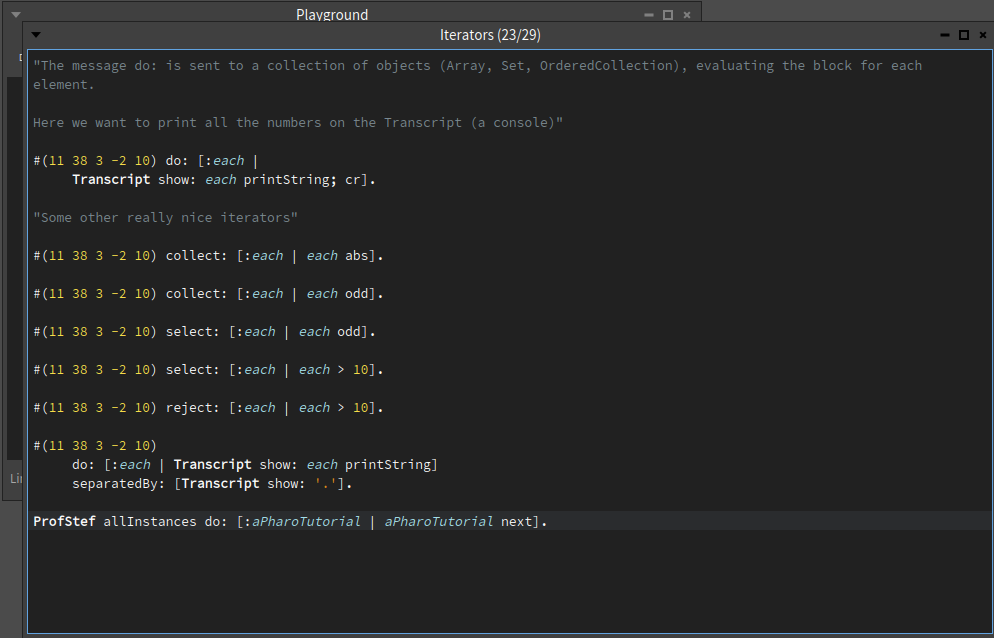
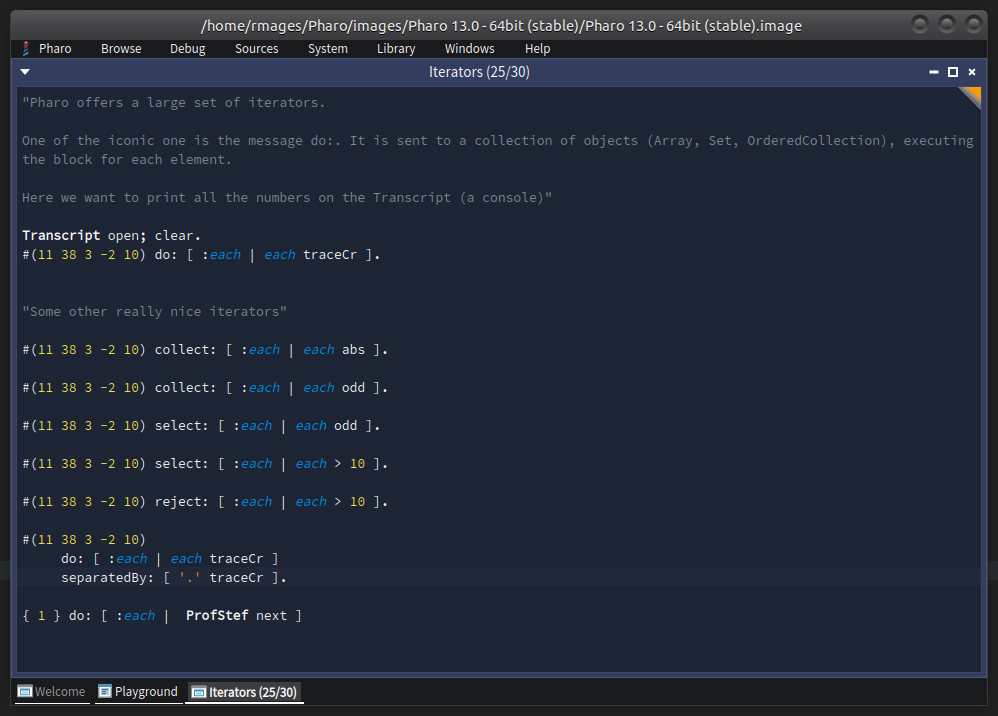
>>> Please give me a hint to understand the "do: separatedBy:" keyword
>>> message used in ProfStef tutorial :
>>>
>>>  i) in Pharo version 12 :
>>>
>>>    https://ramix.org/pharo/ProfStef/iterators23.png
>>>
>>> ii) in Pharo version 13 :
>>>
>>>    https://ramix.org/pharo/ProfStef/iterators25.png
>>>
>>> --
>>> Thanks for your help.
>>> Rene Paul Mages (ramix) GnuPG key : 0x9840A6F7
>>> https://sites.google.com/view/les-logiciels-libres/pharo
>>> https://twitter.com/RenePaulMages
>
> Stéphane Ducasse
> http://stephane.ducasse.free.fr
> 06 30 93 66 73
>
> "If you knew today was your last day on earth, what would you do differently?
> ....ESPECIALLY if, by doing something different, today might not be your last
> day on earth.” Calvin & Hobbes
>
>
>
>
>