All,I posted this comment to the RDF comments group earlier today, in retrospect I should have cc'd this list. Anyway, here is an account of the problem and audience profiles re. RDF and Linked Data.
I have but one goal here. Getting opening up civil debate that enables you address this nagging problem.
My post (minor edits e.g., fixing the links index at the end);To qualify a few things about statements such as RDF != Linked Data in association with de-reference, I would like to clarify a few things.
Web-like Structured Data Representation:TimBL's meme outlined a principled approach structured data representation that results in a Data Web or Web-like structured data, courtesy of HTTP URIs. This approach makes the Web-like structured data scale to the expanse of the scale-free Web.
In his original meme [1] he indicated that this principled approach enables one to look-up what an HTTP URI denotes, while also indicating to publishes that useful information should be accessible from the look-up location.
In the revised meme [2] he added "using standards (RDF, SPARQL). This introduced the problem of using words that mean different things to different audiences which I break down as follows (un-pejoratively):
1. RDFers -- RDF and Linked Data (this thing with appreciative momentum) are now inextricably linked, we'll show them now!
2. RDF-Refluxers -- Linked Data is just a re-branding of RDF, they think we are stupid!
3. Independents -- WTF! (pardon my French, but I want to signal as effectively as possible in this response).
In reality, bearing in mind my proximity to TimBL re. these matters of Linked Data, I genuinely believe he meant (but of course I do not speak for him):
Use standards such as RDF and SAPRQL as an effective (productive) way to provide really useful information when HTTP URIs (as outlined in this note) are looked-up. In reality, when you get round to implementing Linked Data (as a publisher) all you have to do is redirect user agent URI look-up requests to a SPARQL protocol URL which leaves the heavy lifting to a SPARQL processor (which may or may not be a full blown DBMS engine).
As for this whole JSON-LD and RDF affair, there is one subtle detail that makes matters more challenging. JSON-LD is seeking to be published as a deliverable from the RDF group. In taking the aforementioned route, many of the RDF related push-backs become much more understandable.
Anyway, here are some links for additional context re. my comments re. Linked Data as Web-like structured data:
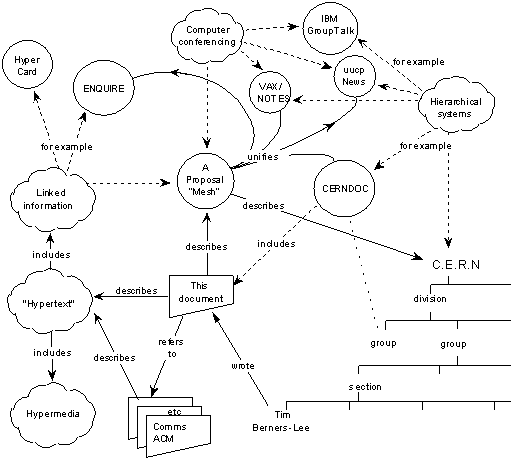
1. http://www.w3.org/DesignIssues/diagrams/history/proposal-fig1.gif -- illustration from original Web design document (this is clearly depicting a Data Web woven together via the typed relations illustrated as connections/connectors)
2. http://www.w3.org/2005/Talks/1110-iswc-tbl/#(4) -- that's Linked Data 1013. http://www.w3.org/2005/Talks/1110-iswc-tbl/#(7) -- URIs + HTTP (this is makes Data Web-like)
4. http://dig.csail.mit.edu/2007/Talks/0511-tab-tbl/#(10) -- Linked Data (again, clearly defined and distinct from RDF).
Inserting Logic into Linked Data (i.e., taking it from our "minds eye" to a Data Web accessible to humans and machines) is where RDF kicks in, with aplomb.
Unfortunately, due to issues associated with OWL misconceptions compounded by RDF/XML dominating OWL examples, many RDFers are reluctant to utter the words "inference" or "reasoning" since they assume those are the issues that scare folks. A current example of that is easily discernible form some of the longer threads on the W3C's LDP [3] list.
Pat Hayes gave a very nice presentation on Blogic [4][5] that puts this issue of Logic and Data Webs in scope.
Links:[1] <http://web.archive.org/web/20061201121454/http://www.w3.org/DesignIssues/LinkedData.html> -- original Linked Data meme (circa. 2006) [2] <http://www.w3.org/DesignIssues/LinkedData.html> -- revised meme (circa. 2009) [3] <http://lists.w3.org/Archives/Public/public-ldp-wg/2013Jun/0132.html> -- sampling of push-back to RDF push-back from a recent Linked Data Platform thread (i.e., the semantics are what matter and this is what RDF is all about)
4. http://slidesha.re/18CtxGK -- Blogic
5. http://videolectures.net/iswc09_hayes_blogic/ -- What's in a Link?

--

Regards,

Kingsley Idehen
Founder & CEO
OpenLink Software
Company Web: http://www.openlinksw.com
Personal Weblog: http://www.openlinksw.com/blog/~kidehen
Twitter/Identi.ca handle: @kidehen
Google+ Profile: https://plus.google.com/112399767740508618350/about
LinkedIn Profile: http://www.linkedin.com/in/kidehen
 smime.p7s
Description: S/MIME Cryptographic Signature