On 6/20/13 12:54 PM, Giovanni Tummarello wrote:
My 2c is .. i agree with kingsley diagram , linked data should be possible without RDF (no matter serialization) :)however this is different from previous definitionsi think its a step forward.. but it is different from previously. Do we want to call it Linked Data 2.0? under this definition also schema.org <http://schema.org> marked up pages would be linked data .. and i agree plenty with this .
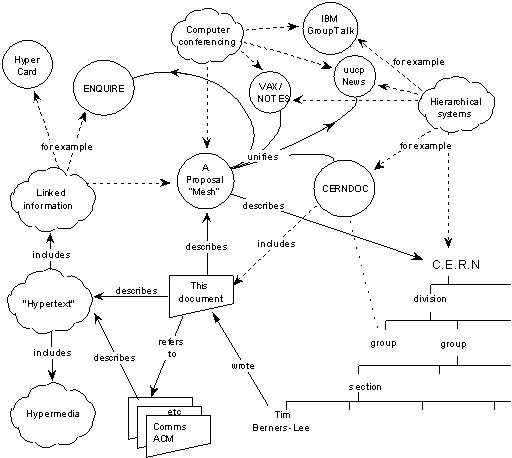
We can reconcile my Venn back to: http://www.nic.funet.fi/index/FUNET/history/internet/w3c/Image1.gif . That diagram (original World Wide Web proposal) is an entity relationship graph. Every connection type is denoted albeit using literals due to the fact that URIs where a work-in-progress at that point or too distorting to insert into the high level proposal.
"describes", "unifies", "wrote", "includes" are literal denotations of different types of relations :-)
Kingsley
GioOn Thu, Jun 20, 2013 at 6:27 PM, Kingsley Idehen <[email protected] <mailto:[email protected]>> wrote:On 6/20/13 11:45 AM, Luca Matteis wrote:On Thu, Jun 20, 2013 at 5:02 PM, Melvin Carvalho <[email protected] <mailto:[email protected]>> wrote: # Restate/reflect ideas that in other posts that are troubling/puzzling and ask for confirmation or clarification. I am simply confused with the idea brought forward by Kingsley that RDF is *not* part of the definition of Linked Data. The evidence shows the contrary: the top sites that define Linked Data, such as Wikipedia, Linkeddata.org and Tim-BL's meme specifically mention RDF, for example: "It builds upon standard Web technologies such as HTTP, RDF and URIs" - http://en.wikipedia.org/wiki/Linked_data "connecting pieces of data, information, and knowledge on the Semantic Web using URIs and RDF." - http://linkeddata.org/ This is *the only thing* that I'm discussing here. Nothing else. The current *definition* of Linked Data.Here's what I am saying, again: 1. You can create and publish web-like structured data without any knowledge of RDF . 2. You can create and publish web-like data that's enhanced with human- and machine-comprehensible entity relationship semantics when you add RDF to the mix. Venn diagram based Illustration of my point: http://bit.ly/16EVFVG . If you want your Linked Data to be interpretable by machine, then you can achieve that goal via RDF based Linked Data and applications equipped with RDF processing capability. RDF entity relationship semantics are *explicit* whereas run-of-the-mill entity relationship model based entity relationship semantics are *implicit*. RDF is the W3C's recommended framework for increasing the semantic fidelity of relations that constitute the World Wide Web. It isn't really that complicated. RDF can be talked about usefully without inadvertently creating an eternally distracting Reality Distortion Field, laden with indefensible ambiguity.--Regards, Kingsley Idehen Founder & CEO OpenLink Software Company Web:http://www.openlinksw.com Personal Weblog:http://www.openlinksw.com/blog/~kidehen <http://www.openlinksw.com/blog/%7Ekidehen> Twitter/Identi.ca handle: @kidehen Google+ Profile:https://plus.google.com/112399767740508618350/about LinkedIn Profile:http://www.linkedin.com/in/kidehen
--

Regards,

Kingsley Idehen
Founder & CEO
OpenLink Software
Company Web: http://www.openlinksw.com
Personal Weblog: http://www.openlinksw.com/blog/~kidehen
Twitter/Identi.ca handle: @kidehen
Google+ Profile: https://plus.google.com/112399767740508618350/about
LinkedIn Profile: http://www.linkedin.com/in/kidehen
 smime.p7s
Description: S/MIME Cryptographic Signature