Max, Heiko, and Chris, thank you for this very valuable work & research that
you do.  Thousands (arguably millions) benefit from your high quality work.  It
is very much appreciated.
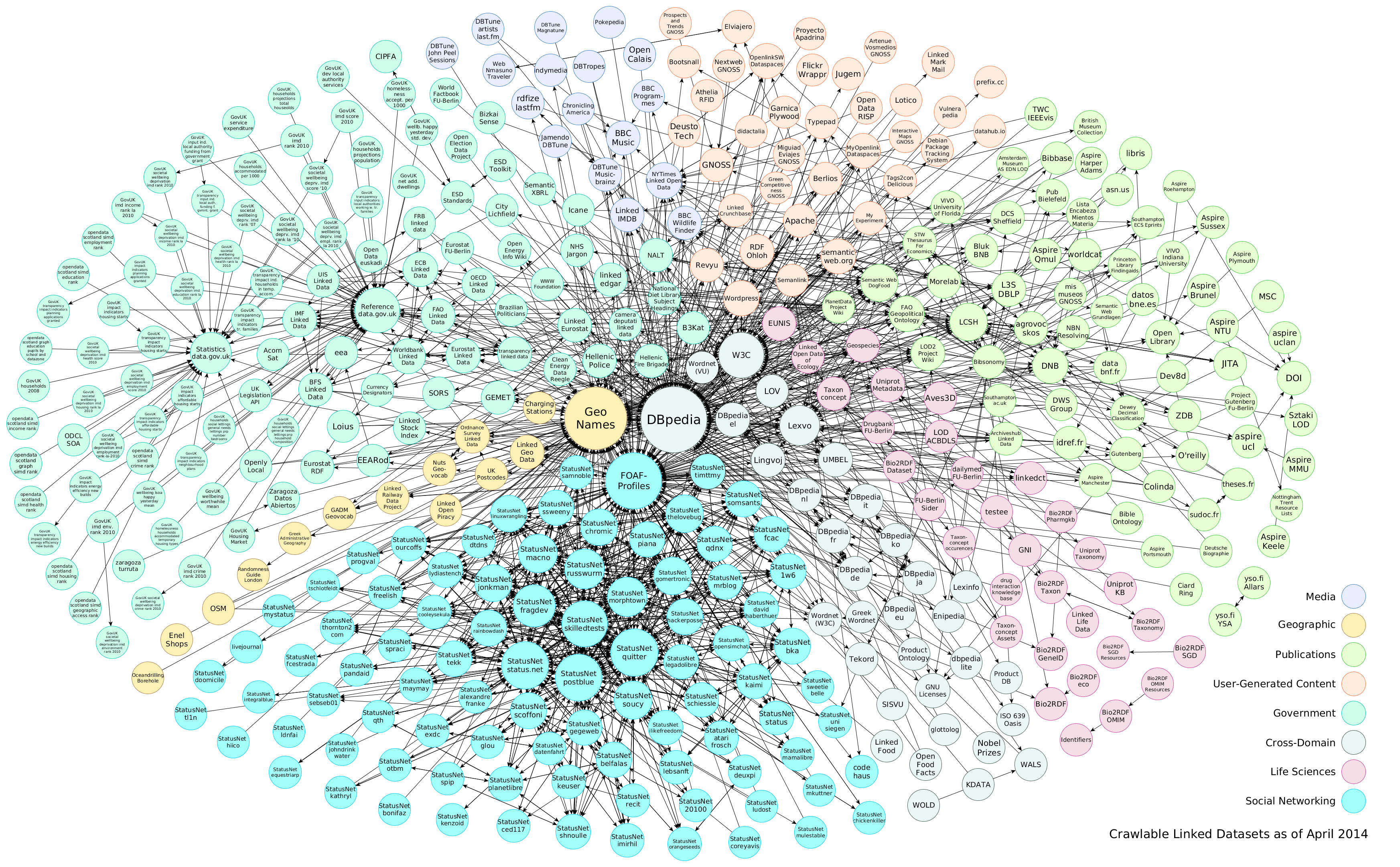
I think the existence of LOD Cloud, how datasets are added, the analysis and
your peer reviewed work should be included in a talk at SemTech 2014 in San
Jose - the 10th anniversary of this conference. [1]  This event has brought
together thousands of sem tech advocates, pioneers & practioners.

FWIW, a number of us on this list are attending/speaking and exhibiting --
perhaps we can assist to make this happen?  What do you think?  I'm happy to
help.  Alternatively, please consider at least doing an interview with staff at
semanticweb.com which has a wide audience.

IMO, there is a lot of interest in the macro trends of publishing & consuming
LOD.  Your work would help to counter the frustrating comments I still hear
from people who learned about the semantic web 8 years ago but haven't kept up.

Normally I wouldn't care about someone ill-informed saying, 'the semantic web
has gone no where -- after a decade, no one is using it ...'

However, I recently heard those words uttered by someone who worked at a major
search firm (formerly), has a prestigious title at a public policy think tank
and was sitting at a breakout session with CTO's from US Census & the National
Oceanic and Atmospheric Administration (NOAA) at the White House!  Surely the
world benefits if data rich authorities know about why being part of the LOD
Cloud is a good thing.

Note: This speaker's comments were dismissed by the CIOs & an exec from
PricewaterhouseCoopers (go figure!) but nonetheless Linked Data PR needs some
improving & your paper & supporting graphs are a valuable contribution.

Again, thank you & I hope you'll consider providing some input (slides,
whatever) to a talk at Semtech '14 to advance the cause.


Cheers,

Bernadette Hyland
CEO, 3 Round Stones, Inc.

http://about.me/bernadettehyland

[1] http://semtechbizsj2014.semanticweb.com/

On Jul 24, 2014, at 8:18 AM, Christian Bizer <[email protected]> wrote:

> Hi all,
>
> Max Schmachtenberg, Heiko Paulheim and I have crawled of the Web of Linked
> Data and have drawn an updated LOD Cloud diagram based on the results of the
> crawl.
>
> This diagram showing all linked datasets that our crawler managed to discover
> in April 2014 is found here:
>
> http://data.dws.informatik.uni-mannheim.de/lodcloud/2014/ISWC-RDB/LODCloudDiagram.png
>
> We also analyzed the compliance of the different datasets with the Linked
> Data best practices and a paper presenting the results of the analysis is
> found below. The paper will appear at ISWC 2014 in the Replication,
> Benchmark, Data and Software Track.
>
> http://dws.informatik.uni-mannheim.de/fileadmin/lehrstuehle/ki/pub/SchmachtenbergBizerPaulheim-AdoptionOfLinkedDataBestPractices.pdf
>
> The raw data used for our analysis is found on this page:
>
> http://data.dws.informatik.uni-mannheim.de/lodcloud/2014/ISWC-RDB/
>
> Our crawler did discover 77 dataset that do not allow crawling via their
> robots.txt files and these datasets were not included into our analysis and
> are also not included in the current version of the LOD Cloud diagram.
>
> A list of these datasets is found at
> http://data.dws.informatik.uni-mannheim.de/lodcloud/2014/ISWC-RDB/tables/notCrawlableDatasets.tsv
>
> In order to give a comprehensive overview of all Linked Data sets that are
> currently online, we would like to draw another version of the LOD Cloud
> diagram including the datasets that our crawler has missed as well as the
> datasets that do not allow crawling.
>
> Thus, if you publish or know about linked datasets that are not in the
> diagram or in the list of not crawlable datasets yet, please:
>
> 1.       Enter them into the datahub.io data catalog until August 8th.
> 2.       Tag them in the catalog with the tag ‘lod’
> (http://datahub.io/dataset?tags=lod)
> 3.       Send an email to Max and Chris pointing us at the entry in the
> catalog.
>
> We will include all datasets into the updated version of the cloud diagram,
> that fulfill the following requirements:
>
> 1.       Data items are accessible via dereferencable URIs.
> 2.       The dataset sets at least 50 RDF links pointing at other datasets or
> at least one other dataset is setting 50 RDF links pointing at your dataset.
>
> Instructions on how to describe your dataset in the catalog are found here:
>
> https://www.w3.org/wiki/TaskForces/CommunityProjects/LinkingOpenData/DataSets/CKANmetainformation
>
> Please make sure that you include information about the RDF links pointing
> from your dataset into other datasets (field links: ) as well as a tag
> indicating the topical category of your dataset, so that we know how to
> include it into the diagram.
> Please also include an example URI from your dataset into the catalog.
>
> We will start to review the new datasets and to draw the updated version of
> the LOD cloud diagram after August 8th.
> So please point us at datasets to be included before this date.
>
> Cheers,
>
> Max, Heiko, and Chris
>
>
> --
> Prof. Dr. Christian Bizer
> Data and Web Science Research Group
> Universität Mannheim, Germany
> [email protected]
> www.bizer.de