"[Python-ideas] dunder methods for encoding & prettiness aware formal &
informal representations"
https://mail.python.org/archives/list/[email protected]/thread/OQPPJ7SNM5CZUI5RYT5R4Z6YZWMNNTZS/
discusses how pretty printing could be extended. I'll bump the thread

On Tue, Mar 31, 2020, 5:54 PM Per Bothner <[email protected]> wrote:

> Inspired by the LWN article (https://lwn.net/Articles/815265/) about
> enhanced pretty-printing,
> I implemented a modified repr/displayhook that makes uses of the builtin
> pretty-printing of the DomTerm (https://domterm.org) terminal emulator.
>
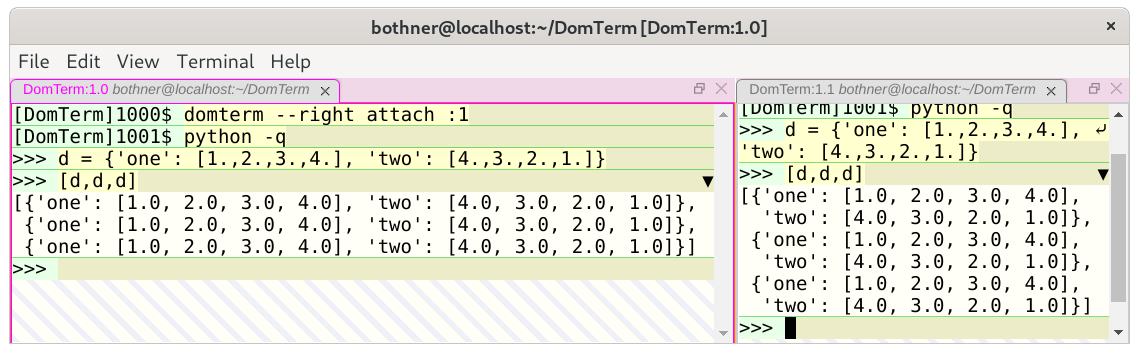
> See this screenshot http://domterm.org/images/python-pretty1.png which
> shows
> the *same* REPL session displayed in two "panes" of different widths.
> More information here:
> http://domterm.org/Python-tips.html
>
> The idea is that Python handles *what* to print, but the terminal emulator
> (or IDE like Jupyter or ipython) decides where to break the lines, add
> indentation, etc.
> The terminal knows the line-width and can dynamically re-format the output
> if the width changes - even for previously-printed output (and even for an
> exited python command).  This is just like many terminals will
> automatically
> re-wrap over-long lines - but on steroids.
>
> This required a rather small amount of code to insert some extra escape
> sequences
> to delimit grouping, optional line-breaks, and indentation - see here:
>
> https://github.com/PerBothner/DomTerm/blob/master/tools/python/domterm/utils.py
>
> I'm not suggesting pprint should depend on the terminal being able to do
> pretty-printing, but I suggest that at the least type-specific
> pretty-printers
> should use overrideable methods to define grouping and optional newlines.
> That would allow an IDE or terminal-specific code to by-pass the Python
> pretty-printing and instead have the terminal/IDE do it.
>
> As an example you can see how Kawa does it - look for the writeList method
> in
>
> https://gitlab.com/kashell/Kawa/-/blob/master/gnu/kawa/functions/DisplayFormat.java
> This calls conceptually abstract methods like startLogicalBlock and
> endLogicalBlock (to delimit groups) and writeSpaceFill (to mark optional
> newline).
>
> Going beyond pretty-printing, I've been thinking about a "data explorer"
> where
> you click on buttons to hide/show more detail.  I'm most familiar with this
> from the JavaScript consoles of Firefox and Chrome.  I implemented a
> "finite"
> version of this idea for Kawa - see here:
> https://domterm.org/saved/dt-prettynested.html
> Note the triangles are clickable butoons that hide or show detail (and how
> this is integrated with pretty-printing).
> This prototype only handles the case where all the displayable data is
> printed,
> even though some may be initially hidden.  To explore larger or circular
> data
> structures you'd want a protocol where the terminal/IDE can request more
> data.
> (I have a rough design for this, but that is a different discussion.  Let
> me know if this would be interesting.)
>
> (I am not primarily a Python programmer, but it's been fun figuring out
> how to implement Python/DomTerm integration.)
> --
>         --Per Bothner
> [email protected]   http://per.bothner.com/
> _______________________________________________
> Python-ideas mailing list -- [email protected]
> To unsubscribe send an email to [email protected]
> https://mail.python.org/mailman3/lists/python-ideas.python.org/
> Message archived at
> https://mail.python.org/archives/list/[email protected]/message/Z5CZH7ODJOZLPTY5S7TRWYGZVBAGU4SP/
> Code of Conduct: http://python.org/psf/codeofconduct/
>
_______________________________________________
Python-ideas mailing list -- [email protected]
To unsubscribe send an email to [email protected]
https://mail.python.org/mailman3/lists/python-ideas.python.org/
Message archived at
https://mail.python.org/archives/list/[email protected]/message/DAGZLAARTTUF7IOS4IBHFM3ZS7O2GC3B/
Code of Conduct: http://python.org/psf/codeofconduct/