Tech Crunch


While We’re Trying To Follow His Game Of  Checkers, Jeff Bezos Is Playing
Chess


MG Siegler


Monday, August 5th, 2013


A few years ago, I just didn’t get it. I couldn’t for the life of me
understand how a company like Amazon could operate, let alone flourish. I spent

the majority of my time following Apple, a company which in many ways was
the  antithesis of Amazon. Apple was all about huge margins, big profit.
Amazon  seemed to avoid profit like the plague. The more razor-thin the margin,
the  better. They were _Bizarro_
(https://en.wikipedia.org/wiki/The_Bizarro_Jerry)  Apple.
And clearly, I’m not the only one confused by Amazon. When _The Washington
Post broke the news today_
(http://www.washingtonpost.com/national/washington-post-to-be-sold-to-jeff-bezos/2013/08/05/ca537c9e-fe0c-11e2-9711-3708310f6f
4d_story.html)  of The Washington  Post being acquired by Amazon founder
and CEO Jeff Bezos, the flow of snark  was fast and furious. “_Bezos
acquisition of WaPo shows just how much this man loves low-margin  businesses._
(https://twitter.com/amir/status/364497142313791490) ” “_So, now Jeff Bezos
owns two lifestyle businesses._
(https://twitter.com/BenedictEvans/status/364486572110254080) “ Etc.  Etc.
I _piled on_ (https://twitter.com/parislemon/status/364489434827198464)  as
well, but only to ensnare some folks in a  conversation about what _I’ve
been  thinking about for the past year or so_
(http://techcrunch.com/2012/11/28/turtles-all-the-way-down/) : Jeff Bezos is no
fool, he’s a  genius. And if
you can’t spot that, you’re the fool. Certainly, I used to  be.
While the game Amazon is playing is not as straightforward as Apple’s, that
 doesn’t mean it’s a bad game to play. In fact, you could argue that it’s
a  better game to be playing right now in the respective life cycles of  the
two companies.
I understand, of course, that Amazon isn’t buying The Washington Post,
Bezos  personally is. And in an age where Newsweek (incidentally, once owned by
The  Washington Post) is getting sold for perhaps fifty cents on _the
literal dollar_ (http://dealbook.nytimes.com/2010/10/07/newsweeks-price-tag-1/)
,
and The Boston Globe is being sold for  effectively _negative $40 million_
(http://mobile.slate.com/blogs/moneybox/2013/08/03/pensions_included_boston_gl
obe_sold_for_40_billion.html) , this move may seem to make less sense  than
Bezos’ Amazon operations. But I would not bet against Bezos here  either.
Here’s the thing that most people, and certainly many in the tech press,
don’t seem to understand about Amazon, and by extension, Bezos: when it comes
to  business, there’s a game being played almost flawlessly.
The goal is actually to not make a huge profit too early, and _Bezos
manages it perfectly_
(https://twitter.com/benedictevans/status/364491625957175297) . You want to
avoid showing your  cards too early as you continue to lay
the groundwork for an ever-larger  business. Occasionally, you’ll have to
show those cards and win a hand to prove  that you can. But the rest of the
time you call and fold, as you await the  monster to take the entire pot.
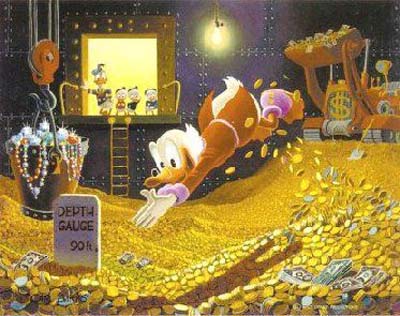
I know that sounds crazy. Cash is king, right? Not always. Just look at
Apple. They are the kings of cash. $13 billion in profit one quarter, $9
billion  the next, and so on. The vault is so full of gold coins that even
_Scrooge McDuck_
(http://blog.twowholecakes.com/wp-content/uploads/2011/03/scrooge-mcduck.jpg)
would need a lifeguard to swim in it. And yet,  Apple’s story
the past year has largely been one of a company in flux. Will they  ever
right the ship? Is it over?
These silly doomsday projections are mainly a result of Wall Street
swinging  from ultra-bullish to extremely bearish on the company in that same
timeframe.  The “problem”? Apple was too successful, too quickly. Because the
iPhone was  such a good business — _a  bigger business than all of Microsoft,
in fact!_ (http://parislemon.com/post/16997124721/size-matters)  — Apple
posted profits that  were only surpassed by a few of the best quarters from the
largest oil  companies. As a result, the company shot from a has-been to
the most valuable  public company in the world.
But growth and more importantly, growth potential is what matters most to
Wall Street. And when you happen to stumble into one of the best businesses
in  the world (the high end of the carrier-subsidized smartphone market),
the only  way to keep that growth going is to find an equal or greater
business (or  several smaller ones that add up to a larger one). It’s not clear
if
Apple will  ever find this business, even with the fabled television and
watch products. The  iPhone business was just that good.
But Amazon has no such problems on Wall Street. Again, they’re Bizarro
Apple.  They’re not showing their cards. While their businesses keep growing
from a  revenue perspective, profit has gone from negligible to non-existent to
an  actual loss this past quarter. And Wall Street loves them for it!
Why? Two reasons.
First, they know that Bezos is devouring Amazon’s profits by pouring them
into infrastructure build-outs. Data centers, shipping centers, etc. These
are  one-time costs that should pay off in the long run.
Second, they believe that at some point in the future, Amazon will flip a
switch and, voila, profit. In fact, Amazon has the ability to do it at
almost  anytime, as Bezos has made clear in the past, but people seem to
forget.
As  Adam Lashinsky reminded us in _a profile of Bezos_
(http://management.fortune.cnn.com/2012/11/16/jeff-bezos-amazon/)  last year:
Bezos even takes a practical approach to his love-hate relationship with
Wall Street. Having worked at a hedge fund in his twenties, he understands
the  investor mentality probably better than most CEOs. Perhaps as a result,
for  the first many years of Amazon’s existence, Bezos frustrated investors
by  refusing to realize Amazon’s profit potential. Then, around 2007, Amazon’
s  investments began to bear fruit, and investors were delighted. The stock
is up  10-fold in the past six years. “We believe in the long term, but the
long term  also has to come,” says Bezos, explaining that periodically
Amazon wants to  “check in” with its ability to make money. Thus, in 2007,
Amazon more than  doubled its profit, to $476 million, on a 38% increase in
sales to almost $15  billion.
A game.
Here’s what else you may not realize: while Amazon may be earning
little-to-no profit each quarter, they continue to bring in money that they can

actually use. How? As former Amazon employee _Eugene Wei explained last year_
(http://www.eugenewei.com/blog/2012/11/28/amazon-and-margins) :
Almost all customers paid by credit card, so Amazon would receive payment
in a day. But they didn’t pay the average distributor or publisher for 90
days  for books they purchased. This gave Amazon a magical financial quality
called  a negative operating cycle. With every book sale, Amazon got cash it
could  hang on to for up weeks on end (in practice it wasn’t actually 89
days of  float since Amazon did purchase some high velocity selling books ahead
of  time). The more Amazon grew, the more cash it banked. Amazon was
turning its  inventory 30, 40 times a year, whereas companies like Barnes and
Noble were  sweating to turn their inventory twice a year. Most people just
look
at a  company’s margins and judge the quality of the business model based
on that,  but the cash flow characteristics of the business can make one
company a far  more valuable company than another with the exact same operating
margin.  Amazon could have had a margin of zero and still made money.
Forget profit, the emphasis has been on _free cash  flow_
(http://en.wikipedia.org/wiki/Free_cash_flow)  since 1997, _as David Lee
reminds us_
(http://daslee.me/reading-jeff-bezos) .
And so I repeat, Bezos is a genius. He’s flying under-the-radar until he
can  buy the radar. And probably the company that makes all the radars as
well. With  Amazon, it’s not “now or never”, it’s “next”.
It’s certainly possible that Amazon slips up and they are never able to
live  up to the ambitions that Bezos has been building towards for the past two
 decades. But even pure mishaps like the LivingSocial and _Pets.com
investments_
(http://www.prnewswire.com/news-releases/petscom-raises-50-million-from-amazoncom-bowman-capital-and-hummer-winblad-venture-partners-74805287.html)
  didn’t do much to deter the  trajectory.
So while The Washington Post purchase may sound insane, it’s probably a
much  more _calculated maneuver_
(http://www.washingtonpost.com/national/jeff-bezos-on-post-purchase/2013/08/05/e5b293de-fe0d-11e2-9711-3708310f6f4d_print.h
tml?hpid=z1)  by Bezos. He’s likely once again playing  chess while we’re
all trying to parse the way he’s playing checkers. And if it  fails, what’s
$250 million for an ever-more-wealthy billionaire anyway? Have you  seen
Amazon’s stock price recently?

--
--
Centroids: The Center of the Radical Centrist Community
<[email protected]>
Google Group: http://groups.google.com/group/RadicalCentrism
Radical Centrism website and blog: http://RadicalCentrism.org

---
You received this message because you are subscribed to the Google Groups
"Centroids: The Center of the Radical Centrist Community" group.
To unsubscribe from this group and stop receiving emails from it, send an email
to [email protected].
For more options, visit https://groups.google.com/groups/opt_out.