Ars Technica

US report predicts CO2 emissions have peaked,  energy independence near
Latest estimates place the energy trade gap at around  3 percent by 2025.

by _John Timmer_ (http://arstechnica.com/author/john-timmer/)  - Dec 18
2013

    *   _Energy_ (http://arstechnica.com/discipline/energy)


Well-sited wind power is cheaper than coal, but the good  sites aren't
evenly distributed throughout the US.
_NREL/DOE_ (http://www.windpoweringamerica.gov/wind_maps.asp)
Although there are some _reasonable  questions_
(http://arstechnica.com/science/2013/12/the-future-of-energy-clear-or-cloudy/)
about the value of
making long-term projections about energy use,  doing so is one of the duties
of
the US' Energy Information Agency. On Monday,  the EIA _released an
overview_ (http://www.eia.gov/forecasts/aeo/er/?src=home-b1)  of a report in
which
it attempts to track the trends in the energy  economy of the US out to
2040. The report contains some eye-popping predictions,  including a huge (but
brief) boom in domestic oil production, a near balance  between energy
imports and exports, and a peak in carbon emissions that's  already in our
past.
Energy predictions are fraught with uncertainty, but this report contains
more than most, since it's predicated on having the entire period out to
2040  covered by legislation and rules that are already on the books. At the
moment,  that would include the expiration of a tax credit that promotes the
installation  of renewable power facilities, something that Congress has
already renewed  several times. Perhaps more significantly, the EPA's rules
governing greenhouse  gas emissions from existing facilities are still being
formulated but are likely  to be in effect for most of the period under
consideration.
This probably explains why the EIA predicts that the slice of domestic
energy  production that comes from renewables only increases from 11 to 12
percent over  the next 30 years.
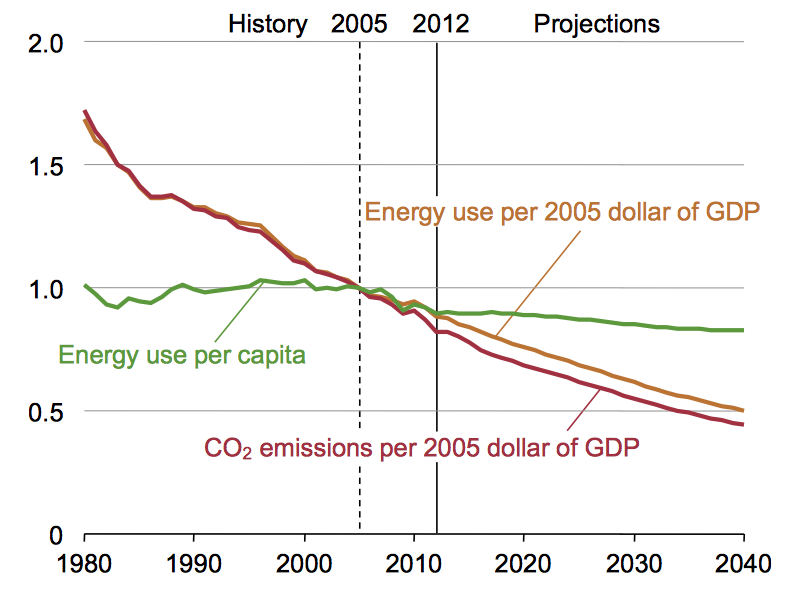
But what's startling is that, despite the slow rise in renewables, the EIA
thinks that the US is already past its peak of carbon emissions (2005 and
2007  both had roughly similar totals and represent the peak). As shown in
the chart  below, the energy used for each dollar of GDP has been dropping
steadily since  the 1980s; carbon emissions for each dollar have recently
started dropping even  faster. The report projects that those trends will both
continue, with  energy/dollar dropping by a total of 43 percent by 2040.
In addition to the growth of natural gas and rise of renewables, the report
 ascribes this drop to an increase in efficiency (vehicle fuel efficiency
in  particular is improving significantly). This won't result in a big drop
in  carbon emissions—continued GDP growth will offset these tends—but it
could mean  a prolonged plateau out to 2040. And, as noted above, policy
changes may  actually help drive a drop, and any climate agreements are likely
to
require  one.
(http://cdn.arstechnica.net/wp-content/uploads/2013/12/Screen-Shot-2013-12-17-at-3.58.54-PM.png)

_Enlarge_
(http://cdn.arstechnica.net/wp-content/uploads/2013/12/Screen-Shot-2013-12-17-at-3.58.54-PM.png)
   / More money, less energy.
US Energy Information  Agency
The other thing driving the drop in carbon intensity is the natural gas
boom.  It's made natural gas the cheapest way to generate electricity in the US
(ahead  of well-sited wind), a change that the report predicts will see gas
become the  largest source of electrical power in the US by 2030,
displacing coal. Given  that burning coal releases far more CO2 per unit of
energy,
any  emissions rules could accelerate this changeover as well.
There's a technique similar to fracking that works for oil, and that's
setting off an equivalent boom. The EIA expects that oil production within the
US will reach levels not seen since the peak in 1970. But oil flows through
 rocks less easily than natural gas, so the boom will be short lived,
peaking  before this decade is over. In contrast, the growth of natural gas
extraction  won't peak at all in the report's timeframe, leading to 50 percent
growth between now and 2040.
The net result is that the gap between net energy production and
consumption,  currently at 16 percent, will drop to under five percent in the
2020s
and stay  there. We'll still import lots of oil, but exports of coal and
natural gas will  offset most of that.


The surge in natural gas supply will have impacts beyond turning the US
into  a net exporter of the fuel. It can be used as a raw material in many
chemical  processes, and the cheap power it generates can make various
industrial  activities more economical. As a result, the EIA foresees a growth
in
domestic  chemical and metal production, as well as other forms of
manufacturing. This  won't be large for any one sector, but the overall growth
will be
fairly  significant.
The other place that's likely to see growth is the use of natural gas in
transportation. The EIA thinks that the price of natural gas will go up, but
that the price of oil will go up even faster, increasing an already
substantial  gap between the two. By 2040, the report suggests that up to three
percent of  the transportation fuel will be in the form of compressed or liquid
natural gas,  mostly used by buses and long-haul freight. It's even
possible that it will find  a use in rail and cargo ships.
So, while the report is limited by its mandate to stick within the confines
 of existing regulations, the most likely results of any regulatory changes
are  to enhance the impact of underlying trends in efficiency and energy
extraction.  In other words, unless governmental policies change radically,
we're likely to  get to some of these places sooner than 2040.

--
--
Centroids: The Center of the Radical Centrist Community
<[email protected]>
Google Group: http://groups.google.com/group/RadicalCentrism
Radical Centrism website and blog: http://RadicalCentrism.org

---
You received this message because you are subscribed to the Google Groups
"Centroids: The Center of the Radical Centrist Community" group.
To unsubscribe from this group and stop receiving emails from it, send an email
to [email protected].
For more options, visit https://groups.google.com/groups/opt_out.